• Wyszukiwanie zaawansowane
  • Kategorie
  • Kategorie BISAC
  • Książki na zamówienie
  • Promocje
  • Granty
  • Książka na prezent
  • Opinie
  • Pomoc
  • Załóż konto
  • Zaloguj się

Music, Mathematics and Language: The New Horizon of Computational Musicology Opened by Information Science » książka


zaloguj się | załóż konto
Logo Krainaksiazek.pl

koszyk

konto

szukaj
topmenu
Księgarnia internetowa
Szukaj
Książki na zamówienie
Promocje
Granty
Książka na prezent
Moje konto
Pomoc
 
 
Wyszukiwanie zaawansowane
Pusty koszyk
Bezpłatna dostawa dla zamówień powyżej 20 złBezpłatna dostawa dla zamówień powyżej 20 zł

Kategorie główne

• Nauka
 [2946912]
• Literatura piękna
 [1852311]

  więcej...
• Turystyka
 [71421]
• Informatyka
 [150889]
• Komiksy
 [35717]
• Encyklopedie
 [23177]
• Dziecięca
 [617324]
• Hobby
 [138808]
• AudioBooki
 [1671]
• Literatura faktu
 [228371]
• Muzyka CD
 [400]
• Słowniki
 [2841]
• Inne
 [445428]
• Kalendarze
 [1545]
• Podręczniki
 [166819]
• Poradniki
 [480180]
• Religia
 [510412]
• Czasopisma
 [525]
• Sport
 [61271]
• Sztuka
 [242929]
• CD, DVD, Video
 [3371]
• Technologie
 [219258]
• Zdrowie
 [100961]
• Książkowe Klimaty
 [124]
• Zabawki
 [2341]
• Puzzle, gry
 [3766]
• Literatura w języku ukraińskim
 [255]
• Art. papiernicze i szkolne
 [7810]
Kategorie szczegółowe BISAC

Music, Mathematics and Language: The New Horizon of Computational Musicology Opened by Information Science

ISBN-13: 9789811951657 / Angielski / Twarda / 2022 / 257 str.
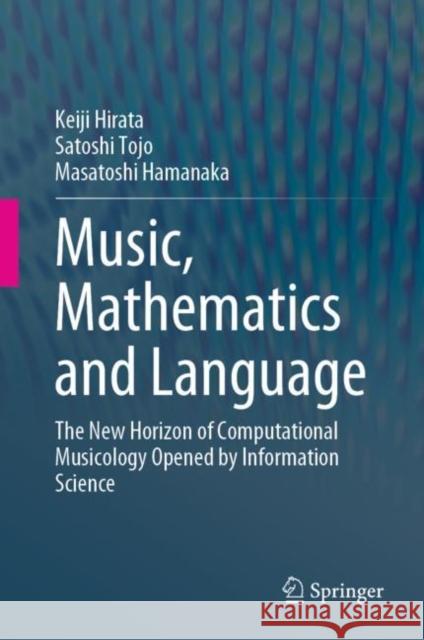
Keiji Hirata; Satoshi Tojo; Masatoshi Hamanaka
Music, Mathematics and Language: The New Horizon of Computational Musicology Opened by Information Science Keiji Hirata Satoshi Tojo Masatoshi Hamanaka 9789811951657 Springer - książkaWidoczna okładka, to zdjęcie poglądowe, a rzeczywista szata graficzna może różnić się od prezentowanej.

Music, Mathematics and Language: The New Horizon of Computational Musicology Opened by Information Science

ISBN-13: 9789811951657 / Angielski / Twarda / 2022 / 257 str.

Keiji Hirata; Satoshi Tojo; Masatoshi Hamanaka
cena 726,29
(netto: 691,70 VAT:  5%)

Najniższa cena z 30 dni: 693,97
Termin realizacji zamówienia:
ok. 22 dni roboczych
Bez gwarancji dostawy przed świętami

Darmowa dostawa!
inne wydania

This book presents a new approach to computational musicology in which music becomes a computational entity based on human cognition, allowing us to calculate music like numbers. Does music have semantics? Can the meaning of music be revealed using symbols and described using language? The authors seek to answer these questions in order to reveal the essence of music.Chapter 1 addresses a very fundamental point, the meaning of music, while referring to semiotics, gestalt, Schenkerian analysis and cognitive reality. Chapter 2 considers why the 12-tone equal temperament came to be prevalent. This chapter serves as an introduction to the mathematical definition of harmony, which concerns the ratios of frequency in tonic waves. Chapter 3, “Music and Language,” explains the fundamentals of grammar theory and the compositionality principle, which states that the semantics of a sentence can be composed in parallel to its syntactic structure. In turn, Chapter 4 explains the most prevalent score notation – the Berklee method, which originated at the Berklee School of Music in Boston – from a different point of view, namely, symbolic computation based on music theory. Chapters 5 and 6 introduce readers to two important theories, the implication-realization model and generative theory of tonal music (GTTM), and explain the essence of these theories, also from a computational standpoint. The authors seek to reinterpret these theories, aiming at their formalization and implementation on a computer. Chapter 7 presents the outcomes of this attempt, describing the framework that the authors have developed, in which music is formalized and becomes computable. Chapters 8 and 9 are devoted to GTTM analyzers and the applications of GTTM. Lastly, Chapter 10 discusses the future of music in connection with computation and artificial intelligence.This book is intended both for general readers who are interested in music, and scientists whose research focuses on music information processing. In order to make the content as accessible as possible, each chapter is self-contained.


This book presents a new approach to computational musicology in which music becomes a computational entity based on human cognition, allowing us to calculate music like numbers. Does music have semantics? Can the meaning of music be revealed using symbols and described using language? The authors seek to answer these questions in order to reveal the essence of music. Chapter 1 addresses a very fundamental point, the meaning of music, while referring to semiotics, gestalt, Schenkerian analysis and cognitive reality. Chapter 2 considers why the 12-tone equal temperament came to be prevalent. This chapter serves as an introduction to the mathematical definition of harmony, which concerns the ratios of frequency in tonic waves. Chapter 3, “Music and Language,” explains the fundamentals of grammar theory and the compositionality principle, which states that the semantics of a sentence can be composed in parallel to its syntactic structure. In turn, Chapter 4 explains the most prevalent score notation – the Berklee method, which originated at the Berklee School of Music in Boston – from a different point of view, namely, symbolic computation based on music theory. Chapters 5 and 6 introduce readers to two important theories, the implication-realization model and generative theory of tonal music (GTTM), and explain the essence of these theories, also from a computational standpoint. The authors seek to reinterpret these theories, aiming at their formalization and implementation on a computer. Chapter 7 presents the outcomes of this attempt, describing the framework that the authors have developed, in which music is formalized and becomes computable. Chapters 8 and 9 are devoted to GTTM analyzers and the applications of GTTM. Lastly, Chapter 10 discusses the future of music in connection with computation and artificial intelligence.This book is intended both for general readers who are interested in music, and scientists whose research focuses on music information processing. In order to make the content as accessible as possible, each chapter is self-contained.

Kategorie:
Informatyka, Bazy danych
Kategorie BISAC:
Computers > Artificial Intelligence - General
Mathematics > Matematyka stosowana
Language Arts & Disciplines > Linguistics - General
Wydawca:
Springer
Język:
Angielski
ISBN-13:
9789811951657
Rok wydania:
2022
Dostępne języki:
Ilość stron:
257
Oprawa:
Twarda

Chapter 1: Toward the Machine Computing Semantics of Music.- Chapter 2: Mathematics of Temperament: Principle and Development.- Chapter 3: Music and Natural Language.- Chapter 4: Berklee Method.- Chapter 5: Implication-Realization Model.- Chapter 6: Generative Theory of Tonal Music and Tonal Pitch Space.- Chapter 7: Formalization of GTTM.- Chapter 8: Implementation of GTTM.- Chapter 9: Application of GTTM.- Chapter 10: Epilogue.

Keiji Hirata is a professor of music informatics at Future University Hakodate.


Satoshi Tojo is a professor in the School of Information Science at JAIST.

Masatoshi Hamanaka is the team leader of the Music Information Intelligence Team at RIKEN Center for Advanced Intelligence Project.


This book presents a new approach to computational musicology in which music becomes a computational entity based on human cognition, allowing us to calculate music like numbers. Does music have semantics? Can the meaning of music be revealed using symbols and described using language? The authors seek to answer these questions in order to reveal the essence of music. 

Chapter 1 addresses a very fundamental point, the meaning of music, while referring to semiotics, gestalt, Schenkerian analysis and cognitive reality. Chapter 2 considers why the 12-tone equal temperament came to be prevalent. This chapter serves as an introduction to the mathematical definition of harmony, which concerns the ratios of frequency in tonic waves. Chapter 3, “Music and Language,” explains the fundamentals of grammar theory and the compositionality principle, which states that the semantics of a sentence can be composed in parallel to its syntactic structure. In turn, Chapter 4 explains the most prevalent score notation – the Berklee method, which originated at the Berklee School of Music in Boston – from a different point of view, namely, symbolic computation based on music theory. Chapters 5 and 6 introduce readers to two important theories, the implication-realization model and generative theory of tonal music (GTTM), and explain the essence of these theories, also from a computational standpoint. The authors seek to reinterpret these theories, aiming at their formalization and implementation on a computer. Chapter 7 presents the outcomes of this attempt, describing the framework that the authors have developed, in which music is formalized and becomes computable. Chapters 8 and 9 are devoted to GTTM analyzers and the applications of GTTM. Lastly, Chapter 10 discusses the future of music in connection with computation and artificial intelligence.

This book is intended both for general readers who are interested in music, and scientists whose research focuses on music information processing. In order to make the content as accessible as possible, each chapter is self-contained.




Udostępnij

Facebook - konto krainaksiazek.pl


Opinie o Krainaksiazek.pl na Opineo.pl

Partner Mybenefit

Krainaksiazek.pl w programie rzetelna firma Krainaksiaze.pl - płatności przez paypal

Czytaj nas na:

Facebook - krainaksiazek.pl
  • książki na zamówienie
  • granty
  • książka na prezent
  • kontakt
  • pomoc
  • opinie
  • regulamin
  • polityka prywatności

Zobacz:

  • Księgarnia czeska

  • Wydawnictwo Książkowe Klimaty

1997-2025 DolnySlask.com Agencja Internetowa

© 1997-2022 krainaksiazek.pl
     
KONTAKT | REGULAMIN | POLITYKA PRYWATNOŚCI | USTAWIENIA PRYWATNOŚCI
Zobacz: Księgarnia Czeska | Wydawnictwo Książkowe Klimaty | Mapa strony | Lista autorów
KrainaKsiazek.PL - Księgarnia Internetowa

Polityka prywatnosci - link
Krainaksiazek.pl - płatnośc Przelewy24
Przechowalnia Przechowalnia




