• Wyszukiwanie zaawansowane
  • Kategorie
  • Kategorie BISAC
  • Książki na zamówienie
  • Promocje
  • Granty
  • Książka na prezent
  • Opinie
  • Pomoc
  • Załóż konto
  • Zaloguj się

Multiscale Multibody Dynamics: Motion Formalism Implementation » książka


zaloguj się | załóż konto
Logo Krainaksiazek.pl

koszyk

konto

szukaj
topmenu
Księgarnia internetowa
Szukaj
Książki na zamówienie
Promocje
Granty
Książka na prezent
Moje konto
Pomoc
 
 
Wyszukiwanie zaawansowane
Pusty koszyk
Bezpłatna dostawa dla zamówień powyżej 20 złBezpłatna dostawa dla zamówień powyżej 20 zł

Kategorie główne

• Nauka
 [2946600]
• Literatura piękna
 [1856966]

  więcej...
• Turystyka
 [72221]
• Informatyka
 [151456]
• Komiksy
 [35826]
• Encyklopedie
 [23190]
• Dziecięca
 [619653]
• Hobby
 [140543]
• AudioBooki
 [1577]
• Literatura faktu
 [228355]
• Muzyka CD
 [410]
• Słowniki
 [2874]
• Inne
 [445822]
• Kalendarze
 [1744]
• Podręczniki
 [167141]
• Poradniki
 [482898]
• Religia
 [510455]
• Czasopisma
 [526]
• Sport
 [61590]
• Sztuka
 [243598]
• CD, DVD, Video
 [3423]
• Technologie
 [219201]
• Zdrowie
 [101638]
• Książkowe Klimaty
 [124]
• Zabawki
 [2473]
• Puzzle, gry
 [3898]
• Literatura w języku ukraińskim
 [254]
• Art. papiernicze i szkolne
 [8170]
Kategorie szczegółowe BISAC

Multiscale Multibody Dynamics: Motion Formalism Implementation

ISBN-13: 9789811984402 / Angielski / Twarda / 2023 / 352 str.
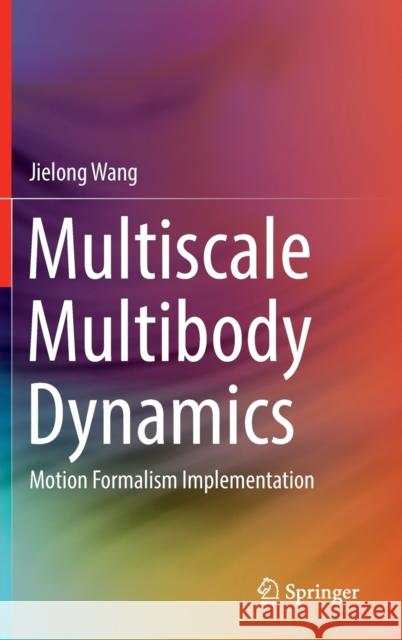
Jielong Wang
Multiscale Multibody Dynamics: Motion Formalism Implementation Jielong Wang 9789811984402 Springer - książkaWidoczna okładka, to zdjęcie poglądowe, a rzeczywista szata graficzna może różnić się od prezentowanej.

Multiscale Multibody Dynamics: Motion Formalism Implementation

ISBN-13: 9789811984402 / Angielski / Twarda / 2023 / 352 str.

Jielong Wang
cena 645,58 zł
(netto: 614,84 VAT:  5%)

Najniższa cena z 30 dni: 578,30 zł
Termin realizacji zamówienia:
ok. 22 dni roboczych
Bez gwarancji dostawy przed świętami

Darmowa dostawa!
inne wydania

This book presents a novel theory of multibody dynamics with distinct features, including unified continuum theory, multiscale modeling technology of multibody system, and motion formalism implementation. All these features together with the introductions of fundamental concepts of vector, dual vector, tensor, dual tensor, recursive descriptions of joints, and the higher-order implicit solvers formulate the scope of the book’s content. In this book, a multibody system is defined as a set consisted of flexible and rigid bodies which are connected by any kinds of joints or constraints to achieve the desired motion. Generally, the motion of multibody system includes the translation and rotation; it is more efficient to describe the motion by using the dual vector or dual tensor directly instead of defining two types of variables, the translation and rotation separately. Furthermore, this book addresses the detail of motion formalism and its finite element implementation of the solid, shell-like, and beam-like structures. It also introduces the fundamental concepts of mechanics, such as the definition of vector, dual vector, tensor, and dual tensor, briefly. Without following the Einstein summation convention, the first- and second-order tensor operations in this book are depicted by linear algebraic operation symbols of row array, column array, and two-dimensional matrix, making these operations easier to understand. In addition, for the integral of governing equations of motion, a set of ordinary differential equations for the finite element-based discrete system, the book discussed the implementation of implicit solvers in detail and introduced the well-developed RADAU IIA algorithms based on post-error estimation to make the contents of the book complete.The intended readers of this book are senior engineers and graduate students in related engineering fields.


This book presents a novel theory of multibody dynamics with distinct features, including unified continuum theory, multiscale modeling technology of multibody system, and motion formalism implementation. All these features together with the introductions of fundamental concepts of vector, dual vector, tensor, dual tensor, recursive descriptions of joints, and the higher-order implicit solvers formulate the scope of the book’s content. In this book, a multibody system is defined as a set consisted of flexible and rigid bodies which are connected by any kinds of joints or constraints to achieve the desired motion. Generally, the motion of multibody system includes the translation and rotation; it is more efficient to describe the motion by using the dual vector or dual tensor directly instead of defining two types of variables, the translation and rotation separately. Furthermore, this book addresses the detail of motion formalism and its finite element implementation of the solid, shell-like, and beam-like structures. It also introduces the fundamental concepts of mechanics, such as the definition of vector, dual vector, tensor, and dual tensor, briefly. Without following the Einstein summation convention, the first- and second-order tensor operations in this book are depicted by linear algebraic operation symbols of row array, column array, and two-dimensional matrix, making these operations easier to understand. In addition, for the integral of governing equations of motion, a set of ordinary differential equations for the finite element-based discrete system, the book discussed the implementation of implicit solvers in detail and introduced the well-developed RADAU IIA algorithms based on post-error estimation to make the contents of the book complete.The intended readers of this book are senior engineers and graduate students in related engineering fields.

Kategorie:
Technologie
Kategorie BISAC:
Technology & Engineering > Mechanical
Science > Mechanics - Solids
Mathematics > Grupy i teoria grup
Wydawca:
Springer
Język:
Angielski
ISBN-13:
9789811984402
Rok wydania:
2023
Dostępne języki:
Ilość stron:
352
Oprawa:
Twarda
Dodatkowe informacje:
Wydanie ilustrowane

Vector and motion.- Motion and deformation.- Cosserat continuum.- Multiscale multibody dynamics.- Recursive formula of joints.- Implicit stiff solvers with post-error estimation.

Dr. Jielong Wang obtained his Ph.D. degree from the School of Aerospace Engineering of Georgia Institute of Technology in 2007. Under the guidance of his adviser, Dr. Olivier A. Bauchau, distinguished Igor Sikorsky Professor of Rotorcraft, he developed interesting approaches to stability analysis based on the Partial Floquet method and designed an efficient and robust system identification algorithm and optimization control method that can be applied to large-scale, flexible multibody dynamics systems. They are now used by the rotorcraft industry, such as Sikorsky and Bell Helicopter, in a routine manner. After graduating from Georgia Institute of Technology, he worked for Gamma Technologies, LLC. In this company, he designed stiff solvers, such as second-order HHT algorithm and 2- and 3-stage Radau IIA algorithms to solve the large-scale ordinary differential equations (ODEs) and the differential algebraic equations (DAEs). These solvers have been plugged in the GT-SUITE as the kernel code to predict the dynamic response of automobile engines and simulate the chemical reaction process of gasoline combustion. He also independently accomplished the nonlinear beam and cable elements, timing belt, spur/helical gear transmission, and semi-rigid contact models.


In 2011, he settled in Beijing, China, and continued his work in multibody dynamics, aeroelasticity, contact/impact, and computational mechanics. He developed the novel numerical modeling program of multibody dynamics, which can model the civil aircraft including wings, fuselage, tails, pylons, nacelles, and control panels as a flexible multibody system to estimate its flight behavior. The element library of this program provides a plenty of elements, such as the geometrically nonlinear beam with warping, the geometrically exact plate and shell, the modal super element, the recursive implementations of six lower pair joints, the screw theory-based rigid body and multi-point constraints, and the Hertz contact models with Columb/LuGre dry frictions. This program couples with the high-precision CFD solvers to implement the real aeroelastic simulation of the complete configuration of civil aircraft in transonic regime. He also proposed the use of Lyapunov characteristic exponents (LCEs) in addition to Floquet theory for nonlinear flutter analysis. He focused on the relations of the Cosserat continuum, multiscale mechanics, and multibody dynamics and extended his research to the finite element implementation of Cosserat continuum and its multiscale modeling technology. Only under the assumption of geometric dimension reduction, he established the unified formulas of governing equations of three-dimensional Cosserat solid, two-dimensional plate/shell, one-dimensional beam, rigid body, three-dimensional Cauchy solid, membrane, and cable. This new multibody theory combined with finite element technology opens a new gate for effective modeling of multibody system. The multiscale analysis under the framework of this unified theory can be carried out in a more efficient manner: The detailed local scale analysis affords the stiffness constants for the global model, and then a detailed strain/stress analysis in the level of local scale is performed using the predicted global stress resultants as load inputs.

This book presents a novel theory of multibody dynamics with distinct features, including unified continuum theory, multiscale modeling technology of multibody system, and motion formalism implementation. All these features together with the introductions of fundamental concepts of vector, dual vector, tensor, dual tensor, recursive descriptions of joints, and the higher-order implicit solvers formulate the scope of the book’s content. In this book, a multibody system is defined as a set consisted of flexible and rigid bodies which are connected by any kinds of joints or constraints to achieve the desired motion. Generally, the motion of multibody system includes the translation and rotation; it is more efficient to describe the motion by using the dual vector or dual tensor directly instead of defining two types of variables, the translation and rotation separately. Furthermore, this book addresses the detail of motion formalism and its finite element implementation of the solid, shell-like, and beam-like structures. It also introduces the fundamental concepts of mechanics, such as the definition of vector, dual vector, tensor, and dual tensor, briefly. Without following the Einstein summation convention, the first- and second-order tensor operations in this book are depicted by linear algebraic operation symbols of row array, column array, and two-dimensional matrix, making these operations easier to understand. In addition, for the integral of governing equations of motion, a set of ordinary differential equations for the finite element-based discrete system, the book discussed the implementation of implicit solvers in detail and introduced the well-developed RADAU IIA algorithms based on post-error estimation to make the contents of the book complete.

The intended readers of this book are senior engineers and graduate students in related engineering fields.




Udostępnij

Facebook - konto krainaksiazek.pl


Opinie o Krainaksiazek.pl na Opineo.pl

Partner Mybenefit

Krainaksiazek.pl w programie rzetelna firma Krainaksiaze.pl - płatności przez paypal

Czytaj nas na:

Facebook - krainaksiazek.pl
  • książki na zamówienie
  • granty
  • książka na prezent
  • kontakt
  • pomoc
  • opinie
  • regulamin
  • polityka prywatności

Zobacz:

  • Księgarnia czeska

  • Wydawnictwo Książkowe Klimaty

1997-2025 DolnySlask.com Agencja Internetowa

© 1997-2022 krainaksiazek.pl
     
KONTAKT | REGULAMIN | POLITYKA PRYWATNOŚCI | USTAWIENIA PRYWATNOŚCI
Zobacz: Księgarnia Czeska | Wydawnictwo Książkowe Klimaty | Mapa strony | Lista autorów
KrainaKsiazek.PL - Księgarnia Internetowa

Polityka prywatnosci - link
Krainaksiazek.pl - płatnośc Przelewy24
Przechowalnia Przechowalnia




