• Wyszukiwanie zaawansowane
  • Kategorie
  • Kategorie BISAC
  • Książki na zamówienie
  • Promocje
  • Granty
  • Książka na prezent
  • Opinie
  • Pomoc
  • Załóż konto
  • Zaloguj się

Multicellular Animals: A New Approach to the Phylogenetic Order in Nature Volume 1 » książka


zaloguj się | załóż konto
Logo Krainaksiazek.pl

koszyk

konto

szukaj
topmenu
Księgarnia internetowa
Szukaj
Książki na zamówienie
Promocje
Granty
Książka na prezent
Moje konto
Pomoc
 
 
Wyszukiwanie zaawansowane
Pusty koszyk
Bezpłatna dostawa dla zamówień powyżej 20 złBezpłatna dostawa dla zamówień powyżej 20 zł

Kategorie główne

• Nauka
 [2950560]
• Literatura piękna
 [1849509]

  więcej...
• Turystyka
 [71097]
• Informatyka
 [151150]
• Komiksy
 [35848]
• Encyklopedie
 [23178]
• Dziecięca
 [617388]
• Hobby
 [139064]
• AudioBooki
 [1657]
• Literatura faktu
 [228597]
• Muzyka CD
 [383]
• Słowniki
 [2855]
• Inne
 [445295]
• Kalendarze
 [1464]
• Podręczniki
 [167547]
• Poradniki
 [480102]
• Religia
 [510749]
• Czasopisma
 [516]
• Sport
 [61293]
• Sztuka
 [243352]
• CD, DVD, Video
 [3414]
• Technologie
 [219456]
• Zdrowie
 [101002]
• Książkowe Klimaty
 [124]
• Zabawki
 [2311]
• Puzzle, gry
 [3459]
• Literatura w języku ukraińskim
 [254]
• Art. papiernicze i szkolne
 [8079]
Kategorie szczegółowe BISAC

Multicellular Animals: A New Approach to the Phylogenetic Order in Nature Volume 1

ISBN-13: 9783642801167 / Angielski / Miękka / 2011 / 225 str.
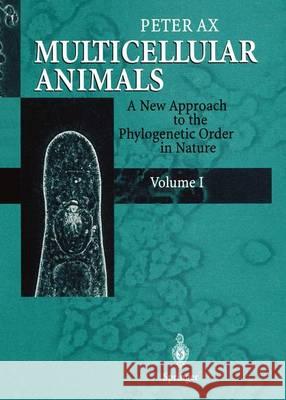
Peter Ax
Multicellular Animals: A New Approach to the Phylogenetic Order in Nature Volume 1 Ax, Peter 9783642801167 Springer - książkaWidoczna okładka, to zdjęcie poglądowe, a rzeczywista szata graficzna może różnić się od prezentowanej.

Multicellular Animals: A New Approach to the Phylogenetic Order in Nature Volume 1

ISBN-13: 9783642801167 / Angielski / Miękka / 2011 / 225 str.

Peter Ax
cena 401,58
(netto: 382,46 VAT:  5%)

Najniższa cena z 30 dni: 385,52
Termin realizacji zamówienia:
ok. 22 dni roboczych
Dostawa w 2026 r.

Darmowa dostawa!

No one can ever have secure knowledge about the gods and creatures, and should anyone hit by chance upon the right thing, he will not know it for sure; that is why everything that we believe to be true is "opinion." XENOPHANES around 500 B.C. (According to ROD 1988, p.85) The goal of phylogenetic systematics (cladistics) is to discover the kinship relations between all organisms on earth and to translate the order we perceive in Nature into an equivalent man-made system. Although the goal is easily formulated, the path is thorny, and the results achieved continue to be imperfect. This is the fate of any science that bases its propositions on the interpretation of histor ical evidence. The diversity found in the millions of species originated as a result of the continuous splitting of biopopulations through time. Combined with this was the emergence of hierarchically linked des cent communities of species. We call the process of origin of descent communities phylogenesis. We do not know, however, the exact course of phylogenesis - we can only formulate hypotheses. The historical evidence at hand consists of the feature patterns of extant species and of extinct species with their combination of original and derived traits which are the result of evolution."


Kategorie:
Nauka, Biologia i przyroda
Kategorie BISAC:
Science > Zoologia i nauki o zwierzętach
Wydawca:
Springer
Język:
Angielski
ISBN-13:
9783642801167
Rok wydania:
2011
Wydanie:
Softcover Repri
Ilość stron:
225
Waga:
0.51 kg
Wymiary:
27.0 x 19.3
Oprawa:
Miękka
Wolumenów:
01

Organisms of the Real World and Their Arrangement in a System Created by Man.- Hypothetical Realism.- Levels of Observation.- Thing and Class.- Individuals and Populations as Things.- Species and Descent Communities as Natural Kinds (Classes).- Natural Kinds as Taxa of the Phylogenetic System.- Elimination of Categories.- Establishing the Phylogenetic System.- Feature Patterns of Species and Ground Patterns of Descent Communities.- The Three Possibilities of Evolutionary Congruences.- Sister Species — Sister Group — Dichotomy.- Lineage — Stem Lineage.- The Formation of Species Groups.- The Change of Meaning Synapomorphy — Symplesiomorphy.- Forming Hypotheses About Synapomorphy.- Homology.- The Search for the Sister Species or Sister Group and the Resulting System.- Hierarchical Tabulation.- Relationship Diagram.- Direct Access to the Autapomorphy.- Molecules and Computers.- The Integration and Meaning of the Fossil Record.- Problematic Large Divisions of Organisms.- ”Animalia“ — ”Plantae“.- ”Procaryota“ — Eucaryota.- ”Protozoa“ — Metazoa.- ”Invertebrata“ — Vertebrata.- The Inflation of Kingdoms.- Systematization of the Metazoa.- Overview.- Monophyly and Ground Pattern.- The Search for the Adelphotaxon Among Unicellular Organisms.- Mesozoa — Parasitic Metazoa with Undetermined Kinship.- Orthonectida.- Dicyemida.- Porifera — Epitheliozoa.- Porifera.- Ground Pattern.- Systematization.- Calcarea — Silicea.- Calcarea.- Silicea.- Demospongea — Hexactinellida.- Demospongea.- Hexactinellida.- Epitheliozoa.- Placozoa — Eumetazoa.- Placozoa.- Eumetazoa.- Cnidaria — Acrosomata.- Cnidaria.- Ground Pattern.- Systematization.- Anthozoa — Tesserazoa.- Anthozoa.- Tesserazoa.- Hydrozoa — Rhopaliophora.- Hydrozoa.- Rhopaliophora.- Cubozoa — Scyphozoa.- Cubozoa.- Scyphozoa.- Acrosomata.- Ctenophora — Bilateria.- Ctenophora.- Ground Pattern.- Bilateria.- Ground Pattern.- Systematization.- Spiralia — Radialia.- Spiralia.- Plathelminthomorpha — Euspiralia.- Plathelminthomorpha.- Gnathostomulida — Plathelminthes.- Gnathostomulida.- Ground Pattern.- Plathelminthes.- Ground Pattern.- Systematization.- Catenulida — Euplathelminthes.- Catenulida.- Euplathelminthes.- Acoelomorpha — Rhabditophora.- Acoelomorpha.- Nemertodermatida — Acoela.- Nemertodermatida.- Acoela.- Rhabditophora.- Macrostomida — Trepaxonemata.- Macrostomida.- Trepaxonemata.- Polycladida — Neoophora.- Polycladida.- Neoophora.- Lecithoepitheliata.- Prolecithophora.- Seriata — Rhabdocoela.- Seriata.- Rhabdocoela.- ”Typhloplanoida“ — Doliopharyngiophora.- ”Typhloplanoida“.- Doliopharyngiophora.- ”Dalyellioida“ — Neodermata.- ”Dalyellioida“.- Neodermata.- Trematoda — Cercomeromorpha.- Trematoda.- Aspidobothrea — Digenea.- Aspidobothrea.- Digenea.- Cercomeromorpha.- Monogenea — Cestoda.- Monogenea.- Cestoda.- Xenoturbellida — A Eumetazoan Taxon with Unclarified Kinship.- Euspiralia.- Nemertini — Trochozoa.- Nemertini.- Traditional Classification.- Ground Pattern and Evolutionary Alterations.- Trochozoa.- Literature.- Register.

Prof. Dr. Peter Ax ist Professor für Zoologie an der Universität Göttingen. Schwerpunkte in Forschung und Lehre: Morphologie, Systematik und Stammesgeschichte der Tiere; Mitglied der Akademie der Wissenschaften und der Literatur in Mainz, der Akademie der Wissenschaften in Göttingen und der Joachim-Jungius-Gesellschaft der Wissenschaften in Hamburg.


Udostępnij

Facebook - konto krainaksiazek.pl


Opinie o Krainaksiazek.pl na Opineo.pl

Partner Mybenefit

Krainaksiazek.pl w programie rzetelna firma Krainaksiaze.pl - płatności przez paypal

Czytaj nas na:

Facebook - krainaksiazek.pl
  • książki na zamówienie
  • granty
  • książka na prezent
  • kontakt
  • pomoc
  • opinie
  • regulamin
  • polityka prywatności

Zobacz:

  • Księgarnia czeska

  • Wydawnictwo Książkowe Klimaty

1997-2025 DolnySlask.com Agencja Internetowa

© 1997-2022 krainaksiazek.pl
     
KONTAKT | REGULAMIN | POLITYKA PRYWATNOŚCI | USTAWIENIA PRYWATNOŚCI
Zobacz: Księgarnia Czeska | Wydawnictwo Książkowe Klimaty | Mapa strony | Lista autorów
KrainaKsiazek.PL - Księgarnia Internetowa

Polityka prywatnosci - link
Krainaksiazek.pl - płatnośc Przelewy24
Przechowalnia Przechowalnia






