• Wyszukiwanie zaawansowane
  • Kategorie
  • Kategorie BISAC
  • Książki na zamówienie
  • Promocje
  • Granty
  • Książka na prezent
  • Opinie
  • Pomoc
  • Załóż konto
  • Zaloguj się

Multi-dimensional Urban Sensing Using Crowdsensing Data » książka


zaloguj się | załóż konto
Logo Krainaksiazek.pl

koszyk

konto

szukaj
topmenu
Księgarnia internetowa
Szukaj
Książki na zamówienie
Promocje
Granty
Książka na prezent
Moje konto
Pomoc
 
 
Wyszukiwanie zaawansowane
Pusty koszyk
Bezpłatna dostawa dla zamówień powyżej 20 złBezpłatna dostawa dla zamówień powyżej 20 zł

Kategorie główne

• Nauka
 [2946600]
• Literatura piękna
 [1856966]

  więcej...
• Turystyka
 [72221]
• Informatyka
 [151456]
• Komiksy
 [35826]
• Encyklopedie
 [23190]
• Dziecięca
 [619653]
• Hobby
 [140543]
• AudioBooki
 [1577]
• Literatura faktu
 [228355]
• Muzyka CD
 [410]
• Słowniki
 [2874]
• Inne
 [445822]
• Kalendarze
 [1744]
• Podręczniki
 [167141]
• Poradniki
 [482898]
• Religia
 [510455]
• Czasopisma
 [526]
• Sport
 [61590]
• Sztuka
 [243598]
• CD, DVD, Video
 [3423]
• Technologie
 [219201]
• Zdrowie
 [101638]
• Książkowe Klimaty
 [124]
• Zabawki
 [2473]
• Puzzle, gry
 [3898]
• Literatura w języku ukraińskim
 [254]
• Art. papiernicze i szkolne
 [8170]
Kategorie szczegółowe BISAC

Multi-dimensional Urban Sensing Using Crowdsensing Data

ISBN-13: 9789811990052 / Angielski / Twarda / 2023
Chaocan Xiang; Panlong Yang; Fu Xiao
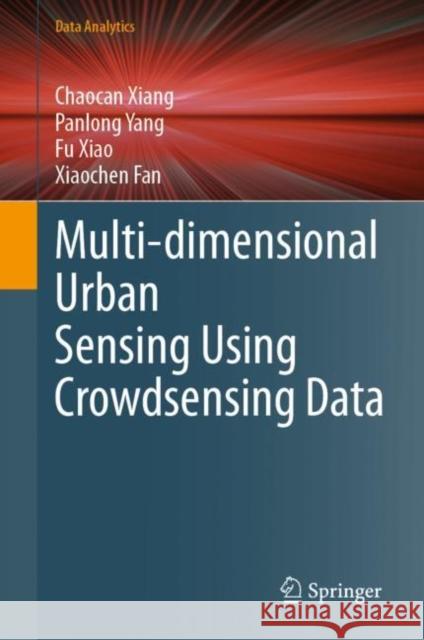
Multi-dimensional Urban Sensing Using Crowdsensing Data Chaocan Xiang Panlong Yang Fu Xiao 9789811990052 Springer - książkaWidoczna okładka, to zdjęcie poglądowe, a rzeczywista szata graficzna może różnić się od prezentowanej.

Multi-dimensional Urban Sensing Using Crowdsensing Data

ISBN-13: 9789811990052 / Angielski / Twarda / 2023

Chaocan Xiang; Panlong Yang; Fu Xiao
cena 685,93 zł
(netto: 653,27 VAT:  5%)

Najniższa cena z 30 dni: 655,41 zł
Termin realizacji zamówienia:
ok. 22 dni roboczych
Bez gwarancji dostawy przed świętami

Darmowa dostawa!
inne wydania

Chaocan Xiang is an Associate Professor at the College of Computer Science, Chongqing University, China. He received his bachelor’s degree and Ph.D. from Nanjing Institute of Communication Engineering, China, in 2009 and 2014, respectively. He subsequently studied at the University of Michigan-Ann Arbor in 2017 (supervised by Prof. Kang G. Shin, IEEE Life Fellow, ACM Fellow). His research interests mainly include UAVs/vehicle-based crowdsensing, urban computing, Internet of Things, Artificial Intelligence, and big data. He has published more than 50 papers, including over 20 in leading venues such as IEEE Transactions on Mobile Computing, IEEE Transactions on Parallel and Distributed Systems, IEEE INFOCOM, and ACM Ubicomp. He has received a best paper award and a best poster award at two international conferences.Panlong Yang is a full Professor at the University of Science and Technology of China. He has been supported by the NSF Jiangsu through a Distinguished Young Scholarship and was honored as a CCF Distinguished Lecturer in 2015. He has published over 150 papers, including 40 in CCF Class A. Since 2012, he has supervised 14 master’s and Ph.D. candidates, including two excellent dissertation winners in Jiangsu Province and the PLA education system. He has been supported by the National Key Development Project and NSFC projects. He has nominated by ACM MobiCom 2009 for the best demo honored mention awards, and won best paper awards at the IEEE MSN and MASS. He has served as general chair of BigCom and TPC chair of IEEE MSN. In addition, he has served as a TPC member of INFOCOM (CCF Class A) and an associate editor of the Journal of Communication of China. He is a Senior Member of the IEEE (2019).Fu Xiao received his Ph.D. in Computer Science and Technology from the Nanjing University of Science and Technology, Nanjing, China, in 2007. He is currently a Professor and Dean of the School of Computer, Nanjing University of Posts and Telecommunications. He has authored more than 60 papers in respected conference proceedings and journals, including IEEE INFOCOM, ACM Mobihoc, IEEE JASC, IEEE/ACM ToN, IEEE TPDS, IEEE TMC, etc. His main research interest is in the Internet of Things. He is a member of the IEEE Computer Society and the Association for Computing Machinery.Xiaochen Fan received his B.S. degree in Computer Science from Beijing Institute of Technology, Beijing, China, in 2013, and his Ph.D. from the University of Technology Sydney, NSW, Australia, in 2021. His research interests include mobile/pervasive computing, deep learning, and Internet of Things (IoT). He has published over 25 peer-reviewed papers in high-quality journals and IEEE/ACM international conference proceedings.


Chaocan Xiang is an Associate Professor at the College of Computer Science, Chongqing University, China. He received his bachelor’s degree and Ph.D. from Nanjing Institute of Communication Engineering, China, in 2009 and 2014, respectively. He subsequently studied at the University of Michigan-Ann Arbor in 2017 (supervised by Prof. Kang G. Shin, IEEE Life Fellow, ACM Fellow). His research interests mainly include UAVs/vehicle-based crowdsensing, urban computing, Internet of Things, Artificial Intelligence, and big data. He has published more than 50 papers, including over 20 in leading venues such as IEEE Transactions on Mobile Computing, IEEE Transactions on Parallel and Distributed Systems, IEEE INFOCOM, and ACM Ubicomp. He has received a best paper award and a best poster award at two international conferences.Panlong Yang is a full Professor at the University of Science and Technology of China. He has been supported by the NSF Jiangsu through a Distinguished Young Scholarship and was honored as a CCF Distinguished Lecturer in 2015. He has published over 150 papers, including 40 in CCF Class A. Since 2012, he has supervised 14 master’s and Ph.D. candidates, including two excellent dissertation winners in Jiangsu Province and the PLA education system. He has been supported by the National Key Development Project and NSFC projects. He has nominated by ACM MobiCom 2009 for the best demo honored mention awards, and won best paper awards at the IEEE MSN and MASS. He has served as general chair of BigCom and TPC chair of IEEE MSN. In addition, he has served as a TPC member of INFOCOM (CCF Class A) and an associate editor of the Journal of Communication of China. He is a Senior Member of the IEEE (2019).Fu Xiao received his Ph.D. in Computer Science and Technology from the Nanjing University of Science and Technology, Nanjing, China, in 2007. He is currently a Professor and Dean of the School of Computer, Nanjing University of Posts and Telecommunications. He has authored more than 60 papers in respected conference proceedings and journals, including IEEE INFOCOM, ACM Mobihoc, IEEE JASC, IEEE/ACM ToN, IEEE TPDS, IEEE TMC, etc. His main research interest is in the Internet of Things. He is a member of the IEEE Computer Society and the Association for Computing Machinery.Xiaochen Fan received his B.S. degree in Computer Science from Beijing Institute of Technology, Beijing, China, in 2013, and his Ph.D. from the University of Technology Sydney, NSW, Australia, in 2021. His research interests include mobile/pervasive computing, deep learning, and Internet of Things (IoT). He has published over 25 peer-reviewed papers in high-quality journals and IEEE/ACM international conference proceedings.

Kategorie:
Informatyka, Internet
Kategorie BISAC:
Computers > Programming - Mobile Devices
Computers > Networking - Hardware
Computers > Distributed Systems - Cloud Computing
Wydawca:
Springer
Seria wydawnicza:
Data Analytics
Język:
Angielski
ISBN-13:
9789811990052
Rok wydania:
2023
Dostępne języki:
Numer serii:
000811846
Oprawa:
Twarda
Dodatkowe informacje:
Wydanie ilustrowane

Part I: How to Collect Crowdsensing Data (Multi-dimensional fundamental issues)

1. User Incentives---Incentivizing Platform-users with win-win effects

1.1 Introduction

1.2 Related Work

1.3 System Model and Problem

       1.3.1 System Model

       1.3.2 Example of Personalized Bidding Scenario

       1.3.3 Problem Formalization

1.4 Picasso: The Incentive Mechanism

       1.4.1 Bid Description in 3-D Space

       1.4.2 Construction of Task Dependency Graph

       1.4.3 PB Decomposition for Efficient Task Allocation

       1.4.4 PB Recombination for Strategy-proof Payment

1.5 Performance Evaluations

1.6 Conclusions

References

2.   Data Transmission Empowered by Edge Computing

2.1 Introduction

2.2 Related Work

2.3 Experimental Explorations

       2.3.1 Uncovering Missing Data Issue in Large-Scale ITSs

       2.3.2 Experimental Explorations of Spatiotemporal Correlations on Traffic Data

2.4 System Model and Problem

       2.4.1 System Model of Edge Computing

       2.4.2 Problem

2.5 GTR: A Large-scale Data Transmission based on Edge Computing

       2.5.1 Suboptimal Deployment of Edge Nodes

       2.5.2 Accurate Traffic Data Recovery Based on Low-Rank Theory

2.6 Performance Evaluations

2.7 Conclusions

References

3.   Data Calibration---Calibrate Without Calibrating

3.1 Introduction

3.2 Related Work

3.3 System Model and Problem

3.4 Auto-calibration Algorithm based on Two-level Iteration

       3.4.1 Algorithm Overview

       3.4.2 Outer Loop

       3.4.3 Inner Loop

       3.4.5 Convergence and Optimality Analysis

3.6 Performance Evaluations

3.7 Conclusions

References


Part II: How to Use Crowdsensing Data for Smart Cities (Multi-dimensional applications)

4.  Communication Service Application---Wireless Spectrum Map Construction

4.1 Introduction

4.2 Related Work

4.3 Understanding RSS Measurement Error in Smartphone

       4.3.1 Experiment Design

       4.3.2 Experiment Observation

4.5 CARM: Crowdsensing Accurate Outdoor RSS Maps with Error-prone Smartphone Measurements

       4.5.1 System Overview

       4.5.2 Iterative Estimation of Model Parameters

       4.5.3 Model-Driven RSS Map Construction

       4.5.4 Algorithm Analysis

4.6 Performance Evaluations

4.7 Conclusions

References

5.  Environmental Protection Application---Urban Pollution Monitoring

5.1 Introduction

5.2 Related Work

5.3 System Model and Problem

       5.3.1 System model

       5.3.2 Problem

5.4 Iterative Truthful-source Identification Algorithm

       5.4.1 Algorithm design

       5.4.2 Algorithm description and analysis

5.5 Performance Evaluations

5.6 Conclusions

References

6.            Urban Traffic Application---Traffic Volume Prediction

6.1 Introduction

6.2 Related Work

6.3 System Overview

6.4 Building-Traffic Correlation Analysis with Multi-Source Datasets

       6.4.1 Correlation Analysis with Building Occupancy Data

       6.4.2 Correlation Analysis with Environmental Data

6.5 Accurate Traffic Prediction with Cross-Domain Learning of Building Data

       6.5.1 Model and Problem

       6.5.2 Attention Mechanisms-Based Encoder-Decoder RNN

6.6 Performance Evaluations

6.7 Conclusions

References


Part III: Open Issues and Conclusions

7.  Open Issues and Conclusions

7.1 Open Issues

       7.1.1 More Crwodsensing Data

       7.1.2 New Urban Applications

       7.1.3 Privacy Protection

7.2 Conclusions

References


Chaocan Xiang (xiangchaocan@cqu.edu.cn) is an Associate Professor at the College of Computer Science, Chongqing University, China. He received his bachelor’s degree and Ph.D. from Nanjing Institute of Communication Engineering, China, in 2009 and 2014, respectively. He subsequently studied at the University of Michigan-Ann Arbor in 2017 (supervised by Prof. Kang G. Shin, IEEE Life Fellow, ACM Fellow). His research interests mainly include UAVs/vehicle-based crowdsensing, urban computing, Internet of Things, Artificial Intelligence, and big data. He has published more than 50 papers, including over 20 in leading venues such as IEEE Transactions on Mobile Computing, IEEE Transactions on Parallel and Distributed Systems, IEEE INFOCOM, and ACM Ubicomp. He has received a best paper award and a best poster award at two international conferences.

Panlong Yang (plyang@ustc.edu.cn) is a full Professor at the University of Science and Technology of China. He has been supported by the NSF Jiangsu through a Distinguished Young Scholarship and was honored as a CCF Distinguished Lecturer in 2015. He has published over 150 papers, including 40 in CCF Class A. Since 2012, he has supervised 14 master’s and Ph.D. candidates, including two excellent dissertation winners in Jiangsu Province and the PLA education system. He has been supported by the National Key Development Project and NSFC projects. He has nominated by ACM MobiCom 2009 for the best demo honored mention awards, and won best paper awards at the IEEE MSN and MASS. He has served as general chair of BigCom and TPC chair of IEEE MSN. In addition, he has served as a TPC member of INFOCOM (CCF Class A) and an associate editor of the Journal of Communication of China. He is a Senior Member of the IEEE (2019).

Fu Xiao (xiaof@njupt.edu.cn) received his Ph.D. in Computer Science and Technology from the Nanjing University of Science and Technology, Nanjing, China, in 2007. He is currently a Professor and Dean of the School of Computer, Nanjing University of Posts and Telecommunications. He has authored more than 60 papers in respected conference proceedings and journals, including IEEE INFOCOM, ACM Mobihoc, IEEE JASC, IEEE/ACM ToN, IEEE TPDS, IEEE TMC, etc. His main research interest is in the Internet of Things. He is a member of the IEEE Computer Society and the Association for Computing Machinery.

Xiaochen Fan (fanxiaochen33@gmail.com) received his B.S. degree in Computer Science from Beijing Institute of Technology, Beijing, China, in 2013, and his Ph.D. from the University of Technology Sydney, NSW, Australia, in 2021. His research interests include mobile/pervasive computing, deep learning, and Internet of Things (IoT). He has published over 25 peer-reviewed papers in high-quality journals and IEEE/ACM international conference proceedings.

In smart cities, the indispensable devices used in people’s daily lives, such as smartphones, smartwatches, vehicles, and smart buildings, are equipped with more and more sensors. For example, most smartphones now have cameras, GPS, acceleration and light sensors. Leveraging the massive sensing data produced by users’ common devices for large-scale, fine-grained sensing in smart cities is referred to as the urban crowdsensing. It can enable applications that are beneficial to a broad range of urban services, including traffic, wireless communication service (4G/5G), and environmental protection.

In this book, we provide an overview of our recent research progress on urban crowdsensing. Unlike the extant literature, we focus on multi-dimensional urban sensing using crowdsensing data. Specifically, the book explores how to utilize crowdsensing to see smart cities in terms of three-dimensional fundamental issues, including how to incentivize users’ participation, how to recommend tasks, and how to transmit the massive sensing data. We propose a number of mechanisms and algorithms to address these important issues, which are key to utilizing the crowdsensing data for realizing urban applications. Moreover, we present how to exploit this available crowdsensing data to see smart cities through three-dimensional applications, including urban pollution monitoring, traffic volume prediction, and urban airborne sensing. More importantly, this book explores using buildings’ sensing data for urban traffic sensing, thus establishing connections between smart buildings and intelligent transportation.

 Given its scope, the book will be of particular interest to researchers, students, practicing professionals, and urban planners. Furthermore, it can serve as a primer, introducing beginners to mobile crowdsensing in smart cities and helping them understand how to collect and exploit crowdsensing data for various urban applications.


Udostępnij

Facebook - konto krainaksiazek.pl


Opinie o Krainaksiazek.pl na Opineo.pl

Partner Mybenefit

Krainaksiazek.pl w programie rzetelna firma Krainaksiaze.pl - płatności przez paypal

Czytaj nas na:

Facebook - krainaksiazek.pl
  • książki na zamówienie
  • granty
  • książka na prezent
  • kontakt
  • pomoc
  • opinie
  • regulamin
  • polityka prywatności

Zobacz:

  • Księgarnia czeska

  • Wydawnictwo Książkowe Klimaty

1997-2025 DolnySlask.com Agencja Internetowa

© 1997-2022 krainaksiazek.pl
     
KONTAKT | REGULAMIN | POLITYKA PRYWATNOŚCI | USTAWIENIA PRYWATNOŚCI
Zobacz: Księgarnia Czeska | Wydawnictwo Książkowe Klimaty | Mapa strony | Lista autorów
KrainaKsiazek.PL - Księgarnia Internetowa

Polityka prywatnosci - link
Krainaksiazek.pl - płatnośc Przelewy24
Przechowalnia Przechowalnia



