• Wyszukiwanie zaawansowane
  • Kategorie
  • Kategorie BISAC
  • Książki na zamówienie
  • Promocje
  • Granty
  • Książka na prezent
  • Opinie
  • Pomoc
  • Załóż konto
  • Zaloguj się

Morphotactics: Basque Auxiliaries and the Structure of Spellout » książka


zaloguj się | załóż konto
Logo Krainaksiazek.pl

koszyk

konto

szukaj
topmenu
Księgarnia internetowa
Szukaj
Książki na zamówienie
Promocje
Granty
Książka na prezent
Moje konto
Pomoc
 
 
Wyszukiwanie zaawansowane
Pusty koszyk
Bezpłatna dostawa dla zamówień powyżej 20 złBezpłatna dostawa dla zamówień powyżej 20 zł

Kategorie główne

• Nauka
 [2946600]
• Literatura piękna
 [1856966]

  więcej...
• Turystyka
 [72221]
• Informatyka
 [151456]
• Komiksy
 [35826]
• Encyklopedie
 [23190]
• Dziecięca
 [619653]
• Hobby
 [140543]
• AudioBooki
 [1577]
• Literatura faktu
 [228355]
• Muzyka CD
 [410]
• Słowniki
 [2874]
• Inne
 [445822]
• Kalendarze
 [1744]
• Podręczniki
 [167141]
• Poradniki
 [482898]
• Religia
 [510455]
• Czasopisma
 [526]
• Sport
 [61590]
• Sztuka
 [243598]
• CD, DVD, Video
 [3423]
• Technologie
 [219201]
• Zdrowie
 [101638]
• Książkowe Klimaty
 [124]
• Zabawki
 [2473]
• Puzzle, gry
 [3898]
• Literatura w języku ukraińskim
 [254]
• Art. papiernicze i szkolne
 [8170]
Kategorie szczegółowe BISAC

Morphotactics: Basque Auxiliaries and the Structure of Spellout

ISBN-13: 9789401781824 / Angielski / Miękka / 2014 / 420 str.
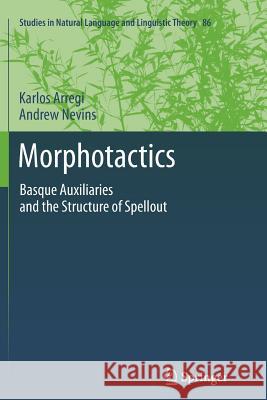
Karlos Arregi; Andrew Nevins
Morphotactics: Basque Auxiliaries and the Structure of Spellout Arregi, Karlos 9789401781824 Springer - książkaWidoczna okładka, to zdjęcie poglądowe, a rzeczywista szata graficzna może różnić się od prezentowanej.

Morphotactics: Basque Auxiliaries and the Structure of Spellout

ISBN-13: 9789401781824 / Angielski / Miękka / 2014 / 420 str.

Karlos Arregi; Andrew Nevins
cena 924,05 zł
(netto: 880,05 VAT:  5%)

Najniższa cena z 30 dni: 882,93 zł
Termin realizacji zamówienia:
ok. 22 dni roboczych
Bez gwarancji dostawy przed świętami

Darmowa dostawa!

This comprehensive treatment of several phenomena in Distributed Morphology explores a number of topics of high relevance to current linguistic theory. It examines the structure of the syntactic and postsyntactic components of word formation, and the role of hierarchical, featural, and linear restrictions within the auxiliary systems of several varieties of Basque. The postsyntactic component is modeled as a highly articulated system that accounts for what is shared and what exhibits variation across Basque dialects. The emphasis is on a principled ordering of postsyntactic operations based on their intrinsic properties, and on the relationship between representations in the Spellout component of grammar with other grammatical modules. The analyses in the book treat related phenomena in other languages and thereby have much to offer for a general morphology readership, as well as those interested in the syntax-morphology interface, the theory of Distributed Morphology, and Basque.


Kategorie:
Nauka, Językoznawstwo
Kategorie BISAC:
Language Arts & Disciplines > Grammar & Punctuation
Foreign Language Study > Miscellaneous
Language Arts & Disciplines > Linguistics - Syntax
Wydawca:
Springer
Seria wydawnicza:
Studies in Natural Language and Linguistic Theory
Język:
Angielski
ISBN-13:
9789401781824
Rok wydania:
2014
Wydanie:
2012
Numer serii:
000091356
Ilość stron:
420
Waga:
0.67 kg
Wymiary:
23.5 x 15.5
Oprawa:
Miękka
Wolumenów:
01

1 Introduction: The Structure of Spellout

1.1 Major Claims of This Book

1.2 Distributed Morphology and the Division of Labor in Word Formation

1.2.1 An Overview of the Serial and Modular Components

1.2.2 An Overview of DM Elements and Operations

1.3 The Basque Language

1.3.1 Geographic and Demographic Background

1.3.2 Orthography and Other Conventions in Representing Basque Sentences

1.3.3 Sources of Data

1.4 Brief Overview of Basque Syntax and Morphology

1.4.1 Argument Structure and Case

1.4.2 The Syntax and Morphology of DPs

1.4.3 The Syntax of Auxiliaries: T, C, and Agreement

1.4.4 The Syntax of Auxiliaries and Pronominal Clitics

1.4.5 Other Aspects of Verbal Syntax

1.5 Overview of the Book

 2 The Syntax of Cliticization and Agreement

2.1 Introduction

2.2 Clitic Placement

2.2.1 Clitic Generation

2.2.2 Clitic Movement

2.2.3 Alternative Analyses of Cliticization

2.2.4 Summary: The Syntax of Cliticization

2.3 The Person-Case Constraint and Absolutive Promotion

2.3.1 The Person-Case Constraint in Basque

2.3.2 Absolutive Promotion

2.3.3 Movement Verbs and PCC Effects

2.3.4 Other PCC Repairs

2.4 Agreement

2.4.1 Multiple Agree

2.4.2 Agree-Copy

2.4.3 Complementizer Agreement

2.4.4 Summary: The Syntax of Agreement

2.5 Default Agreement

2.6 Complementizers Within the Auxiliary Complex

2.7 Conclusion: Cliticization vs. Agreement

3 The Morphophonology of Basque Finite Auxiliaries

3.1 Introduction

3.2 Vocabulary Insertion

3.2.1 Contextual Restrictions and Linear Adjacency

3.2.2 Competition Among Vocabulary Entries

3.3 Clitic Realization in the Morphophonology

3.3.1 Clitics and Morpheme Order in the Auxiliary

3.3.2 The Realization of Clitics

3.3.3 Dative Clitics and Dative Flags

3.3.4 Plural Fission

3.3.5 On the Absence of Third Person Absolutive Clitics

3.3.6 On Plural Morphology in Basque Finite Verbs

3.4 The Realization of Agreement on T

3.4.1 Allomorphy in the Context of Ergative and Dative Clitics

3.4.2 Lekeitio

3.4.3 Ondarru and Zamudio

3.4.4 Multiple Agreement in Lekeitio

3.4.5 Summary

3.5 The Realization of Auxiliary Morphemes in Previous Accounts

3.6 Phonological Rules

3.6.1 Morpheme-Specific Rules

3.6.2 Syllabification and Related Processes

3.6.3 Other Phonological Processes

3.6.4 Rule Interaction

3.6.5 Rules that Apply Across Word Boundaries

3.6.6 Summary

3.7 Conclusion

4 Deletion Operations Targeting Morphological Markedness

4.1 Introduction

4.2 Distinctions Among Types of Postsyntactic Deletion Operations

4.3 Paradigmatic Markedness

4.3.1 Formal/Colloquial Neutralization

4.3.2 Paradigmatic Impoverishment in First Singular Clitics

4.4 Syntagmatic Markedness

4.4.1 Dissimilatory Deletion

4.4.2 3/3 Effects

4.5 On the Nonlinearity of Impoverishment

4.6 Participant Dissimilation

4.6.1 Ondarru

4.6.2 Zamudio

4.6.3 Other Varieties

4.6.4 On the Potential Diachronic Origins of Impoverishment Rules

4.7 Plural Clitic Impoverishment

4.8 A Concise Summary of All Impoverishment Rules Proposed

4.9 Impoverishment in the Light of Crossmodular Structural Parallelism

 5 Linearity-Based Morphotactics

5.1 Introduction

5.2 Generalized Reduplication and Constraints on Morpheme Order

5.2.1 Metathesis and Doubling in Spanish Agreement Morphology

5.2.2 Noninitiality, Metathesis, and Allomorph Selection in Old Irish

5.2.3 Noninitiality in Nonclausal Domains in Amharic and Lithuanian

5.2.4 Nonfinality and Morphological Epenthesis in Italian Infinitives

5.2.5 Multiple Wh-Movement and Constraints on Distance to the Edge

5.2.6 Morpheme-Specific Ordering Constraints in Athapaskan

5.2.7 Interim Conclusion

5.3 The Linearization of Plural Clitics

5.3.1 Absolutive Clitics and Local Plural Metathesis

5.3.2 Long-Distance Plural Metathesis and Doubling

5.3.3 Other Linear Operations Affecting Plural Clitics

5.3.4 Summary: Plural Morphemes and Linearization

5.4 Ergative Metathesis and Related Phenomena in Basque Finite Auxiliaries

5.4.1 Noninitiality and Ergative Metathesis

5.4.2 Ergative Doubling

5.4.3 L-Support

5.4.4 Ergative Metathesis and Doubling of Third Person Clitics

5.4.5 Summary: Noninitiality and Its Repairs

5.5 Ergative Metathesis as a Metathetic Phenomenon

5.6 Additional Repairs to T-Noninitiality

5.6.1 Dative Doubling in Oñati

5.6.2 A Typology of Dative Displacements

5.6.3 Allocutive Metathesis and Doubling

5.7 Linearization and Hierarchical Relations

5.7.1 Hierachical Relations in the Linear Operations Component

5.7.2 Root Reduplication in Ondarru  

5.7.3 Modal Particles and T-Noninitiality

5.8 Conclusion

6 Rule Interaction in a Serial and Modular Architecture

6.1 Introduction

6.2 Testing the Predicted Interactions

6.2.1 Promotion and Dissimilation: Feeding and Counterbleeding

6.2.2 Absolutive Promotion Opaquely Feeds Ergative Metathesis

6.2.3 Participant Dissimilation Feeds Ergative Metathesis

6.2.4 Participant Dissimilation Bleeds Ergative Metathesis

6.2.5 Participant Dissimilation Bleeds Root Reduplication

6.2.6 Promotion, Dissimilation, and Metathesis

6.3 Conclusion: Predictions of a Modular and Derivational Theory

7 Concluding Themes

7.1 Introduction

7.2 Distinguishing Types of Exponents

7.2.1 Plural Marking as a Microcosm of DM Operations

7.2.2 A Recap: Why Clitics and Agreement Must Be Distinguished in Basque

7.3 Crossmodular Structural Parallelism

7.3.1 Formalism and Features: Fission in Phonology and Morphology

7.3.2 Formalism and Features: Markedness and Impoverishment

7.3.3 Formalism: Metathesis/Reduplication in Morphology and Phonology

7.3.4 Architectural Formalism: Lexical Phonology and Modular Organization

7.3.5 Interim Conclusion

7.4 On the Methodological Cycle Between Cross-Dialectal Breadth and Depth

A Indicative Auxiliary Paradigms

B Dialect Classification

References

Name Index

Subject Index

Language Index (including Basque varieties)

This comprehensive treatment of several phenomena in Distributed Morphology explores a number of topics of high relevance to current linguistic theory. It examines the structure of the syntactic and postsyntactic components of word formation, and the role of hierarchical, featural, and linear restrictions within the auxiliary systems of several varieties of Basque.

The postsyntactic component is modeled as a highly articulated system that accounts for what is shared and what exhibits variation across Basque dialects. The emphasis is on a principled ordering of postsyntactic operations based on their intrinsic properties, and on the relationship between representations in the Spellout component of grammar with other grammatical modules. The analyses in the book treat related phenomena in other languages and thereby have much to offer for a general morphology readership, as well as those interested in the syntax-morphology interface, the theory of Distributed Morphology, and Basque.

Nevins, Andrew Andrew Nevins is Associate Professor of Linguistic... więcej >


Udostępnij

Facebook - konto krainaksiazek.pl


Opinie o Krainaksiazek.pl na Opineo.pl

Partner Mybenefit

Krainaksiazek.pl w programie rzetelna firma Krainaksiaze.pl - płatności przez paypal

Czytaj nas na:

Facebook - krainaksiazek.pl
  • książki na zamówienie
  • granty
  • książka na prezent
  • kontakt
  • pomoc
  • opinie
  • regulamin
  • polityka prywatności

Zobacz:

  • Księgarnia czeska

  • Wydawnictwo Książkowe Klimaty

1997-2025 DolnySlask.com Agencja Internetowa

© 1997-2022 krainaksiazek.pl
     
KONTAKT | REGULAMIN | POLITYKA PRYWATNOŚCI | USTAWIENIA PRYWATNOŚCI
Zobacz: Księgarnia Czeska | Wydawnictwo Książkowe Klimaty | Mapa strony | Lista autorów
KrainaKsiazek.PL - Księgarnia Internetowa

Polityka prywatnosci - link
Krainaksiazek.pl - płatnośc Przelewy24
Przechowalnia Przechowalnia





