Moltke Meets Confucius: The Possibility of Mission Command in China » książka





Moltke Meets Confucius: The Possibility of Mission Command in China
ISBN-13: 9783828837706 / Angielski / Twarda / 2016 / 160 str.
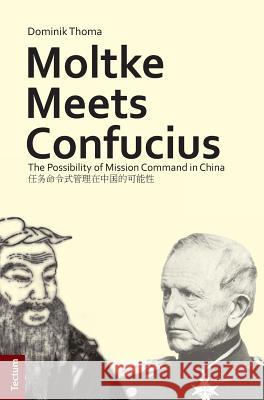
The global business environment is becoming more complex and business activities are increasing in speed. In this volatile environment, companies will need to adjust their approach to strategy, their organizational setup and leadership model in order to be sustainably successful. In military history, armies have gone through the same development. Since the 19th century the concept of Mission Command (Auftragstaktik) has been proven to offer superior performance and competitive advantages through systematic empowerment of employees, decentralised decision-making and allowing (calculated) risk-taking under the severest and most demanding situation: war. In the first part of this book, the historical development of Mission Command is reconstructed and key elements derived. Readers will gain a deeper understanding of the concept of Mission Command, in what situations its application is beneficial, and what is needed for its successful implementation. In the second part, the potential as well as the limitations of Mission Command in China are analysed by contrasting the requirements with findings on Chinese national culture and leadership. This is particularly useful for Chinese and Western leaders of Small and Medium sized Enterprises (SME) working in cross-cultural environments and will enable them to apply an appropriate leadership style when setting up, expanding, or reorganising their operations in China. Dominik Thoma has held various management positions such as General Manager in European and Asian subsidiaries of a multinational company. He lived and worked in Mainland China for several years, where he gained valuable practical insights into the local culture by managing a German - Chinese - Japanese Joint Venture as well as being board member of several companies. Dominik studied Business Information Systems in Germany and earned his Master degrees at the University of Mannheim, Germany and the Tongji University in Shanghai, PRC. He and his family live currently in Munich, Germany.
The global business environment is becoming more complex and business activities are increasing in speed. In this volatile environment, companies will need to adjust their approach to strategy, their organizational setup and leadership model in order to be sustainably successful. In military history, armies have gone through the same development. Since the 19th century the concept of Mission Command (Auftragstaktik) has been proven to offer superior performance and competitive advantages through systematic empowerment of employees, decentralised decision-making and allowing (calculated) risk-taking under the severest and most demanding situation: war. In the first part of this book, the historical development of Mission Command is reconstructed and key elements derived. Readers will gain a deeper understanding of the concept of Mission Command, in what situations its application is beneficial, and what is needed for its successful implementation. In the second part, the potential as well as the limitations of Mission Command in China are analysed by contrasting the requirements with findings on Chinese national culture and leadership. This is particularly useful for Chinese and Western leaders of Small and Medium sized Enterprises (SME) working in cross-cultural environments and will enable them to apply an appropriate leadership style when setting up, expanding, or reorganising their operations in China.




Czytaj nas na:
KrainaKsiazek.PL - Księgarnia Internetowa


