• Wyszukiwanie zaawansowane
  • Kategorie
  • Kategorie BISAC
  • Książki na zamówienie
  • Promocje
  • Granty
  • Książka na prezent
  • Opinie
  • Pomoc
  • Załóż konto
  • Zaloguj się

Modern Software Tools for Scientific Computing » książka


zaloguj się | załóż konto
Logo Krainaksiazek.pl

koszyk

konto

szukaj
topmenu
Księgarnia internetowa
Szukaj
Książki na zamówienie
Promocje
Granty
Książka na prezent
Moje konto
Pomoc
 
 
Wyszukiwanie zaawansowane
Pusty koszyk
Bezpłatna dostawa dla zamówień powyżej 20 złBezpłatna dostawa dla zamówień powyżej 20 zł

Kategorie główne

• Nauka
 [2946600]
• Literatura piękna
 [1856966]

  więcej...
• Turystyka
 [72221]
• Informatyka
 [151456]
• Komiksy
 [35826]
• Encyklopedie
 [23190]
• Dziecięca
 [619653]
• Hobby
 [140543]
• AudioBooki
 [1577]
• Literatura faktu
 [228355]
• Muzyka CD
 [410]
• Słowniki
 [2874]
• Inne
 [445822]
• Kalendarze
 [1744]
• Podręczniki
 [167141]
• Poradniki
 [482898]
• Religia
 [510455]
• Czasopisma
 [526]
• Sport
 [61590]
• Sztuka
 [243598]
• CD, DVD, Video
 [3423]
• Technologie
 [219201]
• Zdrowie
 [101638]
• Książkowe Klimaty
 [124]
• Zabawki
 [2473]
• Puzzle, gry
 [3898]
• Literatura w języku ukraińskim
 [254]
• Art. papiernicze i szkolne
 [8170]
Kategorie szczegółowe BISAC

Modern Software Tools for Scientific Computing

ISBN-13: 9780817639747 / Angielski / Twarda / 1997 / 380 str.
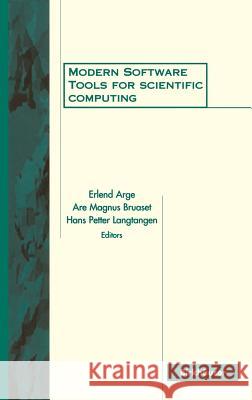
E. Arge; H. P. Langtangen; A. M. Bruaset
Modern Software Tools for Scientific Computing E. Arge H. P. Langtangen A. M. Bruaset 9780817639747 Birkhauser - książkaWidoczna okładka, to zdjęcie poglądowe, a rzeczywista szata graficzna może różnić się od prezentowanej.

Modern Software Tools for Scientific Computing

ISBN-13: 9780817639747 / Angielski / Twarda / 1997 / 380 str.

E. Arge; H. P. Langtangen; A. M. Bruaset
cena 403,47 zł
(netto: 384,26 VAT:  5%)

Najniższa cena z 30 dni: 385,52 zł
Termin realizacji zamówienia:
ok. 22 dni roboczych
Bez gwarancji dostawy przed świętami

Darmowa dostawa!

Looking back at the years that have passed since the realization of the very first electronic, multi-purpose computers, one observes a tremendous growth in hardware and software performance. Today, researchers and engi- neers have access to computing power and software that can solve numerical problems which are not fully understood in terms of existing mathemati- cal theory. Thus, computational sciences must in many respects be viewed as experimental disciplines. As a consequence, there is a demand for high- quality, flexible software that allows, and even encourages, experimentation with alternative numerical strategies and mathematical models. Extensibil- ity is then a key issue; the software must provide an efficient environment for incorporation of new methods and models that will be required in fu- ture problem scenarios. The development of such kind of flexible software is a challenging and expensive task. One way to achieve these goals is to in- vest much work in the design and implementation of generic software tools which can be used in a wide range of application fields. In order to provide a forum where researchers could present and discuss their contributions to the described development, an International Work- shop on Modern Software Tools for Scientific Computing was arranged in Oslo, Norway, September 16-18, 1996. This workshop, informally referred to as Sci Tools '96, was a collaboration between SINTEF Applied Mathe- matics and the Departments of Informatics and Mathematics at the Uni- versity of Oslo.


Kategorie:
Informatyka, Bazy danych
Kategorie BISAC:
Computers > Software Development & Engineering - General
Computers > Languages - General
Computers > Data Science - General
Wydawca:
Birkhauser
Język:
Angielski
ISBN-13:
9780817639747
Rok wydania:
1997
Wydanie:
1997
Ilość stron:
380
Waga:
0.63 kg
Wymiary:
24.31 x 16.48 x 2.29
Oprawa:
Twarda
Wolumenów:
01
Dodatkowe informacje:
Wydanie ilustrowane

I. Computational Differential Equations.- 1 The SCIRun Computational Steering Software System.- 1.1 Introduction.- 1.2 Requirements of SCIRun as a Computational Steering System.- 1.3 Components of SCIRun.- 1.4 The Datatypes Library.- 1.5 Dataflow.- 1.6 Steering in a Dataflow System.- 1.7 Modules.- 1.8 Applications of SCIRun in Computational Medicine.- 1.9 Summary.- 1.10 Future Work.- 1.11 References.- 1.12 Software Appendix.- 2 Object-Oriented Solvers for Initial Value Problems.- 2.1 Introduction.- 2.2 Overview of the Code.- 2.3 Case Studies: New algorithms.- 2.4 Comparison with Classical Solvers.- 2.5 Conclusions.- 2.6 References.- 3 SPRINT2D Software for Convection Dominated PDEs.- 3.1 Introduction.- 3.2 The SPRINT2D Software.- 3.3 Mesh Generation and Adaptivity.- 3.4 A PSE for SPRINT2D.- 3.5 Case Studies.- 3.6 Conclusions.- 3.7 References.- 4 Electrochemical Modelling and Software Genericity.- 4.1 Introduction.- 4.2 Electrochemical Modelling.- 4.3 A Generalized Approach to Numerical Modelling.- 4.4 Abstractions.- 4.5 Critical Remarks.- 4.6 Conclusions.- 4.7 References.- 5 An Object-Oriented Adaptive Finite Element Code: Design Issues and Applications in Hyperthermia Treatment Planning.- 5.1 Introduction.- 5.2 Code Structure.- 5.3 Applications in Hyperthermia Treatment Planning.- 5.4 Concluding Remarks.- 5.5 References.- 6 On the Efficient Implementation of Multilevel Adaptive Methods.- 6.1 Introduction.- 6.2 Multilevel Implementations.- 6.3 Data Abstraction Concepts for Multilevel Adaptive Methods.- 6.4 Efficiency.- 6.5 Abstract Mesh Data Structures.- 6.6 Patch-Adaptive Multigrid.- 6.7 Conclusions.- 6.8 References.- 7 Finite Element Kernel with Metaobject Protocol.- 7.1 Introduction.- 7.2 Example Problems.- 7.3 Procedural Approach.- 7.4 Object-Oriented Approach.- 7.5 Algorithm-Oriented Approach.- 7.6 Conclusions.- 7.7 References.- 8 Efficient Management of Parallelism in Object-Oriented Numerical Software Libraries.- 8.1 Introduction.- 8.2 The Message Passing Model for Programming Distributed-Memory Parallel Systems.- 8.3 Distributed Computational Objects.- 8.4 Six Guiding Principles.- 8.5 PETSc Design of Fundamental Objects.- 8.6 Sample Performance Results.- 8.7 Conclusion.- 8.8 References.- 9 Object-Oriented Construction of Parallel PDE Solvers.- 9.1 Introduction.- 9.2 The Object-Oriented Approach.- 9.3 Overview of Cogito.- 9.4 Case Study 1: Application of Cogito/Grid.- 9.5 Case Study 2: Application of Cogito/Solver.- 9.6 Cogito for Implicit Methods.- 9.7 Validation of Cogito.- 9.8 Concluding Remarks.- 9.9 References.- 10 Modern Software Techniques in Computational Finance.- 10.1 Introduction.- 10.2 Option Computations.- 10.3 Software Design Issues in Option Valuation.- 10.4 FINANZIA Implementation and Examples.- 10.5 Future Extensions.- 10.6 Conclusions.- 10.7 References.- 11 Increasing the Efficiency and Reliability of Software Development for Systems of PDEs.- 11.1 Introduction.- 11.2 A Plastic Forming Process.- 11.3 The Basic Ideas.- 11.4 Diffpack.- 11.5 Systems of PDEs.- 11.6 Extensions of the Concept.- 11.7 Other Applications.- 11.8 Another Application of the Flexible Design.- 11.9 Concluding Remarks.- 11.10 References.- II. Computational Geometry.- 12 Object Oriented Surface Design.- 12.1 Overview.- 12.2 Geometrical Abstractions.- 12.3 Data Structures.- 12.4 Splines.- 12.5 Surfaces.- 12.6 Refiners.- 12.7 Applications.- 12.8 Development Environment.- 12.9 References.- 13 Object-Oriented Scattered Data Modelling with Siscat.- 13.1 Introduction.- 13.2 A Cartographic Model Problem.- 13.3 The Basic Surface Hierarchy in Siscat.- 13.4 Aspects of Basic Methods.- 13.5 Composite Methods.- 13.6 References.- III. Software Development.- 14 Is the Quality of Numerical Subroutine Code Improving?.- 14.1 Introduction.- 14.2 Software Metrics.- 14.3 A Comparison of Freely Available Packages.- 14.4 CALGO Fortran Codes.- 14.5 Conclusion.- 14.6 References.- 15 Object-Oriented Redesign of a Real-World Fortran 77 Solver.- 15.1 Introduction.- 15.2 The SEMPA Project.- 15.3 The CFD Program.- 15.4 Analysis and Redesign of the Solver.- 15.5 Original and New Module Comparison.- 15.6 Discussion of the Approach.- 15.7 References.- 16 Automating the Debugging of Large Numerical Codes.- 16.1 Introduction.- 16.2 Comparative Debugging.- 16.3 Examples of Use.- 16.4 The Wizard.- 16.5 Conclusion.- 16.6 References.- 17 The TAMPR Program Transformation System: Simplifying the Development of Numerical Software.- 17.1 Introduction.- 17.2 Some TAMPR Applications.- 17.3 The TAMPR Approach to Program Transformation.- 17.4 Example of the TAMPR Approach to Program Transformation.- 17.5 Conclusion.- 17.6 References.- List of Contributors.

Prof. H. Petter Langtangen is the director of Center for Biomedical Computing, a Norwegian Center of Excellence at Simula Research Laboratory, and a professor of computer science at the University of Oslo. His research concerns numerical methods and software tools for continuum mechanical problems. Langtangen has been an active developer of open source and commercial software systems for computational sciences. He is a member of the European Academy of Sciences and serves on the editorial board of five leading international journals.


Udostępnij

Facebook - konto krainaksiazek.pl


Opinie o Krainaksiazek.pl na Opineo.pl

Partner Mybenefit

Krainaksiazek.pl w programie rzetelna firma Krainaksiaze.pl - płatności przez paypal

Czytaj nas na:

Facebook - krainaksiazek.pl
  • książki na zamówienie
  • granty
  • książka na prezent
  • kontakt
  • pomoc
  • opinie
  • regulamin
  • polityka prywatności

Zobacz:

  • Księgarnia czeska

  • Wydawnictwo Książkowe Klimaty

1997-2025 DolnySlask.com Agencja Internetowa

© 1997-2022 krainaksiazek.pl
     
KONTAKT | REGULAMIN | POLITYKA PRYWATNOŚCI | USTAWIENIA PRYWATNOŚCI
Zobacz: Księgarnia Czeska | Wydawnictwo Książkowe Klimaty | Mapa strony | Lista autorów
KrainaKsiazek.PL - Księgarnia Internetowa

Polityka prywatnosci - link
Krainaksiazek.pl - płatnośc Przelewy24
Przechowalnia Przechowalnia





