• Wyszukiwanie zaawansowane
  • Kategorie
  • Kategorie BISAC
  • Książki na zamówienie
  • Promocje
  • Granty
  • Książka na prezent
  • Opinie
  • Pomoc
  • Załóż konto
  • Zaloguj się

Modern Physics: Introduction to Statistical Mechanics, Relativity, and Quantum Physics » książka


zaloguj się | załóż konto
Logo Krainaksiazek.pl

koszyk

konto

szukaj
topmenu
Księgarnia internetowa
Szukaj
Książki na zamówienie
Promocje
Granty
Książka na prezent
Moje konto
Pomoc
 
 
Wyszukiwanie zaawansowane
Pusty koszyk
Bezpłatna dostawa dla zamówień powyżej 20 złBezpłatna dostawa dla zamówień powyżej 20 zł

Kategorie główne

• Nauka
 [2946350]
• Literatura piękna
 [1816154]

  więcej...
• Turystyka
 [70666]
• Informatyka
 [151172]
• Komiksy
 [35576]
• Encyklopedie
 [23172]
• Dziecięca
 [611458]
• Hobby
 [135995]
• AudioBooki
 [1726]
• Literatura faktu
 [225763]
• Muzyka CD
 [378]
• Słowniki
 [2917]
• Inne
 [444280]
• Kalendarze
 [1179]
• Podręczniki
 [166508]
• Poradniki
 [469467]
• Religia
 [507199]
• Czasopisma
 [496]
• Sport
 [61352]
• Sztuka
 [242330]
• CD, DVD, Video
 [3348]
• Technologie
 [219391]
• Zdrowie
 [98638]
• Książkowe Klimaty
 [124]
• Zabawki
 [2382]
• Puzzle, gry
 [3525]
• Literatura w języku ukraińskim
 [259]
• Art. papiernicze i szkolne
 [7107]
Kategorie szczegółowe BISAC

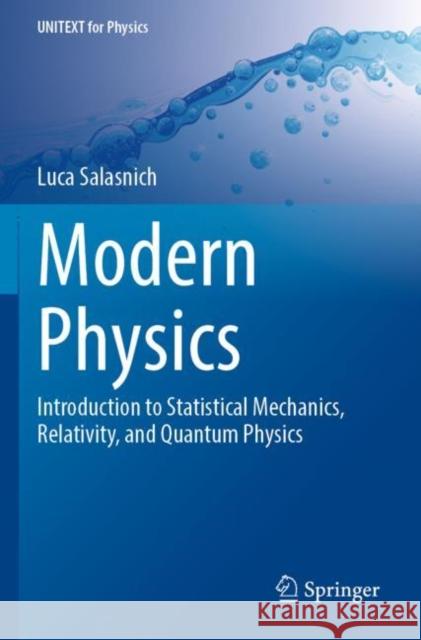
Modern Physics: Introduction to Statistical Mechanics, Relativity, and Quantum Physics

ISBN-13: 9783030937454 / Angielski / Miękka / 2023 / 194 str.
Luca Salasnich
Modern Physics: Introduction to Statistical Mechanics, Relativity, and Quantum Physics Luca Salasnich 9783030937454 Springer Nature Switzerland AG - książkaWidoczna okładka, to zdjęcie poglądowe, a rzeczywista szata graficzna może różnić się od prezentowanej.

Modern Physics: Introduction to Statistical Mechanics, Relativity, and Quantum Physics

ISBN-13: 9783030937454 / Angielski / Miękka / 2023 / 194 str.

Luca Salasnich
cena 280,04
(netto: 266,70 VAT:  5%)

Najniższa cena z 30 dni: 192,74
Termin realizacji zamówienia:
ok. 10-14 dni roboczych.

Darmowa dostawa!

This book offers an introduction to statistical mechanics, special relativity, and quantum physics. It is based on the lecture notes prepared for the one-semester course of "Quantum Physics" belonging to the Bachelor of Science in Material Sciences at the University of Padova.The first chapter briefly reviews the ideas of classical statistical mechanics introduced by James Clerk Maxwell, Ludwig Boltzmann, Willard Gibbs, and others. The second chapter is devoted to the special relativity of Albert Einstein. In the third chapter, it is historically analyzed the quantization of light due to Max Planck and Albert Einstein, while the fourth chapter discusses the Niels Bohr quantization of the energy levels and the electromagnetic transitions. The fifth chapter investigates the Schrodinger equation, which was obtained by Erwin Schrodinger from the idea of Louis De Broglie to associate to each particle a quantum wavelength. Chapter Six describes the basic axioms of quantum mechanics, which were formulated in the seminal books of Paul Dirac and John von Neumann. In chapter seven, there are several important application of quantum mechanics: the quantum particle in a box, the quantum particle in the harmonic potential, the quantum tunneling, the stationary perturbation theory, and the time-dependent perturbation theory. Chapter Eight is devoted to the study of quantum atomic physics with special emphasis on the spin of the electron, which needs the Dirac equation for a rigorous theoretical justification. In the ninth chapter, it is explained the quantum mechanics of many identical particles at zero temperature, while in Chapter Ten the discussion is extended to many quantum particles at finite temperature by introducing and using the quantum statistical mechanics.The four appendices on Dirac delta function, complex numbers, Fourier transform, and differential equations are a useful mathematical aid for the reader.


This book offers an introduction to statistical mechanics, special relativity, and quantum physics. It is based on the lecture notes prepared for the one-semester course of "Quantum Physics" belonging to the Bachelor of Science in Material Sciences at the University of Padova.

The first chapter briefly reviews the ideas of classical statistical mechanics introduced by James Clerk Maxwell, Ludwig Boltzmann, Willard Gibbs, and others. The second chapter is devoted to the special relativity of Albert Einstein. In the third chapter, it is historically analyzed the quantization of light due to Max Planck and Albert Einstein, while the fourth chapter discusses the Niels Bohr quantization of the energy levels and the electromagnetic transitions. The fifth chapter investigates the Schrodinger equation, which was obtained by Erwin Schrodinger from the idea of Louis De Broglie to associate to each particle a quantum wavelength. Chapter Six describes the basic axioms of quantum mechanics, which were formulated in the seminal books of Paul Dirac and John von Neumann. In chapter seven, there are several important application of quantum mechanics: the quantum particle in a box, the quantum particle in the harmonic potential, the quantum tunneling, the stationary perturbation theory, and the time-dependent perturbation theory. Chapter Eight is devoted to the study of quantum atomic physics with special emphasis on the spin of the electron, which needs the Dirac equation for a rigorous theoretical justification. In the ninth chapter, it is explained the quantum mechanics of many identical particles at zero temperature, while in Chapter Ten the discussion is extended to many quantum particles at finite temperature by introducing and using the quantum statistical mechanics. 

The four appendices on Dirac delta function, complex numbers, Fourier transform, and differential equations are a useful mathematical aid for the reader.

Kategorie:
Nauka, Fizyka
Kategorie BISAC:
Science > Fizyka kwantowa
Science > Fizyka relatywistyczna
Wydawca:
Springer Nature Switzerland AG
Seria wydawnicza:
Unitext for Physics
Język:
Angielski
ISBN-13:
9783030937454
Rok wydania:
2023
Wydanie:
2022
Numer serii:
000479809
Ilość stron:
194
Oprawa:
Miękka
Wolumenów:
01
Dodatkowe informacje:
Wydanie ilustrowane

Table of Contents

1 Classical Statistical Mechanics
1.1 Kinetic Theory of Gases 
1.1.1 Maxwell Distribution of Velocities
1.1.2 Maxwell-Boltzmann Distribution of Energies 
1.1.3 Single-Particle Density of States 
1.2 Statistical Ensembles of Gibbs 
1.2.1 Microcanonical Ensemble 
1.2.2 Canonical Ensemble 
1.2.3 Grand Canonical Ensemble 
1.2.4 Many-Particle Density of States 
2 Special Relativity 
2.1 Lorentz Transformations 
2.2 Einstein Postulates 
2.2.1 Gedanken Experiment of Einstein 
2.3 Relativistic Mechanics 
2.3.1 Relativistic Kinematics 
2.3.2 Relativistic Dynamics 
3 Quantum Properties of Light 
3.1 Black-Body Radiation 
3.1.1 Ideal Black Body 
3.1.2 Derivation of the Planck Law 
3.2 Photoelectric E ect 
3.2.1 Experimental Data 
3.2.2 Theoretical Explanation 
3.3 Energy and Linear Momentum of a Photon 
3.4 Compton E ect 
3.4.1 Theoretical Explanation 
4 Quantum Energy Levels of Atoms 
4.1 Energy Spectra 
4.1.1 Energy Spectrum of Hydrogen Atom 
4.2 Hydrogen Atom of Bohr
4.2.1 Derivation of the Bohr Results 
4.3 Energy Levels and Photons 
4.4 Electromagnetic Transitions 
5 Wave Properties of Matter 
5.1 De Broglie Wavelength 
5.1.1 Explaining the Bohr Quantization 
5.2 Experiment of Davisson and Germer 
5.3 Double-Slit Experiment with Light
5.4 Double-Slit Experiment with Electrons 
5.5 Old Quantum Mechanics of Bohr, Wilson and Sommerfeld
5.6 Matrix Quantum Mechanics of Heisenberg, Born and Jordan 
5.7 Wave Quantum Mechanics of Schrodinger 
5.7.1 Derivation of the Schr odinger Equation 
5.8 Formal Quantization Rules
5.8.1 Schrodinger Equation for a Free Particle 
5.8.2 Schrodinger Equation for a Particle in an External Potential 
5.9 Stationary Schr odinger Equation
6 Axioms of Quantum Mechanics 
6.1 Matrix Mechanics 
6.2 Axioms of Quantum Mechanics
7 Applications of Quantum Mechanics 
7.1 Quantum Particle in a One-Dimensional Box Potential
7.2 Quantum Particle in a One-Dimensional Harmonic Potential
8 Quantum Physics of Atoms 
8.1 Quantum Particle in a Separable Potential 
8.1.1 Quantum Particle in the Harmonic Potential 
8.2 Dirac Notation for a Quantum State
8.3 Electron in the Hydrogen Atom 
8.3.1 Schrodinger Equation in Spherical Polar Coordinates 
8.3.2 Selection Rules 
8.4 Pauli Exclusion Principle and the Spin
8.5 Semi-Integer and Integer Spin: Fermions and Bosons
8.6 The Dirac Equation 
8.6.1 The Pauli Equation and the Spin
8.6.2 Dirac Equation with a Central Potential 
8.6.3 Relativistic Hydrogen Atom and Fine Splitting 
8.6.4 Relativistic Corrections to the Schrodinger Hamiltonian
9 Quantum Mechanics of Many-Body Systems 
9.1 Identical Quantum Particles 
9.1.1 Spin-Statistics Theorem
9.2 Non-Interacting Identical Particles
9.2.1 Atomic Shell Structure and the Periodic Table of the Elements 
9.3 Interacting Identical Particles
9.3.1 Variational Principle
9.3.2 Electrons in Atoms and Molecules
10 Quantum Statistical Mechanics 
10.1 Quantum Statistical Ensembles 
10.1.1 Quantum Microcanonical Ensemble 
10.1.2 Quantum Canonical Ensemble 
10.1.3 Quantum Grand Canonical Ensemble 
10.2 Bosons and Fermions at Finite Temperature 
10.2.1 Gas of Photons at Thermal Equlibrium
10.2.2 Gas of Massive Bosons at Thermal Equlibrium 
10.2.3 Gas of Non-Interacting Fermions at Zero Temperature
Appendix A Dirac Delta Function 
A.1 The Heaviside Step Function 
A.2 The Strange Function of Dirac 
A.2.1 Dirac Function and the Integrals 
A.3 Dirac Function in D Spatial Dimensions 
Appendix B Complex Numbers 
B.1 Set of Complex Numbers 
B.2 Gauss Plane 
B.2.1 Polar Representation 
B.3 Euler Formula 
B.3.1 Proof of the Euler Formula 
B.3.2 De Moivre Formula
B.4 Fundamental Theorem of Algebra 
B.5 Complex Functions 
Appendix C Fourier Transform 
C.1 Geometric and Taylor Series
C.2 Fourier Series .
C.2.1 Complex Representation of the Fourier Series 
C.3 Fourier Integral 
C.3.1 Properties of the Fourier Transform 
C.3.2 Fourier Transform and Uncertanty Theorem
C.4 Fourier Transform of Space-Time Functions
Appendix D Di erential equations 
D.1 First-Order Ordinary Di erential Equations
D.1.1 Separation of Variables 
D.2 Second-Order Ordinary Di erential Equations 
D.3 Newton Law as a Second-Order ODE 
D.4 Partial Di erential Equations 
D.4.1 Wave Equation 
D.4.2 Di usion Equation 
Bibliography 

Luca Salasnich is Full Professor of Condensed Matter Theory at the Department of Physics and Astronomy "Galileo Galilei," University of Padova, Italy. He was awarded an M.Sc. in Physics by the University of Padova in 1991, and his Ph.D. in Theoretical Physics by the University of Florence in 1995. His fields of research are condensed matter theory and statistical physics, in particular nonlinear phenomena and macroscopic quantum effects (like superfluidity and superconductivity) in ultra-cold atomic gases and other many-body systems. He has written more than 200 peer-reviewed scientific papers in international journals, with over 4700 citations.


This book offers an introduction to statistical mechanics, special relativity, and quantum physics. It is based on the lecture notes prepared for the one-semester course of "Quantum Physics" belonging to the Bachelor of Science in Material Sciences at the University of Padova.


The first chapter briefly reviews the ideas of classical statistical mechanics introduced by James Clerk Maxwell, Ludwig Boltzmann, Willard Gibbs, and others. The second chapter is devoted to the special relativity of Albert Einstein. In the third chapter, it is historically analyzed the quantization of light due to Max Planck and Albert Einstein, while the fourth chapter discusses the Niels Bohr quantization of the energy levels and the electromagnetic transitions. The fifth chapter investigates the Schrodinger equation, which was obtained by Erwin Schrodinger from the idea of Louis De Broglie to associate to each particle a quantum wavelength. Chapter Six describes the basic axioms of quantum mechanics, which were formulated in the seminal books of Paul Dirac and John von Neumann. In chapter seven, there are several important application of quantum mechanics: the quantum particle in a box, the quantum particle in the harmonic potential, the quantum tunneling, the stationary perturbation theory, and the time-dependent perturbation theory. Chapter Eight is devoted to the study of quantum atomic physics with special emphasis on the spin of the electron, which needs the Dirac equation for a rigorous theoretical justification. In the ninth chapter, it is explained the quantum mechanics of many identical particles at zero temperature, while in Chapter Ten the discussion is extended to many quantum particles at finite temperature by introducing and using the quantum statistical mechanics. 

The four appendices on Dirac delta function, complex numbers, Fourier transform, and differential equations are a useful mathematical aid for the reader.




Udostępnij

Facebook - konto krainaksiazek.pl


Opinie o Krainaksiazek.pl na Opineo.pl

Partner Mybenefit

Krainaksiazek.pl w programie rzetelna firma Krainaksiaze.pl - płatności przez paypal

Czytaj nas na:

Facebook - krainaksiazek.pl
  • książki na zamówienie
  • granty
  • książka na prezent
  • kontakt
  • pomoc
  • opinie
  • regulamin
  • polityka prywatności

Zobacz:

  • Księgarnia czeska

  • Wydawnictwo Książkowe Klimaty

1997-2026 DolnySlask.com Agencja Internetowa

© 1997-2022 krainaksiazek.pl
     
KONTAKT | REGULAMIN | POLITYKA PRYWATNOŚCI | USTAWIENIA PRYWATNOŚCI
Zobacz: Księgarnia Czeska | Wydawnictwo Książkowe Klimaty | Mapa strony | Lista autorów
KrainaKsiazek.PL - Księgarnia Internetowa

Polityka prywatnosci - link
Krainaksiazek.pl - płatnośc Przelewy24
Przechowalnia Przechowalnia




