• Wyszukiwanie zaawansowane
  • Kategorie
  • Kategorie BISAC
  • Książki na zamówienie
  • Promocje
  • Granty
  • Książka na prezent
  • Opinie
  • Pomoc
  • Załóż konto
  • Zaloguj się

Modern Parallel Programming with C++ and Assembly Language: X86 Simd Development Using Avx, Avx2, and Avx-512 » książka


zaloguj się | załóż konto
Logo Krainaksiazek.pl

koszyk

konto

szukaj
topmenu
Księgarnia internetowa
Szukaj
Książki na zamówienie
Promocje
Granty
Książka na prezent
Moje konto
Pomoc
 
 
Wyszukiwanie zaawansowane
Pusty koszyk
Bezpłatna dostawa dla zamówień powyżej 20 złBezpłatna dostawa dla zamówień powyżej 20 zł

Kategorie główne

• Nauka
 [2944077]
• Literatura piękna
 [1814251]

  więcej...
• Turystyka
 [70679]
• Informatyka
 [151074]
• Komiksy
 [35590]
• Encyklopedie
 [23169]
• Dziecięca
 [611005]
• Hobby
 [136031]
• AudioBooki
 [1718]
• Literatura faktu
 [225599]
• Muzyka CD
 [379]
• Słowniki
 [2916]
• Inne
 [443741]
• Kalendarze
 [1187]
• Podręczniki
 [166463]
• Poradniki
 [469211]
• Religia
 [506887]
• Czasopisma
 [481]
• Sport
 [61343]
• Sztuka
 [242115]
• CD, DVD, Video
 [3348]
• Technologie
 [219293]
• Zdrowie
 [98602]
• Książkowe Klimaty
 [124]
• Zabawki
 [2385]
• Puzzle, gry
 [3504]
• Literatura w języku ukraińskim
 [260]
• Art. papiernicze i szkolne
 [7151]
Kategorie szczegółowe BISAC

Modern Parallel Programming with C++ and Assembly Language: X86 Simd Development Using Avx, Avx2, and Avx-512

ISBN-13: 9781484279175 / Angielski / Miękka / 2022 / 656 str.
Daniel Kusswurm
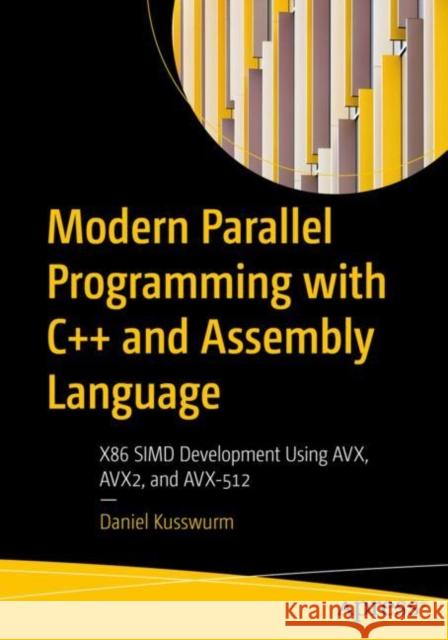
Modern Parallel Programming with C++ and Assembly Language: X86 Simd Development Using Avx, Avx2, and Avx-512 Kusswurm, Daniel 9781484279175 APress - książkaWidoczna okładka, to zdjęcie poglądowe, a rzeczywista szata graficzna może różnić się od prezentowanej.

Modern Parallel Programming with C++ and Assembly Language: X86 Simd Development Using Avx, Avx2, and Avx-512

ISBN-13: 9781484279175 / Angielski / Miękka / 2022 / 656 str.

Daniel Kusswurm
cena 261,63
(netto: 249,17 VAT:  5%)

Najniższa cena z 30 dni: 250,57
Termin realizacji zamówienia:
ok. 22 dni roboczych.

Darmowa dostawa!
Kategorie:
Informatyka
Kategorie BISAC:
Computers > Languages - C++
Computers > Computer Science
Wydawca:
APress
Język:
Angielski
ISBN-13:
9781484279175
Rok wydania:
2022
Ilość stron:
656
Waga:
1.11 kg
Wymiary:
25.4 x 17.78 x 3.35
Oprawa:
Miękka
Wolumenów:
01
Dodatkowe informacje:
Wydanie ilustrowane

Modern X86 SIMD Programming – Outline Page 1 of 7
D. Kusswurm – F:\ModX86SIMD\Outline\ModernX86SIMD_Outline (v1).docx
Introduction
The Introduction presents an overview of the book and includes concise descriptions of each chapter. It also summaries the
hardware and software tools required to use the book’s source code.
Overview
Target Audience
Chapter Descriptions
Source Code
Additional Resources
Chapter 1 – SIMD Fundamentals
Chapter 1 discusses SIMD fundamentals including data types, basic arithmetic, and common data manipulation operations.
Understanding of this material is necessary for the reader to successfully comprehend the book’s subsequent chapters.
 What is SIMD?
 Simple C++ example (Ch01_01)
Brief History of x86 SIMD Instruction Set Extensions
 MMX
 SSE – SSE4.2
 AVX, AVX2, and AVX-512
SIMD Data Types
 Fundamental types
 128b, 256b, 512b
 Integer types
 Packed i8, i16, i32, i64 (signed and unsigned)
 Floating-point types
 Packed f16/b16, f32 and f64
 Little-endian storage
SIMD Arithmetic
 Integer
Addition and subtraction
 Wraparound vs. saturated
 Multiplication
 Bitwise logical
 Floating-point
 Addition, subtraction, multiplication, division, sqrt
 Horizontal addition and subtraction
 Fused multiply-accumulate (FMA)
SIMD Operations
 Integer
 Min & max
 Compares
 Shuffles, permutations, and blends
 Size promotions and reductions
 Floating-point
 Min & max
 Compares
 Shuffles, permutations, and blends
 Size promotions and reductions 
Modern X86 SIMD Programming – Outline Page 2 of 7
D. Kusswurm – F:\ModX86SIMD\Outline\ModernX86SIMD_Outline (v1).docx
 Masked moves
 Conditional execution and merging (AVX-512)
SIMD Programming Overview
 C++ compiler options
 C++ SIMD intrinsic functions
 Assembly language functions
 Testing for AVX, AVX2, and AVX-512
Chapter 2 – AVX C++ Programming - Part 1
Chapter 2 teaches AVX integer arithmetic and other operations using C++ intrinsic functions. It also discusses how to code a
few simple image processing algorithms using C++ intrinsic functions and AVX instructions.
Basic Integer Arithmetic
 Addition (Ch02_01)
Subtraction (Ch02_02)
 Multiplication (Ch02_03)
Common Integer Operations
 Bitwise logical operations (Ch02_04)
 Arithmetic and logical shifts (Ch02_05)
Image Processing Algorithms
 Pixel minimum and maximum (Ch02_06)
 Pixel mean (Ch02_07)
Chapter 3 – AVX C++ Programming - Part 2
Chapter 3 is similar to the previous chapter but emphasizes floating-point instead of integer values. This chapter also
explains how to employ C++ intrinsic functions to perform SIMD arithmetic operations using floating-point arrays and
matrices.
Basic Floating-Point Arithmetic
 Addition, subtraction, etc. (Ch03_01)
 Compares (Ch03_02)
 Conversions (Ch03_03)
Floating-Point Arrays
 Array mean and standard deviation (Ch03_04, Ch03_05)
 Array square roots and compares (Ch03_06, Ch03_07)
Floating-Point Matrices
 Matrix column means (Ch03_08, Ch03_09)
Chapter 4 – AVX2 C++ Programming - Part 1
Chapter 4 describes AVX2 integer programming using C++ intrinsic functions. This chapter also highlights the coding of more
sophisticated image processing functions using the AVX2 instruction set.
Basic Integer Arithmetic
 Addition and subtraction (Ch04_01)
 Pack and unpack operations (Ch04_02)
 Size promotions (Ch04_03)
Image Processing Algorithms
 Pixel clipping (Ch04_04)
 RGB to grayscale (Ch04_05) 
Modern X86 SIMD Programming – Outline Page 3 of 7
D. Kusswurm – F:\ModX86SIMD\Outline\ModernX86SIMD_Outline (v1).docx
 Thresholding (Ch04_06)
 Pixel conversions (Ch04_07)
Chapter 5 – AVX2 C++ Programming - Part 2
Chapter 5 explains how to accelerate the performance of commonly used floating-point algorithms using C++ intrinsic
functions and the AVX2 instruction set. The source code examples in this chapter also demonstrate use of FMA (fusedmultiply-add) arithmetic.
Floating-Point Arrays
 Least squares with FMA (Ch05_01)
Floating-Point Matrices
 Matrix multiplication (Ch05_02, Ch05_03)
 Matrix (4x4) multiplication (Ch05_04, Ch05_05)
 Matrix (4x4) vector multiplication (Ch05_06)
 Matrix inversion (Ch05_07, Ch05_08)
Chapter 6 – AVX2 C++ Programming - Part 3
Chapter 6 is a continuation of the previous chapter. It focuses on more advanced algorithms and SIMD programming
techniques.
Signal Processing
 Brief overview of convolution arithmetic
 1D Convolutions
 Variable and fixed width kernels (Ch06_01, Ch06_02)
 2D Convolutions
 Non-separable kernel (Ch06_03)
 Separable kernel (Ch06_04)
Chapter 7 – AVX-512 C++ Programming - Part 1
Chapter 7 explains AVX-512 integer arithmetic and other operations using C++ intrinsic functions. It also discusses how to
code a few basic image processing algorithms using the AVX-512 instruction set.
Integer Arithmetic
 Addition and subtraction (Ch07_01)
 Masked arithmetic (Ch07_02)
Image Processing
 RGB to grayscale (Ch07_03)
 Image thresholding (Ch07_04)
 Image statistics (Ch07_05)
Chapter 8 – AVX-512 C++ Programming - Part 2
Chapter 8 describes how to code common and advanced floating-point algorithms using C++ intrinsic functions and the AVX512 instruction set.
Floating-Point Arithmetic
 Addition, subtraction, etc. (Ch08_01)
 Masked operations (Ch08_02)
Floating-Point Arrays
 Array mean and standard deviation (Ch08_03) 
Modern X86 SIMD Programming – Outline Page 4 of 7
D. Kusswurm – F:\ModX86SIMD\Outline\ModernX86SIMD_Outline (v1).docx
Floating-Point Matrices
 Covariance matrix (Ch08_04)
 Matrix multiplication (Ch08_05, Ch08_06)
 Matrix (4x4) vector multiplication (Ch08_07)
Signal Processing
 1D convolution using variable and fixed width kernels (Ch08_08)
 2D convolutions using separable kernel (Ch08_09)
Chapter 9 – Supplemental C++ SIMD Programming
Chapter 9 examines supplemental x86 SIMD programming topics including instruction set detection, how to use SIMD math
library functions, and SIMD operations using text strings.
Instruction set detection (Ch09_01)
SIMD Math Library Functions
 Rectangular to polar coordinate conversions (Ch09_02)
 Body surface area calculations (Ch09_03)
SIMD String Operations
 String length (Ch09_04)
Chapter 10 – X86 Processor Architecture
Chapter 10 explains x86 processor architecture including data types, register sets, memory addressing modes, and condition
codes. Knowledge of this material is necessary for the reader to successfully understand the subsequent x86 assembly
language programming chapters.
Data types
 Fundamental data types
 Numerical data types
 SIMD data types
 Strings
Internal architecture
 General-purpose registers
 RFLAGS register
 MXCSR register
 Scalar FP and SIMD registers
Memory addressing
Condition codes
Chapter 11 – Core Assembly Language Programming – Part 1
Chapter 11 teaches fundamental x86-64 assembly language programming and basic instruction use. Understanding of this
material is required to comprehend the source code examples in subsequent chapters.
Integer Arithmetic
 Addition and subtraction (Ch11_01)
 Multiplication (Ch11_02)
 Division (Ch11_03)
 Mixed integer types and stack arguments (Ch11_04)
Integer Operations
 Memory addressing modes (Ch11_05)
 Simple for-loops (Ch11_06) 
Modern X86 SIMD Programming – Outline Page 5 of 7
D. Kusswurm – F:\ModX86SIMD\Outline\ModernX86SIMD_Outline (v1).docx
 Compares (Ch11_07)
Text Strings
 String instructions (Ch11_08)
Chapter 12 – Core Assembly Language Programming – Part 2
Chapter 12 is a continuation of the previous chapter. Topics discussed include scalar floating-point arithmetic, floating-point
arrays, and function calling conventions.
Scalar Floating-Point Arithmetic
 Single-precision arithmetic (Ch12_01)
 Double-precision arithmetic (Ch12_02)
 Compares (Ch12_03)
 Conversions (Ch12_04)
Scalar Floating-Point Arrays
 Mean, SD (Ch12_05)
Function Calling Convention
 Stack frames (Ch12_06)
 Using non-volatile general-purpose registers (Ch12_07)
 Using non-volatile SIMD registers (Ch12_08)
 Macros for function prologues and epilogues (Ch12_09)
Chapter 13 – AVX Assembly Language Programming – Part 1
Chapter 13 explains AVX integer arithmetic and other operations using x86-64 assembly language. It also describes how to
code a few simple image processing algorithms using assembly language.
Integer Arithmetic
 Addition and subtraction (Ch13_01)
 Multiplication (Ch13_02)
Common Integer Operations
 Bitwise logical operations (Ch13_03)
 Arithmetic and logical shifts (Ch13_04)
Image Processing Algorithms
 Pixel minimum and maximum (Ch13_05)
 Pixel mean (Ch13_06)
Chapter 14 – AVX Assembly Language Programming – Part 2
Chapter 14 is similar to the previous chapter but uses floating-point instead of integer values. This chapter also illustrates
how to employ x86-64 assembly language to perform SIMD arithmetic operations using arrays and matrices.
Basic Floating-Point Arithmetic
 Addition and subtraction, etc. (Ch14_01)
 Compares and size conversions (Ch14_02)
Floating-Point Arrays
 Array mean and standard deviation (Ch14_03)
 Array square roots and compares (Ch14_04)
Floating-Point Matrices
 Matrix column means (Ch14_05) 
Modern X86 SIMD Programming – Outline Page 6 of 7
D. Kusswurm – F:\ModX86SIMD\Outline\ModernX86SIMD_Outline (v1).docx
Chapter 15 – AVX2 Assembly Language Programming – Part 1
Chapter 15 describes AVX2 integer programming using x86-64 assembly language. This chapter also highlights the coding of
more sophisticated image processing functions using the AVX2 instruction set.
Integer Arithmetic
 Addition and subtraction (Ch15_01)
Image Processing
 Pixel clipping (Ch15_02)
 RGB to grayscale (Ch15_03)
 Thresholding (Ch15_04)
 Pixel conversions (Ch15_05)
Chapter 16 – AVX2 Assembly Language Programming – Part 2
Chapter 16 explains how to enhance the performance of frequently used floating-point algorithms using x86-64 assembly
language and the AVX2 instruction set.
Floating-Point Arrays
 Least squares with FMA (Ch16_01)
Floating-Point Matrices
 Matrix multiplication (Ch16_02)
 Matrix (4x4) multiplication (Ch16_03)
 Matrix (4x4) vector multiplication (Ch16_04)
Signal Processing
 1D convolutions using fixed and variable width kernels (Ch16_05)
Chapter 17 – AVX-512 Assembly Language Programming – Part 1
Chapter 17 highlights AVX-512 integer arithmetic and other operations using x86-64 assembly language. It also discusses
how to code a few simple image processing algorithms using the AVX-512 instruction set.
Integer Arithmetic
 Addition and subtraction (Ch17_01)
 Compares, merge masking, and zero-masking (Ch17_02)
Image Processing
 Pixel clipping (Ch17_03)
 Image statistics (Ch17_04)
Chapter 18 – AVX-512 Assembly Language Programming – Part 2
Chapter 18 explains how to code common and advanced floating-point algorithms using x86-64 assembly language and the
and the AVX-512 instruction set.
Floating-Point Arrays
 Correlation coefficient (Ch18_01)
 Merge and zero masking (Ch18_02)
 Embedded rounding and broadcasts (Ch18_03)
Floating-Point Matrices
 Matrix (4x4) vector multiplication (Ch18_04)
Signal Processing
 1D convolutions using fixed and variable width kernels (Ch18_05) 
Modern X86 SIMD Programming – Outline Page 7 of 7
D. Kusswurm – F:\ModX86SIMD\Outline\ModernX86SIMD_Outline (v1).docx
Appendix A – Source Code and Development Tools
Appendix A describes how to download, install, and execute the source code. It also includes some brief usage notes
regarding Visual Studio and the GNU C++ compiler.
Source Code Download Information
Software Development Tools
 Microsoft Visual Studio
 GNU C++ compiler
Appendix B – References and Additional Resources
Appendix B contains a list of references that were consulted during the writing of this book. It also lists supplemental
resources that the reader can consult for additional x86 SIMD programming information.
X86 SIMD Programming References
Algorithm References
C++ References
Additional Resources 

​Daniel Kusswurm has over 35 years of professional experience as a software developer, computer scientist, and author. During his career, he has developed innovative software for medical devices, scientific instruments, and image processing applications. On many of these projects, he successfully employed C++ intrinsic functions, x86 assembly language, and SIMD programming techniques to significantly improve the performance of computationally intense algorithms or solve unique programming challenges. His educational background includes a BS in electrical engineering technology from Northern Illinois University along with an MS and PhD in computer science from DePaul University. Daniel Kusswurm is also the author of Modern X86 Assembly Language Programming (ISBN: 978-1484200650), Modern X86 Assembly Language Programming, Second Edition (ISBN: 978-1484240625), and Modern Arm Assembly Language Programming (ISBN: 978 1484262665), all published by Apress.

Learn the fundamentals of x86 Single instruction multiple data (SIMD) programming using C++ intrinsic functions and x86-64 assembly language. This book emphasizes x86 SIMD programming topics and technologies that are relevant to modern software development in applications which can exploit data level parallelism, important for the processing of big data, large batches of data and related important in data science and much more.


Modern Parallel Programming with C++ and Assembly Language is an instructional text that explains x86 SIMD programming using both C++ and assembly language. The book’s content and organization are designed to help you quickly understand and exploit the SIMD capabilities of x86 processors. It also contains an abundance of source code that is structured to accelerate learning and comprehension of essential SIMD programming concepts and algorithms. 


After reading this book, you will be able to code performance-optimized AVX, AVX2, and AVX-512 algorithms using either C++ intrinsic functions or x86-64 assembly language. 

You will:

  • Understand the essential details about x86 SIMD architectures and instruction sets including AVX, AVX2, and AVX-512.
  • Master x86 SIMD data types, arithmetic instructions, and data management operations using both integer and floating-point operands.
  • Code performance-enhancing functions and algorithms that fully exploit the SIMD capabilities of a modern x86 processor.
  • Employ C++ intrinsic functions and x86-64 assembly language code to carry out arithmetic calculations using common programming constructs including arrays, matrices, and user-defined data structures.
  • Harness the x86 SIMD instruction sets to significantly accelerate the performance of computationally intense algorithms in applications such as machine learning, image processing, computer graphics, statistics, and matrix arithmetic.
  • Apply leading-edge coding strategies and techniques to optimally exploit the x86 SIMD instruction sets for maximum possible performance.


  • Udostępnij

    Facebook - konto krainaksiazek.pl


    Opinie o Krainaksiazek.pl na Opineo.pl

    Partner Mybenefit

    Krainaksiazek.pl w programie rzetelna firma Krainaksiaze.pl - płatności przez paypal

    Czytaj nas na:

    Facebook - krainaksiazek.pl
    • książki na zamówienie
    • granty
    • książka na prezent
    • kontakt
    • pomoc
    • opinie
    • regulamin
    • polityka prywatności

    Zobacz:

    • Księgarnia czeska

    • Wydawnictwo Książkowe Klimaty

    1997-2026 DolnySlask.com Agencja Internetowa

    © 1997-2022 krainaksiazek.pl
         
    KONTAKT | REGULAMIN | POLITYKA PRYWATNOŚCI | USTAWIENIA PRYWATNOŚCI
    Zobacz: Księgarnia Czeska | Wydawnictwo Książkowe Klimaty | Mapa strony | Lista autorów
    KrainaKsiazek.PL - Księgarnia Internetowa

    Polityka prywatnosci - link
    Krainaksiazek.pl - płatnośc Przelewy24
    Przechowalnia Przechowalnia







