• Wyszukiwanie zaawansowane
  • Kategorie
  • Kategorie BISAC
  • Książki na zamówienie
  • Promocje
  • Granty
  • Książka na prezent
  • Opinie
  • Pomoc
  • Załóż konto
  • Zaloguj się

Modern Methods of Plant Analysis/Moderne Methoden Der Pflanzenanalyse » książka


zaloguj się | załóż konto
Logo Krainaksiazek.pl

koszyk

konto

szukaj
topmenu
Księgarnia internetowa
Szukaj
Książki na zamówienie
Promocje
Granty
Książka na prezent
Moje konto
Pomoc
 
 
Wyszukiwanie zaawansowane
Pusty koszyk
Bezpłatna dostawa dla zamówień powyżej 20 złBezpłatna dostawa dla zamówień powyżej 20 zł

Kategorie główne

• Nauka
 [2946600]
• Literatura piękna
 [1856966]

  więcej...
• Turystyka
 [72221]
• Informatyka
 [151456]
• Komiksy
 [35826]
• Encyklopedie
 [23190]
• Dziecięca
 [619653]
• Hobby
 [140543]
• AudioBooki
 [1577]
• Literatura faktu
 [228355]
• Muzyka CD
 [410]
• Słowniki
 [2874]
• Inne
 [445822]
• Kalendarze
 [1744]
• Podręczniki
 [167141]
• Poradniki
 [482898]
• Religia
 [510455]
• Czasopisma
 [526]
• Sport
 [61590]
• Sztuka
 [243598]
• CD, DVD, Video
 [3423]
• Technologie
 [219201]
• Zdrowie
 [101638]
• Książkowe Klimaty
 [124]
• Zabawki
 [2473]
• Puzzle, gry
 [3898]
• Literatura w języku ukraińskim
 [254]
• Art. papiernicze i szkolne
 [8170]
Kategorie szczegółowe BISAC

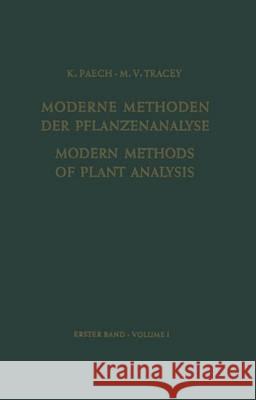
Modern Methods of Plant Analysis/Moderne Methoden Der Pflanzenanalyse

ISBN-13: 9783642805325 / Angielski / Miękka / 2011 / 542 str.
Paech, K.
Modern Methods of Plant Analysis/Moderne Methoden Der Pflanzenanalyse Paech, K. 9783642805325 Springer - książkaWidoczna okładka, to zdjęcie poglądowe, a rzeczywista szata graficzna może różnić się od prezentowanej.

Modern Methods of Plant Analysis/Moderne Methoden Der Pflanzenanalyse

ISBN-13: 9783642805325 / Angielski / Miękka / 2011 / 542 str.

Paech, K.
cena 564,88 zł
(netto: 537,98 VAT:  5%)

Najniższa cena z 30 dni: 539,74 zł
Termin realizacji zamówienia:
ok. 22 dni roboczych
Bez gwarancji dostawy przed świętami

Darmowa dostawa!

Viele bedeutende Errungenschaften der modernen Biologie sind erst nach Erfindung und Amvendung von leistungsfahi, gen Methoden m6glich geworden. Man kann zwar nicht sagen, daB wir in einem "Zeitalter der Methoden" leben, aber jeder Schritt zur LOsung eines wichtigen biologischen Problems muJlte und mu.G durch die Entwicklung einer geeigneten Methode vorbereitet werden. Es gibt nicht viele "klassische" Verfahren, die sich in der physiologisch-chemischen Forschung erhalten haben. Physik und Chemie entdecken immer wieder spezi fische, genauere und bequemere analytische Moglichkeiten, die von Biochemikern iibernommen und fUr die Anwendung auf Pflanzenmaterial abgewandelt werden. Wenn solche neuen Methoden in rein analytischen Zeitschriften veroffentlicht werden, so sind sie zwischen analytischen Verfahren fiir aIle moglichen Gebiete der Chemie, vom Petroleum bis zu SchwermetaIlegierungen, verborgen. Erschei nen sie aber als methodischer Teil in den Arbeiten iiber spezielle biochemische Probleme, so gibt oft weder der Titel der Arbeit nocadie Zusammenfassung einen Hinweis auf die wertvolle Methode und ihre Anwendungsmoglichkeiten. Neue leistungsfahige Methoden erreichen deshalb oft nicht unmittelbar aIle die Forscher, die bei ihren Arbeiten groBten Nutzen daraus ziehen konnten. Das waren die entscheidenden -oberlegungen, die zur Planung dieses Handbuchs fiihrten. Nach unseren Erfahrungen besteht ein Bediirfnis fUr eine moderne Sammlung zuverlassiger Methoden der Pflanzenanalyse vor allem auch in weiten Kreisen der angewandten Botanik, von landwirtschaftlichen und Gartenbau-Insti tuten bis zu pharmazeutischen und technischen Untersuchungsanstalten, die mit pflanzlichem Material zu tun haben."


Kategorie:
Nauka, Biologia i przyroda
Kategorie BISAC:
Science > Botanika
Medical > Medycyna
Wydawca:
Springer
Seria wydawnicza:
Modern Methods of Plant Analysis Moderne Methoden Der Pflanz
Język:
Angielski
ISBN-13:
9783642805325
Rok wydania:
2011
Wydanie:
Softcover Repri
Numer serii:
000403541
Ilość stron:
542
Waga:
0.90 kg
Wymiary:
24.4 x 15.6
Oprawa:
Miękka
Wolumenów:
01
Dodatkowe informacje:
Wydanie dwujęzyczne

— Contents.- Allgemeine Maßnahmen and Bestimmungen bei der Aufarbeitung von Pfianzenmaterial.- A. Aufbewahrung und Konservierung des Untersuchungsgutes.- B. Die Angabe von Analysenresultaten und die Bezugsgrdßen.- C. Die Aufteilung des Untersuchungsmaterials in Fraktionen.- I. Allgemeines.- II. Fraktionierung der Zellkomponenten.- III. Chemische Fraktionen.- D. Aufarbeitung unter Schutz von Sauerstoff.- E. Bestimmung der Trockensubstanz und des Wassergehaltes.- Literatur.- General Methods ior Separation. Making and Handling Extracts.- A. Disintegration of Tissues.- 1. Mechanical Methods.- 2. Enzymic Disintegration.- 3. Chemical Disintegration.- 4. Comparison of Methods of Subdivision.- 5. Terminology.- B. The Preparation and Concentration of Extracts.- I. The Preparation of Extracts.- II. Concentration of Extracts.- 1. Free Evaporation.- 2. Distillation in Vacuo.- 3. Freezing.- 4. Ultrafiltration.- C. Procedures Used in Fractionation.- I. Dialysis.- II. Centrifugation.- III. Precipitation from Aqueous Solution.- D. Drying.- 1. Drying at Room Temperature or Above.- 2. Freeze-drying or Drying by Sublimation.- 3. The Determination of Dry Matter.- References.- Electrical-Transport Methods.- I. Principles.- 1. Control of Environmental Solution and of Conductivity.- 2. Electrical Transport in Presence of Immobilizing Agents and Membranes.- II. Apparatus and Procedures.- 1. Fractionations without Added Electrolyte.- 2. Fractionations with Added Electrolyte.- References.- Multiplikative Verteilung.- A. Grundlagen der Methoden.- I. Der NERNSTsehe Verteilungssatz; Parameter der Verteilung.- II. Bestimmung von Verteilungskoeffizienten.- B. Verfahren der multiplikativen Verteilung.- C. Apparaturen.- I. Apparaturen für Verfahren mit schubweise bewegten Phasen.- II. Apparaturen für Verfahren mit gleichförmig bewegten Phasen.- D. Auswahl von Lösungsmittelsystemen.- E. Die CRAIG-Verteilung als Methode zur Reinheitsprüfung.- Literatur.- Die chromatographiscfae Analyse in Sänlen.- A. Allgemeiner Teil.- I. Die Arten der chromatographischen Trennung.- II. Die drei Typen der Entwicklung der Banden bei der chromatographischen Analyse.- III. Apparate und allgemeine Methodik.- B. Spezieller Teil.- I. Die Durchführung der Adsoiytionsanalyse.- II. Die Durchführung der Verteilungsanalyse.- III. Die Durchführung der Austauschanalyse.- Bibliographie.- Literatur.- Papierehromatographie.- A. Allgemeine Beschreibung.- B. Zubehör.- I. Das Papier.- II. Die Entwicklungskammer.- III. Das Lösungsmittel.- C. Vorbereitung der Bubstanz und Durchführung der Papierchromatographie.- D. Die Auswertung der Chromatogramme.- E. Quantitative Papierehromatographie.- Literatur.- Colorimetrie, Absorptimetrie and Fluorimetrie Methods.- A. Laws of Absorption.- Nomenclature of Absorption Curves.- B. Colorimetry.- I. Comparison with a Series of Liquid Standards.- II. Balancing Method.- III. Comparison with Solid Standards.- IV. General Precautions in Colorimetrie Techniques.- C. Filter Photometry.- I. Single Photocell Colorimeters.- II. Two Photocell Colorimeters.- 1. Optically Balanced Type.- 2. Electrically Compensated.- III. Diffraction Grating Colorimeters.- IV. Errors in Photometric Analysis.- D. Spectrophotometry.- I. Visible and Ultra-violet Regions.- 1. Light Source.- 2. Dispersion System.- 3. Photometric Systems.- 4. Errors in Spectrophotometry.- 5. Applications of Spectrophotometry.- II. Infrared Spectrophotometry.- 1. Instrumentation.- 2. Preparation of Samples.- 3. Operation of the Infrared Spectrophotometer.- 4. Applications of Infrared Spectroscopy.- E. Fluorimetry and Fluorospectrophotometry.- 1. General Procedure.- 2. Factors Affecting Fluorescence in Solution.- 3. Quantitative Fluorimetry.- References.- Refraktometrie und Interferometrie.- A. Theoretische Grundlagen.- B. Eefraktometrie.- I. Meßprinzip.- II. Einzelne Geräte.- 1. PULIMCH-Refraktometer.- 2. ABBE-Refraktometer.- 3. JELLEY-Refraktometer.- III. Skalenmethode zur Untersuchung von Diffusionsvorgängen.- IV. TöFLERsche Schlierenmethode.- C. Interferometrie.- I. Interferenz durch Beugung.- II. Interferenz durch Mehrfachreflexion.- 1. Interferometer nach JAMIN.- 2. Anordnung nach MACH.- 3. Das MIOHELSONSCHE Interierometer.- III. Untersuchung von Diffusions- und Wanderungsvorgängen.- Literatur.- Polarimetrie.- A. Theoretische Grundlagen.- B. Herstellung von polarisiertem Licht.- I. Linear polarisiertes Licht.- II. Elliptisch- und zirkular-poiarisiertes Licht.- C. Experimentelle Bestimmung der optischen Drehung.- I. Meßprinzip.- II. Verschiedene Ausführungsformen von visuellen Polarimetern.- III. Einzelheiten zur Meßtechnik.- IV. Polarimetrie im ultravioletten Spektralbereich.- V. Bestimmung des Zirkulardichroismus.- VI. Polarimetrie im infraroten Spektralbereich.- Literatur.- Nephelometrie.- A. Allgemeines.- B. Methodisches.- I. Trübungsmessungen.- II. Streuungsmessungen.- Literatur.- Principles of Biological Assay.- A. The Nature of a Biological Assay.- B. Direct Assays.- C. Indirect Assays with a Quantitative Response.- I. Response Linearly Related to the Logarithm of the Dose.- 1. Computation of the 6-point Assay.- 2. The 4-point Assay.- II. Response Linearly Related to the Dose.- III. The Use of Homogeneous Groups of Subjects.- 1. Estimation of Error in Randomized Block Assays.- 2. Latin Squares, Cross-over Designs, Incomplete Blocks.- IV. The Planning of Assays with a Quantitative Response.- D. Indirect Assays with a Quantal Response.- I. Calculation of a Probit Assay.- II. Alternative Methods for Evaluating Quantal Assays.- E. The Conduct of Biological Assays.- References.- Methods of Involving Labelled Atoms.- A. Methods for Radioactive Isotopes.- I. Detection of Radioactive Isotopes.- 1. Electroscopes.- 2. GEIGER-MULLER Counters.- 3. Proportional Counters.- 4. Gas Counting.- 5. Scintillation Counters.- II. Sample Preparation.- 1. Material and Sampling.- 2. The Preparation of the Radioactive Gas for Filling the Counter Tube.- III. Correction Procedures.- 1. Geometrical Efficiency and Standardisation.- 2. Other Count Corrections.- 3. Assessment of Error Due to Statistical Variations.- 4. Corrections for Decay of the Radioactive Source.- VI. Autoradiographic Methods.- 1. Autoradiography of Large Tissue Sections and Paper Chromatograms.- 2. Autoradiography of Histological Sections.- 3. Quantitative Estimation of Radioactive Substances Distributed in Histological Sections and in Paper Chromatograms.- V. Disposal of Radioactive Waste and Health Hazard.- B. Methods for Stable Isotopes.- I. Indirect Methods for Deuterium.- Preparation and Purification of Water Samples for Analysis.- II. Mass Spectrometry Method.- 1. Apparatus.- 2. Sources of Error.- 3. Examination of Samples.- 4. Method of Calculating and Presenting Results.- References.- Estimation of pH Values (Living Tissues and Saps).- A. The New pH.- B. Electrometrie Methods.- I. Substances.- II. Apparatus.- III. Method.- IV. Other Electrodes.- C. Indicator Methods.- I. Indicator Papers.- II. Comparators.- III. Capillators.- IV. SMALL’S Range Indicator Method (1926).- V. Micromanipulation.- VI. Natural Indicators.- References.- Oxidation-Reduction Potentials.- A. Measurement of Oxidation-Reduction Potentials.- 1. The Hydrogen Electrode.- 2. The rH Scale.- 3. Oxidation-Reduction Equilibria.- 4. The Relation of the E’0 and rH Values of Systems to Change in pH.- 5. Oxidation-Reduction Titration Curves at Constant pH.- 6. Buffer Systems for Oxidation-Reduction Potentials and Indicator Dyes for rH.- 7. The Oxygen Electrode.- B. Experimental Methods.- I. General Type of Apparatus Required.- II. Application of Oxidation-Reduction Electrode Potential Measurements for Determination of Reaction Rates.- C. Properties of Some Individual Systems.- 1. Haem Compounds.- 2. Flavines and Coenzymes.- 3. Benzoquinones.- 4. Naphthoquinones.- 5. Ascorbic Acid.- 6. Glutathione.- References.- Gasometric Analysis in Plant Investigation (WARBURG, VAN SLYKE, Mierodiffusion Methods and Ethylene).- A. The WARBURG Constant Volume Respirometer and other Manometers.- I. The Apparatus and its Calibration.- II. Methods in Analysis.- III. Respiration and Photosynthesis.- IV. Some Other Types of Manometric Apparatus.- 1. The BARCROFT and Other Differential Respirometers.- 2. Constant Pressure Respirometers.- 3. HEATLEY’S Membrane Mierorespirometer.- 4. Capillary Ultramicrorespirometry.- 5. Cartesian Diver.- Summary.- B. The Measurement of Oxygen and Carbon Dioxide Exchange in Respiration and Photosynthesis.- C. Extraction and Analysis of Gas from Plant Tissue and Sap.- D. The VAN SLYKE Manometric Apparatus.- I. Principle and Procedure.- II. Determination of Free a-Amino-acids with Ninhydrin.- III. Determination of Other Substances.- E. Mierodiffusion Methods.- I. Apparatus and Procedure.- II. Determination of Ammonia.- III. Determination of Other Substances.- F. Ethylene.- I. Distribution.- II. Methods of Detection.- III. Quantitative Determination.- IV. Chemical Identification.- References.- Cytochemieal Methods.- A. Methods for Microscopic Examination of Tissue Sections.- I. Methods of Obtaining Tissue Sections.- II. Physical Methods of Examination.- 1. Polarising Microscope.- 2. Phase Contrast Microscope.- 3. Fluorescence Microscopy.- 4. Light Absorption Method.- 5. X-Ray Absorption Spectroscopy.- 6. Microincineration.- 7. Electron Microscopy.- 8. Radioautography•.- III. Chemical Methods of Examination.- B. Methods Involving the Separation of Cell Constituents.- I. Methods Using Single Cells.- 1. Analysis of Vacuole Contents.- 2. Microdissection of Cells.- 3. Separation of Individual Cells from Tissues•.- 4. Chemical Analysis.- II. Large Scale Mechanical Separation of Cell Constituents.- 1. Isolation of Nuclei.- 2. Isolation of Mitochondria.- 3. Isolation of Microsomes.- 4. Isolation of Chloroplasts.- C. General Conclusions.- References.- Mineral Components and Ash Analysis.- A. Introduction.- 1. Occurrence of Ash Constituents.- 2. Sampling Plant Material.- 3. Grinding Plant Samples.- B. General Preparations.- I. Ashing Plant Material.- 1. Dry Ashing.- 2. Sulphated Ash.- 3. Ashing with Alkali.- 4. Wet Digestion.- II. Concentration Methods for Detection and Estimation of Trace Elements.- 1. 8-Hydroxyquinoline Method.- 2. S-Hydroxyquinotine, Tannic Acid and Thionalide.- 3. Diphenylthiocarbazone (Dithizone) Method.- C. Methods of Analysis.- 1. The Flamephotometer.- 2. The Polarograph.- D. Detection and Estimation of the Major Elements.- I. Calcium.- II. Magnesium.- III. Total Nitrogen.- IV. Nitrate.- V. Nitrite.- VI. Potassium.- VII. Sodium.- VIII. Sulphur.- IX. Chloride.- X. Phosphorus.- E. Determination of the Trace Elements.- I. Aluminium.- II. Boron.- III. Cobalt.- IV. Copper.- V. Iron.- VI. Manganese.- VII. Molybdenum.- VIII. Selenium.- IX. Zinc.- References.- Sachverzeichnis (deutsch-englisch).- Subject Index (English-German).


Udostępnij

Facebook - konto krainaksiazek.pl


Opinie o Krainaksiazek.pl na Opineo.pl

Partner Mybenefit

Krainaksiazek.pl w programie rzetelna firma Krainaksiaze.pl - płatności przez paypal

Czytaj nas na:

Facebook - krainaksiazek.pl
  • książki na zamówienie
  • granty
  • książka na prezent
  • kontakt
  • pomoc
  • opinie
  • regulamin
  • polityka prywatności

Zobacz:

  • Księgarnia czeska

  • Wydawnictwo Książkowe Klimaty

1997-2025 DolnySlask.com Agencja Internetowa

© 1997-2022 krainaksiazek.pl
     
KONTAKT | REGULAMIN | POLITYKA PRYWATNOŚCI | USTAWIENIA PRYWATNOŚCI
Zobacz: Księgarnia Czeska | Wydawnictwo Książkowe Klimaty | Mapa strony | Lista autorów
KrainaKsiazek.PL - Księgarnia Internetowa

Polityka prywatnosci - link
Krainaksiazek.pl - płatnośc Przelewy24
Przechowalnia Przechowalnia





