• Wyszukiwanie zaawansowane
  • Kategorie
  • Kategorie BISAC
  • Książki na zamówienie
  • Promocje
  • Granty
  • Książka na prezent
  • Opinie
  • Pomoc
  • Załóż konto
  • Zaloguj się

Modelling the Toxicity of Nanoparticles » książka


zaloguj się | załóż konto
Logo Krainaksiazek.pl

koszyk

konto

szukaj
topmenu
Księgarnia internetowa
Szukaj
Książki na zamówienie
Promocje
Granty
Książka na prezent
Moje konto
Pomoc
 
 
Wyszukiwanie zaawansowane
Pusty koszyk
Bezpłatna dostawa dla zamówień powyżej 20 złBezpłatna dostawa dla zamówień powyżej 20 zł

Kategorie główne

• Nauka
 [2948695]
• Literatura piękna
 [1824038]

  więcej...
• Turystyka
 [70868]
• Informatyka
 [151073]
• Komiksy
 [35227]
• Encyklopedie
 [23181]
• Dziecięca
 [621575]
• Hobby
 [138961]
• AudioBooki
 [1642]
• Literatura faktu
 [228651]
• Muzyka CD
 [371]
• Słowniki
 [2933]
• Inne
 [445341]
• Kalendarze
 [1243]
• Podręczniki
 [164416]
• Poradniki
 [479493]
• Religia
 [510449]
• Czasopisma
 [502]
• Sport
 [61384]
• Sztuka
 [243086]
• CD, DVD, Video
 [3417]
• Technologie
 [219673]
• Zdrowie
 [100865]
• Książkowe Klimaty
 [124]
• Zabawki
 [2168]
• Puzzle, gry
 [3372]
• Literatura w języku ukraińskim
 [260]
• Art. papiernicze i szkolne
 [7838]
Kategorie szczegółowe BISAC

Modelling the Toxicity of Nanoparticles

ISBN-13: 9783319477527 / Angielski / Twarda / 2017 / 352 str.
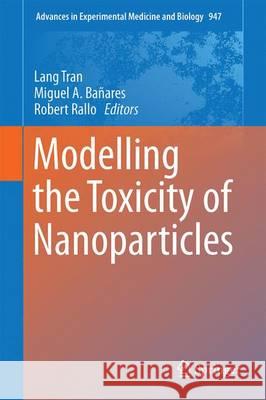
Lang Tran; Miguel A. Banares; Robert Rallo
Modelling the Toxicity of Nanoparticles Lang Tran Miguel A. Banares Robert Rallo 9783319477527 Springer - książkaWidoczna okładka, to zdjęcie poglądowe, a rzeczywista szata graficzna może różnić się od prezentowanej.

Modelling the Toxicity of Nanoparticles

ISBN-13: 9783319477527 / Angielski / Twarda / 2017 / 352 str.

Lang Tran; Miguel A. Banares; Robert Rallo
cena 602,40
(netto: 573,71 VAT:  5%)

Najniższa cena z 30 dni: 578,30
Termin realizacji zamówienia:
ok. 22 dni roboczych.

Darmowa dostawa!

In today's nanotechnology and pharmaceutical research, alternative toxicology testing methods are crucial for ethically and commercially sound practice. This book provides practical guidelines on how to develop and validate quantitative nanostructure-toxicity relationship (QNTR) models, which are ideal for rapidly exploring the effects of a large number of variables in complex scenarios. Through contributions by academic, industrial, and governmental experts, Modelling the Toxicity of Nanoparticles delivers clear instruction on these methods and their integration and use in risk assessment. Specific topics include the physico-chemical characteristics of engineered nanoparticles, nanoparticle interactions, in vivo nanoparticle processing, and more. A much-needed practical guide, Modelling the Toxicity of Nanoparticles is a key text for researchers as well as government and industry regulators.


Kategorie:
Technologie
Kategorie BISAC:
Medical > Farmakologia
Technology & Engineering > Nanotechnology & MEMS
Science > Biologia i przyroda
Wydawca:
Springer
Seria wydawnicza:
Advances in Experimental Medicine and Biology
Język:
Angielski
ISBN-13:
9783319477527
Rok wydania:
2017
Wydanie:
2017
Numer serii:
000253056
Ilość stron:
352
Waga:
0.83 kg
Wymiary:
23.83 x 16.31 x 2.62
Oprawa:
Twarda
Wolumenów:
01

Engineered Nanoparticles – Their physico-chemical characteristics and how to measure them.- Measurement .- The Life-Cycle of Engineered Nanoparticles.- From Dose to Response – In vivo Nanoparticle Processing and Potential Toxicity.- From Dose to Response – Literature review od (Q)SAR Modelling of Nanomaterial Toxicity.- Systems biology to support nanomaterial grouping.- Multiscale modelling of bionano interface.- Biological Surface Adsorption Index of Nanomaterials - Modeling Surface Interactions of Nanomaterials with Biomolecules.- Case study I - An integrated data-driven strategy for safe-by-design nanoparticles: The FP7 MODERN Project.- Case study II  - Compilation of Data and Modeling of Nanoparticle Interactions and Toxicity and in the European NanoPUZZLES Project.- Case study III – The construction of a nanotoxicity database: the MOD-ENP-TOX experience.

Dr Lang Tran is the Principal Toxicologist at the Institute of Occupational Medicine. Lang has contributed considerably on the toxicology of inhaled particles and fibres. His early work was in the mathematical modelling of the retention and clearance of man-made mineral fibres and mineral dusts.  He has led the investigation and the risk assessment of inhaled poorly soluble particles which helped NIOSH in establishing the control limit for fine and ultrafine TiO2 aerosol.
From his experience with particle toxicology Lang has contributed also in many European Research Projects through the Framework 6 and 7 Programmes. Most notable are the project FP7 ENPRA (Risk Assessment of Engineered Nanoparticles) and FP7 MARINA (Managing Risks of Nanoparticles). Lang is currently the chairman of the COST Action TD1204 MODENA on Modelling the toxicity of nanoparticles. Lang is an editor of the NANOTOXICOLOGY and PARTICLE and FIBRE TOXICOLOGY journals.  He also contributes in the organisation of the NANOTOXICOLOGY Symposium series.

Miguel A. Bañares (PhD in Chemistry, University of Salamanca, 1992) is Full Research Professor at ICP Institute for Catalysis, CSIC (Spanish National Research Council), where he joined in 1996 and Associate Editor for Catalysis Today. Was postdoctoral fellow at Lehigh University, PA, and at the University of Notre Dame, IN. Bañares has recently been distinguished by the “Otto Mønsted" Visiting Professorship at DTU University, Denmark (2014) and the FEDER-Region Base de Normandie, “chaire d’excellence” at CNRS Caen, France, during (2013-2015). 

            He has been Deputy Vice-President of CSIC, Spanish National Research Council (2014-2015), chairman of the Management Committee of COST Action D36 (Molecular structure-performance relationships at the surface of functional materials), 2006-2011 and is Vice-Chairman of the Management Committee of COST Action TD1404 MODENA (Modeling Nanomaterial Toxicity), on toxicity of nanoparticles (2012-2016). He is co-founder of Advanced Dispersed Particles in 2011, a CSIC spin-off company, in 2011
           
            Bañares research focuses on understanding structure-property relationships at a molecular scale at the surface of functional materials for catalysis and toxicity by combining in situ and operando analyses with computational description of the structure, spectra and reactivity of functional materials. He has more than 190 publications in international journals and  an “h” factor or 37 with more than 27 plenary/keynote lectures. Bañares research stands on the use of real-time Raman spectroscopy during catalysis combining in situ spectroscopic characterization of functional materials with simultaneous performance measurement. He coined the term “operando” to identify this advanced in situ spectroscopy.  

Dr. Robert Rallo, Associate Professor of Computer Science and Artificial Intelligence in the Departament d’Enginyeria Informàtica i Matemàtiques at Universitat Rovira i Virgili, Tarragona, Catalunya. He directs the Research Group on Bioinformatics & Computational Engineering (BIOCENIT, www.biocenit.cat) and is also the Director of the Advanced Technology Innovation Center (ATIC) at the Universitat Rovira i Virgili. In 2007 and 2009 he was a visiting professor at the University of California Los Angeles where he is also faculty member of the Center for Environmental Implications of Nanotechnology. Since 2013 he serves as Chair for the Modeling WG in the EU NanoSafety Cluster. From 2013 to 2015 he was the EU co-chair of the US-EU Nano-Dialogue Community of Research on Predictive Modeling and Human Health. His research focuses on multi-scale modeling of complex systems of industrial or environmental relevance. Dr. Rallo serves regularly as reviewer for high-ranked scientific journals and international research organizations.

In today’s nanotechnology and pharmaceutical research, alternative toxicology testing methods are crucial for ethically and commercially sound practice. This book provides practical guidelines on how to develop and validate quantitative nanostructure-toxicity relationship (QNTR) models, which are ideal for rapidly exploring the effects of a large number of variables in complex scenarios.

Through contributions by academic, industrial, and governmental experts, Modelling the Toxicity of Nanoparticles delivers clear instruction on these methods and their integration and use in risk assessment. Specific topics include the physico-chemical characteristics of engineered nanoparticles, nanoparticle interactions, in vivo nanoparticle processing, and more.

A much-needed practical guide, Modelling the Toxicity of Nanoparticles is a key text for researchers as well as government and industry regulators.



Udostępnij

Facebook - konto krainaksiazek.pl


Opinie o Krainaksiazek.pl na Opineo.pl

Partner Mybenefit

Krainaksiazek.pl w programie rzetelna firma Krainaksiaze.pl - płatności przez paypal

Czytaj nas na:

Facebook - krainaksiazek.pl
  • książki na zamówienie
  • granty
  • książka na prezent
  • kontakt
  • pomoc
  • opinie
  • regulamin
  • polityka prywatności

Zobacz:

  • Księgarnia czeska

  • Wydawnictwo Książkowe Klimaty

1997-2026 DolnySlask.com Agencja Internetowa

© 1997-2022 krainaksiazek.pl
     
KONTAKT | REGULAMIN | POLITYKA PRYWATNOŚCI | USTAWIENIA PRYWATNOŚCI
Zobacz: Księgarnia Czeska | Wydawnictwo Książkowe Klimaty | Mapa strony | Lista autorów
KrainaKsiazek.PL - Księgarnia Internetowa

Polityka prywatnosci - link
Krainaksiazek.pl - płatnośc Przelewy24
Przechowalnia Przechowalnia




