• Wyszukiwanie zaawansowane
  • Kategorie
  • Kategorie BISAC
  • Książki na zamówienie
  • Promocje
  • Granty
  • Książka na prezent
  • Opinie
  • Pomoc
  • Załóż konto
  • Zaloguj się

Modelling of Powder Die Compaction » książka


zaloguj się | załóż konto
Logo Krainaksiazek.pl

koszyk

konto

szukaj
topmenu
Księgarnia internetowa
Szukaj
Książki na zamówienie
Promocje
Granty
Książka na prezent
Moje konto
Pomoc
 
 
Wyszukiwanie zaawansowane
Pusty koszyk
Bezpłatna dostawa dla zamówień powyżej 20 złBezpłatna dostawa dla zamówień powyżej 20 zł

Kategorie główne

• Nauka
 [2946600]
• Literatura piękna
 [1856966]

  więcej...
• Turystyka
 [72221]
• Informatyka
 [151456]
• Komiksy
 [35826]
• Encyklopedie
 [23190]
• Dziecięca
 [619653]
• Hobby
 [140543]
• AudioBooki
 [1577]
• Literatura faktu
 [228355]
• Muzyka CD
 [410]
• Słowniki
 [2874]
• Inne
 [445822]
• Kalendarze
 [1744]
• Podręczniki
 [167141]
• Poradniki
 [482898]
• Religia
 [510455]
• Czasopisma
 [526]
• Sport
 [61590]
• Sztuka
 [243598]
• CD, DVD, Video
 [3423]
• Technologie
 [219201]
• Zdrowie
 [101638]
• Książkowe Klimaty
 [124]
• Zabawki
 [2473]
• Puzzle, gry
 [3898]
• Literatura w języku ukraińskim
 [254]
• Art. papiernicze i szkolne
 [8170]
Kategorie szczegółowe BISAC

Modelling of Powder Die Compaction

ISBN-13: 9781849965545 / Angielski / Miękka / 2010 / 329 str.
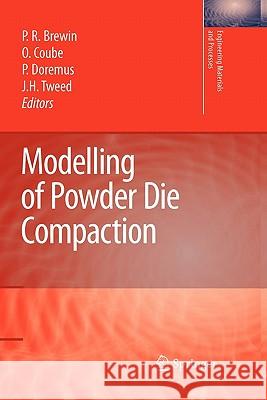
Peter R. Brewin; Olivier Coube; Pierre Doremus
Modelling of Powder Die Compaction Peter R. Brewin Olivier Coube Pierre Doremus 9781849965545 Not Avail - książkaWidoczna okładka, to zdjęcie poglądowe, a rzeczywista szata graficzna może różnić się od prezentowanej.

Modelling of Powder Die Compaction

ISBN-13: 9781849965545 / Angielski / Miękka / 2010 / 329 str.

Peter R. Brewin; Olivier Coube; Pierre Doremus
cena 605,23 zł
(netto: 576,41 VAT:  5%)

Najniższa cena z 30 dni: 578,30 zł
Termin realizacji zamówienia:
ok. 22 dni roboczych
Bez gwarancji dostawy przed świętami

Darmowa dostawa!

Manufacture of components from powders frequently requires a compaction step. This is widely used in the powder metallurgy, ceramic, hardmetal, magnet, pharmaceutical, refractory and other sectors to make anything from complex gears for cars to pills to dishwasher tablets. Development of the tooling to manufacture a component can be a long process with several iterations. A complementary approach is to use a model of the compaction process to predict the way that powder behaves during compaction and hence the loads that need to be applied to achieve compaction and the quality of the compacted part. Modelling of the process of die compaction has been the subject of recent collaborative research from leading experts in Europe and this book presents a summary of the state of the art, taking examples from recent world-class research. In particular the book presents a number of case studies that have been developed to test compaction models. Full details of data required for input to compaction models of these case studies is given together with a survey of the techniques used to generate the data. Details are also given of methods to produce and assess components for validation of die compaction models. Inclusion of information on case studies then provides a reference for testing and validation of compaction models. The reader will gain an appreciation of:

  • The requirements in industry for models of die compaction
  • The techniques available to generate the material data required for input to compaction models
  • The production and assessment of compacts for comparison with model predictions
  • A range of compaction models and the results from exercises comparing results from these models with real powder compacts
  • And a range of potential uses and modes of use of compaction models in industry.

Kategorie:
Technologie
Kategorie BISAC:
Technology & Engineering > Industrial Engineering
Technology & Engineering > Materials Science - Metals & Alloys
Technology & Engineering > Metallurgy
Wydawca:
Not Avail
Seria wydawnicza:
Engineering Materials and Processes
Język:
Angielski
ISBN-13:
9781849965545
Rok wydania:
2010
Numer serii:
000257314
Ilość stron:
329
Waga:
0.54 kg
Wymiary:
23.5 x 15.5
Oprawa:
Miękka
Wolumenów:
01

Introduction Modelling and Part Manufacture Mechanics of Powder Compaction Compaction Models Model Input Data – Elastic Properties Model Input Data – Plastic Properties Model Input Data – Failure Friction and its Measurement in Powder Compaction Processes Die Fill and Powder Transfer Calibration of Compaction Models Production of Case Study Components Assessing Powder Compacts Case Studies: Discussion and Guidelines Modelling Die Compaction in the Pharmaceutical Industry Applications in Industry

The editors have worked together as part of a European networking project aimed at improving powder die compaction using compaction simulation. Peter Brewin co-ordinated the network; while Olivier Coube, Pierre Doremus and James Tweed led the activities of: simulation of powder compaction; generation of input data for powder compaction models; and the generation of case studies and data to test compaction models.

Peter Brewin is technical coordinator of Dienet Thematic Network and technical director of the European Powder Metallurgy Association (EPMA). His background is in alloy steel manufacturing including liquid phase sintering.

Olivier Coube is a R&D mechanical engineer (Ph.D.) with over 10 years of experience in the field of the powder forming process (pressing, sintering and sizing) utilizing mathematical modeling and numerical simulation to solve product development issues. From 1998 to 2004, he led numerous applied research projects for industrial and government contractors at the Fraunhofer-Institute for Mechanics of Materials. Since July 2004 he has been working at Plansee AG as an expert in Numerical Simulation.

Pierre Doremus has worked in Laboratory 3S of the National Polytechnic Institute of Grenoble for 25 years. His research activities are essentially devoted to powder compaction. He has been the supervisor of several Ph.D. students which provided him with the idea of developing academic experimental installations for studying powder densification. This work has always been in relation to the industry or national and European programs. This has led to many publications in scientific journals and conferences.

James Tweed has worked for AEA Technology on a broad range of topics related to the manufacture and performance of materials. Recently he has led work with the Universities of Leicester and Swansea on developing test methods relevant to the manufacture of components by die compaction. This includes assessment of powders and the way they flow and fill dies, as well as their behavior during compaction and ejection. This work has also identified methods for assessing the density distribution in powder compacts.

Manufacture of components from powders frequently requires a compaction step. This is widely used in powder metallurgy, ceramic, hardmetal, magnet, pharmaceutical, refractory and other sectors to make anything from complex gears for cars to pills to dishwasher tablets. Development of the tooling to manufacture a component can be a long process with several iterations. A complementary approach is to use a model of the compaction process to predict the way that powder behaves during compaction and hence the loads that need to be applied to achieve compaction and the quality of the compacted part.

Modelling of the process of die compaction has been the subject of recent collaborative research from leading experts in Europe and Modelling of Powder Die Compaction presents a summary of this state-of-the-art work, taking examples from recent world-class research. In particular, the book presents a number of case studies that have been developed to test compaction models. Full details of the data required for input to compaction models of these case studies is given, together with a survey of the techniques used to generate the data. Details are also given of methods to produce and assess components for validation of die compaction models. The inclusion of information on case studies then provides a reference for the testing and validation of compaction models.

Readers of Modelling of Powder Die Compaction will gain an appreciation of:

  • The requirements in industry for models of die compaction;
  • The techniques available to generate the material data required for input to compaction models;
  • The production and assessment of compacts for comparison with model predictions;
  • A range of compaction models and the results from exercises comparing results from these models with real powder compacts; and
  • A range of potential uses and modes of use of compaction models in industry.



Udostępnij

Facebook - konto krainaksiazek.pl


Opinie o Krainaksiazek.pl na Opineo.pl

Partner Mybenefit

Krainaksiazek.pl w programie rzetelna firma Krainaksiaze.pl - płatności przez paypal

Czytaj nas na:

Facebook - krainaksiazek.pl
  • książki na zamówienie
  • granty
  • książka na prezent
  • kontakt
  • pomoc
  • opinie
  • regulamin
  • polityka prywatności

Zobacz:

  • Księgarnia czeska

  • Wydawnictwo Książkowe Klimaty

1997-2025 DolnySlask.com Agencja Internetowa

© 1997-2022 krainaksiazek.pl
     
KONTAKT | REGULAMIN | POLITYKA PRYWATNOŚCI | USTAWIENIA PRYWATNOŚCI
Zobacz: Księgarnia Czeska | Wydawnictwo Książkowe Klimaty | Mapa strony | Lista autorów
KrainaKsiazek.PL - Księgarnia Internetowa

Polityka prywatnosci - link
Krainaksiazek.pl - płatnośc Przelewy24
Przechowalnia Przechowalnia






