• Wyszukiwanie zaawansowane
  • Kategorie
  • Kategorie BISAC
  • Książki na zamówienie
  • Promocje
  • Granty
  • Książka na prezent
  • Opinie
  • Pomoc
  • Załóż konto
  • Zaloguj się

Modelling and Reasoning with Vague Concepts » książka


zaloguj się | załóż konto
Logo Krainaksiazek.pl

koszyk

konto

szukaj
topmenu
Księgarnia internetowa
Szukaj
Książki na zamówienie
Promocje
Granty
Książka na prezent
Moje konto
Pomoc
 
 
Wyszukiwanie zaawansowane
Pusty koszyk
Bezpłatna dostawa dla zamówień powyżej 20 złBezpłatna dostawa dla zamówień powyżej 20 zł

Kategorie główne

• Nauka
 [2946600]
• Literatura piękna
 [1856966]

  więcej...
• Turystyka
 [72221]
• Informatyka
 [151456]
• Komiksy
 [35826]
• Encyklopedie
 [23190]
• Dziecięca
 [619653]
• Hobby
 [140543]
• AudioBooki
 [1577]
• Literatura faktu
 [228355]
• Muzyka CD
 [410]
• Słowniki
 [2874]
• Inne
 [445822]
• Kalendarze
 [1744]
• Podręczniki
 [167141]
• Poradniki
 [482898]
• Religia
 [510455]
• Czasopisma
 [526]
• Sport
 [61590]
• Sztuka
 [243598]
• CD, DVD, Video
 [3423]
• Technologie
 [219201]
• Zdrowie
 [101638]
• Książkowe Klimaty
 [124]
• Zabawki
 [2473]
• Puzzle, gry
 [3898]
• Literatura w języku ukraińskim
 [254]
• Art. papiernicze i szkolne
 [8170]
Kategorie szczegółowe BISAC

Modelling and Reasoning with Vague Concepts

ISBN-13: 9780387290560 / Angielski / Twarda / 2006 / 246 str.
Jonathan Lawry; J. Lawry
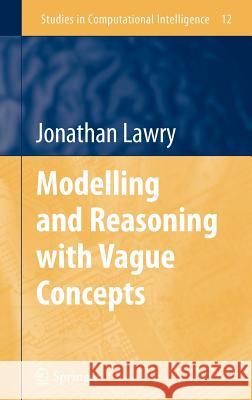
Modelling and Reasoning with Vague Concepts Jonathan Lawry J. Lawry 9780387290560 Springer - książkaWidoczna okładka, to zdjęcie poglądowe, a rzeczywista szata graficzna może różnić się od prezentowanej.

Modelling and Reasoning with Vague Concepts

ISBN-13: 9780387290560 / Angielski / Twarda / 2006 / 246 str.

Jonathan Lawry; J. Lawry
cena 403,47 zł
(netto: 384,26 VAT:  5%)

Najniższa cena z 30 dni: 385,52 zł
Termin realizacji zamówienia:
ok. 22 dni roboczych
Bez gwarancji dostawy przed świętami

Darmowa dostawa!
inne wydania

Vague concepts are intrinsic to human communication. Somehow it would seems that vagueness is central to the flexibility and robustness of natural l- guage descriptions. If we were to insist on precise concept definitions then we would be able to assert very little with any degree of confidence. In many cases our perceptions simply do not provide sufficient information to allow us to verify that a set of formal conditions are met. Our decision to describe an individual as 'tall' is not generally based on any kind of accurate measurement of their height. Indeed it is part of the power of human concepts that they do not require us to make such fine judgements. They are robust to the imprecision of our perceptions, while still allowing us to convey useful, and sometimes vital, information. The study of vagueness in Artificial Intelligence (AI) is therefore motivated by the desire to incorporate this robustness and flexibility into int- ligent computer systems. This goal, however, requires a formal model of vague concepts that will allow us to quantify and manipulate the uncertainty resulting from their use as a means of passing information between autonomous agents. I first became interested in these issues while working with Jim Baldwin to develop a theory of the probability of fuzzy events based on mass assi- ments.


Kategorie:
Informatyka, Bazy danych
Kategorie BISAC:
Computers > Artificial Intelligence - Computer Vision & Pattern Recognition
Computers > Computer Science
Technology & Engineering > Electronics - General
Wydawca:
Springer
Seria wydawnicza:
Studies in Computational Intelligence
Język:
Angielski
ISBN-13:
9780387290560
Rok wydania:
2006
Wydanie:
2006
Numer serii:
000318395
Ilość stron:
246
Waga:
0.57 kg
Wymiary:
23.5 x 15.5
Oprawa:
Twarda
Wolumenów:
01
Dodatkowe informacje:
Bibliografia
Wydanie ilustrowane

List of Figures Preface Acknowledgments Foreword 1: Introduction 2: Vague Concepts And Fuzzy Sets 2.1 Fuzzy Set Theory 2.2 Functionality and Truth-Functionality 2.3 Operational Semantics for Membership Functions 3: Label Semantics 3.1 Introduction and Motivation 3.2 Appropriateness Measures and Mass Assignments on Labels 3.3 Label Expressions and lambda-Sets 3.4 A Voting Model for Label Semantics 3.5 Properties of Appropriateness Measures 3.6 Functional Label Semantics 3.7 Relating Appropriateness Measures to Dempster-Shafer Theory 3.8 Mass Selection Functions based on t-norms 3.9 Alternative Mass Selection Functions 3.10 An Axiomatic Approach to Appropriateness Measures 3.11 Label Semantics as a Model of Assertions 3.12 Relating Label Semantics to Existing Theories of Vagueness 4: Multi-Dimensional And Multi-Instance Label Semantics 4.1 Descriptions Based on Many Attributes 4.2 Multi-dimensional Label Expressions and A-Sets 4.3 Properties of Multi-dimensional Appropriateness Measures 4.4 Describing Multiple Objects 5: Information From Vague Concepts 5.1 Possibility Theory 5.2 The Probability of Fuzzy Sets 5.3 Bayesian Conditioning in Label Semantics 5.4 Possibilistic Conditioning in Label Semantics 5.5 Matching Concepts 5.6 Conditioning From Mass Assignments in Label Semantics 6: Learning Linguistic Models From Data 6.1 Defining Labels for Data Modelling 6.2 Bayesian Classification using Mass Relations 6.3 Prediction using Mass Relations 6.4 Qualitative Information from Mass Relations 6.5 Learning Linguistic Decision Trees 6.6 Prediction using Decision Trees 6.7 Query evaluation and Inference from Linguistic Decision Trees 7: Fusing Knowledge And Data 7.1 From Label Expressions to Informative Priors 7.2 Combining Label Expressions with Data 8: Non-Additive Appropriateness Measures 8.1 Properties of Generalised Appropriateness Measures 8.2 Possibilstic Appropriateness Measures 8.3 An Axiomatic Approach to Generalised Appropriateness Measures 8.4 The Law of Excluded Middle References Index

Vagueness is central to the flexibility and robustness of natural language descriptions. Vague concepts are robust to the imprecision of our perceptions, while still allowing us to convey useful, and sometimes vital, information. The study of vagueness in Artificial Intelligence (AI) is therefore motivated by the desire to incorporate this robustness and flexibility into intelligent computer systems. Such a goal, however, requires a formal model of vague concepts that will allow us to quantify and manipulate the uncertainty resulting from their use as a means of passing information between autonomous agents.

This volume outlines a formal representation framework for modelling and reasoning with vague concepts in Artificial Intelligence. The new calculus has many applications, especially in automated reasoning, learning, data analysis and information fusion. This book gives a rigorous introduction to label semantics theory, illustrated with many examples, and suggests clear operational interpretations of the proposed measures. It also provides a detailed description of how the theory can be applied in data analysis and information fusion based on a range of benchmark problems.


Udostępnij

Facebook - konto krainaksiazek.pl


Opinie o Krainaksiazek.pl na Opineo.pl

Partner Mybenefit

Krainaksiazek.pl w programie rzetelna firma Krainaksiaze.pl - płatności przez paypal

Czytaj nas na:

Facebook - krainaksiazek.pl
  • książki na zamówienie
  • granty
  • książka na prezent
  • kontakt
  • pomoc
  • opinie
  • regulamin
  • polityka prywatności

Zobacz:

  • Księgarnia czeska

  • Wydawnictwo Książkowe Klimaty

1997-2025 DolnySlask.com Agencja Internetowa

© 1997-2022 krainaksiazek.pl
     
KONTAKT | REGULAMIN | POLITYKA PRYWATNOŚCI | USTAWIENIA PRYWATNOŚCI
Zobacz: Księgarnia Czeska | Wydawnictwo Książkowe Klimaty | Mapa strony | Lista autorów
KrainaKsiazek.PL - Księgarnia Internetowa

Polityka prywatnosci - link
Krainaksiazek.pl - płatnośc Przelewy24
Przechowalnia Przechowalnia





