• Wyszukiwanie zaawansowane
  • Kategorie
  • Kategorie BISAC
  • Książki na zamówienie
  • Promocje
  • Granty
  • Książka na prezent
  • Opinie
  • Pomoc
  • Załóż konto
  • Zaloguj się

Modeling Students' Mathematical Modeling Competencies: Ictma 13 » książka


zaloguj się | załóż konto
Logo Krainaksiazek.pl

koszyk

konto

szukaj
topmenu
Księgarnia internetowa
Szukaj
Książki na zamówienie
Promocje
Granty
Książka na prezent
Moje konto
Pomoc
 
 
Wyszukiwanie zaawansowane
Pusty koszyk
Bezpłatna dostawa dla zamówień powyżej 20 złBezpłatna dostawa dla zamówień powyżej 20 zł

Kategorie główne

• Nauka
 [2944077]
• Literatura piękna
 [1814251]

  więcej...
• Turystyka
 [70679]
• Informatyka
 [151074]
• Komiksy
 [35590]
• Encyklopedie
 [23169]
• Dziecięca
 [611005]
• Hobby
 [136031]
• AudioBooki
 [1718]
• Literatura faktu
 [225599]
• Muzyka CD
 [379]
• Słowniki
 [2916]
• Inne
 [443741]
• Kalendarze
 [1187]
• Podręczniki
 [166463]
• Poradniki
 [469211]
• Religia
 [506887]
• Czasopisma
 [481]
• Sport
 [61343]
• Sztuka
 [242115]
• CD, DVD, Video
 [3348]
• Technologie
 [219293]
• Zdrowie
 [98602]
• Książkowe Klimaty
 [124]
• Zabawki
 [2385]
• Puzzle, gry
 [3504]
• Literatura w języku ukraińskim
 [260]
• Art. papiernicze i szkolne
 [7151]
Kategorie szczegółowe BISAC

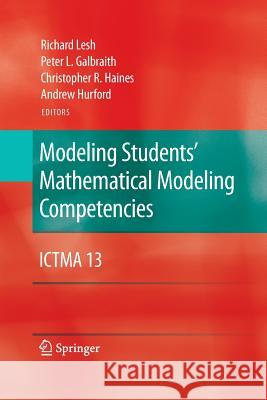
Modeling Students' Mathematical Modeling Competencies: Ictma 13

ISBN-13: 9781489983893 / Angielski / Miękka / 2014 / 650 str.
Richard Lesh;Peter L Galbraith;Christopher R Haines
Modeling Students' Mathematical Modeling Competencies: Ictma 13 Lesh, Richard 9781489983893 Springer - książkaWidoczna okładka, to zdjęcie poglądowe, a rzeczywista szata graficzna może różnić się od prezentowanej.

Modeling Students' Mathematical Modeling Competencies: Ictma 13

ISBN-13: 9781489983893 / Angielski / Miękka / 2014 / 650 str.

Richard Lesh;Peter L Galbraith;Christopher R Haines
cena 603,81
(netto: 575,06 VAT:  5%)

Najniższa cena z 30 dni: 578,30
Termin realizacji zamówienia:
ok. 22 dni roboczych.

Darmowa dostawa!
inne wydania

As we enter the 21st century, there is an urgent need for new approaches to mathematics education emphasizing its relevance in young learners futures. "Modeling Students Mathematical Modeling Competencies" explores the vital trend toward using real-world problems as a basis for teaching mathematics skills, competencies, and applications. Blending theoretical constructs and practical considerations, the book presents papers from the latest conference of the ICTMA, beginning with the basics (Why are models necessary? Where can we find them?) and moving through intricate concepts of how students perceive math, how instructors teach and how both can become better learners. Dispatches as varied as classroom case studies, analyses of math in engineering work, and an in-depth review of modeling-based curricula in the Netherlands illustrate modeling activities on the job, methods of overcoming math resistance, and the movement toward replicable models and lifelong engagement.
A sampling of topics covered:

How students recognize the usefulness of mathematics

Creating the modeling-oriented classroom

Assessing and evaluating students modeling capabilities

The relationship between modeling and problem-solving

Instructor methods for developing their own models of modeling

New technologies for modeling in the classroom

Modeling Students Mathematical Modeling Competencies offers welcome clarity and focus to the international research and professional community in mathematics, science, and engineering education, as well as those involved in the sciences of teaching and learning these subjects."


Kategorie:
Nauka, Matematyka
Kategorie BISAC:
Education > Teaching - Subjects - Mathematics
Science > Study & Teaching
Mathematics > Matematyka stosowana
Wydawca:
Springer
Język:
Angielski
ISBN-13:
9781489983893
Rok wydania:
2014
Wydanie:
2010
Ilość stron:
650
Waga:
0.91 kg
Wymiary:
23.39 x 15.6 x 3.4
Oprawa:
Miękka
Wolumenów:
01
Dodatkowe informacje:
Wydanie ilustrowane

Chapter 1. Introduction: ICTMA and the Teaching of Modeling and Applications, Gabriele KaiserPart I: The Nature of Models & Modeling Modeling: What Is It? Why Do It? Richard Lesh and Thomas FennewaldSection 1: What Are Models? Chapter 2. Modeling Theory for Math and Science Education, David Hestenes Chapter 3. Modeling a Crucial Aspect of Students’ Mathematical Modeling, Mogens Niss Chapter 4. Modeling Perspectives in Math Education Research, Christine Larson, Guershon Harel, Michael Oehrtman, Michelle Zandieh, Chris Rasmussen San, Robert Speiser and Chuck Walter  Section 2: Where Are Models & Modelers Found? Chapter 5. Modeling to Address Techno-Mathematical Literacies in Work, Richard Noss and Celia Hoyles Chapter 6. Mathematical Modeling in Engineering Design Projects, Monica E. Cardella Chapter 7. The Mathematical Expertise of Mechanical Engineers – The Case Of Mechanism Design, Burkhard AlpersSection 3: What Do Modeling Processes Look Like? Chapter 8. Modeling & Quantitative Reasoning: The Summer Jobs Problem, Christine Larson Chapter 9. Tracing Students’ Modeling Processes in School, N. Mousoulides, M. Pittalis, C. Christou and B. SriramanSection 4: What Creates The Need For Modeling? Chapter 10. Turning Ideas into Modeling Problems, Peter Galbraith, Gloria Stillman and Jill Brown Chapter 11. Remarks on a Modeling Cycle and Interpretating Behaviours, Christopher Haines and Rosalind Crouch Chapter 12. Model Eliciting Environments as 'Nurseries' for Modeling Probabilistic Situations, Miriam Amit and Irma Jan Chapter 13. Models as Tools, Especially for Making Sense of Problems, Bob Speiser And Chuck Walter Chapter 14. In-Depth Use of Modeling in Engineering Coursework to Enhance Problem Solving, Renee M. Clark, Larry J. Shuman and Mary Besterfield-Sacre Chapter 15. Generative Activities: Making Sense of 1098 Functions, Sarah M. DavisSection 5: How Do Models Develop? Chapter 16. Modeling the Sensorial Perception in the Classroom, Adolf J. I. Riede Chapter 17. Assessing A Modeling Process Of A Linear Pattern Task, Miriam Amit and Dorit Neria Chapter 18. Single Solution, Multiple Perspectives, Angeles DominguezSection 6: How Is Modeling Different Than Solving? Chapter 19. Problem Solving Versus Modeling, Judith Zawojewski Chapter 20. Investigating The Relationship Between The Problem And The Solver: Who Decides What Math Gets Used? Guadalupe Carmona and Steven Greenstein Chapter 21. Communication : The Essential Difference Between Mathematical Modeling & Problem Solving, Tomas Højgaard Jensen Chapter 22. Analysis Of Modeling Problem Solutions With Methods Of Problem Solving, Gilbert GreefrathPart II: Modeling In School Classrooms Modeling In K-16 Mathematics Classrooms - And Beyond, Richard Lesh, Randy Young and Thomas FennewaldSection 7: How Can Students Recognize the Need for Modeling? Chapter 23. Modeling With Complex Data In The Primary School, Lyn D. English Chapter 24. Two Cases Studies Of Fifth Grade Students Reasoning About Levers, Paula Guerra, Linda Hernández, Ahyoung Kim, Muhsin Menekse and James Middleton Chapter 25. Don’t Disrespect Me: Affect In An Urban Math Class, Roberta Y. Schorr, Yakov M. Epstein, Lisa B. Warner and Celia C. AriasSection 8: How Do Classroom Modling Communities Develop? Chapter 26. Interdisciplinary Modeling Instruction: Helping Fifth Graders Learn About Levers, Brandon Helding, Colleen Megowan-Romanowicz, Tirupalavanam Ganesh and Shirley Fan

As we enter the 21st century, there is an urgent need for new approaches to mathematics education emphasizing its relevance in young learners’ futures. Modeling Students’ Mathematical Modeling Competencies explores the vital trend toward using real-world problems as a basis for teaching mathematics skills, competencies, and applications. Blending theoretical constructs and practical considerations, the book presents papers from the latest conference of the ICTMA, beginning with the basics (Why are models necessary? Where can we find them?) and moving through intricate concepts of how students perceive math, how instructors teach—and how both can become better learners. Dispatches as varied as classroom case studies, analyses of math in engineering work, and an in-depth review of modeling-based curricula in the Netherlands illustrate modeling activities on the job, methods of overcoming math resistance, and the movement toward replicable models and lifelong engagement.

A sampling of topics covered:

  • How students recognize the usefulness of mathematics
  • Creating the modeling-oriented classroom
  • Assessing and evaluating students’ modeling capabilities
  • The relationship between modeling and problem-solving
  • Instructor methods for developing their own models of modeling
  • New technologies for modeling in the classroom


Modeling Students’ Mathematical Modeling Competencies offers welcome clarity and focus to the international research and professional community in mathematics, science, and engineering education, as well as those involved in the sciences of teaching and learning these subjects.


Udostępnij

Facebook - konto krainaksiazek.pl


Opinie o Krainaksiazek.pl na Opineo.pl

Partner Mybenefit

Krainaksiazek.pl w programie rzetelna firma Krainaksiaze.pl - płatności przez paypal

Czytaj nas na:

Facebook - krainaksiazek.pl
  • książki na zamówienie
  • granty
  • książka na prezent
  • kontakt
  • pomoc
  • opinie
  • regulamin
  • polityka prywatności

Zobacz:

  • Księgarnia czeska

  • Wydawnictwo Książkowe Klimaty

1997-2026 DolnySlask.com Agencja Internetowa

© 1997-2022 krainaksiazek.pl
     
KONTAKT | REGULAMIN | POLITYKA PRYWATNOŚCI | USTAWIENIA PRYWATNOŚCI
Zobacz: Księgarnia Czeska | Wydawnictwo Książkowe Klimaty | Mapa strony | Lista autorów
KrainaKsiazek.PL - Księgarnia Internetowa

Polityka prywatnosci - link
Krainaksiazek.pl - płatnośc Przelewy24
Przechowalnia Przechowalnia





