• Wyszukiwanie zaawansowane
  • Kategorie
  • Kategorie BISAC
  • Książki na zamówienie
  • Promocje
  • Granty
  • Książka na prezent
  • Opinie
  • Pomoc
  • Załóż konto
  • Zaloguj się

Modeling Phase Transitions in the Brain » książka


zaloguj się | załóż konto
Logo Krainaksiazek.pl

koszyk

konto

szukaj
topmenu
Księgarnia internetowa
Szukaj
Książki na zamówienie
Promocje
Granty
Książka na prezent
Moje konto
Pomoc
 
 
Wyszukiwanie zaawansowane
Pusty koszyk
Bezpłatna dostawa dla zamówień powyżej 20 złBezpłatna dostawa dla zamówień powyżej 20 zł

Kategorie główne

• Nauka
 [2949965]
• Literatura piękna
 [1857847]

  więcej...
• Turystyka
 [70818]
• Informatyka
 [151303]
• Komiksy
 [35733]
• Encyklopedie
 [23180]
• Dziecięca
 [617748]
• Hobby
 [139972]
• AudioBooki
 [1650]
• Literatura faktu
 [228361]
• Muzyka CD
 [398]
• Słowniki
 [2862]
• Inne
 [444732]
• Kalendarze
 [1620]
• Podręczniki
 [167233]
• Poradniki
 [482388]
• Religia
 [509867]
• Czasopisma
 [533]
• Sport
 [61361]
• Sztuka
 [243125]
• CD, DVD, Video
 [3451]
• Technologie
 [219309]
• Zdrowie
 [101347]
• Książkowe Klimaty
 [123]
• Zabawki
 [2362]
• Puzzle, gry
 [3791]
• Literatura w języku ukraińskim
 [253]
• Art. papiernicze i szkolne
 [7933]
Kategorie szczegółowe BISAC

Modeling Phase Transitions in the Brain

ISBN-13: 9781461425502 / Angielski / Miękka / 2012 / 306 str.
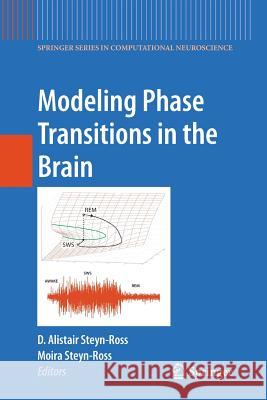
D. Alistair Steyn-Ross; Moira Steyn-Ross; Walter J. Freeman
Modeling Phase Transitions in the Brain D. Alistair Steyn-Ross Moira Steyn-Ross Walter J. Freeman 9781461425502 Springer - książkaWidoczna okładka, to zdjęcie poglądowe, a rzeczywista szata graficzna może różnić się od prezentowanej.

Modeling Phase Transitions in the Brain

ISBN-13: 9781461425502 / Angielski / Miękka / 2012 / 306 str.

D. Alistair Steyn-Ross; Moira Steyn-Ross; Walter J. Freeman
cena 806,99 zł
(netto: 768,56 VAT:  5%)

Najniższa cena z 30 dni: 771,08 zł
Termin realizacji zamówienia:
ok. 22 dni roboczych
Bez gwarancji dostawy przed świętami

Darmowa dostawa!

Foreword by Walter J. Freeman. The induction of unconsciousness using anesthetic agents demonstrates that the cerebral cortex can operate in two very different behavioral modes: alert and responsive vs. unaware and quiescent. But the states of wakefulness and sleep are not single-neuron properties---they emerge as bulk properties of cooperating populations of neurons, with the switchover between states being similar to the physical change of phase observed when water freezes or ice melts. Some brain-state transitions, such as sleep cycling, anesthetic induction, epileptic seizure, are obvious and detected readily with a few EEG electrodes; others, such as the emergence of gamma rhythms during cognition, or the ultra-slow BOLD rhythms of relaxed free-association, are much more subtle. The unifying theme of this book is the notion that all of these bulk changes in brain behavior can be treated as phase transitions between distinct brain states. Modeling Phase Transitions in the Brain contains chapter contributions from leading researchers who apply state-space methods, network models, and biophysically-motivated continuum approaches to investigate a range of neuroscientifically relevant problems that include analysis of nonstationary EEG time-series; network topologies that limit epileptic spreading; saddle--node bifurcations for anesthesia, sleep-cycling, and the wake--sleep switch; prediction of dynamical and noise-induced spatiotemporal instabilities underlying BOLD, alpha-, and gamma-band Hopf oscillations, gap-junction-moderated Turing structures, and Hopf-Turing interactions leading to cortical waves.


Kategorie:
Nauka, Medycyna
Kategorie BISAC:
Medical > Anesthesiology
Medical > Neuroscience
Medical > Neurologia i neurofizjologia kliniczna
Wydawca:
Springer
Seria wydawnicza:
Springer Series in Computational Neuroscience
Język:
Angielski
ISBN-13:
9781461425502
Rok wydania:
2012
Wydanie:
2010
Numer serii:
000364813
Ilość stron:
306
Waga:
0.47 kg
Wymiary:
23.39 x 15.6 x 1.78
Oprawa:
Miękka
Wolumenów:
01

From the book reviews:

"Excellent description of neurophysiology of dynamics systems, both linear and nonlinear. Highly recommended." (Joseph J. Grenier, Amazon.com, October, 2014)

Phase transitions in single neurons and neural populations: Critical slowing, anesthesia, and sleep cycles.- Generalized state-space models for modeling nonstationary EEG time-series.- Spatiotemporal instabilities in neural fields and the effects of additive noise.- Spontaneous brain dynamics emerges at the edge of instability.- Limited spreading: How hierarchical networks prevent the transition to the epileptic state.- Bifurcations and state changes in the human alpha rhythm: Theory and experiment.- Inducing transitions in mesoscopic brain dynamics.- Phase transitions in physiologically-based multiscale mean-field brain models.- A continuum model for the dynamics of the phase transition from slow-wave sleep to REM sleep.- What can a mean-field model tell us about the dynamics of the cortex?.- Phase transitions, cortical gamma, and the selection and read-out of information stored in synapses.- Cortical patterns and gamma genesis are modulated by reversal potentials and gap-junction diffusion.

Foreword by Walter J. Freeman.

The induction of unconsciousness using anesthetic drugs demonstrates that the cerebral cortex can operate in two very different  modes: alert and responsive versus unaware and quiescent.  But the states of wakefulness and sleep are not single-neuron properties---they emerge as bulk properties of cooperating populations of neurons, with the switchover between states being similar to the physical change of phase observed when water freezes or ice melts.  Some brain-state transitions, such as sleep cycling, anesthetic induction, epileptic seizure, are obvious and detected readily with a few EEG electrodes; others, such as the emergence of gamma rhythms during cognition, or the ultra-slow BOLD rhythms of relaxed free-association, are much more subtle.  The unifying theme of this book is the notion that all of these bulk changes in brain behavior can be treated as phase transitions between distinct brain states.

"Modeling Phase Transitions in the Brain" contains chapter contributions from leading researchers who apply state-space methods, network models, and biophysically-motivated continuum approaches to investigate a range of neuroscientifically relevant problems that include analysis of nonstationary EEG time-series; network topologies that limit epileptic spreading; saddle--node bifurcations for anesthesia, sleep-cycling, and the wake--sleep switch; prediction of dynamical and noise-induced spatiotemporal instabilities underlying BOLD, alpha-, and gamma-band EEG oscillations, gap-junction-moderated Turing structures, and Hopf--Turing interactions leading to cortical waves. 

Written for:

Researchers, clinicians, physicians, neurologists

About the editors:

Alistair Steyn-Ross and Moira Steyn-Ross are computational and theoretical physicists in the Department of Engineering, University of Waikato, New Zealand.  They share a long-standing interest in the application of physics-based methods to gain insight into the emergent behavior of complex biological systems such as single neurons and interacting neural populations.


Udostępnij

Facebook - konto krainaksiazek.pl


Opinie o Krainaksiazek.pl na Opineo.pl

Partner Mybenefit

Krainaksiazek.pl w programie rzetelna firma Krainaksiaze.pl - płatności przez paypal

Czytaj nas na:

Facebook - krainaksiazek.pl
  • książki na zamówienie
  • granty
  • książka na prezent
  • kontakt
  • pomoc
  • opinie
  • regulamin
  • polityka prywatności

Zobacz:

  • Księgarnia czeska

  • Wydawnictwo Książkowe Klimaty

1997-2025 DolnySlask.com Agencja Internetowa

© 1997-2022 krainaksiazek.pl
     
KONTAKT | REGULAMIN | POLITYKA PRYWATNOŚCI | USTAWIENIA PRYWATNOŚCI
Zobacz: Księgarnia Czeska | Wydawnictwo Książkowe Klimaty | Mapa strony | Lista autorów
KrainaKsiazek.PL - Księgarnia Internetowa

Polityka prywatnosci - link
Krainaksiazek.pl - płatnośc Przelewy24
Przechowalnia Przechowalnia




