• Wyszukiwanie zaawansowane
  • Kategorie
  • Kategorie BISAC
  • Książki na zamówienie
  • Promocje
  • Granty
  • Książka na prezent
  • Opinie
  • Pomoc
  • Załóż konto
  • Zaloguj się

Model Reduction for Circuit Simulation » książka


zaloguj się | załóż konto
Logo Krainaksiazek.pl

koszyk

konto

szukaj
topmenu
Księgarnia internetowa
Szukaj
Książki na zamówienie
Promocje
Granty
Książka na prezent
Moje konto
Pomoc
 
 
Wyszukiwanie zaawansowane
Pusty koszyk
Bezpłatna dostawa dla zamówień powyżej 20 złBezpłatna dostawa dla zamówień powyżej 20 zł

Kategorie główne

• Nauka
 [2946600]
• Literatura piękna
 [1856966]

  więcej...
• Turystyka
 [72221]
• Informatyka
 [151456]
• Komiksy
 [35826]
• Encyklopedie
 [23190]
• Dziecięca
 [619653]
• Hobby
 [140543]
• AudioBooki
 [1577]
• Literatura faktu
 [228355]
• Muzyka CD
 [410]
• Słowniki
 [2874]
• Inne
 [445822]
• Kalendarze
 [1744]
• Podręczniki
 [167141]
• Poradniki
 [482898]
• Religia
 [510455]
• Czasopisma
 [526]
• Sport
 [61590]
• Sztuka
 [243598]
• CD, DVD, Video
 [3423]
• Technologie
 [219201]
• Zdrowie
 [101638]
• Książkowe Klimaty
 [124]
• Zabawki
 [2473]
• Puzzle, gry
 [3898]
• Literatura w języku ukraińskim
 [254]
• Art. papiernicze i szkolne
 [8170]
Kategorie szczegółowe BISAC

Model Reduction for Circuit Simulation

ISBN-13: 9789400700888 / Angielski / Twarda / 2011 / 332 str.
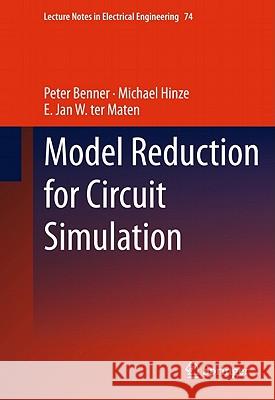
Michael Hinze; Peter Benner; E. Jan W. Maten
Model Reduction for Circuit Simulation Michael Hinze Peter Benner E. Jan W. Maten 9789400700888 Not Avail - książkaWidoczna okładka, to zdjęcie poglądowe, a rzeczywista szata graficzna może różnić się od prezentowanej.

Model Reduction for Circuit Simulation

ISBN-13: 9789400700888 / Angielski / Twarda / 2011 / 332 str.

Michael Hinze; Peter Benner; E. Jan W. Maten
cena 605,23 zł
(netto: 576,41 VAT:  5%)

Najniższa cena z 30 dni: 578,30 zł
Termin realizacji zamówienia:
ok. 22 dni roboczych
Bez gwarancji dostawy przed świętami

Darmowa dostawa!

Simulation based on mathematical models plays a major role in computer aided design of integrated circuits (ICs). Decreasing structure sizes, increasing packing densities and driving frequencies require the use of refined mathematical models, and to take into account secondary, parasitic effects. This leads to very high dimensional problems which nowadays require simulation times too large for the short time-to-market demands in industry. Modern Model Order Reduction (MOR) techniques present a way out of this dilemma in providing surrogate models which keep the main characteristics of the device while requiring a significantly lower simulation time than the full model. With Model Reduction for Circuit Simulation we survey the state of the art in the challenging research field of MOR for ICs, and also address its future research directions. Special emphasis is taken on aspects stemming from miniturisations to the nano scale. Contributions cover complexity reduction using e.g., balanced truncation, Krylov-techniques or POD approaches. For semiconductor applications a focus is on generalising current techniques to differential-algebraic equations, on including design parameters, on preserving stability, and on including nonlinearity by means of piecewise linearisations along solution trajectories (TPWL) and interpolation techniques for nonlinear parts. Furthermore the influence of interconnects and power grids on the physical properties of the device is considered, and also top-down system design approaches in which detailed block descriptions are combined with behavioral models. Further topics consider MOR and the combination of approaches from optimisation and statistics, and the inclusion of PDE models with emphasis on MOR for the resulting partial differential algebraic systems. The methods which currently are being developed have also relevance in other application areas such as mechanical multibody systems, and systems arising in chemistry and to biology. The current number of books in the area of MOR for ICs is very limited, so that this volume helps to fill a gap in providing the state of the art material, and to stimulate further research in this area of MOR. Model Reduction for Circuit Simulation also reflects and documents the vivid interaction between three active research projects in this area, namely the EU-Marie Curie Action ToK project O-MOORE-NICE (members in Belgium, The Netherlands and Germany), the EU-Marie Curie Action RTN-project COMSON (members in The Netherlands, Italy, Germany, and Romania), and the German federal project System reduction in nano-electronics (SyreNe).


Kategorie:
Technologie
Kategorie BISAC:
Technology & Engineering > Electronics - Circuits - General
Technology & Engineering > Optics
Mathematics > Matematyka stosowana
Wydawca:
Not Avail
Seria wydawnicza:
Lecture Notes in Electrical Engineering
Język:
Angielski
ISBN-13:
9789400700888
Rok wydania:
2011
Numer serii:
000367340
Ilość stron:
332
Waga:
0.39 kg
Wymiary:
23.57 x 16.23 x 2.31
Oprawa:
Twarda
Wolumenów:
01
Dodatkowe informacje:
Bibliografia
Wydanie ilustrowane

Part I Invited Papers.

1 The need for novel model order reduction techniques in the electronics industry;.W.H.A. Schilders. 1.1 Introduction. 1.2 Mathematical problems in the electronics industry. 1.3 Passivity and realizability. 1.4 Structure preservation. 1.5 Reduction of MIMO networks. 1.6 MOR for delay equations. 1.7 Parameterized and nonlinear MOR. 1.8 Summary: present and future needs of the electronics industry. References.

2 The SPRIM Algorithm for Structure-Preserving Order Reduction of General RCL Circuits; Roland W. Freund. 2.1 Introduction. 2.2 RCL Circuit Equations. 2.3 Projection-Based Order Reduction. 2.4 The SPRIM Algorithm. 2.5 Treatment of Voltage Sources. 2.6 Numerical Examples. 2.7 Concluding Remarks. References.

3 Balancing-Related Model Reduction of Circuit Equations Using Topological Structure; Tatjana Stykel. 3.1 Introduction. 3.2 Circuit equations. 3.3 Balancing-related model reduction. 3.4 Numerical methods for matrix equations. 3.5 Numerical examples. 3.6 Conclusions and open problems. References.

4 Topics in Model Order Reduction with Applications to Circuit Simulation; Sanda Lefteriu and Athanasios C. Antoulas. 4.1 Introduction and Motivation. 4.2 Background. 4.3 Theoretical Aspects. 4.4 Tangential interpolation for modeling Y-parameters. 4.5 Numerical Results. 4.6 Conclusion. References.

Part II Contributed Papers.

5 Forward and Reverse Modeling of Low Noise Amplifiers based on Circuit Simulations; L. De Tommasi, J. Rommes, T. Beelen, M. Sevat, J. A. Croon and T. Dhaene. 5.1 Introduction. 5.2 Forward and reverse modeling: problem descriptions. 5.3 Forward Modeling. 5.3.1 Performance Figures via Surrogate Models. 5.4 Reverse Modeling with the NBI method. 5.5 Reverse modeling using transistor level simulations. 5.6 Discussion and conclusions. References.

6 Recycling Krylov Subspaces for Solving Linear Systems with Successively Changing Right-Hand Sides Arising in Model Reduction; Peter Benner and Lihong Feng. 6.1 Introduction. 6.2 Methods Based on Recycling Krylov Subspaces. 6.3 Application to Model Order Reduction. 6.4 Simulation Results. 6.5 Conclusions. References.

7 Data-driven Parameterized Model Order Reduction Using z-domain Multivariate Orthonormal Vector Fitting Technique; Francesco Ferranti, Dirk Deschrijver, Luc Knockaert and Tom Dhaene. 7.1 Introduction. 7.2 Background. 7.3 Parametric Macromodeling. 7.4 Choice of basis functions. 7.5 Example: Double folded stub microstrip bandstop filter. 7.6 Conclusions. References.

8 Network Reduction by Inductance Elimination; M.M. Gourary, S.G.Rusakov, S.L.Ulyanov, and M.M.Zharov. 8.1 Introduction. 8.2 Elimination of RC-node by TICER. 8.3 Inductance Elimination. 8.4 Elimination of Coupled Inductances. 8.5 Eliminations under LC Couplings. 8.6 Algorithmic Aspects. 8.7 Numerical Examples. 8.8 Conclusion. References.

9 Simulation of coupled oscillators using nonlinear phase macromodels and model order reduction; Davit Harutyunyan and Joost Rommes. 9.1 Introduction. 9.2 Phase noise analysis of oscillators. 9.3 Oscillator coupled to a balun. 9.4 Oscillator coupling to a transmission line. 9.5 Model order reduction. 9.6 Numerical experiments. 9.7 Conclusion. References.

10 POD Model Order Reduction of Drift-Diffusion Equations in Electrical Networks; Michael Hinze, Martin Kunkel and Morten Vierling. 10.1 Introduction. 10.2 Complete coupled system. 10.3 Simulation of the full system. 10.4 Model reduction. 10.5 Numerical investigation. Appendix: Proper Orthogonal Decomposition. References.

11 Model Reduction of Periodic Descriptor Systems Using Balanced Truncation; Peter Benner, Mohammad-Sahadet Hossain and Tatjana Stykel. 11.1 Introduction. 11.2 Periodic Descriptor Systems. 11.3 Periodic Gramians and Matrix Equations. 11.4 Balanced Truncation Model Reduction. 11.5 Example. 11.6 Conclusion. References.

12 On synthesis of reduced order models; Roxana Ionutiu and Joost Rommes. 12.1 Introduction. 12.2 Foster synthesis of rational transfer functions. 12.3 Structure preservation and synthesis by unstamping. 12.4 Numerical examples. 12.5 Conclusions and outlook. References.

13 Model Reduction Methods for Linear Network Models of Distributed Systems with Sources; Stefan Ludwig and Wolfgang Mathis. 13.1 Introduction. 13.2 Background for Model Reduction of Linear Networks. 13.3 Description of distributed sources. 13.4 Examples. 13.5 Conclusion. References.

14 Structure preserving port-Hamiltonian model reduction of electrical circuits; R.V. Polyuga and A.J. van der Schaft. 14.1 Introduction. 14.2 Linear port-Hamiltonian systems. 14.3 The Kalman decomposition of port-Hamiltonian systems. 14.4 The co-energy variable representation. 14.5 Balancing for port-Hamiltonian systems. 14.6 Reduction of port-Hamiltonian systems in the general case. 14.7 Example. 14.8 Conclusions. Appendix. References.

15 Coupling of numerical and symbolic techniques for model order reduction in circuit design; Oliver Schmidt Thomas Halfmann Patrick Lang. 15.1 Motivation. 15.2 Symbolic Techniques. 15.3 Hierarchical systems. 15.4 Workflow for the exploitation of the hierarchy. 15.5 Comparison to other approaches. 15.6 Summary and future work. References.

16 On Stability, Passivity and Reciprocity Preservation of ESVDMOR; Peter Benner and André Schneider. 16.1 Introduction. 16.2 The Extended SVDMOR Approach. 16.3 Stability, Passivity, and Reciprocity. 16.4 Remarks and Outlook. References.

17 Model order reduction of nonlinear systems in circuit simulation: status and applications; Michael Striebel and Joost Rommes. 17.1 Introduction. 17.2 Linear versus nonlinear model order reduction. 17.3 Some nonlinear MOR techniques. 17.4 TPWL and POD. 17.5 Numerical examples. 17.6 Discussion and outlook. References.

18 An Approach to Nonlinear Balancing and MOR; Erik I. Verriest. 18.1 Static versus Dynamic Approximation. 18.2 Gramians for Linear Systems and Applications. 18.3 Metric Properties of Balanced Truncation. 18.4 Nonlinear Model Reduction. References.

Simulation based on mathematical models plays a major role in computer aided design of integrated circuits (ICs). Decreasing structure sizes, increasing packing densities and driving frequencies require the use of refined mathematical models, and to take into account secondary, parasitic effects. This leads to very high dimensional problems which nowadays require simulation times too large for the short time-to-market demands in industry. Modern Model Order Reduction (MOR) techniques present a way out of this dilemma in providing surrogate models which keep the main characteristics of the device while requiring a significantly lower simulation time than the full model.

With Model Reduction for Circuit Simulation we survey the state of the art in the challenging research field of MOR for ICs, and also address its future research directions. Special emphasis is taken on aspects stemming from miniturisations to the nano scale. Contributions cover complexity reduction using e.g., balanced truncation, Krylov-techniques or POD approaches. For semiconductor applications a focus is on generalising current techniques to differential-algebraic equations, on including design parameters, on preserving stability, and on including nonlinearity by means of piecewise linearisations along solution trajectories (TPWL) and interpolation techniques for nonlinear parts. Furthermore the influence of interconnects and power grids on the physical properties of the device is considered, and also top-down system design approaches in which detailed block descriptions are combined with behavioral models. Further topics consider MOR and the combination of approaches from optimisation and statistics, and the inclusion of PDE models with emphasis on MOR for the resulting partial differential algebraic systems. The methods which currently are being developed have also relevance in other application areas such as mechanical multibody systems, and systems arising in chemistry and to biology.

The current number of books in the area of MOR for ICs is very limited, so that this volume helps to fill a gap in providing the state of the art material, and to stimulate further research in this area of MOR. Model Reduction for Circuit Simulation also reflects and documents the vivid interaction between three active research projects in this area, namely the EU-Marie Curie Action ToK project O-MOORE-NICE (members in Belgium, The Netherlands and Germany), the EU-Marie Curie Action RTN-project COMSON (members in The Netherlands, Italy, Germany, and Romania), and the German federal project System reduction in nano-electronics (SyreNe).




Udostępnij

Facebook - konto krainaksiazek.pl


Opinie o Krainaksiazek.pl na Opineo.pl

Partner Mybenefit

Krainaksiazek.pl w programie rzetelna firma Krainaksiaze.pl - płatności przez paypal

Czytaj nas na:

Facebook - krainaksiazek.pl
  • książki na zamówienie
  • granty
  • książka na prezent
  • kontakt
  • pomoc
  • opinie
  • regulamin
  • polityka prywatności

Zobacz:

  • Księgarnia czeska

  • Wydawnictwo Książkowe Klimaty

1997-2025 DolnySlask.com Agencja Internetowa

© 1997-2022 krainaksiazek.pl
     
KONTAKT | REGULAMIN | POLITYKA PRYWATNOŚCI | USTAWIENIA PRYWATNOŚCI
Zobacz: Księgarnia Czeska | Wydawnictwo Książkowe Klimaty | Mapa strony | Lista autorów
KrainaKsiazek.PL - Księgarnia Internetowa

Polityka prywatnosci - link
Krainaksiazek.pl - płatnośc Przelewy24
Przechowalnia Przechowalnia



