• Wyszukiwanie zaawansowane
  • Kategorie
  • Kategorie BISAC
  • Książki na zamówienie
  • Promocje
  • Granty
  • Książka na prezent
  • Opinie
  • Pomoc
  • Załóż konto
  • Zaloguj się

Mobile Health (Mhealth): Rethinking Innovation Management to Harmonize AI and Social Design » książka


zaloguj się | załóż konto
Logo Krainaksiazek.pl

koszyk

konto

szukaj
topmenu
Księgarnia internetowa
Szukaj
Książki na zamówienie
Promocje
Granty
Książka na prezent
Moje konto
Pomoc
 
 
Wyszukiwanie zaawansowane
Pusty koszyk
Bezpłatna dostawa dla zamówień powyżej 20 złBezpłatna dostawa dla zamówień powyżej 20 zł

Kategorie główne

• Nauka
 [2939893]
• Literatura piękna
 [1808953]

  więcej...
• Turystyka
 [70366]
• Informatyka
 [150555]
• Komiksy
 [35137]
• Encyklopedie
 [23160]
• Dziecięca
 [608786]
• Hobby
 [136447]
• AudioBooki
 [1631]
• Literatura faktu
 [225099]
• Muzyka CD
 [360]
• Słowniki
 [2914]
• Inne
 [442115]
• Kalendarze
 [1068]
• Podręczniki
 [166599]
• Poradniki
 [468390]
• Religia
 [506548]
• Czasopisma
 [506]
• Sport
 [61109]
• Sztuka
 [241608]
• CD, DVD, Video
 [3308]
• Technologie
 [218981]
• Zdrowie
 [98614]
• Książkowe Klimaty
 [124]
• Zabawki
 [2174]
• Puzzle, gry
 [3275]
• Literatura w języku ukraińskim
 [260]
• Art. papiernicze i szkolne
 [7376]
Kategorie szczegółowe BISAC

Mobile Health (Mhealth): Rethinking Innovation Management to Harmonize AI and Social Design

ISBN-13: 9789811942297 / Angielski / Twarda / 2022
Kodama, Kota
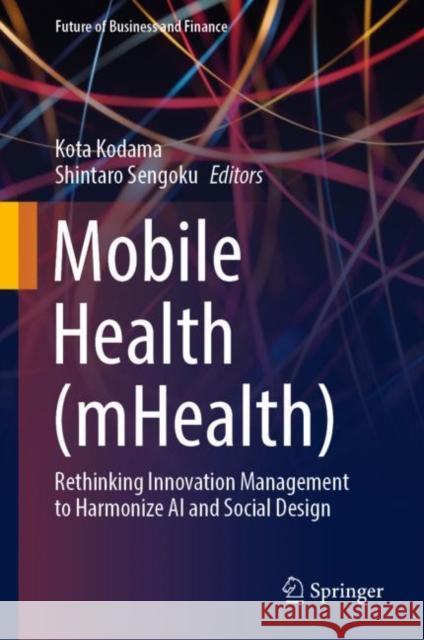
Mobile Health (Mhealth): Rethinking Innovation Management to Harmonize AI and Social Design Kodama, Kota 9789811942297 Springer Nature Singapore - książkaWidoczna okładka, to zdjęcie poglądowe, a rzeczywista szata graficzna może różnić się od prezentowanej.

Mobile Health (Mhealth): Rethinking Innovation Management to Harmonize AI and Social Design

ISBN-13: 9789811942297 / Angielski / Twarda / 2022

Kodama, Kota
cena 401,58
(netto: 382,46 VAT:  5%)

Najniższa cena z 30 dni: 385,52
Termin realizacji zamówienia:
ok. 22 dni roboczych.

Darmowa dostawa!
inne wydania

This book examines the current status of mHealth development, regulations and the social background in Japan, South Korea and China, comparing it to the situation in the United States and the European Union and consider solutions to issues surrounding mHealth.

The recent progress in mobile technology, represented by smartphones and smart watches, has been remarkable. A service called mobile health (mHealth), which uses such mobile technology to manage health, is also becoming a reality. Although the accuracy of medical devices is not as accurate as those used in medicine, the biometric information such as heart rate and SpO2 can already be monitored over a long period of time. Although the technology is maturing to the point where it can be implemented in society, it remains an unapproved service of medical care in most countries. The development and social implementation of mHealth is most active in the US, but social implementation is gradually progressing in other countries as well. In this book, we will first discuss what kind of global and harmonized regulations are desirable by comparing the regulatory reforms necessary for social implementation of mHealth. In addition, mHealth raises privacy concerns in the US because the usual behavior and biometric information of subjects is utilized by private companies. In addition, it is important to note that the behavior and biometric information of subjects collected by smart devices is automatically analyzed by AI technology, mainly machine learning, which makes the analysis a black box.

Kategorie:
Nauka, Ekonomia i biznes
Kategorie BISAC:
Medical > Administration
Business & Economics > Information Management
Business & Economics > Management Science
Wydawca:
Springer Nature Singapore
Seria wydawnicza:
Future of Business and Finance
Język:
Angielski
ISBN-13:
9789811942297
Rok wydania:
2022
Waga:
0.61 kg
Wymiary:
23.5 x 15.5
Oprawa:
Twarda
Dodatkowe informacje:
Wydanie ilustrowane

Global scale comparison of mHealth regulation


Chapter 1 Introduction of the concept of AI in the field of mHealth while discovering the trends in mHealth research field

1.1 Introduction
1.2 Definition of AI handled in this Book
1.3 Literature Review
1.4 Methods
1.4.1 Bibliometric Analysis
1.4.2 Data collection
1.4.3 Data Analysis
1.5 Results
1.5.1 Number of Publications in the mHealth Field
1.5.2 Number of Publications in Countries and Regions
1.5.3 Partnering Networks of countries and Regions
1.5.4 Top Journals in the mHealth Field
1.5.5 Top Keywords and Networks of mHealth Publications
1.5.6 Chronological Trends of mHealth Publication in Countries and Regions
1.6 Discussion
1.7 Conclusion

Chapter 2 Relationship of Innovation and Regulation on mHealth 

2.1 Introduction
2.1.1 Background of Mobile Health Development
2.1.2 Innovation in mHealth
2.1.3 The Objective of This Research
2.1.4 Theoretical Framework
2.2 Methods
2.2.1 Research on Regulations
2.3 Results
2.3.1 Regulatory Transition in USA
2.4 Discussion
2.4.1 Interactive Regulator
2.4.2 Medical Entrepreneur
2.4.3 Current Challenges and Future Perspective
2.5 Limitations
2.6 Conclusion

Chapter 3 The Current Situation of Mobile Health in China from the Perspective of Policy, Application, and User Acceptance: A Multi-Method Systematic Analysis

3.1 Introduction
3.1.1 The Burden of Disease and the Current State of Healthcare in 
China
3.1.2 Healthcare Reform in China
3.1.3 Mobile Health
3.1.4 Objective
3.2 Method
3.2.1 Data Collection
3.2.2 Data analysis
3.3 Results
3.3.1 Summary Analysis of China’s mHealth Policies
3.3.2 Current Status of Mobile Health Applications in China
3.3.3 The User Acceptance of Mobile Health in China
3.4.2 Factors that Affect the Use of Mobile Health Technology
3.4.3 Policy Recommendations
3.5 Limitations

Chapter 4 Digital Healthcare Development and mHealth in South Korea 
4.1 Introduction
4.2 Healthcare Industry with Aging Population Surrounding South Korea
4.3 Healthcare-retaled Policies in the US and EU
4.3.1 US Policy
4.3.2 EU Policy
4.4 Digital Healthcare Policy and Development in South Korea
4.4.1 EMR as the Foundation of Healthcare – Introduction of EMR 
in South Korea
4.4.2 Healthcare-related Policies in South Korea
4.5 mHealth in South Korea
4.6 Status of mHealth Business in South Korea
4.6.1 mHealth through Public Private Partnership (PPP)
4.7 Mobile Healthcare Service Provided by Public Health Centers
4.7.1 Mobile Healthcare Service Provided by Public Healthcare 
Centres for High-Risk People
Discussion of mHealth development with case studies
4.7.2 Mobile Healthcare Service Provided by Public Health Centers 
for Senior
4.7.3 Mobile Healthcare Service Provided by Public Health Centers 
for Youth
4.8 COVID-19 and mHealth in South Korea
4.8.1 Immigration Management
4.8.2 Self-quarantine Monitoring Application
4.8.3 Management of COVID-19 Positive Individuals
4.9 South Korea mHealth Model Driving by Government
4.10 Conclusion

Chapter 5 Regulations and the Status of Social Implementation of Services on mHealth in Japan

5.1 Introduction
5.2 Types of Existing mHealth Application and Examples
5.2.1 Behavior Change Communication
5.2.2 Information System / Data Collection
5.2.3 Logistics / Supply Management
5.2.4 Service Delivery
5.2.5 Financial transactions and Incentives
5.2.6 Workforce Development and Support at Health Care Facilities
5.3 Healthcare System of Japan
5.3.1 Overview of Japanese Healthcare System
5.3.2 The Pharmaceutical Affairs Law
5.3.3 Status of the Consideration of Medical Insurance System 
Reform in Japan
5.4 Status of mHealth Development and Approval as Medical Devices in Japan
5.4.1 Current Regulatory Framework
5.4.2 Regulatory Approvals of Stand-alone Programs as Regulated 
Medical Devices
5.5 Political and Social Initiatives for Health Promotion in Japan
5.6 Examples of mHealth Used for Health Promotion in Japan
5.6.1 Overview of Health Promotion Apps
5.6.2 Example of Broader Use of Health Promotion mHealth
Combination with Life Insurance
5.7 responses of Japanese Pharmaceutical Companies to mHealth
5.7.1 Better Control on Medication: Sensors Embedded in Tablets 
(Medication control) Connected to Smartphones
5.7.2 Development of mHealth Business as a Treatment Option 
Complementing Treatments by Chemical Drugs
5.7.3 mHealth Use in Clinical Trials and Clinical Research in the 
Area of Commercial Interest from Pharmaceutical Business’s 
Perspective
5.7.4 mHealth as Part of a Comprehensive Healthcare Services 
Proposed by Pharmaceutical Companies in the Fields Where 
Companies Have Been Providing Pharmaceutical
5.7.5 Investigation of the Presence or Absence of a Shift of Interest 
from Pharmaceuticals to Medical Devices Among Major Japanese 
Pharmaceutical Companies
5.8 Status of Readiness to Utilize Public Healthcare Big Data
5.9 The State of Japanese Startups in the mHealth Industry
5.10 Conclusion

Chapter 6 Precision Public Health and the Role of mHealth : The Use of Smartphone Applications Worldwide in Mitigating the Covid19 Pandemic and Their Integration as Components of Public Health Policies. A Focus on the French Example

6.1 Public Health, Individual Health, One health and Precision Public Health
6.1.1 Individual Health and the Health of Populations
6.1.2 The Articulation Between Individual and Population Level
6.1.3 Biomedical and Biopsychosocial Models of Health: Individual, 
Environmental and Social Determinants of Health
6.1.4 The Concept of Precision Public Health vs that of P4 Medicine
6.1.5 The Specific Place of Communicable Diseases - an Archetype 
for Reasoning and Decision-Making and Evolution Towards the One 
Health Model
6.2 Guarantee the Conditions of Individual Health and the Health of Populations
6.2.1 Public Policies of Health or Policies of Public Health?
6.2.2 Society of Insurance, Risk-based Society and Sanitization of 
Society
6.2.3 Places of Industry, the Private Sector and the Concept of 
Innovation in Health Policies
6.3 Example of the Covid19 Pandemic
6.3.1 Historical and General Context
6.3.2 Beginning and Development of the Pandemic
6.3.3 First Public Health Measures Taken
6.4 How Were the Information and Decision-making Systems in Place Before the Pandemic, in Terms of Decision Support?
6.4.1 The Count of Deaths, Identification of the Medical Causes of 
Death and the Associated Determinants
6.5 States of Emergency: the Parallel Between Existing and Ad hoc Information Systems, and Usual and Ad hoc Policy Measures
6.6 Contact Tracing Applications and Policy Measures for Pandemic Control
6.6.1 A Call for the Use of Smartphones from Several Countries and 
Several Communities
6.6.2 Use of smartphones and network data - mobility data
6.6.3 Use of Smartphones for Personal Information
6.6.4 Using Smartphones for Contact Tracing
6.7 What Political Measures Have Been Deployed? A Typology
6.7.1 Closure of Certain stores / Public Places
6.7.2 Closure of Schools
6.7.3 Isolation, Quarantine and Confinement
6.7.4 Regional, National and International Travel Restrictions
6.7.5 The Tools Used for These Measures, the Use of Technology
6.8 A Panorama of Applications in Several Countries
6.8.1 Main Initial Intended Uses of the Applications
6.8.2 Main Characteristics of These Applications Depending on the 
Country
6.8.3 Changes in the use of Applications Over Time
6.9 Contact Tracing Applications Seen as Innovations in Health, the case of France
6.9.1 Precision Applications and Public Health - a Synchronous 
Prototype on a Global Scale?
6.9.2 Public or Private?
6.9.3 What Regulations Have the Applications Had to Comply with?
6.10 Evaluate a Priori the Actual Benefit of the Applications
6.10.1 Necessary Coverage, Equipment Rate of Target Populations
6.10.2 Determinants of Intent to Use Applications
6.10.3 Determinants of Application Use
6.11 State of Exception, Exception Status for Applications?
6.12 Innovation, Precision Public Health and Societies
6.12.1 A First Attempt that May Cause Concern: Innovate with Old 
Things, and Ignoring Known Good Practices
6.12.2 Different Political Regimes, But Few Differences in the Use of 
Applications?
6.12.3 Applications as an Example of the Use of Technology as a 
Neutral, Non-Scientific Mediator of Biopolitical Actions

Chapter 7 Summary of the First Half and the Possibilities and Problems Related to mHealth in the Later Chapters

7.1 Summary of the First Half Chapter of the Book
7.1.1 Challenges and Possibilities Faced by Implementation of 
mHealth
7.1.2 International Trends and Development of mHealth Research
7.1.3 Health Care Entrepreneurship with the Development of Policy 
and Regulations
7.1.4 mHealth Research Trends and Policy Regulations in China
7.1.5 mHealth Trends and Advancements in Korea from the 
Perspectives of Policy and Regulations
7.1.6 Trends and Development of mHealth in Japan
7.1.7 Connection Between Public Health and mHealth During the 
Pandemic in France
7.2 Coordinating the Challenges and Solutions for the Development of mHealth Implementation Worldwide
7.3 Possibilities of the development and Future Perspectives in
mHealth
7.3.1 Possibility and Developments of Labor Management with the 
Implementation of mHealth
7.3.2 Expansion of Value Distribution Range with mHealth from the 
Entertainment Perspective
7.3.3 mHealth Development of the Perspectives from Preventive 
Medicine
7.4 Implication of the Book

Discussion of mHealth development with case studies

Chapter 8 mHealth as a Component of Next Generation Healthcare

8.1 Relationship Between Future Social Issues and Mobile Health (mHealth)
8.2 Societal Conditions for the Use of Medical/health Big Data
8.2.1 Societal Conditions and Prospects of Electronic Health Records 
(EHRs)
8.2.2 Prospects of Personal Health Records (PHRs)
8.2.3 Future Use of EHR/PHR and mHealth
8.3 Established Wearable Devices (in market) and Their Reliability
8.3.1 Research Trends of Wearable Devices in Healthcare
8.3.2 Example of Physically Flexible Wearable Devices
8.3.3 Future of Wearable Devices as mHealth Components
8.4 Prospects of Using Virtual Reality (VR)
8.5 Prospects of Artificial Intelligence (AI) and Machine Learning (ML)
8.5.1 Use of AI/ML as Technological Components
8.5.2 Use of AI/ML in Regulated Circumstances
8.6 Consideration on Medical Intervention from a Distance
8.6.1 Effect of New Infectious Diseases on Medical Intervention from 
a Distance or Control of Epidemic
8.6.2 Prospects of the Control of Mental Diseases from a Distance
8.7 Trends of mHealth Providers as Regulated Medical Devices – 
Example in the US
8.8 Early Detection of Diseases from the Data-science Aspect
8.8.1. Prospects of Early Detection of Seizures
8.8.2 Early Detection of COVID-19
8.8.3 Early Detection of Other Infectious Diseases
8.8.4 Future Prospects of Early Detection
8.9 Consideration of Unmet Medical Needs and Cost-effectiveness of mHealth
8.10 Conclusion

Chapter 9 mHealth’s Potential for Measuring Work Attitudes in Psychological and Physical Factors

9.1 Introduction
9.1.1 Workplace Health Environment After a Pandemic
9.1.2 Background of Mobile Health Measurement
9.1.3 Heart Rate Measurement and Measurement Methods
9.1.4 Construction Environment for Workers
9.1.5 Objective of This Research
9.2 Measurement Methods Using Mobile Tools
9.2.1 Devices and Systems Used for the Measurements
9.2.2 Participating Workers
9.2.3 Measurement Parameters
9.2.4 Study Protocol
9.2.5. Data Acquisition
9.2.6. Risk Model and Validity of Variables
9.3 Results of Worker Measurements Measured by the mHealth Device
9.3.1 Characteristics of the Measured Participants
9.3.1.1 Analysis of Relationship between ACC and %HRR by 
Workers
9.3.1.2 Analysis of Relationship between ACC and %HRR by 
Workers’ Age
9.3.1.3 Analysis of Relationship between ACC and %HRR by 
Workers’ BMI
9.3.1.4 Analysis of Relationship between ACC and %HRR by 
Workers’ WBGT
9.3.2 Logistic Regression Model for Workers' Health Risk
9.4 Discussion
9.4.1 Construction Workers’ Health Risk
9.4.2 Future Prospects for Understanding Construction Workers 
and mHealth
9.5. Limitations
9.6 Conclusion

Chapter 10 mHealth Beyond Healthcare -Fusion Approach Towards Better Wellness-

10.1 The Use of mHealth in the Medical Healthcare Sector
10.1.1 mHealth for Disease Care
10.1.2 mHealth for Non-medical Healthcare
10.1.3 mHealth for Wellness
10.2 mHealth Beyond Medicine: Pokémon GO as a Case of Entertainment
10.2.1 Introduction
10.2.2 Key Characteristics
10.2.2.1 Increased Physical Activities
10.2.2.2 Enhanced Communication and Social Connectedness
10.2.2.3 Key Challenges and Perspectives
10.3 Discussion and Future Outlook
10.3.1 Innovation Process
10.3.2 Modes of Innovation
10.3.3 Innovation Dynamics
10.4 Concluding Remarks

Chapter 11 Mobile Health for Preventive Healthcare

11.1 Introduction
11.2 Preventive Healthcare
11.3 Health Literacy
11.4 Self-Monitoring Device for Self-management
11.5 Development of Communication Tools for Healthcare Support
11.6 The Evidence of mHealth for Preventive Healthcare
11.6.1 Hypertension
11.6.2 Diabetes and Obesity
11.6.3 Rheumatic and Musculoskeletal Diseases
11.7 Presenteeism as a Candidate of New Parameter for mHealth
11.8 Conclusion and Subsequent Steps

Chapter 12 Overall Summary

12.1 The Future of Digital Healthcare Systems
12.1.1 Medical Digital Data and Its Handling
12.2 Digital Innovation Platform for Mobile Health
12.2.1 Optimising the Cost-benefit Balance in Regulatory 
Compliance
12.2.2 Innovation Path to Foster Innovative Technologies
12.2.3 Exclusive Reach to Specific Needs
12.2.4 Establishing Platform Leadership
12.3 Limitations and Future Perspectives

Dr. Kodama joined Suntory Holdings Limited after graduating (1998) and completed master's degree (2000) at Kyushu University Department of Pharmaceutical Sciences. He obtained a Ph.D. (Pharmaceutical Sciences) from Kyushu University in 2004. After predoctoral at RIKEN and postdoctoral training at several university, he contributed the industry-academic joint research at Hokkaido University as an associate professor and project manager (2010–2016). He has been appointed for an associate professor, Graduate School of Technology Management (MOT), Ritsumeikan University, since 2016 to present. He has been engaged in a variety of academic, business and projects management, especially in the field of life sciences. His areas of specialization are technology management, entrepreneurship, business development and bioinformatics. Recently, he is selected as Fellow of Fondation France-Japon de l'EHESS.

Prof. Dr. Shintaro Sengoku is Professor and Principal Investigator of School of Environment and Society, Tokyo Institute of Technology and Visiting Professor of the Institute for Future Initiatives, the University of Tokyo. He has professional experience in advisory services at McKinsey&Company and Fast Track Initiative, Inc., a venture capital focusing on the bio/health technology industry; research and education experience in the field of management of technology and innovation research at Graduate School of Pharmaceutical Sciences, the University of Tokyo, International Collaborative Center, Kyoto University and Institute for Integrated Cell-Material Sciences (WPI-iCeMS), Kyoto University.


This book examines the current status of mHealth development, regulations and the social background in Japan, South Korea and China, comparing it to the situation in the United States and the European Union and consider solutions to issues surrounding mHealth.

The recent progress in mobile technology, represented by smartphones and smart watches, has been remarkable. A service called mobile health (mHealth), which uses such mobile technology to manage health, is also becoming a reality. Although the accuracy of medical devices is not as accurate as those used in medicine, the biometric information such as heart rate and SpO2 can already be monitored over a long period of time. Although the technology is maturing to the point where it can be implemented in society, it remains an unapproved service of medical care in most countries. The development and social implementation of mHealth is most active in the US, but social implementation is gradually progressing in other countries as well. In this book, we will first discuss what kind of global and harmonized regulations are desirable by comparing the regulatory reforms necessary for social implementation of mHealth. In addition, mHealth raises privacy concerns in the US because the usual behavior and biometric information of subjects is utilized by private companies. In addition, it is important to note that the behavior and biometric information of subjects collected by smart devices is automatically analyzed by AI technology, mainly machine learning, which makes the analysis a black box.


Udostępnij

Facebook - konto krainaksiazek.pl


Opinie o Krainaksiazek.pl na Opineo.pl

Partner Mybenefit

Krainaksiazek.pl w programie rzetelna firma Krainaksiaze.pl - płatności przez paypal

Czytaj nas na:

Facebook - krainaksiazek.pl
  • książki na zamówienie
  • granty
  • książka na prezent
  • kontakt
  • pomoc
  • opinie
  • regulamin
  • polityka prywatności

Zobacz:

  • Księgarnia czeska

  • Wydawnictwo Książkowe Klimaty

1997-2026 DolnySlask.com Agencja Internetowa

© 1997-2022 krainaksiazek.pl
     
KONTAKT | REGULAMIN | POLITYKA PRYWATNOŚCI | USTAWIENIA PRYWATNOŚCI
Zobacz: Księgarnia Czeska | Wydawnictwo Książkowe Klimaty | Mapa strony | Lista autorów
KrainaKsiazek.PL - Księgarnia Internetowa

Polityka prywatnosci - link
Krainaksiazek.pl - płatnośc Przelewy24
Przechowalnia Przechowalnia






