• Wyszukiwanie zaawansowane
  • Kategorie
  • Kategorie BISAC
  • Książki na zamówienie
  • Promocje
  • Granty
  • Książka na prezent
  • Opinie
  • Pomoc
  • Załóż konto
  • Zaloguj się

Mobile Applications: Design, Development and Optimization » książka


zaloguj się | załóż konto
Logo Krainaksiazek.pl

koszyk

konto

szukaj
topmenu
Księgarnia internetowa
Szukaj
Książki na zamówienie
Promocje
Granty
Książka na prezent
Moje konto
Pomoc
 
 
Wyszukiwanie zaawansowane
Pusty koszyk
Bezpłatna dostawa dla zamówień powyżej 20 złBezpłatna dostawa dla zamówień powyżej 20 zł

Kategorie główne

• Nauka
 [2946912]
• Literatura piękna
 [1852311]

  więcej...
• Turystyka
 [71421]
• Informatyka
 [150889]
• Komiksy
 [35717]
• Encyklopedie
 [23177]
• Dziecięca
 [617324]
• Hobby
 [138808]
• AudioBooki
 [1671]
• Literatura faktu
 [228371]
• Muzyka CD
 [400]
• Słowniki
 [2841]
• Inne
 [445428]
• Kalendarze
 [1545]
• Podręczniki
 [166819]
• Poradniki
 [480180]
• Religia
 [510412]
• Czasopisma
 [525]
• Sport
 [61271]
• Sztuka
 [242929]
• CD, DVD, Video
 [3371]
• Technologie
 [219258]
• Zdrowie
 [100961]
• Książkowe Klimaty
 [124]
• Zabawki
 [2341]
• Puzzle, gry
 [3766]
• Literatura w języku ukraińskim
 [255]
• Art. papiernicze i szkolne
 [7810]
Kategorie szczegółowe BISAC

Mobile Applications: Design, Development and Optimization

ISBN-13: 9783030023898 / Angielski / Twarda / 2022 / 740 str.
Tejinder Randhawa
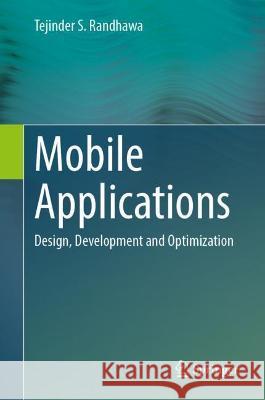
Mobile Applications: Design, Development and Optimization Randhawa, Tejinder S. 9783030023898 Springer - książkaWidoczna okładka, to zdjęcie poglądowe, a rzeczywista szata graficzna może różnić się od prezentowanej.

Mobile Applications: Design, Development and Optimization

ISBN-13: 9783030023898 / Angielski / Twarda / 2022 / 740 str.

Tejinder Randhawa
cena 362,27
(netto: 345,02 VAT:  5%)

Najniższa cena z 30 dni: 346,96
Termin realizacji zamówienia:
ok. 22 dni roboczych
Bez gwarancji dostawy przed świętami

Darmowa dostawa!

Using Android as a reference, this book teaches development of mobile apps designed to be responsive, trustworthy and robust, and optimized for maintainability. As the share of mission-critical mobile apps continues to increase in the ever-expanding mobile app ecosystem, it has become imperative that processes and procedures to assure their reliance are developed and included in the software life cycle at opportune times. Memory, CPU, battery life and screen size limitations of smartphones coupled with volatility associated with mobile environments underlines that the quality assurance strategies that proved to be successful for desktop applications may no longer be effective in mobile apps. To that effect, this book lays a foundation upon which quality assurance processes and procedures for the mobile apps could be devised. This foundation is composed of analytical models, experimental test-beds and software solutions. Analytical models proposed in literature to predict software quality are studied and adapted for mobile apps. The efficacy of these analytical models in prejudging the operations of mobile apps under design and development is evaluated. A comprehensive test suite is presented that empirically assesses a mobile app's compliance to its quality expectations. Test procedures to measure quality attributes such as maintainability, usability, performance, scalability, reliability, availability and security, are detailed. Utilization of test tools provided in Android Studio as well as third-party vendors in constructing the corresponding test-beds is highlighted. An in-depth exploration of utilities, services and frameworks available on Android is conducted, and the results of their parametrization observed through experimentation to construct quality assurance solutions are presented. Experimental development of some example mobile apps is conducted to gauge adoption of process models and determine favorable opportunities for integrating the quality assurance processes and procedures in the mobile app life cycle. Role of automation in testing, integration, deployment and configuration management is demonstrated to offset cost overheads of integrating quality assurance process in the life cycle of the mobile apps.


Kategorie:
Informatyka, Bazy danych
Kategorie BISAC:
Computers > Hardware - General
Computers > Information Technology
Computers > Programming - General
Wydawca:
Springer
Język:
Angielski
ISBN-13:
9783030023898
Rok wydania:
2022
Wydanie:
2021
Ilość stron:
740
Oprawa:
Twarda
Wolumenów:
01
Dodatkowe informacje:
Wydanie ilustrowane

Abbreviations and Acronyms

List of Figures

List of Tables

Listing


1 Software Life Cycle

 1.1 Process Models    

1.2 Functional Specifications  

1.2.1 User Stories       

1.2.2 UML Use Case Diagrams

1.2.3 Software Requirements Specifications   

1.3 Non-Functional Requirements       

1.4 Test Driven Development  

1.4.1 Acceptance Tests          

1.4.2 Unit Tests          

1.5 Continuous Integration and Delivery          

1.5.1 Software Configuration Management     

1.5.2 Continuous Integration and Delivery       

Summary    

EXERCISES           

REFERENCES


2 Development Fundamentals 

2.1 Graphical User Interface   

2.1.1 GUI Objects and Layouts

2.1.2  Event Handling  

2.1.3  Redirection       

2.2 Data Storage         

2.2.1 Key-value Pairs  

2.2.2 Files       

2.2.3 Database Systems         

2.2.4 Personal Data Storage   

2.3  Data Connectivity 

2.3.1  Web Access      

2.3.2  Short Message Service 

2.4 Concurrency         

2.4.1 Threads and Asynchronous Tasks         

2.4.2 Processes          

2.5 Location and Sensor APIs 

Summary         

EXERCISES    

REFERENCES


3 Software Quality Assessment           

3.1 Functional Requirements Testing  

3.1.1 Equivalence Class Partitioning   

3.1.2 Boundary Value Analysis

3.1.3 Domain Test Design       

3.2 Maintainability

3.2.1 Sub-Characteristics        

3.2.2 Maintainability Measures

3.3 Usability and Accessibility 

3.3.1 Models   

3.3.2 Evaluation          

3.4 Performance Testing         

3.4.1 Latency Measurement    

3.4.2 GUI Performance

3.4.3 Memory Usage   

3.4.4 Network Usage   

3.4.5 Battery Usage    

3.5 Scalability Testing 

3.5.1 Scalability Models          

3.5.2 Load Test Design           

3.6 Reliability Testing  

 3.6.1 Growth Models  

3.6.2 Fault Injection    

3.6.3 Operational Profile         

3.6.4 Reliability Test Design    

3.7 Availability 

3.7.1 Availability Models         

3.7.2 Stress Testing    

3.8 Safety       

3.8.1 FMEA     

3.8.2 FTA        

3.9 Security     

3.9.1 Vulnerabilities and Threat Analysis         

3.9.2 Security Testing 

3.10 Static Code Analysis        

Summary         

EXERCISES    

REFERENCES 151


4 Maintainability and Multi-Platform Development       

4.1 Software Patterns  

4.1.1 Programming Paradigms

4.1.2 Design Patterns 

4.1.3 Architecture Patterns      

4.2 Design Description

4.2.1 Structural

4.2.2 Behavioral          

4.3 Multi-Platform Development          

4.3.1 Native Development       

4.3.2 Hybrid    

4.3.3 Cross-Platform Development     

Summary         

EXERCISES    

REFERENCES


5 User Interaction Optimization           

5.1 Multimodality         

5.1.1 Touch Gestures 

5.1.2 Motion Gestures

5.1.3 Verbal Gestures 

5.1.4 Visual Gestures 

5.1.5 Accessibility Frameworks           

5.2 Navigation Controls           

5.3 Dashboards           

5.4 Custom GUI          

5.5 Animated GUI       

Summary         

EXERCISES    

REFERENCES


6 Performance Acceleration    

6.1 Data Compression

6.1.1 Lossless Compression   

6.1.2 Lossy Compression        

6.2 Data I/O Optimization        

6.2.1 File System I/O  

6.2.2 Network I/O        

6.3 Rendering Pipelines          

6.3.1 Animation Rendering     

6.3.2 Video Rendering

6.3.3 Augmented Reality         

6.3.4 Hardware Acceleration   

6.4 Parallel Programming        

6.4.1 Thread Priority   

6.4.2 Data Parallel Computation          

Summary         

EXERCISES    

REFERENCES


7 Scalability Provisioning        

7.1 Scalable Media Transport 

7.2 Scalable Local Storage     

7.2.1 Data Models       

7.2.2 Data Structures and Query Plan 

7.2.3 Location Queries

7.3 Scalable Design Patterns  

7.3.1 Data Cache        

7.3.2 Event Notifications         

7.3.3 Task Scheduling

7.4 GUI Scalability       

Summary         

EXERCISES    

REFERENCES


8 Reliability Assurance

8.1 Thread Safe Patterns        

8.1.1 Serializing GUI Updates 

8.1.2 Serializing Shared Memory Access        

8.1.3 Thread Synchronization 

8.2 Memory Leaks      

8.3 Reliable Persistent Storage           

8.3.1 Isolation and Consistency          

8.3.2 Atomicity and Durability  

8.3.3 Sharded Persistent Storage       

8.4 Data Validation      

8.4.1 Input Validation   

8.4.2 Integrity Constraints       

8.5 Stateful Data Transport     

Summary         

EXERCISES    

REFERENCES


9 Availability and Fault-Tolerance       

9.1 Availability Primitives         

9.1.1 Design Diversity 

9.1.2 Broadcast Primitives       

9.2 Critical Communication Availability

9.2.1 Network Fault Tolerance

9.2.2 Design Diverse Emergency Communication Architecture           

9.3 Sensor Fusion and Redundancy   

9.4 Data Availability     

9.4.1 Data Synchronization     

9.4.2 Data Sharing      

9.5 Battery Power Saving        

Summary         

EXERCISES    

REFERENCES


10 Security and Trust  

10.1 Cryptographic Primitives  

10.1.1 Symmetric Cryptography          

10.1.2 Asymmetric Cryptography        

10.1.3 Message Digest

10.1.4 Message Authentication Codes

10.1.5 Digital Signatures         

10.2 Secure Web Access        

10.2.1 User Authentication      

10.2.2 Authentication Delegation and Single Sign On 

10.2.3 Access and Authorization Delegation   

10.2.4 Peer-Authentication and Confidentiality

10.3 Secure Network Access  

10.3.1 Transport Layer Security          

10.3.2 Layer 3 Security

10.3.3 Layer 2 Security

10.4 Secure System Access   

10.4.1 Mobile Application Authenticity 

10.4.2 Securing Inter-Application Communication       

10.4.3 Permissions and Access Control          

Summary         

EXERCISES    

REFERENCES


Appendix A     


Appendix B     

B.1  Compile and Deploy a Servlet     

B.2  Compile and Deploy a Web Socket Hub  

B.3  Configure Tomcat to Enable SSL 

B.4  Install and Configure Jenkins       

B.5  Install Metrics Reloaded   


Index


Tejinder S. Randhawa has worked in the high-tech industry for over 25 years. At Mobile NewMedia Ltd., he is currently leading the research and development of a secure and reliable unified communications and monitoring platform for health care. The platform supports plug-and-play of wireless sensors and dash-boarding of vitals on mobile and embedded platforms; and can also be deployed in environments where no fixed communications infrastructure exists by utilizing WiFi Mesh. Prior to this, he worked with Dyaptive Systems (now JDS Uniphase) on the analysis of Testing Requirements for CDMA2000 cellular data applications and development of data traffic generators for testing such networks. Before joining Dyaptive Systems, he worked with CRC (Communication Research Center), Ottawa on the security aspects of mobile ad hoc networks.

Tejinder has a PhD in Engineering Science from Simon Fraser University where he also held appointments as an Adjunct Professor for several years between 2002 and 2017. He has been a faculty member at BCIT since 1995. He has developed and taught graduate- and senior undergraduate-level courses in wireless network protocols, data network protocols, software engineering, wireless and mobile applications, database systems, client server computing and distributed systems.

His R&D activities have covered technical areas of Health Monitoring, Health Information Systems, sensor systems/networks, Wireless Networks, Internet Protocols, Voice Over IP, Multimedia Communication, Network Security, Mobile Applications, Software Engineering and operations research.  His work has been published in peer-reviewed technical papers as well as US and Canadian patents that he has co-authored.


Using Android as a reference, this book teaches the development of mobile apps designed to be responsive, trustworthy and robust, and optimized for maintainability. As the share of mission-critical mobile apps continues to increase in the ever-expanding mobile app ecosystem, it has become imperative that processes and procedures to assure their reliance are developed and included in the software life cycle at opportune times. Memory, CPU, battery life and screen size limitations of smartphones coupled with volatility associated with mobile environments underlines that the quality assurance strategies that proved to be successful for desktop applications may no longer be effective in mobile apps. To that effect, this book lays a foundation upon which quality assurance processes and procedures for mobile apps could be devised. This foundation is composed of analytical models, experimental test-beds and software solutions.  

Analytical models proposed in the literature to predict software quality are studied and adapted for mobile apps. The efficacy of these analytical models in prejudging the operations of mobile apps under design and development is evaluated. A comprehensive test suite is presented that empirically assesses a mobile app’s compliance to its quality expectations. Test procedures to measure quality attributes such as maintainability, usability, performance, scalability, reliability, availability and security, are detailed. Utilization of test tools provided in Android Studio as well as third-party vendors in constructing the corresponding test-beds is highlighted. An in-depth exploration of utilities, services and frameworks available on Android is conducted, and the results of their parametrization observed through experimentation to construct quality assurance solutions are presented. Experimental development of some example mobile apps is conducted to gauge adoption of process models and determine favorable opportunities for integrating the quality assurance processes and procedures in the mobile app life cycle. The role of automation in testing, integration, deployment and configuration management is demonstrated to offset cost overheads of integrating quality assurance process in the life cycle of mobile apps.  


Udostępnij

Facebook - konto krainaksiazek.pl


Opinie o Krainaksiazek.pl na Opineo.pl

Partner Mybenefit

Krainaksiazek.pl w programie rzetelna firma Krainaksiaze.pl - płatności przez paypal

Czytaj nas na:

Facebook - krainaksiazek.pl
  • książki na zamówienie
  • granty
  • książka na prezent
  • kontakt
  • pomoc
  • opinie
  • regulamin
  • polityka prywatności

Zobacz:

  • Księgarnia czeska

  • Wydawnictwo Książkowe Klimaty

1997-2025 DolnySlask.com Agencja Internetowa

© 1997-2022 krainaksiazek.pl
     
KONTAKT | REGULAMIN | POLITYKA PRYWATNOŚCI | USTAWIENIA PRYWATNOŚCI
Zobacz: Księgarnia Czeska | Wydawnictwo Książkowe Klimaty | Mapa strony | Lista autorów
KrainaKsiazek.PL - Księgarnia Internetowa

Polityka prywatnosci - link
Krainaksiazek.pl - płatnośc Przelewy24
Przechowalnia Przechowalnia





