• Wyszukiwanie zaawansowane
  • Kategorie
  • Kategorie BISAC
  • Książki na zamówienie
  • Promocje
  • Granty
  • Książka na prezent
  • Opinie
  • Pomoc
  • Załóż konto
  • Zaloguj się

Mimo-Ofdm Wireless Communications with MATLAB » książka


zaloguj się | załóż konto
Logo Krainaksiazek.pl

koszyk

konto

szukaj
topmenu
Księgarnia internetowa
Szukaj
Książki na zamówienie
Promocje
Granty
Książka na prezent
Moje konto
Pomoc
 
 
Wyszukiwanie zaawansowane
Pusty koszyk
Bezpłatna dostawa dla zamówień powyżej 20 złBezpłatna dostawa dla zamówień powyżej 20 zł

Kategorie główne

• Nauka
 [2949965]
• Literatura piękna
 [1857847]

  więcej...
• Turystyka
 [70818]
• Informatyka
 [151303]
• Komiksy
 [35733]
• Encyklopedie
 [23180]
• Dziecięca
 [617748]
• Hobby
 [139972]
• AudioBooki
 [1650]
• Literatura faktu
 [228361]
• Muzyka CD
 [398]
• Słowniki
 [2862]
• Inne
 [444732]
• Kalendarze
 [1620]
• Podręczniki
 [167233]
• Poradniki
 [482388]
• Religia
 [509867]
• Czasopisma
 [533]
• Sport
 [61361]
• Sztuka
 [243125]
• CD, DVD, Video
 [3451]
• Technologie
 [219309]
• Zdrowie
 [101347]
• Książkowe Klimaty
 [123]
• Zabawki
 [2362]
• Puzzle, gry
 [3791]
• Literatura w języku ukraińskim
 [253]
• Art. papiernicze i szkolne
 [7933]
Kategorie szczegółowe BISAC

Mimo-Ofdm Wireless Communications with MATLAB

ISBN-13: 9780470825617 / Angielski / Twarda / 2010 / 544 str.
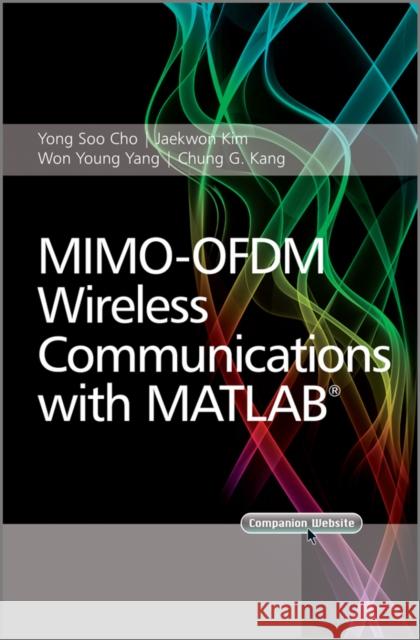
Yong Soo Cho;Jaekwon Kim;Won Young Yang
Mimo-Ofdm Wireless Communications with MATLAB Cho, Yong Soo 9780470825617  - książkaWidoczna okładka, to zdjęcie poglądowe, a rzeczywista szata graficzna może różnić się od prezentowanej.

Mimo-Ofdm Wireless Communications with MATLAB

ISBN-13: 9780470825617 / Angielski / Twarda / 2010 / 544 str.

Yong Soo Cho;Jaekwon Kim;Won Young Yang
cena 536,31 zł
(netto: 510,77 VAT:  5%)

Najniższa cena z 30 dni: 530,83 zł
Termin realizacji zamówienia:
ok. 30 dni roboczych
Bez gwarancji dostawy przed świętami

Darmowa dostawa!

MIMO-OFDM is a key technology for next-generation cellular communications (3GPP-LTE, Mobile WiMAX, IMT-Advanced) as well as wireless LAN (IEEE 802.11a, IEEE 802.11n), wireless PAN (MB-OFDM), and broadcasting (DAB, DVB, DMB). In MIMO-OFDM Wireless Communications with MATLAB(R), the authors provide a comprehensive introduction to the theory and practice of wireless channel modeling, OFDM, and MIMO, using MATLAB(R) programs to simulate the various techniques on MIMO-OFDM systems.

  • One of the only books in the area dedicated to explaining simulation aspects
  • Covers implementation to help cement the key concepts
  • Uses materials that have been classroom-tested in numerous universities
  • Provides the analytic solutions and practical examples with downloadable MATLAB(R) codes
  • Simulation examples based on actual industry and research projects
  • Presentation slides with key equations and figures for instructor use
MIMO-OFDM Wireless Communications with MATLAB(R) is a key text for graduate students in wireless communications. Professionals and technicians in wireless communication fields, graduate students in signal processing, as well as senior undergraduates majoring in wireless communications will find this book a practical introduction to the MIMO-OFDM techniques. Instructor materials and MATLAB(R) code examples available for download at www.wiley.com/go/chomimo

MIMO–OFDM is a key technology for next–generation cellular communications (3GPP–LTE, Mobile WiMAX, IMT–Advanced) as well as wireless LAN (IEEE 802.11a, IEEE 802.11n), wireless PAN (MB–OFDM), and broadcasting (DAB, DVB, DMB). In MIMO–OFDM Wireless Communications with MATLAB®, the authors provide a comprehensive introduction to the theory and practice of wireless channel modeling, OFDM, and MIMO, using MATLAB® programs to simulate the various techniques on MIMO–OFDM systems.

  • One of the only books in the area dedicated to explaining simulation aspects
  • Covers implementation to help cement the key concepts
  • Uses materials that have been classroom–tested in numerous universities
  • Provides the analytic solutions and practical examples with downloadable MATLAB® codes
  • Simulation examples based on actual industry and research projects
  • Presentation slides with key equations and figures for instructor use

MIMO–OFDM Wireless Communications with MATLAB® is a key text for graduate students in wireless communications. Professionals and technicians in wireless communication fields, graduate students in signal processing, as well as senior undergraduates majoring in wireless communications will find this book a practical introduction to the MIMO–OFDM techniques.Instructor materials and MATLAB® code examples available for download at www.wiley.com/go/chomimo

Kategorie:
Technologie
Kategorie BISAC:
Technology & Engineering > Mobile & Wireless Communications
Technology & Engineering > Telecommunications
Język:
Angielski
ISBN-13:
9780470825617
Rok wydania:
2010
Ilość stron:
544
Waga:
0.92 kg
Wymiary:
25.15 x 17.27 x 2.79
Oprawa:
Twarda
Wolumenów:
01
Dodatkowe informacje:
Bibliografia
Wydanie ilustrowane

Preface.

Limits of Liability and Disclaimer of Warranty of Software.

1 The Wireless Channel: Propagation and Fading.

1.1 Large–Scale Fading.

1.1.1 General Path Loss Model.

1.1.2 Okumura/Hata Model.

1.1.3 IEEE 802.16d Model.

1.2 Small–Scale Fading.

1.2.1 Parameters for Small–Scale Fading.

1.2.2 Time–Dispersive vs. Frequency–Dispersive Fading.

1.2.3 Statistical Characterization and Generation of Fading Channel.

2 SISO Channel Models.

2.1 Indoor Channel Models.

2.1.1 General Indoor Channel Models.

2.1.2 IEEE 802.11 Channel Model.

2.1.3 Saleh–Valenzuela (S–V) Channel Model.

2.1.4 UWB Channel Model.

2.2 Outdoor Channel Models.

2.2.1 FWGN Model.

2.2.2 Jakes Model.

2.2.3 Ray–Based Channel Model.

2.2.4 Frequency–Selective Fading Channel Model.

2.2.5 SUI Channel Model.

3 MIMO Channel Models.

3.1 Statistical MIMO Model.

3.1.1 Spatial Correlation.

3.1.2 PAS Model.

3.2 I–METRA MIMO Channel Model.

3.2.1 Statistical Model of Correlated MIMO Fading Channel.

3.2.2 Generation of Correlated MIMO Channel Coefficients.

3.2.3 I–METRA MIMO Channel Model.

3.2.4 3GPP MIMO Channel Model.

3.3 SCM MIMO Channel Model.

3.3.1 SCM Link–Level Channel Parameters.

3.3.2 SCM Link–Level Channel Modeling.

3.3.3 Spatial Correlation of Ray–Based Channel Model.

4 Introduction to OFDM.

4.1 Single–Carrier vs. Multi–Carrier Transmission.

4.1.1 Single–Carrier Transmission.

4.1.2 Multi–Carrier Transmission.

4.1.3 Single–Carrier vs. Multi–Carrier Transmission.

4.2 Basic Principle of OFDM.

4.2.1 OFDM Modulation and Demodulation.

4.2.2 OFDM Guard Interval.

4.2.3 OFDM Guard Band.

4.2.4 BER of OFDM Scheme.

4.2.5 Water–Filling Algorithm for Frequency–Domain Link Adaptation.

4.3 Coded OFDM.

4.4 OFDMA: Multiple Access Extensions of OFDM.

4.4.1 Resource Allocation Subchannel Allocation Types.

4.4.2 Resource Allocation Subchannelization.

4.5 Duplexing.

5 Synchronization for OFDM.

5.1 Effect of STO.

5.2 Effect of CFO.

5.2.1 Effect of Integer Carrier Frequency Offset (IFO).

5.2.2 Effect of Fractional Carrier Frequency Offset (FFO).

5.3 Estimation Techniques for STO.

5.3.1 Time–Domain Estimation Techniques for STO.

5.3.2 Frequency–Domain Estimation Techniques for STO.

5.4 Estimation Techniques for CFO.

5.4.1 Time–Domain Estimation Techniques for CFO.

5.4.2 Frequency–Domain Estimation Techniques for CFO.

5.5 Effect of Sampling Clock Offset.

5.5.1 Effect of Phase Offset in Sampling Clocks.

5.5.2 Effect of Frequency Offset in Sampling Clocks.

5.6 Compensation for Sampling Clock Offset.

5.7 Synchronization in Cellular Systems.

5.7.1 Downlink Synchronization.

5.7.2 Uplink Synchronization.

6 Channel Estimation.

6.1 Pilot Structure.

6.1.1 Block Type.

6.1.2 Comb Type.

6.1.3 Lattice Type.

6.2 Training Symbol–Based Channel Estimation.

6.2.1 LS Channel Estimation.

6.2.2 MMSE Channel Estimation.

6.3 DFT–Based Channel Estimation.

6.4 Decision–Directed Channel Estimation.

6.5 Advanced Channel Estimation Techniques.

6.5.1 Channel Estimation Using a Superimposed Signal.

6.5.2 Channel Estimation in Fast Time–Varying Channels.

6.5.3 EM Algorithm–Based Channel Estimation.

6.5.4 Blind Channel Estimation.

7 PAPR Reduction.

7.1 Introduction to PAPR.

7.1.1 Definition of PAPR.

7.1.2 Distribution of OFDM Signal.

7.1.3 PAPR and Oversampling.

7.1.4 Clipping and SQNR.

7.2 PAPR Reduction Techniques.

7.2.1 Clipping and Filtering.

7.2.2 PAPR Reduction Code.

7.2.3 Selective Mapping.

7.2.4 Partial Transmit Sequence.

7.2.5 Tone Reservation.

7.2.6 Tone Injection.

7.2.7 DFT Spreading.

8 Inter–Cell Interference Mitigation Techniques.

8.1 Inter–Cell Interference Coordination Technique.

8.1.1 Fractional Frequency Reuse.

8.1.2 Soft Frequency Reuse.

8.1.3 Flexible Fractional Frequency Reuse.

8.1.4 Dynamic Channel Allocation.

8.2 Inter–Cell Interference Randomization Technique.

8.2.1 Cell–Specific Scrambling.

8.2.2 Cell–Specific Interleaving.

8.2.3 Frequency–Hopping OFDMA.

8.2.4 Random Subcarrier Allocation.

8.3 Inter–Cell Interference Cancellation Technique.

8.3.1 Interference Rejection Combining Technique.

8.3.2 IDMA Multiuser Detection.

9 MIMO: Channel Capacity.

9.1 Useful Matrix Theory.

9.2 Deterministic MIMO Channel Capacity.

9.2.1 Channel Capacity when CSI is Known to the Transmitter Side.

9.2.2 Channel Capacity when CSI is Not Available at the Transmitter Side.

9.2.3 Channel Capacity of SIMO and MISO Channels.

9.3 Channel Capacity of Random MIMO Channels.

10 Antenna Diversity and Space–Time Coding Techniques.

10.1 Antenna Diversity.

10.1.1 Receive Diversity.

10.1.2 Transmit Diversity.

10.2 Space–Time Coding (STC): Overview.

10.2.1 System Model.

10.2.2 Pairwise Error Probability.

10.2.3 Space–Time Code Design.

10.3 Space–Time Block Code (STBC).

10.3.1 Alamouti Space–Time Code.

10.3.2 Generalization of Space–Time Block Coding.

10.3.3 Decoding for Space–Time Block Codes.

10.3.4 Space–Time Trellis Code.

11 Signal Detection for Spatially Multiplexed MIMO Systems.

11.1 Linear Signal Detection.

11.1.1 ZF Signal Detection.

11.1.2 MMSE Signal Detection.

11.2 OSIC Signal Detection.

11.3 ML Signal Detection.

11.4 Sphere Decoding Method.

11.5 QRM–MLD Method.

11.6 Lattice Reduction–Aided Detection.

11.6.1 Lenstra–Lenstra–Lovasz (LLL) Algorithm.

11.6.2 Application of Lattice Reduction.

11.7 Soft Decision for MIMO Systems.

11.7.1 Log–Likelihood–Ratio (LLR) for SISO Systems.

11.7.2 LLR for Linear Detector–Based MIMO System.

11.7.3 LLR for MIMO System with a Candidate Vector Set.

11.7.4 LLR for MIMO System Using a Limited Candidate Vector Set.

Appendix 11.A Derivation of Equation (11.23).

12 Exploiting Channel State Information at the Transmitter Side.

12.1 Channel Estimation on the Transmitter Side.

12.1.1 Using Channel Reciprocity.

12.1.2 CSI Feedback.

12.2 Precoded OSTBC.

12.3 Precoded Spatial–Multiplexing System.

12.4 Antenna Selection Techniques.

12.4.1 Optimum Antenna Selection Technique.

12.4.2 Complexity–Reduced Antenna Selection.

12.4.3 Antenna Selection for OSTBC.

13 Multi–User MIMO.

13.1 Mathematical Model for Multi–User MIMO System.

13.2 Channel Capacity of Multi–User MIMO System.

13.2.1 Capacity of MAC.

13.2.2 Capacity of BC.

13.3 Transmission Methods for Broadcast Channel.

13.3.1 Channel Inversion.

13.3.2 Block Diagonalization.

13.3.3 Dirty Paper Coding (DPC).

13.3.4 Tomlinson–Harashima Precoding.

References.

Index.

MIMO–OFDM is a key technology for next–generation cellular communications (3GPP–LTE, Mobile WiMAX, IMT–Advanced) as well as wireless LAN (IEEE 802.11a, IEEE 802.11n), wireless PAN (MB–OFDM), and broadcasting (DAB, DVB, DMB). In MIMO–OFDM Wireless Communications with MATLAB ®, the authors provide a comprehensive introduction to the theory and practice of wireless channel modeling, OFDM, and MIMO, using MATLAB ® programs to simulate the various techniques on MIMO–OFDM systems.

  • One of the only books in the area dedicated to explaining simulation aspects
  • Covers implementation to help cement the key concepts
  • Uses materials that have been classroom–tested in numerous universities
  • Provides the analytic solutions and practical examples with downloadable MATLAB® codes
  • Simulation examples based on actual industry and research projects
  • Presentation slides with key equations and figures for instructor use

MIMO–OFDM Wireless Communications with MATLAB® is a key text for graduate students in wireless communications. Professionals and technicians in wireless communication fields, graduate students in signal processing, as well as senior undergraduates majoring in wireless communications will find this book a practical introduction to the MIMO–OFDM techniques.

Instructor materials and MATLAB® code examples available for download at www.wiley.com/go/chomimo


Udostępnij

Facebook - konto krainaksiazek.pl


Opinie o Krainaksiazek.pl na Opineo.pl

Partner Mybenefit

Krainaksiazek.pl w programie rzetelna firma Krainaksiaze.pl - płatności przez paypal

Czytaj nas na:

Facebook - krainaksiazek.pl
  • książki na zamówienie
  • granty
  • książka na prezent
  • kontakt
  • pomoc
  • opinie
  • regulamin
  • polityka prywatności

Zobacz:

  • Księgarnia czeska

  • Wydawnictwo Książkowe Klimaty

1997-2025 DolnySlask.com Agencja Internetowa

© 1997-2022 krainaksiazek.pl
     
KONTAKT | REGULAMIN | POLITYKA PRYWATNOŚCI | USTAWIENIA PRYWATNOŚCI
Zobacz: Księgarnia Czeska | Wydawnictwo Książkowe Klimaty | Mapa strony | Lista autorów
KrainaKsiazek.PL - Księgarnia Internetowa

Polityka prywatnosci - link
Krainaksiazek.pl - płatnośc Przelewy24
Przechowalnia Przechowalnia





