• Wyszukiwanie zaawansowane
  • Kategorie
  • Kategorie BISAC
  • Książki na zamówienie
  • Promocje
  • Granty
  • Książka na prezent
  • Opinie
  • Pomoc
  • Załóż konto
  • Zaloguj się

Microscopic Methods in Metals » książka


zaloguj się | załóż konto
Logo Krainaksiazek.pl

koszyk

konto

szukaj
topmenu
Księgarnia internetowa
Szukaj
Książki na zamówienie
Promocje
Granty
Książka na prezent
Moje konto
Pomoc
 
 
Wyszukiwanie zaawansowane
Pusty koszyk
Bezpłatna dostawa dla zamówień powyżej 20 złBezpłatna dostawa dla zamówień powyżej 20 zł

Kategorie główne

• Nauka
 [2949965]
• Literatura piękna
 [1857847]

  więcej...
• Turystyka
 [70818]
• Informatyka
 [151303]
• Komiksy
 [35733]
• Encyklopedie
 [23180]
• Dziecięca
 [617748]
• Hobby
 [139972]
• AudioBooki
 [1650]
• Literatura faktu
 [228361]
• Muzyka CD
 [398]
• Słowniki
 [2862]
• Inne
 [444732]
• Kalendarze
 [1620]
• Podręczniki
 [167233]
• Poradniki
 [482388]
• Religia
 [509867]
• Czasopisma
 [533]
• Sport
 [61361]
• Sztuka
 [243125]
• CD, DVD, Video
 [3451]
• Technologie
 [219309]
• Zdrowie
 [101347]
• Książkowe Klimaty
 [123]
• Zabawki
 [2362]
• Puzzle, gry
 [3791]
• Literatura w języku ukraińskim
 [253]
• Art. papiernicze i szkolne
 [7933]
Kategorie szczegółowe BISAC

Microscopic Methods in Metals

ISBN-13: 9783642465734 / Angielski / Miękka / 2012 / 457 str.
Ulrich Gonser
Microscopic Methods in Metals Ulrich Gonser 9783642465734 Springer - książkaWidoczna okładka, to zdjęcie poglądowe, a rzeczywista szata graficzna może różnić się od prezentowanej.

Microscopic Methods in Metals

ISBN-13: 9783642465734 / Angielski / Miękka / 2012 / 457 str.

Ulrich Gonser
cena 201,72 zł
(netto: 192,11 VAT:  5%)

Najniższa cena z 30 dni: 192,74 zł
Termin realizacji zamówienia:
ok. 22 dni roboczych
Bez gwarancji dostawy przed świętami

Darmowa dostawa!

Methods of scientific investigation can be divided into two categories: they are either macroscopic or microscopic in nature. The former are generally older, classical methods where the sample as a whole is studied and various local prop erties are deduced by differentiation. The microscopic methods, on the other hand, have been discovered and developed more recently, and they operate for the most part on an atomistic scale. Glancing through the shelves of books on the various scientific fields, and, in particular, on the field of physical metallurgy, we are surprised at how lit tle consideration has been given to the microscopic methods. How these tools provide new insight and information is a question which so far has not at tracted much attention. Similar observations can be made at scientific confer ences, where the presentation of papers involving microscopic methods is often pushed into a far corner. This has led users of such methods to organize their own special conferences. The aim of this book is to bridge the present gap and encourage more interaction between the various fields of study and selected microscopic meth ods, with special emphasis on their suitability for investigating metals. In each case the principles of the method are reviewed, the advantages and successes pointed out, but also the shortcomings and limitations indicated."


Kategorie:
Nauka, Fizyka
Kategorie BISAC:
Science > Physics - Condensed Matter
Science > Spectroscopy & Spectrum Analysis
Technology & Engineering > Optics
Wydawca:
Springer
Seria wydawnicza:
Topics in Current Physics
Język:
Angielski
ISBN-13:
9783642465734
Rok wydania:
2012
Wydanie:
Softcover Repri
Numer serii:
000186407
Ilość stron:
457
Waga:
0.75 kg
Wymiary:
24.41 x 16.99 x 2.44
Oprawa:
Miękka
Wolumenów:
01

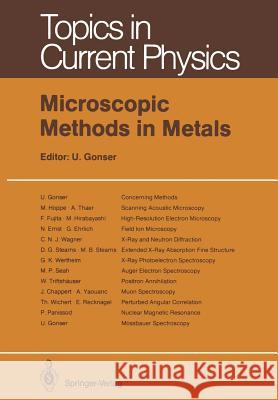
1. Concerning Methods.- 1.1 Descriptive Methods.- 1.2 Abbreviated Methods.- 1.3 Name-Tag Methods.- 2. Scanning Acoustic Microscopy.- 2.1 Principle of Scanning Acoustic Microscopy (SAM).- 2.2 The Image Contrast of Solids in the Reflection Scanning Acoustic Microscope; V(z)-Curves.- 2.3 Examples of Practical Applications of Reflection Scanning Acoustic Microscopy.- 2.3.1 Grain Structure.- 2.3.2 Diffusion Zones.- 2.3.3 Materials Defects.- 2.4 Outlook.- References27.- 3. High-Resolution Electron Microscopy.- 3.1 Background.- 3.1.1 Historical Development.- 3.1.2 Conventional vs. High-Resolution Electron Microscopy.- 3.2 Basic Principles of High-Resolution Electron Microscopy.- 3.2.1 Formation of Lattice Fringe Images.- 3.2.2 Formation of Many-Beam Lattice Images.- 3.2.3 Image Simulation by the Multislice Method.- 3.3 Applications.- 3.3.1 Defect and Defect Analysis.- 3.3.2 Amorphous Metals and Alloys.- 3.3.3 Ordered Alloys and Intermetallic Compounds.- 3.3.4 Phase Transformation.- 3.3.5 Surface, Grain Boundary and Interface.- 3.4 Outlook.- References.- 4. Field Ion Microscopy.- 4.1 Principles and Techniques.- 4.1.1 Magnification, Resolution, and Image Formation.- 4.1.2 Field Evaporation and Desorption.- 4.1.3 Specimen Preparation.- 4.1.4 Image Detection.- 4.1.5 Variants of the Field Ion Microscope.- 4.1.6 Field Emission Field Ion Microscopy.- 4.1.7 The Atom-Probe.- 4.2 Illustrative FIM Studies.- 4.2.1 Atomic Events on Solids.- 4.2.2 Field Evaporation and Desorption Measurements.- References.- 5. X-Ray and Neutron Diffraction.- 5.1 Diffraction of Neutrons and X-Rays by Poly- and Non-Crystalline Alloys.- 5.1.1 Neutron and X-Ray Scattering.- 5.1.2 General Scattering Theory for Solid and Liquid Solutions.- 5.1.3 Binary Alloys.- 5.1.4 Chemical Short-Range Order in Binary Alloys.- 5.1.5 Topological Order in Crystalline Solid Solutions.- 5.1.6 Integrated Intensity.- 5.2 Experimental Techniques.- 5.2.1 X-Ray and Neutron Sources.- 5.2.2 Instrumentation.- 5.3 Applications.- 5.3.1 Structure of Metallic Glasses and Liquids.- 5.3.2 Phase Analysis of Poly-Crystalline Mixtures.- 5.3.3 Small-Angle Scattering.- 5.3.4 Line Profile Analysis of Powder Pattern Peaks.- 5.3.5 Residual Stress Measurements.- 5.3.6 Grazing Incidence X-Ray Scattering.- References.- 6. Extended X-Ray Absorption Fine Structure.- 6.1 Theory.- 6.1.1 Overview.- 6.1.2 The Standard EXAFS Formula.- 6.1.3 Validity of the Theory.- 6.2 Experimental Techniques.- 6.3 Analysis.- 6.3.1 Basic Manipulations.- 6.3.2 Determination of Structural Parameters.- 6.3.3 Guidelines for Using EXAFS Spectroscopy.- 6.4 Experimental Applications.- 6.4.1 Local Environment Surrounding Solute Atoms.- 6.4.2 Comparison to Theoretical Models.- 6.4.3 Debye-Waller Factors — Mean-Square Displacements.- 6.4.4 Structure of Amorphous Metals.- References.- 7. X-Ray Photoelectron Spectroscopy.- 7.1 Historical.- 7.2 Basic Principles.- 7.2.1 Photoemission.- 7.2.2 The Core-Electron Binding Energy in a Metal.- 7.2.3 Core-Electron Satellites.- 7.2.4 Plasmons, Electron Mean-Free Path, and Surface Aspects of XPS.- 7.2.5 Measurement of Core-Electron Binding Energy by XPS.- 7.3 Related Methods.- 7.3.1 Angle-Resolved Photoemission Spectroscopy (ARPES).- 7.3.2 Inverse Photoemission Spectroscopy (IPES).- 7.3.3 X-Ray Absorption Edge Spectroscopy (XAS).- 7.3.4 X-Ray Emission Spectroscopy (XES).- 7.3.5 Auger Electron Spectroscopy (AES).- 7.3.6 Electron Energy Loss Spectroscopy (EELS).- 7.4 Applications.- 7.4.1 Chemical Analysis.- 7.4.2 Binding Energy Shifts.- 7.4.3 Valence Electron Density of States.- 7.4.4 Conduction-Electron Screening.- 7.5 Recent Developments.- 7.5.1 Surface Atoms.- 7.5.2 Metal Clusters.- References.- 8. Auger Electron Spectroscopy.- 8.1 History.- 8.2 Principles.- 8.2.1 The Auger Energies.- 8.2.2 The Auger Electron Emission Depth.- 8.2.3 Quantitative Analysis by AES.- 8.2.4 Composition Depth Profiling.- 8.2.5 Spatial Resolution in Auger Microscopy.- 8.3 The Instrument.- 8.4 Related Methods.- 8.5 Applications.- 8.5.1 Grain Boundary Segregation Studies.- 8.5.2 Surface Segregation.- 8.5.3 Grain Boundary Diffusion.- 8.5.4 Defect-Enhanced Diffusion.- 8.5.5 Other Studies.- 8.6 Future Developments.- References.- 9. Positron Annihilation.- 9.1 Background.- 9.2 Basic Principles.- 9.2.1 Positron Thermalization.- 9.2.2 Annihilation Process.- 9.3 Experimental Methods.- 9.3.1 Positron Sources.- 9.3.2 Angular Correlation of Annihilation Photons.- 9.3.3 Doppler Broadening of Annihilation Radiation.- 9.3.4 Lifetime Measurements of Positrons.- 9.3.5 Monoenergetic Positron Beams.- 9.4 Applications.- 9.4.1 Fermi Surfaces in Metals and Alloys.- 9.4.2 Metals at Various Temperatures.- 9.4.3 Radiation Induced Defects.- 9.4.4 Amorphous Alloys.- 9.4.5 Surfaces.- 9.5 Conclusions and Outlook.- References.- 10. Muon Spectroscopy.- 10.1 Basic Principles of the Experimental Techniques.- 10.2 The Depolarization Functions.- 10.2.1 Slow Dipole Fluctuations.- 10.2.2 Dipole Fluctuations and Correlation Functions.- 10.3 Diffusion Studies by ?+ SR.- 10.3.1 Standard Theory of the Diffusion of a Light Interstitial in a Metal.- 10.3.2 Effects of Impurities and Defects on the ?+ Damping Rate.- 10.3.3 Quantum ?+ Diffusion in Metals.- 10.3.4 Classical ?+ Diffusion in Metals.- 10.3.5 ?+ Diffusion in Hydrides.- 10.4 Magnetic Studies by ?+ SR.- 10.4.1 Static Properties.- 10.4.2 Dynamic Properties.- 10.5 Conclusions.- References.- 11. Perturbed Angular Correlation.- 11.1 Background.- 11.2 Principles.- 11.2.1 Spin Alignment.- 11.2.2 Spin Precession.- 11.3 Detection of Hyperfine Fields.- 11.3.1 Magnetic Dipole Interaction.- 11.3.2 Electric Quadrupole Interaction.- 11.4 Radioactive Probes, Preparation and Techniques.- 11.4.1 Probe Atoms and Sample Preparation.- 11.4.2 Data Recording and Analysis.- 11.4.3 PAC and Mössbauer Spectroscopy.- 11.5 Applications.- 11.5.1 Hyperfine Fields at Impurities.- 11.5.2 Surface Studies.- 11.5.3 Diffusion of Light Gases in Tantalum.- 11.5.4 Defects and Impurities.- 11.6 Future Developments and Conclusions.- References.- 12. Nuclear Magnetic Resonance.- 12.1 Introductory Comments.- 12.2 Physical Background of an NMR Experiment — Hyperfine Interactions.- 12.2.1 Nuclear Paramagnetism.- 12.2.2 Thermal Equilibrium and Dynamic Properties of the Spin System.- 12.2.3 Electric Interaction — Nuclear Quadrupole Moment.- 12.2.4 Summary.- 12.3 Basic NMR Experiment — Principles and Setup.- 12.3.1 Spin Movement in a Magnetic Field.- 12.3.2 Free Induction Decay — Transverse Relaxation Time.- 12.3.3 Spin Echo — Homogeneous and Inhomogeneous Broadenings.- 12.3.4 Spin-Lattice Relaxation Measurement.- 12.3.5 Spectrum Measurement.- 12.3.6 NMR Techniques and Instruments.- 12.3.7 Phase Coherent Pulsed NMR Spectrometer.- 12.3.8 Feasibility of an NMR Observation.- 12.4 NMR Outputs — Microscopic Origin.- 12.4.1 Hyperfine Fields.- 12.4.2 Frequency Shifts.- 12.4.3 Relaxation Times.- 12.4.4 Electric Field Gradient.- 12.4.5 Summary.- 12.5 Applications — Structural Investigations.- 12.5.1 Phase Analysis.- 12.5.2 Chemical Short-Range Order.- 12.5.3 Structure of Amorphous Metals.- 12.5.4 Atomic Motion in Metals.- 12.6 Applications — Electronic and Magnetic Properties.- 12.6.1 Local Magnetic Susceptibilities and Moments.- 12.6.2 Impurities in Metals.- 12.6.3 Magnetic Impurities — Occurrence of Magnetism.- 12.6.4 Concentrated Alloys — Local Environment Effects.- 12.6.5 Magnetic Structure and Phase Transition.- 12.6.6 Spin Fluctuations in Rare Earth Based Compounds.- 12.6.7 Electronic Phase Transitions.- 12.7 Conclusion and Outlook.- References.- 13. Mössbauer Spectroscopy.- 13.1 History.- 13.2 Principles.- 13.2.1 Line Width.- 13.2.2 Line Shape.- 13.2.3 Line Intensity (Recoil-Free Fraction).- 13.3 Mössbauer Isotopes.- 13.3.1 Sources.- 13.3.2 Absorbers.- 13.4 Methodology.- 13.4.1 Classical Setup.- 13.4.2 Scattering Geometry.- 13.5 Hyperfine Interactions.- 13.5.1 Isomer Shift.- 13.5.2 Magnetic Hyperfine Interaction.- 13.5.3 Electric Quadrupole Interaction.- 13.5.4 Mixed Interactions.- 13.5.5 Polarimetry.- 13.6 Relativistic Effects.- 13.7 Time-Dependent Effects.- 13.8 Applications.- 13.8.1 Iron.- 13.8.2 Phase Analysis.- 13.8.3 Texture.- 13.8.4 Defects.- 13.8.5 Amorphous.- 13.8.6 Relaxation Phenomena.- 13.9 Outlook.- References.- Additional References with Titles.


Udostępnij

Facebook - konto krainaksiazek.pl


Opinie o Krainaksiazek.pl na Opineo.pl

Partner Mybenefit

Krainaksiazek.pl w programie rzetelna firma Krainaksiaze.pl - płatności przez paypal

Czytaj nas na:

Facebook - krainaksiazek.pl
  • książki na zamówienie
  • granty
  • książka na prezent
  • kontakt
  • pomoc
  • opinie
  • regulamin
  • polityka prywatności

Zobacz:

  • Księgarnia czeska

  • Wydawnictwo Książkowe Klimaty

1997-2025 DolnySlask.com Agencja Internetowa

© 1997-2022 krainaksiazek.pl
     
KONTAKT | REGULAMIN | POLITYKA PRYWATNOŚCI | USTAWIENIA PRYWATNOŚCI
Zobacz: Księgarnia Czeska | Wydawnictwo Książkowe Klimaty | Mapa strony | Lista autorów
KrainaKsiazek.PL - Księgarnia Internetowa

Polityka prywatnosci - link
Krainaksiazek.pl - płatnośc Przelewy24
Przechowalnia Przechowalnia





