• Wyszukiwanie zaawansowane
  • Kategorie
  • Kategorie BISAC
  • Książki na zamówienie
  • Promocje
  • Granty
  • Książka na prezent
  • Opinie
  • Pomoc
  • Załóż konto
  • Zaloguj się

Microbial Symbionts and Plant Health: Trends and Applications for Changing Climate » książka


zaloguj się | załóż konto
Logo Krainaksiazek.pl

koszyk

konto

szukaj
topmenu
Księgarnia internetowa
Szukaj
Książki na zamówienie
Promocje
Granty
Książka na prezent
Moje konto
Pomoc
 
 
Wyszukiwanie zaawansowane
Pusty koszyk
Bezpłatna dostawa dla zamówień powyżej 20 złBezpłatna dostawa dla zamówień powyżej 20 zł

Kategorie główne

• Nauka
 [2946600]
• Literatura piękna
 [1856966]

  więcej...
• Turystyka
 [72221]
• Informatyka
 [151456]
• Komiksy
 [35826]
• Encyklopedie
 [23190]
• Dziecięca
 [619653]
• Hobby
 [140543]
• AudioBooki
 [1577]
• Literatura faktu
 [228355]
• Muzyka CD
 [410]
• Słowniki
 [2874]
• Inne
 [445822]
• Kalendarze
 [1744]
• Podręczniki
 [167141]
• Poradniki
 [482898]
• Religia
 [510455]
• Czasopisma
 [526]
• Sport
 [61590]
• Sztuka
 [243598]
• CD, DVD, Video
 [3423]
• Technologie
 [219201]
• Zdrowie
 [101638]
• Książkowe Klimaty
 [124]
• Zabawki
 [2473]
• Puzzle, gry
 [3898]
• Literatura w języku ukraińskim
 [254]
• Art. papiernicze i szkolne
 [8170]
Kategorie szczegółowe BISAC

Microbial Symbionts and Plant Health: Trends and Applications for Changing Climate

ISBN-13: 9789819900299 / Angielski
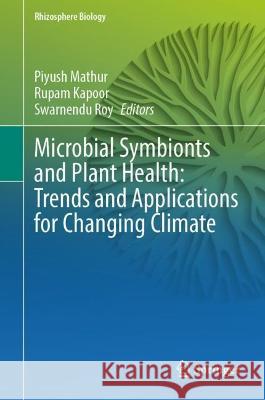
Piyush Mathur; Rupam Kapoor; Swarnendu Roy
Microbial Symbionts and Plant Health: Trends and Applications for Changing Climate Piyush Mathur Rupam Kapoor Swarnendu Roy 9789819900299 Springer - książkaWidoczna okładka, to zdjęcie poglądowe, a rzeczywista szata graficzna może różnić się od prezentowanej.

Microbial Symbionts and Plant Health: Trends and Applications for Changing Climate

ISBN-13: 9789819900299 / Angielski

Piyush Mathur; Rupam Kapoor; Swarnendu Roy
cena 806,99 zł
(netto: 768,56 VAT:  5%)

Najniższa cena z 30 dni: 771,08 zł
Termin realizacji zamówienia:
ok. 22 dni roboczych
Bez gwarancji dostawy przed świętami

Darmowa dostawa!
inne wydania

This book provides a comprehensive understanding of the complex relationship between microbial symbionts and plants in the era of climate change. It focuses on the plant microbiome associated with different plant organs like roots, leaves, stems, fruit, and seeds, and showcases their significant role in the enhancement of crop yield and protection in a sustainable manner. Concomitantly, acumens to the most emerging trends in plant microbial research that includes rhizosphere engineering and metagenomics are also covered in this title. The association of microbial symbionts with the host offers a wide advantage in terms of acclimatization to varied environmental conditions. A large number of microbes such as cyanobacteria, PGPR, endophytes, and AMF have been shown to improve plant growth and production under the effect of various abiotic and biotic stresses. These microbial symbionts secrete several secondary metabolites, signaling molecules, and hydrolytic enzymes that play a multifarious role in improving plant growth and yield. Moreover, the symbionts have been known to regulate the host responses at the molecular level. Bioprospecting these microbial symbionts will provide an alternative to the chemical-based fertilizers and pave the path for the development of biofertilizers. The book is a suitable reading material for undergraduate and postgraduate students, researchers, and scientists working in the field of agricultural biotechnology, microbiology, mycology and plant pathology, and allied fields of plant and microbial sciences. The book in this context attempts to provide an integrative and exhaustive study as well as research material that would help the scientific community in wide respect.


This book provides a comprehensive understanding of the complex relationship between microbial symbionts and plants in the era of climate change. It focuses on the plant microbiome associated with different plant organs like roots, leaves, stems, fruit, and seeds, and showcases their significant role in the enhancement of crop yield and protection in a sustainable manner. Concomitantly, acumens to the most emerging trends in plant microbial research that includes rhizosphere engineering and metagenomics are also covered in this title. The association of microbial symbionts with the host offers a wide advantage in terms of acclimatization to varied environmental conditions. A large number of microbes such as cyanobacteria, PGPR, endophytes, and AMF have been shown to improve plant growth and production under the effect of various abiotic and biotic stresses. These microbial symbionts secrete several secondary metabolites, signaling molecules, and hydrolytic enzymes that play a multifarious role in improving plant growth and yield. Moreover, the symbionts have been known to regulate the host responses at the molecular level. Bioprospecting these microbial symbionts will provide an alternative to the chemical-based fertilizers and pave the path for the development of biofertilizers. The book is a suitable reading material for undergraduate and postgraduate students, researchers, and scientists working in the field of agricultural biotechnology, microbiology, mycology and plant pathology, and allied fields of plant and microbial sciences. The book in this context attempts to provide an integrative and exhaustive study as well as research material that would help the scientific community in wide respect. 

Kategorie:
Nauka, Biologia i przyroda
Kategorie BISAC:
Technology & Engineering > Agriculture - General
Science > Botanika
Science > Biotechnology
Wydawca:
Springer
Seria wydawnicza:
Rhizosphere Biology
Język:
Angielski
ISBN-13:
9789819900299

Chapter 1: Global climate perturbations: sustainable microbial mitigation strategies.- Chapter 2: Soil microflora and their interaction with plants under changing climatic scenarios.- Chapter 3: Beneficial microbial consortia and their role in sustainable agriculture under climate change conditions.- Chapter 4: Unfolding the role of beneficial microbes and microbial techniques on improvement of sustainable agriculture under climatic challenges.- Chapter 5: Microbes and their role in alleviation of abiotic and biotic stress tolerance in crop plants.- Chapterb 6: Plant-microbe interaction and their role in mitigation of heat stress.- Chapter 7: Role of soil microbes against abiotic stresses induced oxidative stresses in plants.- Chapter 8: An overview of the multifaceted role of plant growth promoting microorganisms and endophytes in sustainable agriculture: Developments and prospects.- Chapter 9: Plant growth promoting rhizobacteria (PGPR): an indispensable tool for climate resilient crop production.- Chapter 10: Plant endophyte interactions- a driving phenomenon for boosting plant health in the face of climate change.- Chapter 11: Deciphering the role of growth promoting bacterial endophytes in harmonizing plant health.- Chapter 12: Endophytic microbes and their role in plant health.- Chapter 13: Multitrophic Reciprocity of AMF with Plants and Other Soil Microbes in Relation to Biotic Stress.- Chapter 14: Effect of temperature and defence response on the severity of dry root rot disease in chickpea caused by Macrophomina phaseolina.- Chapter 15: Emerging roles of plant growth promoting rhizobacteria in salt stress alleviation: applications in sustainable agriculture.- Chapter 16: Studies on orchidoid mycorrhizae and mycobionts. associated with orchid plants as plant growth promoters and stimulator in seed germination.- Chapter 17: Current status of mycorrhizal biofertilizer in crop improvement and its future prospects.- Chapter 18: New developments in techniques like metagenomics. metaproteomics for isolation. identification. and characterization of microbes from varied environment.-  Chapter 19: Mushroom metagenome: tool to unravel interaction network of plant. mycorrhiza and bacteria.- Chapter 20: Extremophile bacterial and archaebacterial population: metagenomics and novel enzyme reserve.- Chapter 21: Microbial nanotechnology: a biocompatible technology for sustainable and green agriculture practice.- Chapter 22: Bacteriophage Assisted Diagnostics and Management of Plant Diseases.

Dr. Piyush Mathur is presently working as an assistant professor in the Department of Botany, University of North Bengal, West Bengal, India. He has been teaching for the past 6 years and has taught both at the undergraduate and post graduate level Dr. Mathur has done his PhD in botany with a specialization in mycology and plant pathology. Presently, he is supervising four PhD research scholars who are working on microbial diversity, bioprospecting, and plant disease management. He has published several papers in well-known international journals of repute. Dr. Mathur has also contributed articles as book chapters in international and national books. He has recently edited a book entitled Plant Stress: Challenges and Management in the New Decade published by Springer under ASTI series and is working on other books too with Springer. Dr. Mathur is an active member of the Society of Rapeseed Mustard Research (SRMR), Bharatpur, and Delhi University Botanical Society (DUBS) Delhi, India.


Prof. Rupam Kapoor is presently working as a senior professor in the Department of Botany, University of Delhi. She is an active researcher working in the field of plant-fungus interactions for many years. Prof. Kapoor has been listed in the global ranking of the top 2% scientist for her significant contribution for two consecutive years 2020–21. She has supervised 12 PhD theses and 10 MPhil theses, and mentored a number of MSc dissertations. She has publications in well-known peer-reviewed national and international journals of high repute. A number of articles have also been published in the form of book chapters in international and national books.  She is presently serving as an associate editor of 3Biotech, an international journal from Springer. She is also working as a review editor on the editorial board of Frontiers in Plant Science – Plant Symbiotic Interactions. Prof. Kapoor is a member of various learned societies like the International Mycorrhiza Society and International Symbiosis Society as well as a life member of Mycological Society of India, Indian Society of Mycology and Plant Pathology, Indian Botanical Society, and many more. 


Dr. Swarnendu Roy is presently working as an assistant professor at the University of North Bengal, Siliguri, India. He has more than 12 years of teaching experience. His doctoral thesis involved understanding the mechanism of salinity stress tolerance in grasses. Dr. Roy has published more than 35 articles in reputed journals with high impact factors like Water Research, Scientific Reports, Plant Physiology and Biochemistry, and Physiologia Plantarum. He has recently edited a book entitled Plant Stress: Challenges and Management in the New Decade published by Springer and also published several book chapters in edited volumes. He is presently supervising four PhD research scholars who are working on stress management in plants by engineered nanoparticles, synthesis of starch-based biofilms, and edible coatings. He received International Travel Support (ITS) from DST, Govt. of India, to present his research paper at the International Conference on Integrative Plant Physiology at Sitges, Spain. He is a life member of prestigious societies like The Indian Science Congress Association and Association of Food Scientists and Technologists (India).


This book provides a comprehensive understanding of the complex relationship between microbial symbionts and plants in the era of climate change. It focuses on the plant microbiome associated with different plant organs like roots, leaves, stems, fruit, and seeds, and showcases their significant role in the enhancement of crop yield and protection in a sustainable manner. Concomitantly, acumens to the most emerging trends in plant microbial research that includes rhizosphere engineering and metagenomics are also covered in this title. The association of microbial symbionts with the host offers a wide advantage in terms of acclimatization to varied environmental conditions. A large number of microbes such as cyanobacteria, PGPR, endophytes, and AMF have been shown to improve plant growth and production under the effect of various abiotic and biotic stresses. These microbial symbionts secrete several secondary metabolites, signaling molecules, and hydrolytic enzymes that play a multifarious role in improving plant growth and yield. Moreover, the symbionts have been known to regulate the host responses at the molecular level. Bioprospecting these microbial symbionts will provide an alternative to the chemical-based fertilizers and pave the path for the development of biofertilizers. The book is a suitable reading material for undergraduate and postgraduate students, researchers, and scientists working in the field of agricultural biotechnology, microbiology, mycology and plant pathology, and allied fields of plant and microbial sciences. The book in this context attempts to provide an integrative and exhaustive study as well as research material that would help the scientific community in wide respect. 



Udostępnij

Facebook - konto krainaksiazek.pl


Opinie o Krainaksiazek.pl na Opineo.pl

Partner Mybenefit

Krainaksiazek.pl w programie rzetelna firma Krainaksiaze.pl - płatności przez paypal

Czytaj nas na:

Facebook - krainaksiazek.pl
  • książki na zamówienie
  • granty
  • książka na prezent
  • kontakt
  • pomoc
  • opinie
  • regulamin
  • polityka prywatności

Zobacz:

  • Księgarnia czeska

  • Wydawnictwo Książkowe Klimaty

1997-2025 DolnySlask.com Agencja Internetowa

© 1997-2022 krainaksiazek.pl
     
KONTAKT | REGULAMIN | POLITYKA PRYWATNOŚCI | USTAWIENIA PRYWATNOŚCI
Zobacz: Księgarnia Czeska | Wydawnictwo Książkowe Klimaty | Mapa strony | Lista autorów
KrainaKsiazek.PL - Księgarnia Internetowa

Polityka prywatnosci - link
Krainaksiazek.pl - płatnośc Przelewy24
Przechowalnia Przechowalnia



