• Wyszukiwanie zaawansowane
  • Kategorie
  • Kategorie BISAC
  • Książki na zamówienie
  • Promocje
  • Granty
  • Książka na prezent
  • Opinie
  • Pomoc
  • Załóż konto
  • Zaloguj się

Microbial Metal Respiration: From Geochemistry to Potential Applications » książka


zaloguj się | załóż konto
Logo Krainaksiazek.pl

koszyk

konto

szukaj
topmenu
Księgarnia internetowa
Szukaj
Książki na zamówienie
Promocje
Granty
Książka na prezent
Moje konto
Pomoc
 
 
Wyszukiwanie zaawansowane
Pusty koszyk
Bezpłatna dostawa dla zamówień powyżej 20 złBezpłatna dostawa dla zamówień powyżej 20 zł

Kategorie główne

• Nauka
 [2949965]
• Literatura piękna
 [1857847]

  więcej...
• Turystyka
 [70818]
• Informatyka
 [151303]
• Komiksy
 [35733]
• Encyklopedie
 [23180]
• Dziecięca
 [617748]
• Hobby
 [139972]
• AudioBooki
 [1650]
• Literatura faktu
 [228361]
• Muzyka CD
 [398]
• Słowniki
 [2862]
• Inne
 [444732]
• Kalendarze
 [1620]
• Podręczniki
 [167233]
• Poradniki
 [482388]
• Religia
 [509867]
• Czasopisma
 [533]
• Sport
 [61361]
• Sztuka
 [243125]
• CD, DVD, Video
 [3451]
• Technologie
 [219309]
• Zdrowie
 [101347]
• Książkowe Klimaty
 [123]
• Zabawki
 [2362]
• Puzzle, gry
 [3791]
• Literatura w języku ukraińskim
 [253]
• Art. papiernicze i szkolne
 [7933]
Kategorie szczegółowe BISAC

Microbial Metal Respiration: From Geochemistry to Potential Applications

ISBN-13: 9783642441387 / Angielski / Miękka / 2014 / 236 str.
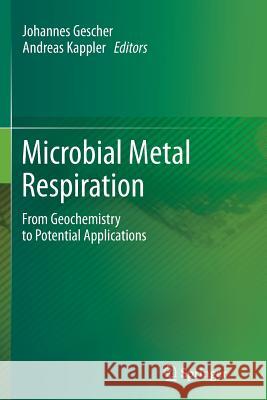
Johannes Gescher;Andreas Kappler
Microbial Metal Respiration: From Geochemistry to Potential Applications Johannes Gescher, Andreas Kappler 9783642441387 Springer-Verlag Berlin and Heidelberg GmbH &  - książkaWidoczna okładka, to zdjęcie poglądowe, a rzeczywista szata graficzna może różnić się od prezentowanej.

Microbial Metal Respiration: From Geochemistry to Potential Applications

ISBN-13: 9783642441387 / Angielski / Miękka / 2014 / 236 str.

Johannes Gescher;Andreas Kappler
cena 605,23 zł
(netto: 576,41 VAT:  5%)

Najniższa cena z 30 dni: 578,30 zł
Termin realizacji zamówienia:
ok. 22 dni roboczych
Bez gwarancji dostawy przed świętami

Darmowa dostawa!
inne wydania

Microbes can respire on metals. This seemingly simple finding is one of the major discoveries that were made in the field of microbiology in the last few decades. The importance of this observation is evident. Metals are highly abundant on our planet. Iron is even the most abundant element on Earth and the forth most abundant element in the Earth's crust. Hence, in some environments iron, but also other metals or metalloids, are the dominant respiratory electron acceptors. Their reduction massively drives the carbon cycle in these environments and establishes redox cycles of the metallic electron acceptors themselves. These redox cycles are not only a driving force for other biotic reactions but are furthermore necessary for initiating a number of geochemically relevant abiotic redox conversions. Although widespread and ecologically influential, electron transfer onto metals like ferric iron or manganese is biochemically challenging. The challenge is to transfer respiratory electrons onto metals that occur in nature at neutral pH in the form of metal oxides or oxihydroxides that are effectively insoluble. Obviously, it is necessary that the microbes specially adapt in order to catalyze the electron transfer onto insoluble electron acceptors. The elucidation of these adaptations is an exciting ongoing process. To sum it up, dissimilatory metal reduction has wide-spread implications in the field of microbiology, biochemistry and geochemistry and its discovery was one of the major reasons to establish a novel scientific field called geomicrobiology. Recently, the discovery of potential applications of dissimilatory metal reducers in bioremediation or current production in a microbial fuel cell further increased the interest in studying microbial metal reduction.


Kategorie:
Nauka
Kategorie BISAC:
Science > Earth Sciences - Geology
Science > Mikrobiologia
Wydawca:
Springer-Verlag Berlin and Heidelberg GmbH &
Język:
Angielski
ISBN-13:
9783642441387
Rok wydania:
2014
Dostępne języki:
Angielski
Wydanie:
2012
Ilość stron:
236
Waga:
0.38 kg
Wymiary:
23.523.5 x 15.5
Oprawa:
Miękka
Wolumenów:
01
Dodatkowe informacje:
Wydanie ilustrowane

Minerals and Aqueous Species of Iron and Manganese as Reactants and Products of Microbial Metal Respiration.- Energetic and Molecular Constraints on the Mechanism of Environmental Fe(III) Reduction by Geobacter.- Biochemistry of Extracellular Respiration in Shewanella oneidensis.- On the Role of Endogenous Electron Shuttles in Extracellular Electron Transfer.- Humic Substances and Extracellular Electron Transfer.- Metal Reducers und Reduction Targets. A Short Survey about the Distribution of Dissimilatory Metal Reducers and the Multitude of Terminal Electron Acceptors.- Metal Reduction as a Tool in Bioremediation Processes.- Dissimilatory Metal Reducers Producing Electricity.- Microbial Fuel Cells. 

Microbes can respire on metals. This seemingly simple finding is one of the major discoveries that were made in the field of microbiology in the last few decades. The importance of this observation is evident. Metals are highly abundant on our planet. Iron is even the most abundant element on Earth and the forth most abundant element in the Earth’s crust. Hence, in some environments iron, but also other metals or metalloids, are the dominant respiratory electron acceptors. Their reduction massively drives the carbon cycle in these environments and establishes redox cycles of the metallic electron acceptors themselves. These redox cycles are not only a driving force for other biotic reactions but are furthermore necessary for initiating a number of geochemically relevant abiotic redox conversions. Although widespread and ecologically influential, electron transfer onto metals like ferric iron or manganese is biochemically challenging. The challenge is to transfer respiratory electrons onto metals that occur in nature at neutral pH in the form of metal oxides or oxihydroxides that are effectively insoluble. Obviously, it is necessary that the microbes specially adapt in order to catalyze the electron transfer onto insoluble electron acceptors. The elucidation of these adaptations is an exciting ongoing process. To sum it up, dissimilatory metal reduction has wide-spread implications in the field of microbiology, biochemistry and geochemistry and its discovery was one of the major reasons to establish a novel scientific field called geomicrobiology. Recently, the discovery of potential applications of dissimilatory metal reducers in bioremediation or current production in a microbial fuel cell further increased the interest in studying microbial metal reduction.                        



Udostępnij

Facebook - konto krainaksiazek.pl


Opinie o Krainaksiazek.pl na Opineo.pl

Partner Mybenefit

Krainaksiazek.pl w programie rzetelna firma Krainaksiaze.pl - płatności przez paypal

Czytaj nas na:

Facebook - krainaksiazek.pl
  • książki na zamówienie
  • granty
  • książka na prezent
  • kontakt
  • pomoc
  • opinie
  • regulamin
  • polityka prywatności

Zobacz:

  • Księgarnia czeska

  • Wydawnictwo Książkowe Klimaty

1997-2025 DolnySlask.com Agencja Internetowa

© 1997-2022 krainaksiazek.pl
     
KONTAKT | REGULAMIN | POLITYKA PRYWATNOŚCI | USTAWIENIA PRYWATNOŚCI
Zobacz: Księgarnia Czeska | Wydawnictwo Książkowe Klimaty | Mapa strony | Lista autorów
KrainaKsiazek.PL - Księgarnia Internetowa

Polityka prywatnosci - link
Krainaksiazek.pl - płatnośc Przelewy24
Przechowalnia Przechowalnia




