Metals from K2 and Mapungubwe, Middle Limpopo Valley: A technological study of early second millennium material culture, with an emphasis on conservat » książka





Metals from K2 and Mapungubwe, Middle Limpopo Valley: A technological study of early second millennium material culture, with an emphasis on conservat
ISBN-13: 9781407312958 / Angielski / Miękka / 2014 / 182 str.
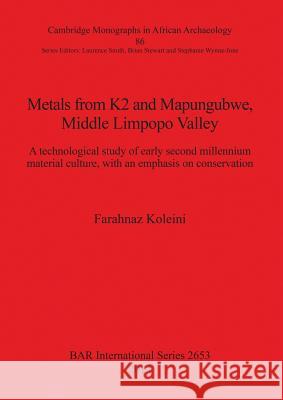
Metals from K2 and Mapungubwe, Middle Limpopo Valley: A technological study of early second millennium material culture, with an emphasis on conservat
ISBN-13: 9781407312958 / Angielski / Miękka / 2014 / 182 str.
(netto: 297,06 VAT: 5%)
Najniższa cena z 30 dni: 311,27
ok. 30 dni roboczych
Bez gwarancji dostawy przed świętami
Darmowa dostawa!
The book focuses on the conservation of iron and copper objects that mostly belong to the Iron Age sites of K2 and Mapungubwe (AD 825-1290), the two most prominent archaeological settlements in the middle Limpopo valley area of northern South Africa. For the purpose of conservation three main objectives were considered: revealing the material and methods of fabrication; evaluating physical and chemical stability; and preservation. Chapter 1 provides a short introduction to the study and presents its objectives. Chapter 2 then sets out the analytical methods and principles used in gathering and managing the data obtained. Next, Chapters 3 and 4 discuss the methods of manufacture of the selected artefacts as well as their physical stability. In these chapters the artefacts were respectively studied by the use of non-destructive methods such as neutron tomography and microscopy. Here, a new quantitative technique for estimating the corrosion percentage by using neutron tomograms and IMAGEJ software was introduced. Some of the objects with ambiguities as to their fabrication, were sampled destructively for metallographical examination and further chemical analyses. The native objects were manufactured by hot forging or cold working followed by annealing only in the case of copper, strip twisting and casting of molten copper in one piece mould. Meanwhile, new light was shed regarding signs of a new technique used in the production of some types of round wire on Mapungubwe Hill (strip-drawing). Chapter 5 examines the chemical stability of the artefacts and the deterioration processes affecting them, considering both the composition of corrosion products and the effects of environmental conditions on their formation. This information was gathered using analytical techniques such as Raman spectroscopy, XRD and SEM-EDS. Chapter 6 then presents suitable and practical conservation methods for the objects in question. These methods consist of both interventive and preventive conservation. The thesis concludes (in Chapter 7) with a summary of the results obtained.
The book focuses on the conservation of iron and copper objects that mostly belong to the Iron Age sites of K2 and Mapungubwe (AD 825-1290), the two most prominent archaeological settlements in the middle Limpopo valley area of northern South Africa. For the purpose of conservation three main objectives were considered: revealing the material and methods of fabrication; evaluating physical and chemical stability; and preservation. Chapter 1 provides a short introduction to the study and presents its objectives. Chapter 2 then sets out the analytical methods and principles used in gathering and managing the data obtained. Next, Chapters 3 and 4 discuss the methods of manufacture of the selected artefacts as well as their physical stability. In these chapters the artefacts were respectively studied by the use of non-destructive methods such as neutron tomography and microscopy. Here, a new quantitative technique for estimating the corrosion percentage by using neutron tomograms and IMAGEJ software was introduced. Some of the objects with ambiguities as to their fabrication, were sampled destructively for metallographical examination and further chemical analyses. The native objects were manufactured by hot forging or cold working followed by annealing only in the case of copper, strip twisting and casting of molten copper in one piece mould. Meanwhile, new light was shed regarding signs of a new technique used in the production of some types of round wire on Mapungubwe Hill (strip-drawing). Chapter 5 examines the chemical stability of the artefacts and the deterioration processes affecting them, considering both the composition of corrosion products and the effects of environmental conditions on their formation. This information was gathered using analytical techniques such as Raman spectroscopy, XRD and SEM-EDS. Chapter 6 then presents suitable and practical conservation methods for the objects in question. These methods consist of both interventive and preventive conservation. The thesis concludes (in Chapter 7) with a summary of the results obtained.




Czytaj nas na:
KrainaKsiazek.PL - Księgarnia Internetowa


