• Wyszukiwanie zaawansowane
  • Kategorie
  • Kategorie BISAC
  • Książki na zamówienie
  • Promocje
  • Granty
  • Książka na prezent
  • Opinie
  • Pomoc
  • Załóż konto
  • Zaloguj się

Metallurgy of Welding » książka


zaloguj się | załóż konto
Logo Krainaksiazek.pl

koszyk

konto

szukaj
topmenu
Księgarnia internetowa
Szukaj
Książki na zamówienie
Promocje
Granty
Książka na prezent
Moje konto
Pomoc
 
 
Wyszukiwanie zaawansowane
Pusty koszyk
Bezpłatna dostawa dla zamówień powyżej 20 złBezpłatna dostawa dla zamówień powyżej 20 zł

Kategorie główne

• Nauka
 [2949965]
• Literatura piękna
 [1857847]

  więcej...
• Turystyka
 [70818]
• Informatyka
 [151303]
• Komiksy
 [35733]
• Encyklopedie
 [23180]
• Dziecięca
 [617748]
• Hobby
 [139972]
• AudioBooki
 [1650]
• Literatura faktu
 [228361]
• Muzyka CD
 [398]
• Słowniki
 [2862]
• Inne
 [444732]
• Kalendarze
 [1620]
• Podręczniki
 [167233]
• Poradniki
 [482388]
• Religia
 [509867]
• Czasopisma
 [533]
• Sport
 [61361]
• Sztuka
 [243125]
• CD, DVD, Video
 [3451]
• Technologie
 [219309]
• Zdrowie
 [101347]
• Książkowe Klimaty
 [123]
• Zabawki
 [2362]
• Puzzle, gry
 [3791]
• Literatura w języku ukraińskim
 [253]
• Art. papiernicze i szkolne
 [7933]
Kategorie szczegółowe BISAC

Metallurgy of Welding

ISBN-13: 9789401095082 / Angielski / Miękka / 2012
J. F. Lancaster
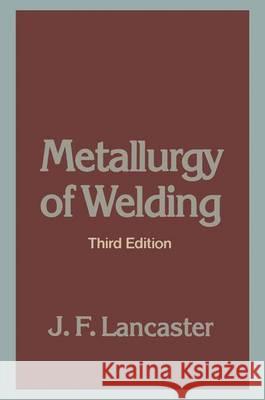
Metallurgy of Welding J. F. Lancaster   9789401095082 Springer - książkaWidoczna okładka, to zdjęcie poglądowe, a rzeczywista szata graficzna może różnić się od prezentowanej.

Metallurgy of Welding

ISBN-13: 9789401095082 / Angielski / Miękka / 2012

J. F. Lancaster
cena 342,95 zł
(netto: 326,62 VAT:  5%)

Najniższa cena z 30 dni: 327,68 zł
Termin realizacji zamówienia:
ok. 22 dni roboczych
Bez gwarancji dostawy przed świętami

Darmowa dostawa!

This book is intended, like its predecessor (The metallurgy of welding, brazing and soldering), to provide a textbook for undergraduate and postgraduate students concerned with welding, and for candidates taking the Welding Institute examinations. At the same time, it may prove useful to practising engineers, metallurgists and welding engineers in that it offers a resume of information on welding metallurgy together with some material on the engineering problems associated with welding such as reliability and risk analysis. In certain areas there have been developments that necessitated complete re-writing of the previous text. Thanks to the author's colleagues in Study Group 212 of the International Institute of Welding, understanding of mass flow in fusion welding has been radically transformed. Knowledge of the metallurgy of carbon and ferritic alloy steel, as applied to welding, has continued to advance at a rapid pace, while the literature on fracture mechanics accumulates at an even greater rate. In other areas, the welding of non-ferrous metals for example, there is little change to report over the last decade, and the original text of the book is only slightly modified. In those fields where there has been significant advance, the subject has become more quantitative and the standard of math- ematics required for a proper understanding has been raised.


Kategorie:
Technologie
Kategorie BISAC:
Technology & Engineering > Technical & Manufacturing Industries & Trades
Science > General
Technology & Engineering > Materials Science - Metals & Alloys
Wydawca:
Springer
Język:
Angielski
ISBN-13:
9789401095082
Rok wydania:
2012
Wydanie:
1980
Oprawa:
Miękka
Wolumenów:
01

1 Introductory.- 1.1 Welding in ancient and medieval times.- 1.2 The advent of fusion welding.- 1.3 The theory of metal joining techniques.- 1.4 Welding engineering.- 2 Processes and Types of Joint.- 2.1 The general character of welding, brazing, soldering and adhesive jointing.- 2.2 The nature of welding processes.- 2.2.1 The classification of fusion welding processes.- 2.2.2 Heat source intensity.- 2.2.3 Heat input rate.- 2.2.4 Shielding methods.- 2.3 Types of fusion welded joint.- 3 Mass and Heat Flow in Welding.- 3.1 General.- 3.2 Mass flow: general.- 3.3 Mass flow from the electrode to the workpiece.- 3.3.1 The pinch instability.- 3.3.2 Other modes of instability.- 3.4 Mass flow in the weld pool.- 3.5 Heat flow : general.- 3.5.1 Heat sources.- 3.5.2 The welding arc.- 3.5.2.1 Electrode interactions.- 3.5.2.2 The arc column.- 3.5.3 Heat flow in the electrode.- 3.5.3.1 Time-dependent heat flow.- 3.5.4 Heat flow in the weld pool.- 3.5.5 Heat flow in the solid workpiece: theory.- 3.5.6 Heat flow in the solid workpiece: experimental.- 4 Metallurgical Effects of the Weld Thermal Cycle.- 4.1 Metallurgical effects in the weld metal.- 4.1.1 Gas-metal reactions.- 4.1.1.1 Absorption.- 4.1.1.2 Reaction.- 4.1.1.3 Evolution.- 4.1.2 Dilution and uniformity of the weld deposit.- 4.1.3 Weld pool solidification.- 4.1.4 Weld cracking.- 4.1.4.1 Supersokdus cracking.- 4.1.4.2 Subsolidus cracking.- 4.2 Metallurgical effects in the parent metal and solidified weld metal.- 4.2.1 Microstructural changes in the heat-affected zone.- 4.2.2 Precipitation and embrittlement in the heat-affected zone.- 4.2.3 Contraction and residual stress.- 5 Solid-Phase Welding.- 5.1 Fundamentals.- 5.1.1 The cohesion and strength of metals.- 5.1.2 Surface deformation.- 5.1.3 Surface films.- 5.1.4 Recrystallisation.- 5.1.5 Diffusion.- 5.2 Processes.- 5.2.1 Pressure welding at elevated temperature.- 5.2.2 Diffusion bonding.- 5.2.3 Cold pressure welding.- 5.2.4 Friction welding.- 5.2.5 Explosive welding.- 6 Brazing, Soldering and Adhesive Bonding.- 6.1 Physical aspects.- 6.1.1 Bonding.- 6.1.2 Surface energy and contact angle.- 6.1.3 Capillary action.- 6.2 Soldering and brazing.- 6.2.1 Wetting and spreading.- 6.2.2 Filling the joint.- 6.2.3 Solidification range.- 6.3 Soldering.- 6.3.1 Joint design.- 6.3.2 Solders.- 6.3.3 Fluxes.- 6.3.4 Soldering methods.- 6.3.5 Application to various metals.- 6.4 Brazing.- 6.4.1 Joint design.- 6.4.2 Brazing solders.- 6.4.3 Fluxes and protective atmospheres.- 6.4.4 Brazing methods.- 6.4.5 Bronze welding.- 6.4.6 Application to various metals.- 6.5 Adhesive bonding.- 6.5.1 Mechanical strength.- 6.5.1.1 Contact angle.- 6.5.1.2 Residual stress and stress concentration factors.- 6.5.2 Bonding methods.- 6.5.2.1 Preparing the surface.- 6.5.2.2 Types of adhesive and the mode of application.- 6.5.2.3 Curing the joint.- 6.5.2.4 Testing.- 6.5.3 Applications.- 7 Carbon and Ferritic-Alloy Steels.- 7.1 Scope.- 7.2 Metallurgy of the liquid weld metal.- 7.2.1 Gas—metal reactions.- 7.2.1.1 Reactions in the transferring drop.- 7.2.1.2 Reactions in the weld pool.- 7.2.2 Slag-metal reactions.- 7.2.2.1 The mechanics of slag-metal interaction.- 7.2.2.2 The chemistry of slag-metal interaction.- 7.2.3 Solidification and solidification cracking.- 7.3 Transformation and microstructure of steel.- 7.3.1 Transformation and microstructure of weld metal.- 7.3.2 Transformation and microstructure in the heat-affected zone.- 7.4 The mechanical properties of the welded joint.- 7.4.1 The mechanical properties of weld metals.- 7.4.2 The mechanical properties of the heat-affected zone.- 7.4.2.1 The hardness of the HAZ.- 7.4.2.2 The fracture toughness of the HAZ.- 7.5 Stress intensification, embrittlement, and cracking of fusion welds below the solidus.- 7.5.1 Stress concentration.- 7.5.2 Embrittlement of fusion welds.- 7.5.3 The hydrogen embrittlement and cracking of welds in steel.- 7.5.3.1 Hydrogen attack.- 7.5.3.2 Hydrogen embrittlement.- 7.5.3.3 The solution of hydrogen.- 7.5.3.4 Cracking due to dissolved hydrogen.- 7.5.3.5 Hydrogen-induced cold cracking in welds.- 7.5.3.6 Testing for hydrogen-induced cold cracking.- 7.5.3.7 Measures to avoid hydrogen-induced cold cracking.- 7.5.4 Chevron cracking.- 7.5.5 Lamellar tearing.- 7.5.6 Reheat cracking.- 7.6 Welding problems with iron and steel products.- 7.6.1 Cast iron.- 7.6.2 Steels used primarily for their mechanical properties.- 7.6.2.1 Carbon and carbon-manganese steels.- 7.6.2.2 Microalloyed steels.- 7.6.2.3 Low-alloy normalised and tempered (NT) steels.- 7.6.2.4 Low-alloy quenched and tempered (QT) steels.- 7.6.3 Steels for subzero temperature use.- 7.6.4 Low-alloy corrosion- and heat-resisting steels.- 7.6.5 Ferritic and austenitic/ferritic chromium stainless steels.- 8 Austenitic and High-Alloy Steels.- 8.1 Scope.- 8.2 Metallurgy of the weld metal and heat-affected zone.- 8.2.1 Alloy constitution.- 8.2.2 Carbide precipitation.- 8.2.3 Solidification cracking in the weld deposit.- 8.2.4 Hot cracking in the heat-affected zone during welding.- 8.2.5 Reheat cracking.- 8.3 Corrosion.- 8.3.1 Intergranular corrosion.- 8.3.2 Stress corrosion cracking.- 8.3.3 Preferential corrosion of welds.- 8.4 Corrosion-resistant steels: alloys and welding procedures.- 8.5 Weld overlay cladding and dissimilar metal joints.- 8.6 Heat-resisting steels: alloys and welding procedures.- 8.7 Hardenable high-alloy steels.- 9 Non-Ferrous Metals.- 9.1 Aluminium and its alloys.- 9.1.1 Processes and materials.- 9.1.2 Porosity.- 9.1.3 Cracking.- 9.1.4 Mechanical properties.- 9.1.5 Alloys and welding procedures.- 9.2 Magnesium and its alloys.- 9.2.1 Alloys and welding procedures.- 9.2.2 Oxide film removal.- 9.2.3 Cracking.- 9.2.4 Mechanical properties.- 9.2.5 Corrosion resistance and fire risk.- 9.3 Copper and its alloys.- 9.3.1 Processes and materials.- 9.3.2 Heat input.- 9.3.3 Porosity.- 9.3.4 Cracking.- 9.3.5 Mechanical properties.- 9.3.6 Alloys and welding procedures.- 9.4 Nickel and its alloys.- 9.4.1 Cracking.- 9.4.2 Porosity.- 9.4.3 Mechanical properties.- 9.4.4 Corrosion resistance.- 9.4.5 Oxidation and creep resistance.- 9.4.6 Alloys and welding procedures.- 9.5 The reactive and refractory metals — beryllium, titanium, zirconium, niobium, molybdenum, tantalum and tungsten.- 9.5.1 Embrittlement due to gas absorption.- 9.5.2 Embrittlement due to recrystalhsation.- 9.5.3 Porosity.- 9.5.4 Cracking.- 9.5.5 Tensile properties.- 9.5.6 Alloys and welding procedures.- 9.6 The low-melting metals: lead and zinc.- 9.6.1 Lead.- 9.6.2 Zinc.- 9.7 The precious metals: silver, gold, platinum.- 9.7.1 Silver.- 9.7.2 Gold.- 9.7.3 Platinum.- 9.7.4 Other platinum-group metals.- 10 The Behaviour of Welds in Service.- 10.1 Reliability.- 10.2 Service problems associated with welding.- 10.3 Fast crack growth.- 10.3.1 General.- 10.3.2 Linear elastic-fracture mechanics (LEFM).- 10.3.3 Alternative means of estimating or measuring fracture toughness.- 10.4 Slow crack propagation.- 10.5 Corrosion of welds.- 10.6 Risk analysis.- Appendix 1 Symbols.- Appendix 2 Conversion Factors.


Udostępnij

Facebook - konto krainaksiazek.pl


Opinie o Krainaksiazek.pl na Opineo.pl

Partner Mybenefit

Krainaksiazek.pl w programie rzetelna firma Krainaksiaze.pl - płatności przez paypal

Czytaj nas na:

Facebook - krainaksiazek.pl
  • książki na zamówienie
  • granty
  • książka na prezent
  • kontakt
  • pomoc
  • opinie
  • regulamin
  • polityka prywatności

Zobacz:

  • Księgarnia czeska

  • Wydawnictwo Książkowe Klimaty

1997-2025 DolnySlask.com Agencja Internetowa

© 1997-2022 krainaksiazek.pl
     
KONTAKT | REGULAMIN | POLITYKA PRYWATNOŚCI | USTAWIENIA PRYWATNOŚCI
Zobacz: Księgarnia Czeska | Wydawnictwo Książkowe Klimaty | Mapa strony | Lista autorów
KrainaKsiazek.PL - Księgarnia Internetowa

Polityka prywatnosci - link
Krainaksiazek.pl - płatnośc Przelewy24
Przechowalnia Przechowalnia





