• Wyszukiwanie zaawansowane
  • Kategorie
  • Kategorie BISAC
  • Książki na zamówienie
  • Promocje
  • Granty
  • Książka na prezent
  • Opinie
  • Pomoc
  • Załóż konto
  • Zaloguj się

Metadata-Driven Software Systems in Biomedicine: Designing Systems That Can Adapt to Changing Knowledge » książka


zaloguj się | załóż konto
Logo Krainaksiazek.pl

koszyk

konto

szukaj
topmenu
Księgarnia internetowa
Szukaj
Książki na zamówienie
Promocje
Granty
Książka na prezent
Moje konto
Pomoc
 
 
Wyszukiwanie zaawansowane
Pusty koszyk
Bezpłatna dostawa dla zamówień powyżej 20 złBezpłatna dostawa dla zamówień powyżej 20 zł

Kategorie główne

• Nauka
 [2946912]
• Literatura piękna
 [1852311]

  więcej...
• Turystyka
 [71421]
• Informatyka
 [150889]
• Komiksy
 [35717]
• Encyklopedie
 [23177]
• Dziecięca
 [617324]
• Hobby
 [138808]
• AudioBooki
 [1671]
• Literatura faktu
 [228371]
• Muzyka CD
 [400]
• Słowniki
 [2841]
• Inne
 [445428]
• Kalendarze
 [1545]
• Podręczniki
 [166819]
• Poradniki
 [480180]
• Religia
 [510412]
• Czasopisma
 [525]
• Sport
 [61271]
• Sztuka
 [242929]
• CD, DVD, Video
 [3371]
• Technologie
 [219258]
• Zdrowie
 [100961]
• Książkowe Klimaty
 [124]
• Zabawki
 [2341]
• Puzzle, gry
 [3766]
• Literatura w języku ukraińskim
 [255]
• Art. papiernicze i szkolne
 [7810]
Kategorie szczegółowe BISAC

Metadata-Driven Software Systems in Biomedicine: Designing Systems That Can Adapt to Changing Knowledge

ISBN-13: 9781447126621 / Angielski / Miękka / 2013 / 396 str.
Prakash M. Nadkarni
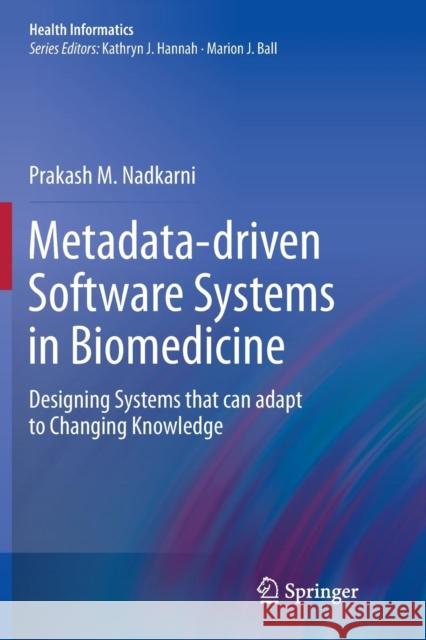
Metadata-Driven Software Systems in Biomedicine: Designing Systems That Can Adapt to Changing Knowledge Nadkarni, Prakash M. 9781447126621 Springer - książkaWidoczna okładka, to zdjęcie poglądowe, a rzeczywista szata graficzna może różnić się od prezentowanej.

Metadata-Driven Software Systems in Biomedicine: Designing Systems That Can Adapt to Changing Knowledge

ISBN-13: 9781447126621 / Angielski / Miękka / 2013 / 396 str.

Prakash M. Nadkarni
cena 363,12
(netto: 345,83 VAT:  5%)

Najniższa cena z 30 dni: 346,96
Termin realizacji zamówienia:
ok. 22 dni roboczych
Bez gwarancji dostawy przed świętami

Darmowa dostawa!

While the use of database technology is ubiquitous throughout IT (and health IT in particular), it is not generally appreciated that, as a database increases in scope, certain designs are far superior to others. In biomedical domains, new knowledge is being generated continually, and the databases that must support areas such as clinical care and research must also be able to evolve while requiring minimal or no logical / physical redesign. Appropriately designed metadata, and software designed to utilize it effectively, can provide significant insulation against change. Many of the larger EMR or clinical research database vendors have realized this, but their designs are proprietary and not described in the literature. Consequently, numerous misconceptions abound among individuals who have not had to work with large-scale biomedical systems, and graduates of a health or bioinformatics program may find that they need to unlearn what they were taught in database and software design classes in order to work productively with such systems. A working knowledge of such systems is also important for individuals who are not primarily software developers, such as health informaticians, medical information officers and data analysts. This book is, in a sense, intended to prepare all of the above individuals for the real world.


Kategorie:
Nauka, Medycyna
Kategorie BISAC:
Medical > Administration
Science > Biologia i przyroda
Medical > Family & General Practice
Wydawca:
Springer
Seria wydawnicza:
Health Informatics
Język:
Angielski
ISBN-13:
9781447126621
Rok wydania:
2013
Wydanie:
2011
Numer serii:
000037529
Ilość stron:
396
Waga:
0.59 kg
Wymiary:
23.22 x 15.57 x 2.34
Oprawa:
Miękka
Wolumenów:
01
Dodatkowe informacje:
Wydanie ilustrowane

1. What is metadata? Types of metadata.- Descriptive (interpreted by humans).- Technical (utilized by software).- Some metadata shows characteristics of both.- How metadata is represented.- Why use metadata to build biomedical systems? Caveat: Metadata-driven systems are initially harder to build, Building for change: flexibility and maintainability, Elimination of repetitious coding tasks, Case Study: Table-driven approaches to software design.- 2. Metadata for supporting electronic medical records.- The Entity-Attribute-Value (EAV) data model:.- Why EAV is problematic without metadata-editing capabilities: the TMR experience.- Pros and Cons of EAV: When not to use EAV.- How metadata allows ad hoc query to be data-model agnostic.- Transactional operations vs. warehousing operations.- Case Study: The I2B2 clinical data warehouse model.- Providing end-user customizability, Case Study: EpicCare Flowsheets.- 3. Metadata for clinical study data management systems (CSDMS).- Critical differences between an EMR and a CSDMS.- Essential elements of a CSDMS.- HTML-based vs. non-Web interfaces: pros and cons.- Case Study: Metadata for robust interactive data validation.- Metadata and the support of basic bioscience research.- Object dictionaries and synonyms: the NCBI Entrez approach.- Fundamentals of object-oriented modeling: the use of classes.- Case study: representing neuroscience data: SenseLab.- Case study: managing phenotype data.- 4. Descriptive Metadata: Controlled Biomedical Terminologies.- Classification of Controlled Vocabularies, with examples: Collections of Terms, Taxonomies: a hierarchical structure, Thesauri: Concepts vs. Terms, Ontologies: Classes and Properties, Cimino’s criteria for a good controlled vocabulary, Fundamentals of Description Logics, Pre-coordination vs. compositional approaches to new concept definition, Challenges when the set of permissible operations is incomplete, Difficulties in end-user employment of large vocabularies, The use of vocabulary subsets: the 95/5 problem, Case Study: the SNOMED vocabulary.- 5. Metadata and XML.- Introduction to XML.- Strengths of XML for information interchange.- Misconceptions and common pitfalls in XML use.- Weaknesses of XML as the basis for data modeling.- The Microarray Gene Expression Data (MGED) experience.- Use of the Unified Modeling Language.- UML is intended for human visualization.- UML has an internal XML equivalent (XMI).- Case Study: Clinical text markup.- 6. Metadata and the modeling of ontologies.- Ontology modeling tools: Protégé.- Common Pitfalls in Ontology Modeling.- Scalable ontology designs.- Supporting reasoning in ontologies: classification.- An introduction to Semantic Web technologies.- Limitations: the open-world assumption.- Case Study: Implementing constraints in SNOMED.- 7. Metadata and Production-Rule Engines.- Introduction to Production-Rule Systems.- Strengths and weaknesses of rule frameworks.- Embedded rule engines.- Data that can be executed as code: the Eval function.- Designing for extensibility.- Supporting versioning.- Case Study: The Jones Criteria for Rheumatic Fever.- 8. Biomedical Metadata Standards.- Why there can be no universal standard: a metadata model is problem-specific.- Standards for Descriptive Metadata.- ISO/IEC 11179: Purpose and Limitations.- Standards for Technical Metadata.- Have been designed for individual problem domains.- CDISC for clinical study data interchange.- Interchange standards for gene expression and proteomics.- 9. The HL7 v3 Reference Information Model.- Elements of the model.- What the model is not intended to encompass.- The clinical document architecture.- The Messaging Standard: Backward Incompatibilities.- Limitations and controversies.

To build good systems, one needs both good development skills as well as a thorough knowledge of the problem one is trying to solve. Knowledge of software history – what has worked and what hasn’t – also helps in these types of detailed projects. Metadata-Driven Software Systems in Biomedicine lays down some of the foundations and provides a knowledge-base to assist this process.
The technical portion of the book consists of database schemas and working code that provide non-trivial examples for the practitioner who is conversant with software development and wishes to employ the approaches described in the book.  Eight of the ten chapters include case studies, while the book also includes extensible designs in biomedical applications: electronic medical records, clinical study data management systems, laboratory research support systems, ontologies, and production-rule subsystems. This book is therefore ideal for individuals who have to interact with large biomedical database systems in an information-technology or informatician capacity, build interfaces to such systems or design new systems themselves.


Udostępnij

Facebook - konto krainaksiazek.pl


Opinie o Krainaksiazek.pl na Opineo.pl

Partner Mybenefit

Krainaksiazek.pl w programie rzetelna firma Krainaksiaze.pl - płatności przez paypal

Czytaj nas na:

Facebook - krainaksiazek.pl
  • książki na zamówienie
  • granty
  • książka na prezent
  • kontakt
  • pomoc
  • opinie
  • regulamin
  • polityka prywatności

Zobacz:

  • Księgarnia czeska

  • Wydawnictwo Książkowe Klimaty

1997-2025 DolnySlask.com Agencja Internetowa

© 1997-2022 krainaksiazek.pl
     
KONTAKT | REGULAMIN | POLITYKA PRYWATNOŚCI | USTAWIENIA PRYWATNOŚCI
Zobacz: Księgarnia Czeska | Wydawnictwo Książkowe Klimaty | Mapa strony | Lista autorów
KrainaKsiazek.PL - Księgarnia Internetowa

Polityka prywatnosci - link
Krainaksiazek.pl - płatnośc Przelewy24
Przechowalnia Przechowalnia





