• Wyszukiwanie zaawansowane
  • Kategorie
  • Kategorie BISAC
  • Książki na zamówienie
  • Promocje
  • Granty
  • Książka na prezent
  • Opinie
  • Pomoc
  • Załóż konto
  • Zaloguj się

Mesh Adaptation for Computational Fluid Dynamics, Volume 1: Continuous Riemannian Metrics and Feature-Based Adaptation » książka

zaloguj się | załóż konto
Logo Krainaksiazek.pl

koszyk

konto

szukaj
topmenu
Księgarnia internetowa
Szukaj
Książki na zamówienie
Promocje
Granty
Książka na prezent
Moje konto
Pomoc
 
 
Wyszukiwanie zaawansowane
Pusty koszyk
Bezpłatna dostawa dla zamówień powyżej 20 złBezpłatna dostawa dla zamówień powyżej 20 zł

Kategorie główne

• Nauka
 [2952079]
• Literatura piękna
 [1850969]

  więcej...
• Turystyka
 [71058]
• Informatyka
 [151066]
• Komiksy
 [35579]
• Encyklopedie
 [23181]
• Dziecięca
 [620496]
• Hobby
 [139036]
• AudioBooki
 [1646]
• Literatura faktu
 [228729]
• Muzyka CD
 [379]
• Słowniki
 [2932]
• Inne
 [445708]
• Kalendarze
 [1409]
• Podręczniki
 [164793]
• Poradniki
 [480107]
• Religia
 [510956]
• Czasopisma
 [511]
• Sport
 [61267]
• Sztuka
 [243299]
• CD, DVD, Video
 [3411]
• Technologie
 [219640]
• Zdrowie
 [100984]
• Książkowe Klimaty
 [124]
• Zabawki
 [2281]
• Puzzle, gry
 [3363]
• Literatura w języku ukraińskim
 [258]
• Art. papiernicze i szkolne
 [8020]
Kategorie szczegółowe BISAC

Mesh Adaptation for Computational Fluid Dynamics, Volume 1: Continuous Riemannian Metrics and Feature-Based Adaptation

ISBN-13: 9781786308313 / Angielski / Twarda / 2022 / 256 str.
Dervieux
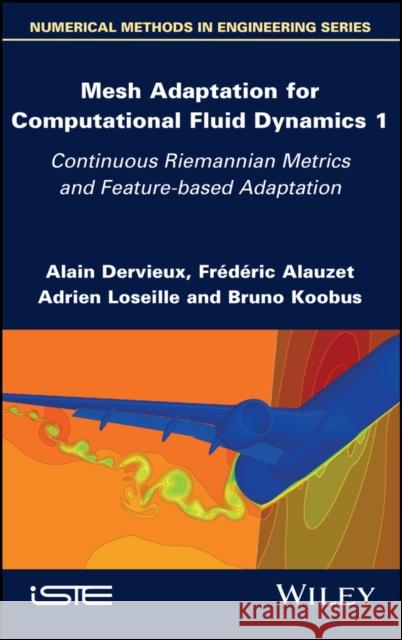
Mesh Adaptation for Computational Fluid Dynamics, Volume 1: Continuous Riemannian Metrics and Feature-Based Adaptation Dervieux, Alain 9781786308313 ISTE Ltd - książkaWidoczna okładka, to zdjęcie poglądowe, a rzeczywista szata graficzna może różnić się od prezentowanej.

Mesh Adaptation for Computational Fluid Dynamics, Volume 1: Continuous Riemannian Metrics and Feature-Based Adaptation

ISBN-13: 9781786308313 / Angielski / Twarda / 2022 / 256 str.

Dervieux
cena 607,23
(netto: 578,31 VAT:  5%)

Najniższa cena z 30 dni: 603,49
Termin realizacji zamówienia:
ok. 30 dni roboczych
Dostawa w 2026 r.

Darmowa dostawa!
Kategorie:
Nauka, Fizyka
Kategorie BISAC:
Science > Fizyka matematyczna
Science > Dynamika
Wydawca:
ISTE Ltd
Język:
Angielski
ISBN-13:
9781786308313
Rok wydania:
2022
Ilość stron:
256
Waga:
0.67 kg
Oprawa:
Twarda

Acknowledgments ixIntroduction xiChapter 1 CFD Numerical Models 11.1. Compressible flow 11.1.1. Introduction 11.1.2. Spatial representation 41.1.3. Spatial second-order accuracy: MUSCL 131.1.4. Low dissipation advection schemes 161.1.5. Time advancing 171.1.6. Positivity of mixed element-volume formulations 201.2. Viscous compressible flows 271.2.1. Model for laminar flows 271.2.2. Boundary conditions spatial discretization 311.2.3. No-slip boundary condition 311.2.4. Slip boundary condition 311.2.5. Influence stencil 321.2.6. Spalart-Allmaras one equation turbulence model 331.2.7. SA one-equation model without trip and without ft2 term 331.2.8. "Standard" SA one-equation model (without trip) 351.2.9. "Full" SA one-equation model (with trip) 351.2.10. Mixed element-volume discretization of SA 351.2.11. Implicit time integration 391.3. A multi-fluid incompressible model 401.3.1. Introduction 401.3.2. Bi-fluid incompressible Navier-Stokes equations 401.3.3. Finite element approximation 421.3.4. Error estimate for the level set advection 441.3.5. Provisional conclusion on scheme accuracy 461.4. Appendix: circumcenter cells 471.4.1. Two-dimensional circumcenter cells 471.4.2. Three-dimensional circumcenter cells 481.5. Notes 49Chapter 2 Mesh Convergence and Barriers 512.1. Introduction 512.2. The early capturing property 532.2.1. Smoothness, non-smoothness, heterogeneity 532.2.2. Behavior of the uniform-mesh strategy 542.2.3. An example of 1D adaptation 562.3. Unstructured meshes in finite element method 582.3.1. Basics of finite element meshes 582.3.2. Anisotropy 592.4. Accuracy of an interpolation 602.5. Isotropic adaptative interpolation 612.5.1. The 2D case 612.5.2. A first 3D case 622.5.3. A limiting barrier for the isotropic 3D case 642.6. Anisotropic adaptative interpolation 642.6.1. Anisotropic adaptation of a Heaviside function 642.6.2. Heaviside function with curved discontinuity 662.7. Numerical illustration: anisotropic versus isotropic interpolation 672.8. CFD applications of anisotropic capture 682.8.1. Pressure with discontinuous gradient 682.8.2. Scramjet flow 682.9. Unsteady case 712.9.1. Barriers for second-order time-leveled case 722.9.2. Barriers for third-order time-leveled case 742.10. Conclusion 752.11. Notes 76Chapter 3 Mesh Representation 773.1. Introduction 773.2. An introductory example 783.3. Euclidean metric space 813.3.1. Geometric interpretation 843.3.2. Natural metric mapping 853.4. Riemannian metric space 853.5. Generation of adapted anisotropic meshes 903.5.1. Unit element 903.5.2. Geometric invariants 923.5.3. Global duality 953.5.4. Quantifying mesh anisotropy 1033.6. Operations on metrics 1043.6.1. Metric intersection 1043.6.2. Metric interpolation 1063.7. Computation of geometric quantities 1083.7.1. Computation of lengths 1083.7.2. Computation of volumes 1103.8. Notes 1103.8.1. A short history 110Chapter 4 Geometric Error Estimate 1134.1. The 1D case 1144.1.1. 1D metric 1144.1.2. P 1 Interpolation error bound 1154.1.3. 1D optimal metric 1164.1.4. Convergence order of the continuous metric model 1184.2. Discrete-continuous duality for linear interpolation error 1204.2.1. Interpolation error in L¯ 1 norm for quadratic functions 1214.2.2. Linear interpolation on a continuous element 1244.2.3. Continuous linear interpolate 1264.3. Numerical validation of the continuous interpolation error 1334.3.1. Continuous interpolation error calculation 1344.3.2. Comparison with discrete interpolation error computation 1384.3.3. Three-dimensional validation 1424.3.4. Some conclusions 1464.4. Optimal control of the interpolation error in L p norm 1474.4.1. Formal resolution 1474.4.2. Uniqueness 1504.4.3. Optimal orientations and main result 1514.5. Multidimensional discontinuity capturing 1544.6. Linear interpolate operator 1554.7. A local L infinity upper bound of the interpolation error 1564.8. Metric construction for mesh adaptation 1594.8.1. Handling degenerated cases 1614.8.2. Isotropic mesh adaptation 1624.9. Mesh adaptation for analytical functions 1624.9.1. Algorithms 1624.9.2. Examples of L infinity adaptation 1634.10. Conclusion 1704.11. Notes 171Chapter 5 Multiscale Adaptation for Steady Simulations 1735.1. Introduction 1735.2. Definitions and notations (2D) 1745.3. Solving the problematic of the unknown solution (2D/3D) 1765.4. Numerical computation/recovery of the Hessian matrix 1795.4.1. Numerical computation of nodal gradients (2D) 1795.4.2. A double L¯ 2 -projection method 1805.4.3. A method based on the Green formula 1815.4.4. A least-square approach 1815.4.5. From our experience 1835.4.6. Discrete-continuous interpolation 1835.5. Solution interpolation 1835.5.1. Localization algorithm 1835.5.2. Classical polynomial interpolation 1875.6. Mesh adaptation algorithm 1895.7. Example of a CFD numerical simulation 1905.8. Conclusion 1915.9. Notes 1915.9.1. A short review of mesh/PDE coupling 191Chapter 6 Multiscale Convergence and Certification in CFD 1956.1. Introduction 1956.2. A mesh convergence algorithm 1976.2.1. Mesh adaptation with a fixed complexity 1986.2.2. Transfers and numerical convergence 1996.3. An academic test case 2016.3.1. Uniform refinement study 2016.3.2. Isotropic adaptation study 2036.3.3. Anisotropic adaptation study 2036.3.4. Error level 2046.4. 3D multiscale anisotropic mesh adaptation 2056.5. Conclusion 2066.6. Notes 208References 211Index 225Summary of Volume 2 227

Alain Dervieux is chief scientist at the Société Lemma and emeritus senior scientist at Inria, Sophia Antipolis. His main research interests are computational fluid dynamics, particularly approximations on unstructured meshes.Frederic Alauzet is a senior researcher at Inria Saclay and adjunct professor at Mississippi State University. His research focuses on anisotropic mesh adaptation, advanced solvers, mesh generation and moving mesh methods.Adrien Loseille is a research scientist at Inria Saclay, working in Luminary Cloud. His main domains of interest are unstructured mesh generation and adaptation for computational fluid dynamics.Bruno Koobus is professor at the University of Montpellier. His main research interests cover computational fluid dynamics, in particular the development of numerical methods on fixed and moving meshes, turbulence modeling and parallel algorithms.


Udostępnij

Facebook - konto krainaksiazek.pl


Opinie o Krainaksiazek.pl na Opineo.pl

Partner Mybenefit

Krainaksiazek.pl w programie rzetelna firma Krainaksiaze.pl - płatności przez paypal

Czytaj nas na:

Facebook - krainaksiazek.pl
  • książki na zamówienie
  • granty
  • książka na prezent
  • kontakt
  • pomoc
  • opinie
  • regulamin
  • polityka prywatności

Zobacz:

  • Księgarnia czeska

  • Wydawnictwo Książkowe Klimaty

1997-2025 DolnySlask.com Agencja Internetowa

© 1997-2022 krainaksiazek.pl
     
KONTAKT | REGULAMIN | POLITYKA PRYWATNOŚCI | USTAWIENIA PRYWATNOŚCI
Zobacz: Księgarnia Czeska | Wydawnictwo Książkowe Klimaty | Mapa strony | Lista autorów
KrainaKsiazek.PL - Księgarnia Internetowa

Polityka prywatnosci - link
Krainaksiazek.pl - płatnośc Przelewy24
Przechowalnia Przechowalnia







