• Wyszukiwanie zaawansowane
  • Kategorie
  • Kategorie BISAC
  • Książki na zamówienie
  • Promocje
  • Granty
  • Książka na prezent
  • Opinie
  • Pomoc
  • Załóż konto
  • Zaloguj się

Memory and the Computational Brain: Why Cognitive Science Will Transform Neuroscience » książka

zaloguj się | załóż konto
Logo Krainaksiazek.pl

koszyk

konto

szukaj
topmenu
Księgarnia internetowa
Szukaj
Książki na zamówienie
Promocje
Granty
Książka na prezent
Moje konto
Pomoc
 
 
Wyszukiwanie zaawansowane
Pusty koszyk
Bezpłatna dostawa dla zamówień powyżej 20 złBezpłatna dostawa dla zamówień powyżej 20 zł

Kategorie główne

• Nauka
 [2946912]
• Literatura piękna
 [1852311]

  więcej...
• Turystyka
 [71421]
• Informatyka
 [150889]
• Komiksy
 [35717]
• Encyklopedie
 [23177]
• Dziecięca
 [617324]
• Hobby
 [138808]
• AudioBooki
 [1671]
• Literatura faktu
 [228371]
• Muzyka CD
 [400]
• Słowniki
 [2841]
• Inne
 [445428]
• Kalendarze
 [1545]
• Podręczniki
 [166819]
• Poradniki
 [480180]
• Religia
 [510412]
• Czasopisma
 [525]
• Sport
 [61271]
• Sztuka
 [242929]
• CD, DVD, Video
 [3371]
• Technologie
 [219258]
• Zdrowie
 [100961]
• Książkowe Klimaty
 [124]
• Zabawki
 [2341]
• Puzzle, gry
 [3766]
• Literatura w języku ukraińskim
 [255]
• Art. papiernicze i szkolne
 [7810]
Kategorie szczegółowe BISAC

Memory and the Computational Brain: Why Cognitive Science Will Transform Neuroscience

ISBN-13: 9781405122870 / Angielski / Twarda / 2009 / 336 str.
Randy Gallistel; C. R. Gallistel; Adam King
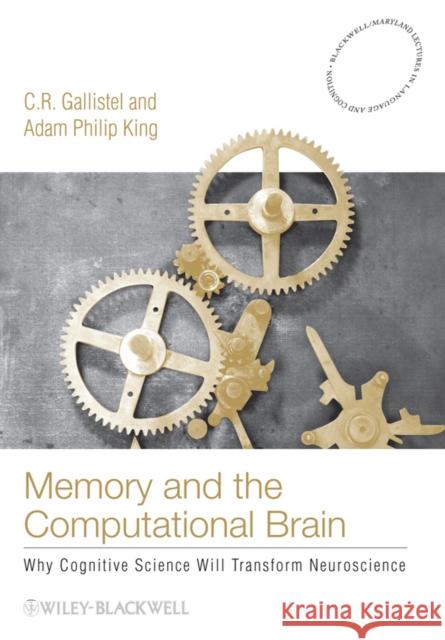
Memory and the Computational Brain: Why Cognitive Science Will Transform Neuroscience Gallistel, C. R. 9781405122870 Wiley-Blackwell - książkaWidoczna okładka, to zdjęcie poglądowe, a rzeczywista szata graficzna może różnić się od prezentowanej.

Memory and the Computational Brain: Why Cognitive Science Will Transform Neuroscience

ISBN-13: 9781405122870 / Angielski / Twarda / 2009 / 336 str.

Randy Gallistel; C. R. Gallistel; Adam King
cena 489,64
(netto: 466,32 VAT:  5%)

Najniższa cena z 30 dni: 487,62
Termin realizacji zamówienia:
ok. 30 dni roboczych
Bez gwarancji dostawy przed świętami

Darmowa dostawa!

Memory and the Computational Brain offers a provocative argument that goes to the heart of neuroscience, proposing that the field can and should benefit from the recent advances of cognitive science and the development of information theory over the course of the last several decades.

  • A provocative argument that impacts across the fields of linguistics, cognitive science, and neuroscience, suggesting new perspectives on learning mechanisms in the brain
  • Proposes that the field of neuroscience can and should benefit from the recent advances of cognitive science and the development of information theory
  • Suggests that the architecture of the brain is structured precisely for learning and for memory, and integrates the concept of an addressable read/write memory mechanism into the foundations of neuroscience
  • Based on lectures in the prestigious Blackwell-Maryland Lectures in Language and Cognition, and now significantly reworked and expanded to make it ideal for students and faculty


Kategorie:
Nauka, Językoznawstwo
Kategorie BISAC:
Language Arts & Disciplines > Linguistics - General
Medical > Neuroscience
Psychology > Cognitive Psychology & Cognition
Wydawca:
Wiley-Blackwell
Seria wydawnicza:
Blackwell/Maryland Lectures in Language and Cognition
Język:
Angielski
ISBN-13:
9781405122870
Rok wydania:
2009
Numer serii:
000038845
Ilość stron:
336
Waga:
0.72 kg
Wymiary:
24.64 x 17.27 x 2.29
Oprawa:
Twarda
Wolumenów:
01
Dodatkowe informacje:
Bibliografia
Glosariusz/słownik
Wydanie ilustrowane

"The book covers wide–ranging ground––indeed, it passes for a computer science or philosophy textbook in places––but it does so in a consistently lucid and engaging fashion." ( CHOICE, December 2009)

"The authors provide a cogent set of ideas regarding a kind of brain functional architecture that could serve as a thought–provoking alternative to that envisioned by current dogma. If one is seriously concerned with understanding and investigating the brain and how it operates, taking the time to absorb the ideas conveyed in this book is likely to be time well spent." (PsycCRITIQUES, November 2009)

"Along with a light complement of fascinating psychological case studies of representations of space and time, and a heavy set of polemical sideswipes at neuroscientists and their hapless computational fellow travelers, this book has the simple goal of persuading us of the importance of a particular information processing mechanism that it claims does not currently occupy center stage." (Nature Neuroscience, October 2009)

Preface.

1. Information.

Shannon’s Theory of Communication.

Measuring Information.

Efficient Coding.

Information and the Brain.

Digital and Analog Signals.

Appendix: The Information Content of Rare Versus Common Events and Signals.

2. Bayesian Updating.

Bayes’ Theorem and Our Intuitions About Evidence.

Using Bayes’ Rule.

Summary.

3. Functions.

Functions of One Argument.

Composition and Decomposition of Functions.

Functions of More than One Argument.

The Limits to Functional Decomposition.

Functions Can Map to Multi–Part Outputs.

Mapping to Multiple–Element Outputs Does Not Increase Expressive Power.

Defining Particular Functions.

Summary: Physical/Neurobiological Implications of Facts about Functions.

4. Representations.

Some Simple Examples.

Notation.

The Algebraic Representation of Geometry.

5. Symbols.

Physical Properties of Good Symbols.

Symbol Taxonomy.

Summary.

6. Procedures.

Algorithms.

Procedures, Computation, and Symbols.

Coding and Procedures.

Two Senses of Knowing.

A Geometric Example.

7. Computation.

Formalizing Procedures.

The Turing Machine.

Turing Machine for the Successor Function.

Turing Machines for ƒ is —even

Turing Machines for ƒ +

Minimal Memory Structure.

General Purpose Computer.

Summary.

8. Architectures.

One–Dimensional Look–Up Tables (If–Then Implementation).

Adding State Memory: Finite–State Machines.

Adding Register Memory.

Summary.

9. Data Structures.

Finding Information in Memory.

An Illustrative Example.

Procedures and the Coding of Data Structures.

The Structure of the Read–Only Biological Memory.

10. Computing with Neurons.

Transducers and Conductors.

Synapses and the Logic Gates.

The Slowness of It All.

The Time–Scale Problem.

Synaptic Plasticity.

Recurrent Loops in Which Activity Reverberates.

11. The Nature of Learning.

Learning As Rewiring.

Synaptic Plasticity and the Associative Theory of Learning.

Why Associations Are Not Symbols.

Distributed Coding.

Learning As the Extraction and Preservation of Useful Information.

Updating an Estimate of One’s Location.

12. Learning Time and Space.

Computational Accessibility.

Learning the Time of Day.

Learning Durations.

Episodic Memory.

13. The Modularity of Learning.

Example 1: Path Integration.

Example 2: Learning the Solar Ephemeris.

Example 3: “Associative” Learning.

Summary.

14. Dead Reckoning in a Neural Network.

Reverberating Circuits as Read/Write Memory Mechanisms.

Implementing Combinatorial Operations by Table–Look–Up.

The Full Model.

The Ontogeny of the Connections?

How Realistic is the Model?

Lessons to be Drawn.

Summary.

15. Neural Models of Interval Timing.

Timing an Interval on First Encounter.

Dworkin’s Paradox.

Neurally Inspired Models.

The Deeper Problems.

16. The Molecular Basis of Memory.

The Need to Separate Theory of Memory from Theory of Learning.

The Coding Question.

A Cautionary Tale.

Why Not Synaptic Conductance?

A Molecular or Sub–Molecular Mechanism?

Bringing the Data to the Computational Machinery.

Is It Universal?

References.

Glossary.

Index.

C. R. Gallistel is Co–Director of the Rutgers Center for Cognitive Science. He is one of the foremost psychologists working on the foundations of cognitive neuroscience. His publications include The Symbolic Foundations of Conditional Behavior (2002), and The Organization of Learning (1990).

Adam Philip King is Assistant Professor of Mathematics at Fairfield University.

Memory and the Computational Brain spans the fields of cognitive science, linguistics, psychology, neuroscience, and education, to suggest new perspectives on the way we consider learning mechanisms in the brain.

Gallistel and King propose that the architecture of the brain is structured precisely for learning and for memory, and that the concept of an addressable read/write memory mechanism should be integrated into the foundations of neuroscience. They argue that the field of neuroscience can and should benefit from the recent advances of cognitive science and the development of information theory over the recent decades. Based on three lectures given by Randy Gallistel in the prestigious Blackwell–Maryland Lectures in Language and Cognition, the text has been significantly revised and expanded with numerous interdisciplinary examples and models and reflects recent research to make it essential reading for both students and those working in the field.


Udostępnij

Facebook - konto krainaksiazek.pl


Opinie o Krainaksiazek.pl na Opineo.pl

Partner Mybenefit

Krainaksiazek.pl w programie rzetelna firma Krainaksiaze.pl - płatności przez paypal

Czytaj nas na:

Facebook - krainaksiazek.pl
  • książki na zamówienie
  • granty
  • książka na prezent
  • kontakt
  • pomoc
  • opinie
  • regulamin
  • polityka prywatności

Zobacz:

  • Księgarnia czeska

  • Wydawnictwo Książkowe Klimaty

1997-2025 DolnySlask.com Agencja Internetowa

© 1997-2022 krainaksiazek.pl
     
KONTAKT | REGULAMIN | POLITYKA PRYWATNOŚCI | USTAWIENIA PRYWATNOŚCI
Zobacz: Księgarnia Czeska | Wydawnictwo Książkowe Klimaty | Mapa strony | Lista autorów
KrainaKsiazek.PL - Księgarnia Internetowa

Polityka prywatnosci - link
Krainaksiazek.pl - płatnośc Przelewy24
Przechowalnia Przechowalnia






