• Wyszukiwanie zaawansowane
  • Kategorie
  • Kategorie BISAC
  • Książki na zamówienie
  • Promocje
  • Granty
  • Książka na prezent
  • Opinie
  • Pomoc
  • Załóż konto
  • Zaloguj się

Membrane Computing: An Introduction » książka

zaloguj się | załóż konto
Logo Krainaksiazek.pl

koszyk

konto

szukaj
topmenu
Księgarnia internetowa
Szukaj
Książki na zamówienie
Promocje
Granty
Książka na prezent
Moje konto
Pomoc
 
 
Wyszukiwanie zaawansowane
Pusty koszyk
Bezpłatna dostawa dla zamówień powyżej 20 złBezpłatna dostawa dla zamówień powyżej 20 zł

Kategorie główne

• Nauka
 [2949965]
• Literatura piękna
 [1857847]

  więcej...
• Turystyka
 [70818]
• Informatyka
 [151303]
• Komiksy
 [35733]
• Encyklopedie
 [23180]
• Dziecięca
 [617748]
• Hobby
 [139972]
• AudioBooki
 [1650]
• Literatura faktu
 [228361]
• Muzyka CD
 [398]
• Słowniki
 [2862]
• Inne
 [444732]
• Kalendarze
 [1620]
• Podręczniki
 [167233]
• Poradniki
 [482388]
• Religia
 [509867]
• Czasopisma
 [533]
• Sport
 [61361]
• Sztuka
 [243125]
• CD, DVD, Video
 [3451]
• Technologie
 [219309]
• Zdrowie
 [101347]
• Książkowe Klimaty
 [123]
• Zabawki
 [2362]
• Puzzle, gry
 [3791]
• Literatura w języku ukraińskim
 [253]
• Art. papiernicze i szkolne
 [7933]
Kategorie szczegółowe BISAC

Membrane Computing: An Introduction

ISBN-13: 9783642628337 / Angielski / Miękka / 2013 / 420 str.
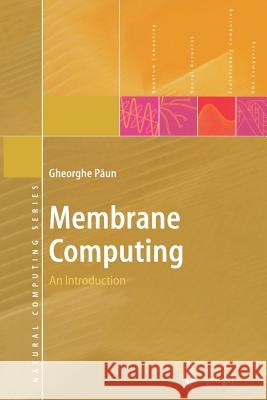
Gheorghe Paun
Membrane Computing: An Introduction Paun, Gheorghe 9783642628337 Springer - książkaWidoczna okładka, to zdjęcie poglądowe, a rzeczywista szata graficzna może różnić się od prezentowanej.

Membrane Computing: An Introduction

ISBN-13: 9783642628337 / Angielski / Miękka / 2013 / 420 str.

Gheorghe Paun
cena 201,72
(netto: 192,11 VAT:  5%)

Najniższa cena z 30 dni: 192,74
Termin realizacji zamówienia:
ok. 22 dni roboczych
Bez gwarancji dostawy przed świętami

Darmowa dostawa!

Membrane computing is an unconventional model of computation associated with a new computing paradigm. The field of membrane computing was initiated in 1998 by the author of this book; it is a branch of natural computing inspired by the structure and functioning of the living cell and devises distributed parallel computing models in the form of membrane systems. This book is the first monograph surveying the new field in a systematic and coherent way. It presents the central notions and results: the main classes of P systems, the main results about their computational power and efficiency, a complete bibliography, and a series of open problems and research topics.


Kategorie:
Informatyka, Bazy danych
Kategorie BISAC:
Computers > Computer Science
Mathematics > Logic
Computers > Machine Theory
Wydawca:
Springer
Seria wydawnicza:
Natural Computing
Język:
Angielski
ISBN-13:
9783642628337
Rok wydania:
2013
Wydanie:
Softcover Repri
Numer serii:
000304236
Ilość stron:
420
Waga:
0.66 kg
Wymiary:
23.5 x 15.5
Oprawa:
Miękka
Wolumenów:
01
Dodatkowe informacje:
Bibliografia
Wydanie ilustrowane

From the reviews:

"The subject of this book is the new computing model known as P-systems (honoring the initiator of the model who is the author of this book) and also as membrane systems. ... the book introduces complexity classes of problems that are suitable for membrane systems. It also provides many open problems in such membrane complexity theory. ... The book has extensive references, open problems and many ideas for further development." (Natasha Jonoska, Zentralblatt MATH, Vol. 1034, 2004)

1. Introduction: Membrane Computing — What It Is and What It Is Not.- 2. Prerequisites.- 2.1 The Biological Membrane.- 2.1.1 The Structure of the Plasma Membrane.- 2.1.2 Trans-membrane Transport.- 2.1.3 Cellular Division: Mitosis.- 2.2 The Neuron.- 2.3 Elements of Computability.- 2.3.1 Basic Notions and Notations.- 2.3.2 Operations with Strings and Languages.- 2.3.3 Chomsky Grammars.- 2.3.4 Characterizations, Necessary Conditions.- 2.3.5 Lindenmayer Systems.- 2.3.6 Finite Automata, Turing Machines.- 2.3.7 Regulated Rewriting.- 2.3.8 On the Difference Between CS and RE.- 2.3.9 Universal Turing Machines and Type-0 Grammars.- 2.3.10 Splicing, Insertion—Deletion, Context Adjoining.- 2.3.11 Elements of Complexity.- 2.3.12 Multisets.- 2.4 Bibliographical Notes.- 3. Membrane Systems with Symbol—Objects.- 3.1 A Simple Class.- 3.2 Two Examples.- 3.3 The Power of the Simple Class.- 3.4 Basic Extensions.- 3.4.1 Dissolving a Membrane.- 3.4.2 Priorities Among the Evolution Rules.- 3.4.3 Two Further Examples.- 3.4.4 The Power of Priority.- 3.4.5 The Power of Synchronization.- 3.5 A Formal Definition.- 3.6 Further Extensions.- 3.6.1 Weak Target Commands.- 3.6.2 Controlling the Permeability of Membranes.- 3.6.3 Communication Controlled by Concentration.- 3.6.4 Creating Rules During the Computation.- 3.6.5 Using Promoters/Inhibitors.- 3.7 Systems with External Output.- 3.8 Bibliographical Notes.- 4. Trading Evolution for Communication.- 4.1 Systems with Symport/Antiport.- 4.2 Computational Universality.- 4.3 Controls on the Use of Rules.- 4.4 Following the Traces of Objects.- 4.5 Systems with Carriers.- 4.6 Bibliographical Notes.- 5. Structuring the Objects.- 5.1 Rewriting Membrane Systems.- 5.2 Some Variants and Their Power.- 5.2.1 Rule Creation.- 5.2.2 Conditional Rewriting.- 5.2.3 Conditional Communication.- 5.2.4 Replicated Rewriting.- 5.2.5 Parallel Rewriting.- 5.3 Splicing Membrane Systems.- 5.4 Contextual Membrane Systems.- 5.5 Insertion—Deletion Membrane Systems.- 5.6 Bibliographical Notes.- 6. Networks of Membranes.- 6.1 The Splicing Case.- 6.2 Using Symport/Antiport Rules.- 6.3 Neural-like Networks of Membranes.- 6.3.1 Definitions and Examples.- 6.3.2 The Computational Power.- 6.3.3 The Computational Efficiency.- 6.4 Bibliographical Notes.- 7. Trading Space for Time.- 7.1 Complexity Classes for Membrane Systems.- 7.2 Using Membrane Division.- 7.2.1 Solving SAT in Linear Time.- 7.2.2 Solving the Hamiltonian Path Problem.- 7.2.3 Using Cooperative Rules.- 7.2.4 Is Membrane Division Necessary?.- 7.3 Using Membrane Creation.- 7.3.1 Solving SAT.- 7.3.2 Solving HPP.- 7.3.3 The Case of String—Objects.- 7.4 Using String Replication.- 7.5 Using Pre-computed Resources.- 7.6 Bibliographical Notes.- 8. Further Technical Results.- 8.1 Decidability Results.- 8.2 Unary Systems.- 8.3 A Representation of Context—free Languages.- 8.4 Valuating the String—Objects.- 8.5 Systems with Enhanced Membrane Handling.- 8.6 Brief Excursion Through the Literature.- 8.6.1 Generalized Sequential Membrane Systems.- 8.6.2 Bidimensional Objects.- 8.6.3 Membrane Systems and Stream X-machines.- 8.6.4 Membrane Systems and Ambient Calculus.- 8.6.5 A Direct Construction of a Universal System.- 8.6.6 Further Research Topics.- 9. (Attempts to Get) Back to Reality.- 9.1 Getting Closer to the Cell by Energy Accounting.- 9.2 Getting Closer to the Cell by Gemmation.- 9.3 Getting Closer to the Cell: Bilayer Membranes.- 9.4 In Silico Implementations.- 9.5 Artificial Life Applications.- 9.6 A Simulation of Photosynthesis.- Open Problems.- Universality Results.- References.

Like quantum computing or DNA computing, membrane computing is an unconventional model of computation associated with a new computing paradigm. The field of membrane computing was initiated in 1998 by the author of this book; it is a branch of natural computing inspired by the structure and functioning of the living cell and devises distributed parallel computing models in the form of membrane systems, also called P systems.
This book is the first monograph surveying the new field in a systematic and coherent way. It presents the central notions and results: the main classes of P systems, the main results about their computational power and efficiency, a complete bibliography, and a series of open problems and research topics. Thus, the book is indispensible reading for anybody interested in molecular computing.

Paun, Gheorghe Paun from the Romanian Academy... więcej >


Udostępnij

Facebook - konto krainaksiazek.pl


Opinie o Krainaksiazek.pl na Opineo.pl

Partner Mybenefit

Krainaksiazek.pl w programie rzetelna firma Krainaksiaze.pl - płatności przez paypal

Czytaj nas na:

Facebook - krainaksiazek.pl
  • książki na zamówienie
  • granty
  • książka na prezent
  • kontakt
  • pomoc
  • opinie
  • regulamin
  • polityka prywatności

Zobacz:

  • Księgarnia czeska

  • Wydawnictwo Książkowe Klimaty

1997-2025 DolnySlask.com Agencja Internetowa

© 1997-2022 krainaksiazek.pl
     
KONTAKT | REGULAMIN | POLITYKA PRYWATNOŚCI | USTAWIENIA PRYWATNOŚCI
Zobacz: Księgarnia Czeska | Wydawnictwo Książkowe Klimaty | Mapa strony | Lista autorów
KrainaKsiazek.PL - Księgarnia Internetowa

Polityka prywatnosci - link
Krainaksiazek.pl - płatnośc Przelewy24
Przechowalnia Przechowalnia





