• Wyszukiwanie zaawansowane
  • Kategorie
  • Kategorie BISAC
  • Książki na zamówienie
  • Promocje
  • Granty
  • Książka na prezent
  • Opinie
  • Pomoc
  • Załóż konto
  • Zaloguj się

Mediterranean-Type Ecosystems: The Function of Biodiversity » książka

zaloguj się | załóż konto
Logo Krainaksiazek.pl

koszyk

konto

szukaj
topmenu
Księgarnia internetowa
Szukaj
Książki na zamówienie
Promocje
Granty
Książka na prezent
Moje konto
Pomoc
 
 
Wyszukiwanie zaawansowane
Pusty koszyk
Bezpłatna dostawa dla zamówień powyżej 20 złBezpłatna dostawa dla zamówień powyżej 20 zł

Kategorie główne

• Nauka
 [2950560]
• Literatura piękna
 [1849509]

  więcej...
• Turystyka
 [71097]
• Informatyka
 [151150]
• Komiksy
 [35848]
• Encyklopedie
 [23178]
• Dziecięca
 [617388]
• Hobby
 [139064]
• AudioBooki
 [1657]
• Literatura faktu
 [228597]
• Muzyka CD
 [383]
• Słowniki
 [2855]
• Inne
 [445295]
• Kalendarze
 [1464]
• Podręczniki
 [167547]
• Poradniki
 [480102]
• Religia
 [510749]
• Czasopisma
 [516]
• Sport
 [61293]
• Sztuka
 [243352]
• CD, DVD, Video
 [3414]
• Technologie
 [219456]
• Zdrowie
 [101002]
• Książkowe Klimaty
 [124]
• Zabawki
 [2311]
• Puzzle, gry
 [3459]
• Literatura w języku ukraińskim
 [254]
• Art. papiernicze i szkolne
 [8079]
Kategorie szczegółowe BISAC

Mediterranean-Type Ecosystems: The Function of Biodiversity

ISBN-13: 9783642788833 / Angielski / Miękka / 2011 / 366 str.
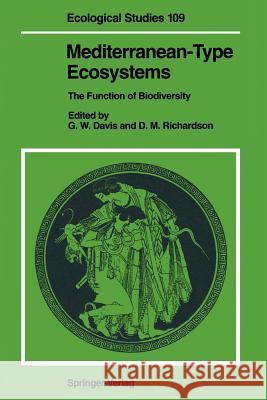
George W. Davis; David M. Richardson
Mediterranean-Type Ecosystems: The Function of Biodiversity Davis, George W. 9783642788833 Springer - książkaWidoczna okładka, to zdjęcie poglądowe, a rzeczywista szata graficzna może różnić się od prezentowanej.

Mediterranean-Type Ecosystems: The Function of Biodiversity

ISBN-13: 9783642788833 / Angielski / Miękka / 2011 / 366 str.

George W. Davis; David M. Richardson
cena 401,58
(netto: 382,46 VAT:  5%)

Najniższa cena z 30 dni: 385,52
Termin realizacji zamówienia:
ok. 22 dni roboczych
Dostawa w 2026 r.

Darmowa dostawa!

Human activities are causing species extinctions at a rate and magnitude rivaling those of past geologic extinction events.
Exploring mediterranean-type ecosystems - the Mediterranean Basin, California, Chile, Australia, and South Africa - this volume addresses the question whether biological diversity plays a significant role in the functioning of natural ecosystems, and to what extent that diversity can be reduced without causing system malfunction. Comparative studies in ecosystems that are similar in certain respects, but differ in others, offer considerable scope for gaining new insights into the links between biodiversity and ecosystem functioning.


Kategorie:
Nauka, Biologia i przyroda
Kategorie BISAC:
Science > Life Sciences - Ecology
Science > Biologia i przyroda
Science > Botanika
Wydawca:
Springer
Seria wydawnicza:
Ecological Studies
Język:
Angielski
ISBN-13:
9783642788833
Rok wydania:
2011
Wydanie:
Softcover Repri
Numer serii:
000007171
Ilość stron:
366
Waga:
0.59 kg
Wymiary:
23.5 x 15.5
Oprawa:
Miękka
Wolumenów:
01

"This book has earned a place in the ecology section of any college library. Personally, I don't think I need to read any more books on biodiversity" Bulletin of the Torrey Botanical Club'

1 Mediterranean-Type Ecosystems: Opportunities and Constraints for Studying the Function of Biodiversity.- 1.1 Focus on Mediterranean-Type Ecosystems.- 1.2 Definitions.- 1.3 Why Study Biodiversity and Ecosystem Function?.- 1.4 Linking Diversity and Ecosystem Function.- 1.5 Mediterranean-Type Ecosystems: Similarities and Differences Between Regions.- 1.5.1 Climate.- 1.5.2 Soils.- 1.5.3 Vegetation.- 1.5.4 Human Transformation.- 1.6 History of Research on Mediterranean-Type Ecosystems.- 1.7 Opportunities for Studying Links Between Biodiversity and Ecosystem Function in MTEs.- References.- 2 Biodiversity and Ecosystem Function in the Mediterranean Basin: Human and Non-Human Determinants.- 2.1 Introduction.- 2.2 Geography, Climate and Habitat Diversity.- 2.2.1 Geography.- 2.2.2 Climate.- 2.2.3 Habitat Diversity.- 2.3 Patterns of Mediterranean Diversities in Relation to Space and Time.- 2.3.1 Flora and Vegetation.- 2.3.2 Vertebrates.- 2.4 The Historical Load and Mediterranean Adaptations.- 2.4.1 Life History Traits of Mediterranean Plants: Historical Effects or Adaptations?.- 2.4.2 Intraspecific Variation.- 2.4.3 Tests of Convergence Between Bird Communities of Mediterranean Regions of France, Chile and California.- 2.5 Humans and the Mediterranean Biota.- 2.5.1 Fire.- 2.5.2 Deforestation.- 2.5.3 Land-Use Patterns.- 2.5.4 The Case of the Disappearing Black Truffles.- 2.5.5 Differences in Human Pressures, North and South.- 2.6 Biodiversity and Ecosystem Function at the Community Level.- 2.6.1 Disturbances as Key Events in Community Dynamics: a Case Study of Post-Fire Succession.- 2.6.2 Regeneration Traits.- 2.6.3 Changing Tree Cover: Oaks, Pines and Soil Fertility.- 2.6.4 Aromatic Compounds and Insect Pollinators.- 2.6.5 Extinctions and Invasions.- 2.7 Functional Groups and Redundancy.- 2.7.1 Legumes, Grasses and Possible Interactions among Them.- 2.7.2 Avian Frugivores and Bird-Dispersed Plants in Mediterranean Shrublands.- 2.7.3 Species Equivalence and Density Compensation.- 2.7.4 Earthworms: Keystone Species at Risk.- 2.7.5 The Spatial Dynamics of Predatory Ants.- 2.8 Ecological and Evolutionary Consequences of Patchiness.- 2.9 The Future.- 2.9.1 Regional and Global Changes.- 2.9.2 Restoration, Rehabilitation and Reallocation.- 2.9.3 Positive Feedback Switches in Mediterranean Ecosystems.- References.- 3 Biodiversity and Ecosystem Functioning in Mediterranean-Climate California.- 3.1 Introduction.- 3.2 Patterns and Determinants of Diversity.- 3.2.1 Historical Determinants of Floristic Diversity.- 3.2.2 Historical Determinants of Vertebrate Diversity.- 3.2.3 Present Patterns of Plant Diversity.- 3.2.4 Present Patterns of Insect Diversity.- 3.2.5 Present Patterns of Vertebrate Diversity.- 3.2.6 Diversity Patterns of Fungi.- 3.2.7 Patterns of Genetic Diversity.- 3.2.8 Effect of Wildfire Frequency on Landscape Diversity.- 3.2.9 Effect of Alien Species’ Invasions on Native Flora and Fauna.- 3.2.10 Effect of Habitat Fragmentation on Patterns of Diversity.- 3.3 Biodiversity and Community Structure and Function.- 3.3.1 Plant Linkages with Other Trophic Levels: Oaks as a Case History.- 3.3.2 Vertebrate Communities.- 3.3.3 Invertebrate Communities.- 3.4 Biodiversity and Ecosystem Function.- 3.4.1 The Annual Grassland Ecosystem.- 3.4.2 The Chaparral Ecosystem.- 3.5 Conclusions.- 3.6 Future Research Needs.- References.- 4 Functional Approaches to Biodiversity in the Mediterranean-Type Ecosystems of Central Chile.- 4.1 Introduction.- 4.2 Biodiversity in Chile.- 4.2.1 Vascular Plants.- 4.2.2 Mammals.- 4.2.3 Birds.- 4.2.4 Reptils and Amphibians.- 4.2.5 Invertebrates.- 4.3 Mediterranean-Type Ecosystems in Central Chile.- 4.4 The Role of Diversity in Ecosystem Function.- 4.5 Plant Species Diversity and Growth-Form Diversity.- 4.6 Environmental Resources as a Factor in Diversity.- 4.6.1 Soil Moisture Resources.- 4.6.2 Nutrient Availability.- 4.6.3 Fire Frequency and Biodiversity.- 4.7 Storage of Species Diversity.- 4.8 Biodiversity in Vertebrate Predator/Prey Systems.- 4.9 Production of Honey at the Community Level.- 4.9.1 Species Representation in Pollen Load Samples.- 4.10 Impact of Changes in Climate and Land-Use on Biodiversity.- 4.11 Conclusions.- References.- 5 Function of Biodiversity in the Mediterranean-Type Ecosystems of Southwestern Australia.- 5.1 Introduction.- 5.2 Mediterranean-Type Ecosystems in Australia.- 5.2.1 Physical Characteristics.- 5.2.2 Vegetation Patterns.- 5.2.3 Floristic Patterns.- 5.2.4 Faunal Richness.- 5.2.5 Landscape Patterns.- 5.2.6 Response to Disturbance.- 5.2.7 Response to Environmental Constraints.- 5.2.8 Human Transformation.- 5.3 Ecosystem Function of Biodiversity.- 5.3.1 Environmental Change and the Loss of Megafauna.- 5.3.2 A Comparison of Natural and Agricultural Systems.- 5.3.3 Loss of Multiple Ecosystem Components: Mistletoes in Eucalypt Woodlands.- 5.3.4 Complex Interactions: Cockatoos, Banksias and Grubs, and Marsupials and Mycorrhizae.- 5.3.5 Ecosystem Processes.- 5.3.6 Functional Groups: Useful or Not?.- 5.3.7 Keystone Species: Banksia prionotes as a Keystone Plant.- 5.4 Research Opportunities.- 5.4.1 Removal of a Functional Group: Jarrah Forest Fire Regimes.- 5.4.2 Removal of a Functional Group: Effects of Phytophthora cinnamomi.- 5.4.3 Additions of Species / Functional Groups in Mine Site Rehabilitation.- 5.4.4 Addition and Removal of Species / Functional Groups: Fragmentation and Revegetation in Agricultural Areas.- 5.4.5 Comparisons Between Species-Rich and Species-Poor Native Plant Communities.- 5.5 Conclusions.- References.- 6 Links between Biodiversity and Ecosystem Function in the Cape Floristic Region.- 6.1 Introduction.- 6.1.1 The Link Between Biodiversity and Ecosystem Function.- 6.1.2 Defining Biodiversity, Ecosystem Function and Scales of Measurement.- 6.1.3 Opportunities at the Cape.- 6.2 Geography of the Region.- 6.3 Patterns of Biodiversity in the Cape Floristic Region.- 6.3.1 Broad-Scale Patterns of Biodiversity.- 6.3.2 Patterns and Determinants of Diversity: Plant Species and Functional Groups.- 6.3.3 Patterns and Determinants of Diversity: Animal Species and Functional Groups.- 6.4 Biodiversity and Ecosystem Function: Community-Level Perspectives.- 6.4.1 Plant Growth Forms as Functional Groups.- 6.4.2 Regeneration Traits of Plants.- 6.4.3 An Ecophysiological Approach to Functional Grouping in Plants.- 6.4.4 Empty Functional Groups.- 6.4.5 Animal Communities.- 6.4.6 Keystone Taxa.- 6.5 Biodiversity and Ecosystem Function: Landscape-Level Perspectives.- 6.5.1 Within Formations.- 6.5.2 Between Formations.- 6.6 The Ecology of Formation Shifts.- 6.6.1 Forest-Fynbos.- 6.6.2 Fynbos-Renosterveld.- 6.6.3 Fynbos-Grassland.- 6.6.4 Fynbos-Alien Trees.- 6.6.5 Formation Shifts and Ecosystem Function.- 6.7 Conclusions.- References.- 7 Ecosystem Function of Biodiversity: Can We Learn From the Collective Experience of MTE Research?.- 7.1 Introduction.- 7.2 Mediterranean-Type Ecosystems as a Focus.- 7.3 Diversity and System Function: a Distillation of MTE Thinking.- 7.3.1 Similarities and Differences in Approach.- 7.4 The Way Ahead.- 7.4.1 Continuing the Search for a New Paradigm.- References.- Taxonomic Index.


Udostępnij

Facebook - konto krainaksiazek.pl


Opinie o Krainaksiazek.pl na Opineo.pl

Partner Mybenefit

Krainaksiazek.pl w programie rzetelna firma Krainaksiaze.pl - płatności przez paypal

Czytaj nas na:

Facebook - krainaksiazek.pl
  • książki na zamówienie
  • granty
  • książka na prezent
  • kontakt
  • pomoc
  • opinie
  • regulamin
  • polityka prywatności

Zobacz:

  • Księgarnia czeska

  • Wydawnictwo Książkowe Klimaty

1997-2025 DolnySlask.com Agencja Internetowa

© 1997-2022 krainaksiazek.pl
     
KONTAKT | REGULAMIN | POLITYKA PRYWATNOŚCI | USTAWIENIA PRYWATNOŚCI
Zobacz: Księgarnia Czeska | Wydawnictwo Książkowe Klimaty | Mapa strony | Lista autorów
KrainaKsiazek.PL - Księgarnia Internetowa

Polityka prywatnosci - link
Krainaksiazek.pl - płatnośc Przelewy24
Przechowalnia Przechowalnia






