• Wyszukiwanie zaawansowane
  • Kategorie
  • Kategorie BISAC
  • Książki na zamówienie
  • Promocje
  • Granty
  • Książka na prezent
  • Opinie
  • Pomoc
  • Załóż konto
  • Zaloguj się

Medical Radiation Dosimetry: Theory of Charged Particle Collision Energy Loss » książka


zaloguj się | załóż konto
Logo Krainaksiazek.pl

koszyk

konto

szukaj
topmenu
Księgarnia internetowa
Szukaj
Książki na zamówienie
Promocje
Granty
Książka na prezent
Moje konto
Pomoc
 
 
Wyszukiwanie zaawansowane
Pusty koszyk
Bezpłatna dostawa dla zamówień powyżej 20 złBezpłatna dostawa dla zamówień powyżej 20 zł

Kategorie główne

• Nauka
 [2946350]
• Literatura piękna
 [1816154]

  więcej...
• Turystyka
 [70666]
• Informatyka
 [151172]
• Komiksy
 [35576]
• Encyklopedie
 [23172]
• Dziecięca
 [611458]
• Hobby
 [135995]
• AudioBooki
 [1726]
• Literatura faktu
 [225763]
• Muzyka CD
 [378]
• Słowniki
 [2917]
• Inne
 [444280]
• Kalendarze
 [1179]
• Podręczniki
 [166508]
• Poradniki
 [469467]
• Religia
 [507199]
• Czasopisma
 [496]
• Sport
 [61352]
• Sztuka
 [242330]
• CD, DVD, Video
 [3348]
• Technologie
 [219391]
• Zdrowie
 [98638]
• Książkowe Klimaty
 [124]
• Zabawki
 [2382]
• Puzzle, gry
 [3525]
• Literatura w języku ukraińskim
 [259]
• Art. papiernicze i szkolne
 [7107]
Kategorie szczegółowe BISAC

Medical Radiation Dosimetry: Theory of Charged Particle Collision Energy Loss

ISBN-13: 9781447154020 / Angielski / Twarda / 2013 / 622 str.
Brian J. McParland
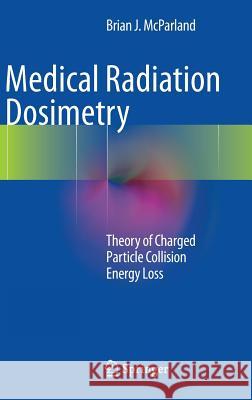
Medical Radiation Dosimetry: Theory of Charged Particle Collision Energy Loss McParland, Brian J. 9781447154020 Springer - książkaWidoczna okładka, to zdjęcie poglądowe, a rzeczywista szata graficzna może różnić się od prezentowanej.

Medical Radiation Dosimetry: Theory of Charged Particle Collision Energy Loss

ISBN-13: 9781447154020 / Angielski / Twarda / 2013 / 622 str.

Brian J. McParland
cena 885,61
(netto: 843,44 VAT:  5%)

Najniższa cena z 30 dni: 848,19
Termin realizacji zamówienia:
ok. 16-18 dni roboczych.

Darmowa dostawa!

Accurate radiation dosimetry is a requirement of radiation oncology, diagnostic radiology and nuclear medicine. It is necessary so as to satisfy the needs of patient safety, therapeutic and diagnostic optimisation, and retrospective epidemiological studies of the biological effects resulting from low absorbed doses of ionising radiation. The radiation absorbed dose received by the patient is the ultimate consequence of the transfer of kinetic energy through collisions between energetic charged particles and atoms of the tissue being traversed. Thus, the ability of the medical physicist to both measure and calculate accurately patient dosimetry demands a deep understanding of the physics of charged particle interactions with matter. Interestingly, the physics of charged particle energy loss has an almost exclusively theoretical basis, thus necessitating an advanced theoretical understanding of the subject in order to apply it appropriately to the clinical regime.​ Each year, about one-third of the world's population is exposed to ionising radiation as a consequence of diagnostic or therapeutic medical practice. The optimisation of the resulting radiation absorbed dose received by the patient and the clinical outcome sought, whether diagnostic or therapeutic, demands accuracy in the evaluation of the radiation absorbed doses resulting from such exposures. This requirement arrises primarily from two broadly-encompassing factors:

  • The requirement in radiation oncology for a 5% or less uncertainty in the calculation and measurement of absorbed dose so as to optimise the therapeutic ratio of the probabilities of tumour control and normal tissue complications; and
  • The establishment and further refinement of dose reference levels used in diagnostic radiology and nuclear medicine to minimise the amount of absorbed dose for a required degree of diagnostic benefit.
The radiation absorbed dose is the outcome of energetic charged particles decelerating and transferring their kinetic energy to tissue. The calculation of this energy deposition, characterised by the stopping power, is unique in that it is derived entirely from theoretical principles. This dominant role of the associated theory makes its understanding of fundamental to the calculation of the radiation absorbed dose to the patient.The theoretical development of charged particle energy loss recognised in medical physics textbooks is in general limited to basic derivations based upon classical theory, generally a simplified form of the Bohr theory. More advanced descriptions of, for example, the Bethe-Bloch quantum result usually do not go beyond the simple presentation of the result without full explanation of the theoretical development of the theory and consideration of its limitations, its dependencies upon the Born perturbation theory and the various correction factors needed to correct for the failures of that Born theory at higher orders. This is not appropriate for a full understanding of the theory that its importance deserves. The medical radiation physicist should be aware of the details of the theoretical derivations of charged particle energy loss in order to appreciate the levels of accuracy in tabular data provided in reports and the calculation methodologies used in modern Monte Carlo calculations of radiation dosimetry.

Kategorie:
Nauka, Medycyna
Kategorie BISAC:
Medical > Radiologia
Medical > Biochemistry
Technology & Engineering > Imaging Systems
Wydawca:
Springer
Język:
Angielski
ISBN-13:
9781447154020
Rok wydania:
2013
Wydanie:
2014
Ilość stron:
622
Waga:
1.04 kg
Wymiary:
24.1 x 15.7 x 3.0
Oprawa:
Twarda
Wolumenów:
01

From the book reviews:

"This is a detailed comprehensive discussion of quantum mechanics and particle physics related to radiation physics and therapy. ... This book is of great value to radiation oncologists and physicists. I highly recommend it." (Joseph J. Grenier, Amazon.com, October, 2014)

Part I. Introduction to Charged Particles.- ​1. Introduction.- 2. Elements of Quantum Scattering Theory.- Part II. Elastic Coulomb Scatter.- 3. Introduction of Part II.- 4. Elastic Coulomb Scatter from an Unscreened Point Charge.- 5. Elastic Coulomb Scatter from Distributed and Screened Charges.- 6. Multiple Elastic Coulomb Scatter.- Part III. Collision Energy Loss.- 7. Introduction to Part III.- 8. Soft Collisions.- 9. Hard Collisions.- 10. Total and Restricted Collision Stopping Powers and Theory of the Mean Energy Expended to Create an Ion Pair.- 11. Mean Excitation Energy.- 12. Higher-Order Corrections in the Collision Stopping Power.- 13. Charged Particle Range.- 14. Collision Energy Loss in Compound Media.- Part IV. Stochastic Collision Energy Loss.- 15. Introduction to Part IV.- 16. Collision Statistics.- 17. The Chapman-Kolmogorov and Bothe-Landau Equations.- 18. Probability Distribution Functions for Collision Energy Loss.

Brian J McParland, BASc MSc PhD CPhys CSci FCCPM FIPEM FInstP, is a Head of Medical Physics with an extensive research and clinical background in medical physics in senior hospital, university and commercial appointments.  He is a recognised authority in the field of medical radiation dosimetry, having practised the discipline in radiation oncology, diagnostic radiology, nuclear medicine and radiation protection.  Dr McParland is an elected Fellow of the Canadian College of Physicists in Medicine, the Institute of Physics and Engineering in Medicine, and the Institute of Physics, and is both a Certified Scientist and a Certified Physicist in the United Kingdom.   Dr McParland is the author of the awarded companion text book, Nuclear Medicine Radiation Dosimetry: Advanced Theoretical Principles and of over 90 peer-reviewed publications in the medical and physics literature.

Medical Radiation Dosimetry: Theory of Charged Particle Collision Energy Loss provides a uniquely required advanced, comprehensive and definitive theoretical description of the physics of charged particle collision energy loss and the role that it plays in the clinical radiation dosimetry resulting from exposure to ionising radiation.

Medical Radiation Dosimetry: Theory of Charged Particle Collision Energy Loss is both an advanced mathematical and physics treatise and an essential reference volume for the medical physics graduate student and the medical radiation physicist working in the field of clinical and research radiation dosimetry. It will assist both audiences in both the understanding of the genesis of the numerical data provided in multiple technical reports and publications, and of the limitations of these data.


Udostępnij

Facebook - konto krainaksiazek.pl


Opinie o Krainaksiazek.pl na Opineo.pl

Partner Mybenefit

Krainaksiazek.pl w programie rzetelna firma Krainaksiaze.pl - płatności przez paypal

Czytaj nas na:

Facebook - krainaksiazek.pl
  • książki na zamówienie
  • granty
  • książka na prezent
  • kontakt
  • pomoc
  • opinie
  • regulamin
  • polityka prywatności

Zobacz:

  • Księgarnia czeska

  • Wydawnictwo Książkowe Klimaty

1997-2026 DolnySlask.com Agencja Internetowa

© 1997-2022 krainaksiazek.pl
     
KONTAKT | REGULAMIN | POLITYKA PRYWATNOŚCI | USTAWIENIA PRYWATNOŚCI
Zobacz: Księgarnia Czeska | Wydawnictwo Książkowe Klimaty | Mapa strony | Lista autorów
KrainaKsiazek.PL - Księgarnia Internetowa

Polityka prywatnosci - link
Krainaksiazek.pl - płatnośc Przelewy24
Przechowalnia Przechowalnia







