• Wyszukiwanie zaawansowane
  • Kategorie
  • Kategorie BISAC
  • Książki na zamówienie
  • Promocje
  • Granty
  • Książka na prezent
  • Opinie
  • Pomoc
  • Załóż konto
  • Zaloguj się

Mechanical Systems, Classical Models: Volume 1: Particle Mechanics » książka


zaloguj się | załóż konto
Logo Krainaksiazek.pl

koszyk

konto

szukaj
topmenu
Księgarnia internetowa
Szukaj
Książki na zamówienie
Promocje
Granty
Książka na prezent
Moje konto
Pomoc
 
 
Wyszukiwanie zaawansowane
Pusty koszyk
Bezpłatna dostawa dla zamówień powyżej 20 złBezpłatna dostawa dla zamówień powyżej 20 zł

Kategorie główne

• Nauka
 [2946912]
• Literatura piękna
 [1852311]

  więcej...
• Turystyka
 [71421]
• Informatyka
 [150889]
• Komiksy
 [35717]
• Encyklopedie
 [23177]
• Dziecięca
 [617324]
• Hobby
 [138808]
• AudioBooki
 [1671]
• Literatura faktu
 [228371]
• Muzyka CD
 [400]
• Słowniki
 [2841]
• Inne
 [445428]
• Kalendarze
 [1545]
• Podręczniki
 [166819]
• Poradniki
 [480180]
• Religia
 [510412]
• Czasopisma
 [525]
• Sport
 [61271]
• Sztuka
 [242929]
• CD, DVD, Video
 [3371]
• Technologie
 [219258]
• Zdrowie
 [100961]
• Książkowe Klimaty
 [124]
• Zabawki
 [2341]
• Puzzle, gry
 [3766]
• Literatura w języku ukraińskim
 [255]
• Art. papiernicze i szkolne
 [7810]
Kategorie szczegółowe BISAC

Mechanical Systems, Classical Models: Volume 1: Particle Mechanics

ISBN-13: 9789048173693 / Angielski / Miękka / 2010 / 778 str.
Petre P. Teodorescu
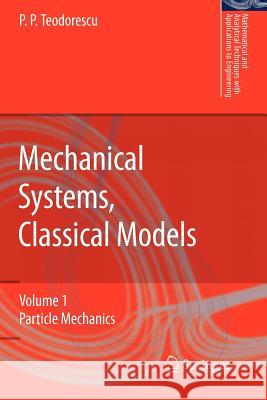
Mechanical Systems, Classical Models: Volume 1: Particle Mechanics Teodorescu, Petre P. 9789048173693 Springer - książkaWidoczna okładka, to zdjęcie poglądowe, a rzeczywista szata graficzna może różnić się od prezentowanej.

Mechanical Systems, Classical Models: Volume 1: Particle Mechanics

ISBN-13: 9789048173693 / Angielski / Miękka / 2010 / 778 str.

Petre P. Teodorescu
cena 805,10
(netto: 766,76 VAT:  5%)

Najniższa cena z 30 dni: 771,08
Termin realizacji zamówienia:
ok. 22 dni roboczych
Bez gwarancji dostawy przed świętami

Darmowa dostawa!

All phenomena in nature are characterized by motion; this is an essential property of matter, having infinitely many aspects. Motion can be mechanical, physical, chemical or biological, leading to various sciences of nature, mechanics being one of them. Mechanics deals with the objective laws of mechanical motion of bodies, the simplest form of motion. In the study of a science of nature mathematics plays an important role. Mechanics is the first science of nature which was expressed in terms of mathematics by considering various mathematical models, associated to phenomena of the surrounding nature. Thus, its development was influenced by the use of a strong mathematical tool; on the other hand, we must observe that mechanics also influenced the introduction and the development of many mathematical notions. In this respect, the guideline of the present book is precisely the mathematical model of mechanics. A special accent is put on the solving methodology as well as on the mathematical tools used; vectors, tensors and notions of field theory. Continuous and discontinuous phenomena, various mechanical magnitudes are presented in a unitary form by means of the theory of distributions. Some appendices give the book an autonomy with respect to other works, special previous mathematical knowledge being not necessary. Some applications connected to important phenomena of nature are presented, and this also gives one the possibility to solve problems of interest from the technical, engineering point of view. In this form, the book becomes we dare say a unique outline of the literature in the field; the author wishes to present the most important aspects connected with the study of mechanical systems, mechanics being regarded as a science of nature, as well as its links to other sciences of nature. Implications in technical sciences are not neglected."


Kategorie:
Nauka, Fizyka
Kategorie BISAC:
Science > Mechanics - General
Mathematics > Matematyka stosowana
Science > Fizyka matematyczna
Wydawca:
Springer
Seria wydawnicza:
Mathematical and Analytical Techniques with Applications to
Język:
Angielski
ISBN-13:
9789048173693
Rok wydania:
2010
Numer serii:
000308998
Ilość stron:
778
Waga:
1.19 kg
Wymiary:
23.5 x 15.5
Oprawa:
Miękka
Wolumenów:
01
Dodatkowe informacje:
Bibliografia

From the reviews:

"This book is the first volume of a treatise on the classical theory of mechanical systems. ... The book is useful at the graduate level in physics and mechanical engineering, as well as in mathematics. ... The mathematical aspects are carefully presented. The text provides a detailed analysis of some generic examples, which will be enough to show how the theory is applied, at least for experienced readers. The subjects covered by the text are divided into 10 large chapters." (José Fernández-Núñez, Mathematical Reviews, Issue 2008 j)

PREFACE 1. NEWTONIAN MODEL OF MECHANICS. 1.1. Mechanics, science of nature. 1.1.1. Basic notions. 1.1.2. Mathematical model of mechanics. 1.2. Dimensional analysis. Units. Homogeneity. Similitude. 1.2.1. Physical quantities. Units. 1.2.2. Homogeneity. 1.2.3. Similitude. 2. MECHANICS OF THE SYSTEMS OF FORCES. 2.1. Introductory notions. 2.1.1. Decomposition of forces. Bases. 2.1.2. Products of vectors. 2.2. Systems of forces. 2.2.1. Moments. 2.2.2. Reduction of systems of forces. 3. MASS GEOMETRY. DISPLACEMENTS. CONSTRAINTS. 3.1. Mass geometry. 3.1.1. Centres of mass. 3.1.2. Moments of inertia. 3.2. Displacements. Constraints. 3.2.1. Displacements. 3.2.2. Constraints. 4. STATICS. 4.1. Statics of discrete mechanical systems. 4.1.1. Statics of the particle. 4.1.2. Statics of discrete systems of particles. 4.2. Statics of solids. 4.2.1. Statics of rigid solids. 4.2.2. Statics of threads. 5. KINEMATICS. 5.1. Kinematics of the particle. 5.1.1. Trajectory and velocity of the particle. 5.1.2. Acceleration of the particle. 5.1.3. Particular cases of motion of a particle. 5.2. Kinematics of the rigid solid. 5.2.1. Kinematical formulae in the motion of a rigid solid. 5.2.2. Particular cases of motion of the rigid solid. 5.2.3. General motion of the rigid solid. 5.3. Relative motion. Kinematics of mechanical systems. 5.3.1. Relative motion of a particle. 5.3.2. Relative motion of the rigid solid. 5.3.3. Kinematics of systems of rigid solids. 6. DYNAMICS OF THE PARTICLE WITH RESPECT TO AN INERTIAL FRAME OF REFERENCE. 6.1. Introductory notions. General theorems. 6.1.1. Introductory notions. 6.1.2. General theorems. 6.2. Dynamics of the particle subjected to constraints. 6.2.1. General considerations. 6.2.2. Motion of the particle with one or two degrees of freedom. 7. PROBLEMS OF DYNAMICS OF THE PARTICLE. 7.1. Motion of the particle in a gravitational field. 7.1.1. Rectilinear and plane motion. 7.1.2. Motion of a heavy particle. 7.1.3. Pendulary motion. 7.2. Other problems of dynamics of the particle. 7.2.1. Tautochronous motions. Motions on a brachistochrone and on a geodesic curve. 7.2.2. Other applications. 7.2.3. Stability of equilibrium of a particle. 8. DYNAMICS OF THE PARTICLE IN A FIELD OF ELASTIC FORCES. 8.1. The motion of a particle acted upon by a central force. 8.1.1. General results. 8.1.2. Other problems. 8.2. Motion of a particle subjected to the action of an elastic force. 8.2.1. Mechanical systems with two degrees of freedom. 8.2.2. Mechanical systems with a single degree of freedom. 9. NEWTONIAN THEORY OF UNIVERSAL ATTRACTION. 9.1. Newtonian model of universal attraction. 9.1.1. Principle of universal attraction. 9.1.2. Theory of Newtonian potential. 9.2. Motion due to the action of Newtonian forces of attraction. 9.2.1. Motion of celestial bodies. 9.2.2. Problem of artificial satellites of the Earth and of interplanetary vehicles. 9.2.3. Applications to the theory of motion at the atomic level. 10. OTHER CONSIDERATIONS ON PARTICLE DYNAMICS. 10.1. Motion with discontinuity. 10.1.1. Particle dynamics. 10.1.2. General theorems. 10.2. Motion of a particle with respect to a non-inertial frame of reference. 10.2.1. Relative motion. Relative equilibrium. 10.2.2. Elements of terrestrial mechanics. 10.3. Dynamics of the particle of variable mass. 10.3.1. Mathematical model of the motion. General theorems. 10.3.2. Motion of a particle of variable mass in a gravitational field. 10.3.3. Mathematical pendulum. Motion of a particle of variable mass in a field of central forces. 10.3.4. Applications of Meshcherskii’s generalized equation. APPENDIX. 1. Elements of vector calculus. 1.1. Vector analysis. 1.2. Exterior differential calculus. 2. Notions of field theory. 2.1. Conservative vectors. Gradient. 2.2. Differential operators of first and second order. 2.3. Integral formulae. 3. Elements of theory of distributions. 3.1. Composition of distributions. 3.2. Integral transforms in distributions. 3.3.

Prof. Dr. Doc. Petre P. Teodorescu
Born: June 30, 1929, Bucuresti.
M.Sc.: Faculty of Mathematics of the University of Bucharest, 1952; Faculty of Bridges of the Technical University of Civil Engineering, Bucharest, 1953.
Ph.D.: "Calculus of rectangular deep beams in a general case of support and loading", Technical University of Civil Engineering, Bucharest, 1955.
Academic Positions: Consulting Professor.
at the University of Bucharest, Faculty of Mathematics.
Fields of Research: Mechanics of Deformable Solids (especially Elastic Solids), Mathematical Methods of Calculus in Mechanics.
Selected Publications:
1. "Applications of the Theory of Distributions in Mechanics", Editura Academiei-Abacus Press, Bucuresti-Tunbrige Wells, Kent, 1974 (with W. Kecs);
2. "Dynamics of Linear Elastic Bodies", Editura Academiei-Abacus Press, Bucuresti-Tunbrige Wells, Kent, 1975;
3. "Spinor and Non-Euclidean Tensor Calculus with Applications", Editura Tehnicã-Abacus Press, Bucuresti-Tunbrige Wells, Kent, 1983 (with I. Beju and E. Soos);
4. "Mechanical Systems", vol. I, II, Editura Tehnicã, Bucuresti, 1988.
Invited Addresses: The 2nd European Conference of Solid Mechanics, September 1994, Genoa, Italy: Leader of a Section of the Conference and a Communication.
Lectures Given Abroad: Hannover, Dortmund, Paderborn, Germany, 1994; Padova, Pisa, Italy, 1994.
Additional Information: Prize "Gh. Titeica" of the Romanian Academy in 1966; Member in the Advisory Board of Meccanica (Italy), Mechanics Research Communications and Letters in Applied Engineering Sciences (U.S.A.); Member of GAMM (Germany) and AMS (U.S.A.); Reviewer: Mathematical Reviews, Zentralblatt fuer Mathematik und ihre Grenzgebiete, Ph.D. advisor.

All phenomena in nature are characterized by motion; this is an essential property of matter, having infinitely many aspects. Motion can be mechanical, physical, chemical or biological, leading to various sciences of nature, mechanics being one of them. Mechanics deals with the objective laws of mechanical motion of bodies, the simplest form of motion.

In the study of a science of nature mathematics plays an important role. Mechanics is the first science of nature which was expressed in terms of mathematics by considering various mathematical models, associated to phenomena of the surrounding nature. Thus, its development was influenced by the use of a strong mathematical tool; on the other hand, we must observe that mechanics also influenced the introduction and the development of many mathematical notions.

In this respect, the guideline of the present book is precisely the mathematical model of mechanics. A special accent is put on the solving methodology as well as on the mathematical tools used; vectors, tensors and notions of field theory. Continuous and discontinuous phenomena, various mechanical magnitudes are presented in a unitary form by means of the theory of distributions. Some appendices give the book an autonomy with respect to other works, special previous mathematical knowledge being not necessary.

Some applications connected to important phenomena of nature are presented, and this also gives one the possibility to solve problems of interest from the technical, engineering point of view. In this form, the book becomes – we dare say – a unique outline of the literature in the field; the author wishes to present the most important aspects connected with the study of mechanical systems, mechanics being regarded as a science of nature, as well as its links to other sciences of nature. Implications in technical sciences are not neglected.

Audience:
Librarians, and researchers interested in the fundamentals of mechanics


Udostępnij

Facebook - konto krainaksiazek.pl


Opinie o Krainaksiazek.pl na Opineo.pl

Partner Mybenefit

Krainaksiazek.pl w programie rzetelna firma Krainaksiaze.pl - płatności przez paypal

Czytaj nas na:

Facebook - krainaksiazek.pl
  • książki na zamówienie
  • granty
  • książka na prezent
  • kontakt
  • pomoc
  • opinie
  • regulamin
  • polityka prywatności

Zobacz:

  • Księgarnia czeska

  • Wydawnictwo Książkowe Klimaty

1997-2025 DolnySlask.com Agencja Internetowa

© 1997-2022 krainaksiazek.pl
     
KONTAKT | REGULAMIN | POLITYKA PRYWATNOŚCI | USTAWIENIA PRYWATNOŚCI
Zobacz: Księgarnia Czeska | Wydawnictwo Książkowe Klimaty | Mapa strony | Lista autorów
KrainaKsiazek.PL - Księgarnia Internetowa

Polityka prywatnosci - link
Krainaksiazek.pl - płatnośc Przelewy24
Przechowalnia Przechowalnia





