• Wyszukiwanie zaawansowane
  • Kategorie
  • Kategorie BISAC
  • Książki na zamówienie
  • Promocje
  • Granty
  • Książka na prezent
  • Opinie
  • Pomoc
  • Załóż konto
  • Zaloguj się

Maximum-Likelihood Deconvolution: A Journey Into Model-Based Signal Processing » książka


zaloguj się | załóż konto
Logo Krainaksiazek.pl

koszyk

konto

szukaj
topmenu
Księgarnia internetowa
Szukaj
Książki na zamówienie
Promocje
Granty
Książka na prezent
Moje konto
Pomoc
 
 
Wyszukiwanie zaawansowane
Pusty koszyk
Bezpłatna dostawa dla zamówień powyżej 20 złBezpłatna dostawa dla zamówień powyżej 20 zł

Kategorie główne

• Nauka
 [2949965]
• Literatura piękna
 [1857847]

  więcej...
• Turystyka
 [70818]
• Informatyka
 [151303]
• Komiksy
 [35733]
• Encyklopedie
 [23180]
• Dziecięca
 [617748]
• Hobby
 [139972]
• AudioBooki
 [1650]
• Literatura faktu
 [228361]
• Muzyka CD
 [398]
• Słowniki
 [2862]
• Inne
 [444732]
• Kalendarze
 [1620]
• Podręczniki
 [167233]
• Poradniki
 [482388]
• Religia
 [509867]
• Czasopisma
 [533]
• Sport
 [61361]
• Sztuka
 [243125]
• CD, DVD, Video
 [3451]
• Technologie
 [219309]
• Zdrowie
 [101347]
• Książkowe Klimaty
 [123]
• Zabawki
 [2362]
• Puzzle, gry
 [3791]
• Literatura w języku ukraińskim
 [253]
• Art. papiernicze i szkolne
 [7933]
Kategorie szczegółowe BISAC

Maximum-Likelihood Deconvolution: A Journey Into Model-Based Signal Processing

ISBN-13: 9781461279853 / Angielski / Miękka / 2011 / 227 str.
C. S. M. Burrus
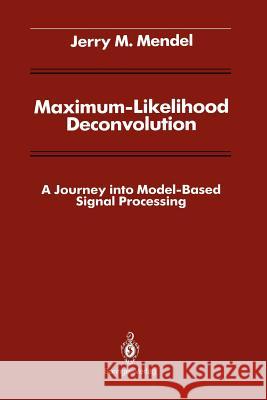
Maximum-Likelihood Deconvolution: A Journey Into Model-Based Signal Processing Mendel, Jerry M. 9781461279853 Springer - książkaWidoczna okładka, to zdjęcie poglądowe, a rzeczywista szata graficzna może różnić się od prezentowanej.

Maximum-Likelihood Deconvolution: A Journey Into Model-Based Signal Processing

ISBN-13: 9781461279853 / Angielski / Miękka / 2011 / 227 str.

C. S. M. Burrus
cena 201,72
(netto: 192,11 VAT:  5%)

Najniższa cena z 30 dni: 192,74
Termin realizacji zamówienia:
ok. 22 dni roboczych
Bez gwarancji dostawy przed świętami

Darmowa dostawa!

Convolution is the most important operation that describes the behavior of a linear time-invariant dynamical system. Deconvolution is the unraveling of convolution. It is the inverse problem of generating the system's input from knowledge about the system's output and dynamics. Deconvolution requires a careful balancing of bandwidth and signal-to-noise ratio effects. Maximum-likelihood deconvolution (MLD) is a design procedure that handles both effects. It draws upon ideas from Maximum Likelihood, when unknown parameters are random. It leads to linear and nonlinear signal processors that provide high-resolution estimates of a system's input. All aspects of MLD are described, from first principles in this book. The purpose of this volume is to explain MLD as simply as possible. To do this, the entire theory of MLD is presented in terms of a convolutional signal generating model and some relatively simple ideas from optimization theory. Earlier approaches to MLD, which are couched in the language of state-variable models and estimation theory, are unnecessary to understand the essence of MLD. MLD is a model-based signal processing procedure, because it is based on a signal model, namely the convolutional model. The book focuses on three aspects of MLD: (1) specification of a probability model for the system's measured output; (2) determination of an appropriate likelihood function; and (3) maximization of that likelihood function. Many practical algorithms are obtained. Computational aspects of MLD are described in great detail. Extensive simulations are provided, including real data applications.


Kategorie:
Technologie
Kategorie BISAC:
Technology & Engineering > Telecommunications
Wydawca:
Springer
Seria wydawnicza:
Signal Processing and Digital Filtering
Język:
Angielski
ISBN-13:
9781461279853
Rok wydania:
2011
Wydanie:
Softcover Repri
Numer serii:
000221107
Ilość stron:
227
Waga:
0.38 kg
Wymiary:
23.5 x 15.5
Oprawa:
Miękka
Wolumenów:
01

1 - Introduction.- 1.1 Introduction.- 1.2 Our Approach.- 1.3 Likelihood Versus Probability.- 1.4 Maximum-Likelihood Method.- 1.5 Comments.- 2 - Convolutional Model.- 2.1 Introduction.- 2.2 The Seismic Convolutional Model.- 2.3 Input.- 2.3.1 Gaussian White Sequences.- 2.3.2 Bernoulli White Sequences.- 2.3.3 Bernoulli-Gaussian White Sequences.- 2.3.4 Bernoulli-Gaussian Plus Backscatter Sequences.- 2.4 Channel Model IR (Seismic Wavelet).- 2.5 Measurement Noise.- 2.6 Other Effects.- 2.7 Mathematical Model.- 2.8 Summary.- 3 - Likelihood.- 3.1 Introduction.- 3.2 Loglikelihood.- 3.3 Likelihood Function.- 3.4 Using Given Information.- 3.5 Message for the Reader.- 3.6 Mathematical Likelihood Functions.- 3.7 Mathematical Loglikelihood Functions.- 3.8 Summary.- 4 - Maximizing Likelihood.- 4.1 Introduction.- 4.2 A Rationale.- 4.3 Block Component Search Algorithms.- 4.4 Mathematical Fact.- 4.5 Separation Principle.- 4.6 Update Random Parameters.- 4.7 Binary Detection.- 4.7.1 Threshold Detector.- 4.7.2 Single Most-Likely Replacement Detector.- 4.7.3 Multiple Most-Likely Replacement Detector.- 4.7.4 Single Spike Shift Detector.- 4.7.5 Other Detectors.- 4.8 Update Wavelet Parameters.- 4.9 Update Statistical Parameters.- 4.10 Message for the Reader.- 4.11 Summary.- 5 - Properties and Performance.- 5.1 Introduction.- 5.2 Minimum-Variance Deconvolution.- 5.3 Detectors.- 5.3.1 Threshold Detector.- 5.3.2 SMLR Detector.- 5.4 A Modified Likelihood Function.- 5.5 An Objective Function.- 5.6 Marquardt-Levenberg Algorithm.- 5.7 Convergence.- 5.8 Entropy Interpretation.- 5.9 Summary.- 6 - Examples.- 6.1 Introduction.- 6.2 Some Real Data Examples.- 6.3 Minimum-Variance Deconvolution.- 6.4 Detection.- 6.5 Block Component Method.- 6.6 Backscatter.- 6.7 Noncausal Channel Models.- 6.8 Summary.- 7 - Mathematical Details for Chapter 4.- 7.1 Introduction.- 7.2 Mathematical Fact.- 7.3 Separation Principle.- 7.4 Minimum-Variance Deconvolution.- 7.5 Threshold Detector.- 7.6 Single Most-Likely Replacement Detector.- 7.7 Single Spike Shift Detector.- 7.8 SSS-SMLR Detector.- 7.9 Marquardt-Levenberg Algorithm.- 7.10 Calculating Gradients.- 7.10.1 Gradients of M with Respect to a and b.- 7.10.2 Gradients of L with Respect to a and b.- 7.10.3 Derivatives of M with Respect to Variances.- 7.10.4 Derivatives of L with Respect to Variances.- 7.11 Calculating Second Derivatives.- 7.11.1 Pseudo-Hessian of M with Respect to a and b.- 7.11.2 Pseudo-Hessian of L with Respect to a and b.- 7.11.3 Second Derivatives of M with Respect to Variances.- 7.11.4 Second Derivatives of L with Respect to Variances.- 7.12 Why vr Cannot be Estimated: Maximization of L or M is an Ill-Posed Problem.- 7.13 An Algorithm for ?.- 8 - Mathematical Details for Chapter 5.- 8.1 Introduction.- 8.2 MVD Filter Properties.- 8.2.1 Derivation of F(?).- 8.2.2 Undershoot Property.- 8.3 Threshold Detector.- 8.4 Modified Likelihood Function.- 8.5 Separation Principle for P and Derivation of N from P.- 8.6 Why vr Cannot be Estimated: Maximization of P or N is not an Ill-Posed Problem.- 8.7 SMLR1 Detector Based on N.- 8.8 Quadratic Convergence of the Newton-Raphson Algorithm.- 8.9 Wavelet Identifiability.- 8.10 Convergence of Adaptive SMLR Detector.- 9 - Computational Considerations.- 9.1 Introduction.- 9.2 Recursive Processing.- 9.2.1 A Recursive Wavelet Model.- 9.2.2 Recursive MVD Algorithm.- 9.2.2.1 Input Estimator.- 9.2.2.2 Backward-Running Filter.- 9.2.2.3 Innovations Process.- 9.2.2.4 Kalman Predictor.- 9.2.3 Detection.- 9.2.4 Likelihood and Objective Functions.- 9.2.5 Gradients of L and M.- 9.2.5.1 Gradients of L.- 9.2.5.2 Gradients of M.- 9.2.6 Pseudo-Hessians of L and M.- 9.2.6.1 Pseudo-Hessian of L.- 9.2.6.2 Pseudo-Hessian of M.- 9.2.7 Computational Requirements for Recursive Processing.- 9.3 Summary.- References.


Udostępnij

Facebook - konto krainaksiazek.pl


Opinie o Krainaksiazek.pl na Opineo.pl

Partner Mybenefit

Krainaksiazek.pl w programie rzetelna firma Krainaksiaze.pl - płatności przez paypal

Czytaj nas na:

Facebook - krainaksiazek.pl
  • książki na zamówienie
  • granty
  • książka na prezent
  • kontakt
  • pomoc
  • opinie
  • regulamin
  • polityka prywatności

Zobacz:

  • Księgarnia czeska

  • Wydawnictwo Książkowe Klimaty

1997-2025 DolnySlask.com Agencja Internetowa

© 1997-2022 krainaksiazek.pl
     
KONTAKT | REGULAMIN | POLITYKA PRYWATNOŚCI | USTAWIENIA PRYWATNOŚCI
Zobacz: Księgarnia Czeska | Wydawnictwo Książkowe Klimaty | Mapa strony | Lista autorów
KrainaKsiazek.PL - Księgarnia Internetowa

Polityka prywatnosci - link
Krainaksiazek.pl - płatnośc Przelewy24
Przechowalnia Przechowalnia





