• Wyszukiwanie zaawansowane
  • Kategorie
  • Kategorie BISAC
  • Książki na zamówienie
  • Promocje
  • Granty
  • Książka na prezent
  • Opinie
  • Pomoc
  • Załóż konto
  • Zaloguj się

Matrix Algebra for Linear Mode » książka


zaloguj się | załóż konto
Logo Krainaksiazek.pl

koszyk

konto

szukaj
topmenu
Księgarnia internetowa
Szukaj
Książki na zamówienie
Promocje
Granty
Książka na prezent
Moje konto
Pomoc
 
 
Wyszukiwanie zaawansowane
Pusty koszyk
Bezpłatna dostawa dla zamówień powyżej 20 złBezpłatna dostawa dla zamówień powyżej 20 zł

Kategorie główne

• Nauka
 [2950560]
• Literatura piękna
 [1849509]

  więcej...
• Turystyka
 [71097]
• Informatyka
 [151150]
• Komiksy
 [35848]
• Encyklopedie
 [23178]
• Dziecięca
 [617388]
• Hobby
 [139064]
• AudioBooki
 [1657]
• Literatura faktu
 [228597]
• Muzyka CD
 [383]
• Słowniki
 [2855]
• Inne
 [445295]
• Kalendarze
 [1464]
• Podręczniki
 [167547]
• Poradniki
 [480102]
• Religia
 [510749]
• Czasopisma
 [516]
• Sport
 [61293]
• Sztuka
 [243352]
• CD, DVD, Video
 [3414]
• Technologie
 [219456]
• Zdrowie
 [101002]
• Książkowe Klimaty
 [124]
• Zabawki
 [2311]
• Puzzle, gry
 [3459]
• Literatura w języku ukraińskim
 [254]
• Art. papiernicze i szkolne
 [8079]
Kategorie szczegółowe BISAC

Matrix Algebra for Linear Mode

ISBN-13: 9781118592557 / Angielski / Twarda / 2013 / 392 str.
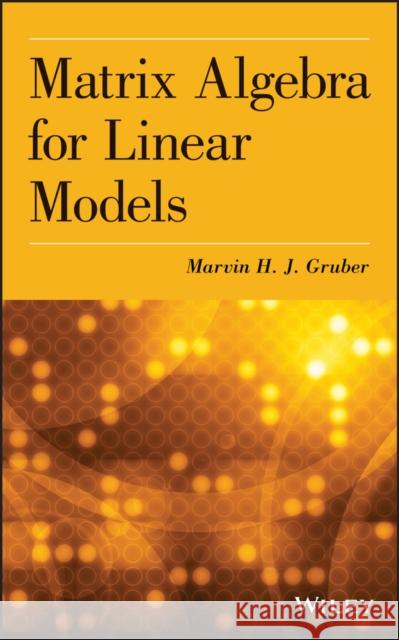
M. H. J. Gruber
Matrix Algebra for Linear Mode Gruber, Marvin H. J. 9781118592557 John Wiley & Sons - książkaWidoczna okładka, to zdjęcie poglądowe, a rzeczywista szata graficzna może różnić się od prezentowanej.

Matrix Algebra for Linear Mode

ISBN-13: 9781118592557 / Angielski / Twarda / 2013 / 392 str.

M. H. J. Gruber
cena 521,33
(netto: 496,50 VAT:  5%)

Najniższa cena z 30 dni: 518,11
Termin realizacji zamówienia:
ok. 30 dni roboczych
Dostawa w 2026 r.

Darmowa dostawa!

A self-contained introduction to matrix analysis theory and applications in the field of statistics

Comprehensive in scope, "Matrix Algebra for Linear Models "offers a succinct summary of matrix theory and its related applications to statistics, especially linear models. The book provides a unified presentation of the mathematical properties and statistical applications of matrices in order to define and manipulate data.

Written for theoretical and applied statisticians, the book utilizes multiple numerical examples to illustrate key ideas, methods, and techniques crucial to understanding matrix algebra's application in linear models. "Matrix Algebra for Linear Models "expertly balances concepts and methods allowing for a side-by-side presentation of matrix theory and its linear model applications. Including concise summaries on each topic, the book also features: Methods of deriving results from the properties of eigenvalues and the singular value decompositionSolutions to matrix optimization problems for obtaining more efficient biased estimators for parameters in linear regression modelsA section on the generalized singular value decompositionMultiple chapter exercises with selected answers to enhance understanding of the presented material

"Matrix Algebra for Linear Models "is an ideal textbook for advanced undergraduate and graduate-level courses on statistics, matrices, and linear algebra. The book is also an excellent reference for statisticians, engineers, economists, and readers interested in the linear statistical model.


Kategorie:
Nauka, Matematyka
Kategorie BISAC:
Mathematics > Prawdopodobieństwo i statystyka
Wydawca:
John Wiley & Sons
Język:
Angielski
ISBN-13:
9781118592557
Rok wydania:
2013
Ilość stron:
392
Waga:
0.63 kg
Wymiary:
23.62 x 15.75 x 2.54
Oprawa:
Twarda
Wolumenów:
01
Dodatkowe informacje:
Bibliografia

This book seems suitable for an advanced undergraduate and/or introductory master′s level course . . . Four appealing features of this book are its inclusion of an overview, a summary, exercises (with answers provided), and numerical examples for all sections.   (American Mathematical Society, 1 November 2015)

The book is suitable for graduate and postgraduate students and researchers. This book is highly recommended.   (Zentralblatt, 1 April 2015)

This is an excellent and comprehensive presentation of the use of matrices for linear models. The writing is very clear, and the layout is excellent. It would serve well either as a class text or as the foundation for individual personal study.   (International Statistical Review, 18 March 2014)

Preface xiii

Acknowledgments xv

Part I Basic Ideas about Matrices and Systems of Linear Equations 1

Section 1 What Matrices are and Some Basic Operations with Them 3

1.1 Introduction, 3

1.2 What are Matrices and Why are they Interesting to a Statistician? 3

1.3 Matrix Notation, Addition, and Multiplication, 6

1.4 Summary, 10

Exercises, 10

Section 2 Determinants and Solving a System of Equations 14

2.1 Introduction, 14

2.2 Definition of and Formulae for Expanding Determinants, 14

2.3 Some Computational Tricks for the Evaluation of Determinants, 16

2.4 Solution to Linear Equations Using Determinants, 18

2.5 Gauss Elimination, 22

2.6 Summary, 27

Exercises, 27

Section 3 The Inverse of a Matrix 30

3.1 Introduction, 30

3.2 The Adjoint Method of Finding the Inverse of a Matrix, 30

3.3 Using Elementary Row Operations, 31

3.4 Using the Matrix Inverse to Solve a System of Equations, 33

3.5 Partitioned Matrices and Their Inverses, 34

3.6 Finding the Least Square Estimator, 38

3.7 Summary, 44

Exercises, 44

Section 4 Special Matrices and Facts about Matrices that will be Used in the Sequel 47

4.1 Introduction, 47

4.2 Matrices of the Form aIn + bJn, 47

4.3 Orthogonal Matrices, 49

4.4 Direct Product of Matrices, 52

4.5 An Important Property of Determinants, 53

4.6 The Trace of a Matrix, 56

4.7 Matrix Differentiation, 57

4.8 The Least Square Estimator Again, 62

4.9 Summary, 62

Exercises, 63

Section 5 Vector Spaces 66

5.1 Introduction, 66

5.2 What is a Vector Space?, 66

5.3 The Dimension of a Vector Space, 68

5.4 Inner Product Spaces, 70

5.5 Linear Transformations, 73

5.6 Summary, 76

Exercises, 76

Section 6 The Rank of a Matrix and Solutions to Systems of Equations 79

6.1 Introduction, 79

6.2 The Rank of a Matrix, 79

6.3 Solving Systems of Equations with Coefficient Matrix of Less than Full Rank, 84

6.4 Summary, 87

Exercises, 87

Part II Eigenvalues, the Singular Value Decomposition, and Principal Components 91

Section 7 Finding the Eigenvalues of a Matrix 93

7.1 Introduction, 93

7.2 Eigenvalues and Eigenvectors of a Matrix, 93

7.3 Nonnegative Definite Matrices, 101

7.4 Summary, 104

Exercises, 105

Section 8 The Eigenvalues and Eigenvectors of Special Matrices 108

8.1 Introduction, 108

8.2 Orthogonal, Nonsingular, and Idempotent Matrices, 109

8.3 The Cayley Hamilton Theorem, 112

8.4 The Relationship between the Trace, the Determinant, and the Eigenvalues of a Matrix, 114

8.5 The Eigenvalues and Eigenvectors of the Kronecker Product of Two Matrices, 116

8.6 The Eigenvalues and the Eigenvectors of a Matrix of the Form aI + bJ, 117

8.7 The Loewner Ordering, 119

8.8 Summary, 121

Exercises, 122

Section 9 The Singular Value Decomposition (SVD) 124

9.1 Introduction, 124

9.2 The Existence of the SVD, 125

9.3 Uses and Examples of the SVD, 127

9.4 Summary, 134

Exercises, 134

Section 10 Applications of the Singular Value Decomposition 137

10.1 Introduction, 137

10.2 Reparameterization of a Non–full–Rank Model to a Full–Rank Model, 137

10.3 Principal Components, 141

10.4 The Multicollinearity Problem, 143

10.5 Summary, 144

Exercises, 145

Section 11 Relative Eigenvalues and Generalizations of the Singular Value Decomposition 146

11.1 Introduction, 146

11.2 Relative Eigenvalues and Eigenvectors, 146

11.3 Generalizations of the Singular Value Decomposition:

Overview, 151

11.4 The First Generalization, 152

11.5 The Second Generalization, 157

11.6 Summary, 160

Exercises, 160

Part III Generalized Inverses 163

Section 12 Basic Ideas about Generalized Inverses 165

12.1 Introduction, 165

12.2 What is a Generalized Inverse and How is One Obtained?, 165

12.3 The Moore Penrose Inverse, 170

12.4 Summary, 173

Exercises, 173

Section 13 Characterizations of Generalized Inverses Using the Singular Value Decomposition 175

13.1 Introduction, 175

13.2 Characterization of the Moore Penrose Inverse, 175

13.3 Generalized Inverses in Terms of the Moore Penrose Inverse, 177

13.4 Summary, 185

Exercises, 186

Section 14 Least Square and Minimum Norm Generalized Inverses 188

14.1 Introduction, 188

14.2 Minimum Norm Generalized Inverses, 189

14.3 Least Square Generalized Inverses, 193

14.4 An Extension of Theorem 7.3 to Positive–Semi–definite Matrices, 196

14.5 Summary, 197

Exercises, 197

Section 15 More Representations of Generalized Inverses 200

15.1 Introduction, 200

15.2 Another Characterization of the Moore Penrose Inverse, 200

15.3 Still Another Representation of the Generalized Inverse, 204

15.4 The Generalized Inverse of a Partitioned

Matrix, 207

15.5 Summary, 211

Exercises, 211

Section 16 Least Square Estimators for Less than Full–Rank Models 213

16.1 Introduction, 213

16.2 Some Preliminaries, 213

16.3 Obtaining the LS Estimator, 214

16.4 Summary, 221

Exercises, 221

Part IV Quadratic Forms and the Analysis of Variance 223

Section 17 Quadratic Forms and their Probability Distributions 225

17.1 Introduction, 225

17.2 Examples of Quadratic Forms, 225

17.3 The Chi–Square Distribution, 228

17.4 When does the Quadratic Form of a Random Variable have a Chi–Square Distribution?, 230

17.5 When are Two Quadratic Forms with the Chi–Square

Distribution Independent?, 231

17.6 Summary, 234

Exercises, 235

Section 18 Analysis of Variance: Regression Models and the One– and Two–Way Classification 237

18.1 Introduction, 237

18.2 The Full–Rank General Linear Regression Model, 237

18.3 Analysis of Variance: One–Way Classification, 241

18.4 Analysis of Variance: Two–Way Classification, 244

18.5 Summary, 249

Exercises, 249

Section 19 More ANOVA—253

19.1 Introduction, 253

19.2 The Two–Way Classification with Interaction, 254

19.3 The Two–Way Classification with One Factor Nested, 258

19.4 Summary, 262

Exercises, 262

Section 20 The General Linear Hypothesis 264

20.1 Introduction, 264

20.2 The Full–Rank Case, 264

20.3 The Non–full–Rank Case, 267

20.4 Contrasts, 270

20.5 Summary, 273

Exercises, 273

Part V Matrix Optimization Problems 275

Section 21 Unconstrained Optimization Problems 277

21.1 Introduction, 277

21.2 Unconstrained Optimization Problems, 277

21.3 The Least Square Estimator Again, 281

21.4 Summary, 283

Exercises, 283

Section 22 Constrained Minimization Problems with Linear Constraints 287

22.1 Introduction, 287

22.2 An Overview of Lagrange Multipliers, 287

22.3 Minimizing a Second–Degree Form with Respect to a Linear Constraint, 293

22.4 The Constrained Least Square Estimator, 295

22.5 Canonical Correlation, 299

22.6 Summary, 302

Exercises, 302

Section 23 The Gauss Markov Theorem 304

23.1 Introduction, 304

23.2 The Gauss Markov Theorem and the Least Square Estimator, 304

23.3 The Modified Gauss Markov Theorem and the Linear Bayes Estimator, 306

23.4 Summary, 311

Exercises, 311

Section 24 Ridge Regression–Type Estimators 314

24.1 Introduction, 314

24.2 Minimizing a Second–Degree Form with Respect to a Quadratic Constraint, 314

24.3 The Generalized Ridge Regression Estimators, 315

24.4 The Mean Square Error of the Generalized Ridge Estimator without Averaging over the Prior Distribution, 317

24.5 The Mean Square Error Averaging over the Prior Distribution, 321

24.6 Summary, 321

Exercises, 321

Answers to Selected Exercises 324

References 366

Index 368

Marvin H. J. Gruber, PHD, is Professor Emeritus in the School of Mathematical Sciences at Rochester Institute of Technology. He has authored several books and journal articles in his areas of research interest, which include improving the efficiency of regression estimators. Dr. Gruber is a member of the American Mathematical Society and the American Statistical Association.

A self–contained introduction to matrix analysis theory and applications in the field of statistics

Comprehensive in scope, Matrix Algebra for Linear Models offers a succinct summary of matrix theory and its related applications to statistics, especially linear models. The book provides a unified presentation of the mathematical properties and statistical applications of matrices in order to define and manipulate data.

Written for theoretical and applied statisticians, the book utilizes multiple numerical examples to illustrate key ideas, methods, and techniques crucial to understanding matrix algebra s application in linear models. Matrix Algebra for Linear Models expertly balances concepts and methods allowing for a side–by–side presentation of matrix theory and its linear model applications. Including concise summaries on each topic, the book also features:

  • Methods of deriving results from the properties of eigenvalues and the singular value decomposition
  • Solutions to matrix optimization problems for obtaining more efficient biased estimators for parameters in linear regression models
  • A section on the generalized singular value decomposition
  • Multiple chapter exercises with selected answers to enhance understanding of the presented material

Matrix Algebra for Linear Models is an ideal textbook for advanced undergraduate and graduate–level courses on statistics, matrices, and linear algebra. The book is also an excellent reference for statisticians, engineers, economists, and readers interested in the linear statistical model.




Udostępnij

Facebook - konto krainaksiazek.pl


Opinie o Krainaksiazek.pl na Opineo.pl

Partner Mybenefit

Krainaksiazek.pl w programie rzetelna firma Krainaksiaze.pl - płatności przez paypal

Czytaj nas na:

Facebook - krainaksiazek.pl
  • książki na zamówienie
  • granty
  • książka na prezent
  • kontakt
  • pomoc
  • opinie
  • regulamin
  • polityka prywatności

Zobacz:

  • Księgarnia czeska

  • Wydawnictwo Książkowe Klimaty

1997-2025 DolnySlask.com Agencja Internetowa

© 1997-2022 krainaksiazek.pl
     
KONTAKT | REGULAMIN | POLITYKA PRYWATNOŚCI | USTAWIENIA PRYWATNOŚCI
Zobacz: Księgarnia Czeska | Wydawnictwo Książkowe Klimaty | Mapa strony | Lista autorów
KrainaKsiazek.PL - Księgarnia Internetowa

Polityka prywatnosci - link
Krainaksiazek.pl - płatnośc Przelewy24
Przechowalnia Przechowalnia



