• Wyszukiwanie zaawansowane
  • Kategorie
  • Kategorie BISAC
  • Książki na zamówienie
  • Promocje
  • Granty
  • Książka na prezent
  • Opinie
  • Pomoc
  • Załóż konto
  • Zaloguj się

Mathematics for Social Sciences and Arts: Algebraic Modeling » książka


zaloguj się | załóż konto
Logo Krainaksiazek.pl

koszyk

konto

szukaj
topmenu
Księgarnia internetowa
Szukaj
Książki na zamówienie
Promocje
Granty
Książka na prezent
Moje konto
Pomoc
 
 
Wyszukiwanie zaawansowane
Pusty koszyk
Bezpłatna dostawa dla zamówień powyżej 20 złBezpłatna dostawa dla zamówień powyżej 20 zł

Kategorie główne

• Nauka
 [2946600]
• Literatura piękna
 [1856966]

  więcej...
• Turystyka
 [72221]
• Informatyka
 [151456]
• Komiksy
 [35826]
• Encyklopedie
 [23190]
• Dziecięca
 [619653]
• Hobby
 [140543]
• AudioBooki
 [1577]
• Literatura faktu
 [228355]
• Muzyka CD
 [410]
• Słowniki
 [2874]
• Inne
 [445822]
• Kalendarze
 [1744]
• Podręczniki
 [167141]
• Poradniki
 [482898]
• Religia
 [510455]
• Czasopisma
 [526]
• Sport
 [61590]
• Sztuka
 [243598]
• CD, DVD, Video
 [3423]
• Technologie
 [219201]
• Zdrowie
 [101638]
• Książkowe Klimaty
 [124]
• Zabawki
 [2473]
• Puzzle, gry
 [3898]
• Literatura w języku ukraińskim
 [254]
• Art. papiernicze i szkolne
 [8170]
Kategorie szczegółowe BISAC

Mathematics for Social Sciences and Arts: Algebraic Modeling

ISBN-13: 9783031377914 / Angielski
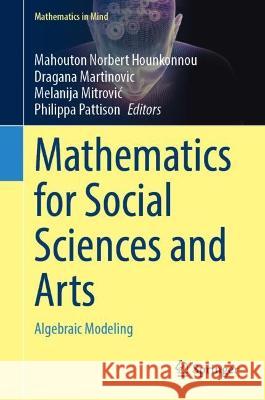
Mahouton Norbert Hounkonnou; Dragana Martinovic; Melanija Mitrovic
Mathematics for Social Sciences and Arts: Algebraic Modeling Mahouton Norbert Hounkonnou Dragana Martinovic Melanija Mitrovic 9783031377914 Springer - książkaWidoczna okładka, to zdjęcie poglądowe, a rzeczywista szata graficzna może różnić się od prezentowanej.

Mathematics for Social Sciences and Arts: Algebraic Modeling

ISBN-13: 9783031377914 / Angielski

Mahouton Norbert Hounkonnou; Dragana Martinovic; Melanija Mitrovic
cena 564,88 zł
(netto: 537,98 VAT:  5%)

Najniższa cena z 30 dni: 501,19 zł
Termin realizacji zamówienia:
ok. 22 dni roboczych
Bez gwarancji dostawy przed świętami

Darmowa dostawa!
Kategorie:
Nauka, Matematyka
Kategorie BISAC:
Mathematics > Matematyka stosowana
Mathematics > Algebra - Abstrakcyjna
Mathematics > Graphic Methods
Wydawca:
Springer
Seria wydawnicza:
Mathematics in Mind
Język:
Angielski
ISBN-13:
9783031377914

Preface

Mahouton Norbert Hounkonnou, Dragana Martinovic, Melanija Mitrović, and Philippa Pattison

Foreword
Daya Reddy

Introduction
Mahouton Norbert Hounkonnou, Dragana Martinovic, Melanija Mitrović, and Philippa Pattison

PART I: ALGEBRAIC THINKING AND MODELING

Chapter 1: Problematic of mathematics and social sciences and arts: An ubiquitous constructive interaction in algebraic modeling
Mahouton Norbert Hounkonnou and Melanija Mitrović

Chapter 2: Algebra as a semiotic modeling system
Marcel Danesi

Chapter 3: The "unreasonable" effectiveness of mathematical modeling
Jacek Woźny

Chapter 4: Algebra and modeling in mathematics school curricula
Dragana Martinovic

Chapter 5: Gödel's incompleteness as an argument for dualism
Zvonimir Šikić

Chapter 6: Vetoing--social, logical and mathematical aspects
Branislav Boričić and Marija Srećković

PART II: SEMIGROUPS AND OTHER ALGEBRAIC STRUCTURES IN SOCIAL SCIENCES

Chapter 7: Constructive semigrou0p with apartness--a state of the art
Melanija Mitrović, Mahouton Norbert Hounkonnou, and Paula Catarino

Chapter 8: Algebraic approaches to the analysis of social networks
Philippa Pattison

Chapter 9: Relational systems of transport network and providences in ancient Rome
J. Antonio Rivero Ostoic

Chapter 10: Time and sequence in networks of social interactions
Lucia Falzon

Chapter 11: Algebraic structures and social processes
John Levi Martin

Mahouton Norbert Hounkonnou is a Full Professor at the University of Abomey-Calavi, Benin. His works deal with noncommutative and nonlinear mathematics, mathematical physics and complexity. He was a member of UNESCO Scientific Council for International Basic Sciences Programme and member of the InterAcademy Partnership (IAP) working group on Harnessing Science, Engineering and Medicine to Address Africa’s Challenges. He is also a member of several academies, including the Academy of Science of South Africa, Hassan II Academy of Science and Technology, Morocco, African Academy of Sciences, The World Academy of Sciences. He is the co- chair of the Network of African, European and Mediterranean Academies for Science Education, President of the Network of African Science Academies and former President of Benin National Academy of Sciences, Arts and Letters. He is member of the IAP Science Education Global Council, and representative for Africa of the International Mathematical Union (IMU) Commission for Developing Countries (CDC). He was awarded several international prestigious Prizes, the last being the American Institute of Physics 2023 Tate Medal for his efforts to build and maintain an enduring transnational African mathematical physics research and education community.

Dr. Dragana Martinovic is Professor Emerita at Faculty of Education, University of Windsor. She is a Fellow of the Fields Institute for Research in Mathematical Sciences and a Co-Director of the Fields Centre for Mathematics Education. She is a founding and current Co-Editor of the Springer book series, Mathematics Education in the Digital Era. Dragana serves on the Editorial Boards for Brill’sStudies in Mathematics in the Arts and Humanities book series, Springer’s Mathematics in Mind book series, and journals such as Participatory Educational Research (PER) and Semiotica. Dragana is also the Chair of the GeoGebra Institute of Canada/Institut de GeoGebra du Canada (GIC-IGC). Dragana has co-chaired various national and international conferences. In her research, Dragana explores knowledge for teaching mathematics, ways in which technology can assist in teaching and learning of mathematics, and epistemologies of Science, Mathematics, Engineering, and Mathematics (STEM) in relation to teacher and K–12 education. Dragana’s research is funded by SSHRC, KNAER, the Fields Institute, and various Canadian government organizations. She has published edited books and books of conference proceedings and multiple book chapters, refereed journal papers, and research and technical reports.

Melanija Mitrović is a Full Professor at the University of Niš, Serbia, having received her PhD degree at the same university. She works in the field of classical and constructive algebra. Her innovating work within the theory of constructive binary structures with apartness positions her among the pioneers of constructive mathematics in Serbia. She develops interdisciplinary research investigating applications of algebraic structures to problems in engineering space, social sciences and humanities. She is, also, the Head of the Center of Applied Mathematics of the Faculty of Mechanical Engineering Niš, CAM- FMEN (since 2019), a member of the Editorial Board of Mathematics in Mind, Springer; a member of the Fields Cognitive Science Network. She holds the status of Permanent Full Professor at the International Chair in Mathematical Physics and Applications (ICMPA-UNESCO Chair), University of Abomey-Calavi, Benin Republic. She has held visiting professor positions at Linköping University and Malardaren University, Sweden; Bar-Ilan University, Israel; TU Wien, Austria; UTAD and University of Minho, Portugal; and Politecnico di Milano, Italy. She is member of the Grant Selection Committee (GSC) of the International Mathematical Union (IMU) Commission for Developing Countries (CDC).

Philippa (Pip) Pattison is an Emeritus Professor at the University of Melbourne and University of Sydney, having retired in 2021 as Deputy Vice-Chancellor Education at the University of Sydney.  Pip’s research is focussed primarily on the development of mathematical and statistical models for social networks and network processes. Following early work on algebraic models for social networks, she developed in collaboration with others a hierarchy of statistical models for social networks that recognise the potential endogeneity of network processes and can reproduce a wide variety of their observed characteristics.  She and her colleagues have extended these models to a variety of data structures and forms and have developed methods for estimating models from partial network data resulting from snowball sampling designs.  These developments are now being widely applied across a number of social and behavioural science domains.  Pip’s work has attracted a number of awards, including the University of Melbourne Special Thesis Award in 1983, the Australian Psychological Society Early Career Award in 1988, and the Simmel Award of the International Network for Social Network Analysis in 2002.  Pip was elected a Fellow of the Academy of Social Sciences in Australia in 1995 and became an Officer of the Order of Australia in 2015.


This book addresses interconnections between contemporary advances in mathematics, especially algebra, with applications in the social sciences and the arts. It promotes the idea that knowledge cannot remain in disciplinary silos, rather, it belongs to all people, and is dedicated to associative relationships in a variety of mathematics applications, from sociology to linguistics, including anthropology, semiotics, education, and cognitive science. Contributions illuminate some of the ways in which algebra is developed, learned, understood, communicated, and applied in the social sciences and the humanities.

The content in this book has its origins in a conference, Mathematics for Social Sciences and Arts–Algebraic Modelling, virtually hosted by the Faculty of Mechanical Engineering, University of Niš, Serbia, from the 24th to the 26th of May, 2021. This conference brought together scholars from various disciplines and geographic regions and focused on the juxtaposition of algebra and social science applications. The conference organizers, higher education institutes from four different continents, invited leading scientists in social sciences and algebra, to contribute to this volume.

The first part of this book addresses algebraic and mathematical thinking, specifically learning and practicing mathematics from a cognitive science perspective, as well as illustrative applications to distinctly human concerns, like education and semiotics. The second part focuses on algebraic semigroups and some of their generalizations. This book and the conference that engendered it provide an example of a fruitful collaboration, in which the skills and deep knowledge of algebraic structures, modeling, social sciences and arts brought in by the authors from different countries and continents merge in harmonious ways. These expositions are a rich resource and are of interest both to mathematicians and non-mathematicians.


Udostępnij

Facebook - konto krainaksiazek.pl


Opinie o Krainaksiazek.pl na Opineo.pl

Partner Mybenefit

Krainaksiazek.pl w programie rzetelna firma Krainaksiaze.pl - płatności przez paypal

Czytaj nas na:

Facebook - krainaksiazek.pl
  • książki na zamówienie
  • granty
  • książka na prezent
  • kontakt
  • pomoc
  • opinie
  • regulamin
  • polityka prywatności

Zobacz:

  • Księgarnia czeska

  • Wydawnictwo Książkowe Klimaty

1997-2025 DolnySlask.com Agencja Internetowa

© 1997-2022 krainaksiazek.pl
     
KONTAKT | REGULAMIN | POLITYKA PRYWATNOŚCI | USTAWIENIA PRYWATNOŚCI
Zobacz: Księgarnia Czeska | Wydawnictwo Książkowe Klimaty | Mapa strony | Lista autorów
KrainaKsiazek.PL - Księgarnia Internetowa

Polityka prywatnosci - link
Krainaksiazek.pl - płatnośc Przelewy24
Przechowalnia Przechowalnia






