• Wyszukiwanie zaawansowane
  • Kategorie
  • Kategorie BISAC
  • Książki na zamówienie
  • Promocje
  • Granty
  • Książka na prezent
  • Opinie
  • Pomoc
  • Załóż konto
  • Zaloguj się

Mathematical and Statistical Modeling for Emerging and Re-Emerging Infectious Diseases » książka

zaloguj się | załóż konto
Logo Krainaksiazek.pl

koszyk

konto

szukaj
topmenu
Księgarnia internetowa
Szukaj
Książki na zamówienie
Promocje
Granty
Książka na prezent
Moje konto
Pomoc
 
 
Wyszukiwanie zaawansowane
Pusty koszyk
Bezpłatna dostawa dla zamówień powyżej 20 złBezpłatna dostawa dla zamówień powyżej 20 zł

Kategorie główne

• Nauka
 [2949965]
• Literatura piękna
 [1857847]

  więcej...
• Turystyka
 [70818]
• Informatyka
 [151303]
• Komiksy
 [35733]
• Encyklopedie
 [23180]
• Dziecięca
 [617748]
• Hobby
 [139972]
• AudioBooki
 [1650]
• Literatura faktu
 [228361]
• Muzyka CD
 [398]
• Słowniki
 [2862]
• Inne
 [444732]
• Kalendarze
 [1620]
• Podręczniki
 [167233]
• Poradniki
 [482388]
• Religia
 [509867]
• Czasopisma
 [533]
• Sport
 [61361]
• Sztuka
 [243125]
• CD, DVD, Video
 [3451]
• Technologie
 [219309]
• Zdrowie
 [101347]
• Książkowe Klimaty
 [123]
• Zabawki
 [2362]
• Puzzle, gry
 [3791]
• Literatura w języku ukraińskim
 [253]
• Art. papiernicze i szkolne
 [7933]
Kategorie szczegółowe BISAC

Mathematical and Statistical Modeling for Emerging and Re-Emerging Infectious Diseases

ISBN-13: 9783319404110 / Angielski / Twarda / 2016 / 356 str.
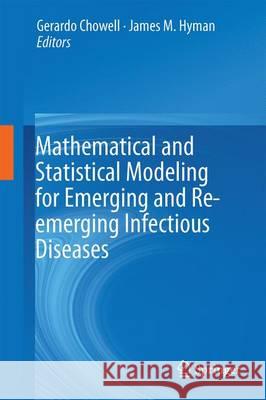
Gerardo Chowell; James M. Hyman
Mathematical and Statistical Modeling for Emerging and Re-Emerging Infectious Diseases Chowell, Gerardo 9783319404110 Springer - książkaWidoczna okładka, to zdjęcie poglądowe, a rzeczywista szata graficzna może różnić się od prezentowanej.

Mathematical and Statistical Modeling for Emerging and Re-Emerging Infectious Diseases

ISBN-13: 9783319404110 / Angielski / Twarda / 2016 / 356 str.

Gerardo Chowell; James M. Hyman
cena 403,47
(netto: 384,26 VAT:  5%)

Najniższa cena z 30 dni: 385,52
Termin realizacji zamówienia:
ok. 22 dni roboczych
Bez gwarancji dostawy przed świętami

Darmowa dostawa!

The contributions by epidemic modeling experts describe how mathematical models and statistical forecasting are created to capture the most important aspects of an emerging epidemic.Readers will discover a broad range of approaches to address questions, such as

  • Can we control Ebola via ring vaccination strategies?
  • How quickly should we detect Ebola cases to ensure epidemic control?
  • What is the likelihood that an Ebola epidemic in West Africa leads to secondary outbreaks in other parts of the world?
  • When does it matter to incorporate the role of disease-induced mortality on epidemic models?
  • What is the role of behavior changes on Ebola dynamics?
  • How can we better understand the control of cholera or Ebola using optimal control theory?
  • How should a population be structured in order to mimic the transmission dynamics of diseases such as chlamydia, Ebola, or cholera?
  • How can we objectively determine the end of an epidemic?
  • How can we use metapopulation models to understand the role of movement restrictions and migration patterns on the spread of infectious diseases?
  • How can we capture the impact of household transmission using compartmental epidemic models?
  • How could behavior-dependent vaccination affect the dynamical outcomes of epidemic models?
The derivation and analysis of the mathematical models addressing these questions provides a wide-ranging overview of the new approaches being created to better forecast and mitigate emerging epidemics. This book will be of interest to researchers in the field of mathematical epidemiology, as well as public health workers.

Kategorie:
Nauka, Medycyna
Kategorie BISAC:
Mathematics > Prawdopodobieństwo i statystyka
Medical > Choroby zakaźne
Medical > Biostatistics
Wydawca:
Springer
Język:
Angielski
ISBN-13:
9783319404110
Rok wydania:
2016
Wydanie:
2016
Ilość stron:
356
Waga:
0.82 kg
Wymiary:
24.23 x 15.88 x 2.41
Oprawa:
Twarda
Wolumenów:
01

"This book focuses on mathematical and statistical modeling to capture the important aspects of emerging epidemics that can help public health workers and researchers to better understand the spread of infections and reduce the uncertainty of the estimates of disease prevalence, as well as to help evaluate the potential effectiveness of different approaches for bringing an epidemic under control. ... recommended to researchers in the field of mathematical epidemiology and public health workers who are involved in epidemic disease control." (Hemang B. Panchal, Doody's Book Reviews, November, 2016)

Preface
1  A Reality of Its Own
3  Modeling the Impact of Behavior Change on the Spread of Ebola
3  A model for coupled outbreaks contained by behavior change
4  Real-time assessment of the international spreading risk associated with the 2014 West African Ebola    Outbreak
5  Modeling the case of early detection of Ebola virus disease
6  Modeling ring vaccination strategies to control Ebola virus disease epidemics
7  Estimation of the number of sickbeds during Ebola epidemics using optimal control theory
8  Inverse problems and Ebola virus disease using an age of infection model
9  Assessing the Efficiency of Movement
10 Restriction as a Control Strategy of Ebola
11 Patch models of EVD transmission dynamics
12 From bee species aggregation to models of disease avoidance: The \emph{Ben-Hur} effect}
13 Designing Public Health Policies to Mitigate the Adverse Consequences of Rural-Urban Migration via      Meta-Population Modeling
14 Age of Infection Epidemic Models
15 Optimal Control of Vaccination in an Age-Structured Cholera Model
16 A Multi-risk Model for Understanding the Spread of Chlamydia
17 The 1997 Measles Outbreak in Metropolitan São Paulo, Brazil: Strategic Implications of Increasing        Urbanization
18 Methods to determine the end of an infectious disease epidemic: A short review
19 Statistical considerations in infectious disease randomized controlled trials
20 Epidemic models with and without mortality: when does it matter?
21 Capturing Household Transmission in Compartmental Models of Infectious Disease
22 Bistable endemic states in a Susceptible-Infectious-Susceptible model with behavior-dependent Vaccination
Index

Gerardo Chowell is an associate professor and a Second Century Initiative Scholar (2CI) in the School of Public Health at Georgia State University in Atlanta. His research program includes the development and application of quantitative approaches for understanding the transmission dynamics and control of infectious diseases including influenza, Ebola, and dengue fever. His work has appeared in high-impact journals including The New England Journal of Medicine, PLOS Medicine, and BMC Medicine, and has been cited by major media outlets including the Washington Post and TIME magazine.

James (Mac) Hyman has developed and analyzed mathematical models for the transmission of HIV/AIDs, influenza, malaria, dengue fever, chikungunya, and infections.  His current focus is to identify approaches where these models can help public health workers be more effective in mitigating the impact of emerging diseases.  He was a research scientist at Los Alamos National Laboratory for over thirty years, is a past president of the Society for Industrial and Applied Mathematics (SIAM),  and now holds the Phillips Distinguished Chair in Mathematics at Tulane University.

The contributions by epidemic modeling experts describe how mathematical models and statistical forecasting are created to capture the most important aspects of an emerging epidemic.Readers will discover a broad range of approaches to address questions, such as

  • Can we control Ebola via ring vaccination strategies?
  • How quickly should we detect Ebola cases to ensure epidemic control?
  •  What is the likelihood that an Ebola epidemic in West Africa leads to secondary outbreaks in other parts of the world?  
  • When does it matter to incorporate the role of disease-induced mortality on epidemic models?
  •  What is the role of behavior changes on Ebola dynamics? 
  • How can we better understand the control of cholera or Ebola using optimal control theory?
  • How should a population be structured in order to mimic the transmission dynamics of diseases such as chlamydia, Ebola, or cholera?
  • How can we objectively determine the end of an epidemic?
  • How can we use metapopulation models to understand the role of movement restrictions and migration patterns on the spread of infectious diseases?
  • How can we capture the impact of household transmission using compartmental epidemic models?
  • How could behavior-dependent vaccination affect the dynamical outcomes of epidemic models? 

The derivation and analysis of the mathematical models addressing these questions provides a wide-ranging overview of the new approaches being created to better forecast and mitigate emerging epidemics. 

This book will be of interest to researchers in the field of mathematical epidemiology, as well as public health workers.


Udostępnij

Facebook - konto krainaksiazek.pl


Opinie o Krainaksiazek.pl na Opineo.pl

Partner Mybenefit

Krainaksiazek.pl w programie rzetelna firma Krainaksiaze.pl - płatności przez paypal

Czytaj nas na:

Facebook - krainaksiazek.pl
  • książki na zamówienie
  • granty
  • książka na prezent
  • kontakt
  • pomoc
  • opinie
  • regulamin
  • polityka prywatności

Zobacz:

  • Księgarnia czeska

  • Wydawnictwo Książkowe Klimaty

1997-2025 DolnySlask.com Agencja Internetowa

© 1997-2022 krainaksiazek.pl
     
KONTAKT | REGULAMIN | POLITYKA PRYWATNOŚCI | USTAWIENIA PRYWATNOŚCI
Zobacz: Księgarnia Czeska | Wydawnictwo Książkowe Klimaty | Mapa strony | Lista autorów
KrainaKsiazek.PL - Księgarnia Internetowa

Polityka prywatnosci - link
Krainaksiazek.pl - płatnośc Przelewy24
Przechowalnia Przechowalnia







