• Wyszukiwanie zaawansowane
  • Kategorie
  • Kategorie BISAC
  • Książki na zamówienie
  • Promocje
  • Granty
  • Książka na prezent
  • Opinie
  • Pomoc
  • Załóż konto
  • Zaloguj się

Mathematical Tools in Production Management » książka


zaloguj się | załóż konto
Logo Krainaksiazek.pl

koszyk

konto

szukaj
topmenu
Księgarnia internetowa
Szukaj
Książki na zamówienie
Promocje
Granty
Książka na prezent
Moje konto
Pomoc
 
 
Wyszukiwanie zaawansowane
Pusty koszyk
Bezpłatna dostawa dla zamówień powyżej 20 złBezpłatna dostawa dla zamówień powyżej 20 zł

Kategorie główne

• Nauka
 [2946912]
• Literatura piękna
 [1852311]

  więcej...
• Turystyka
 [71421]
• Informatyka
 [150889]
• Komiksy
 [35717]
• Encyklopedie
 [23177]
• Dziecięca
 [617324]
• Hobby
 [138808]
• AudioBooki
 [1671]
• Literatura faktu
 [228371]
• Muzyka CD
 [400]
• Słowniki
 [2841]
• Inne
 [445428]
• Kalendarze
 [1545]
• Podręczniki
 [166819]
• Poradniki
 [480180]
• Religia
 [510412]
• Czasopisma
 [525]
• Sport
 [61271]
• Sztuka
 [242929]
• CD, DVD, Video
 [3371]
• Technologie
 [219258]
• Zdrowie
 [100961]
• Książkowe Klimaty
 [124]
• Zabawki
 [2341]
• Puzzle, gry
 [3766]
• Literatura w języku ukraińskim
 [255]
• Art. papiernicze i szkolne
 [7810]
Kategorie szczegółowe BISAC

Mathematical Tools in Production Management

ISBN-13: 9781461595601 / Angielski / Miękka / 2012 / 391 str.
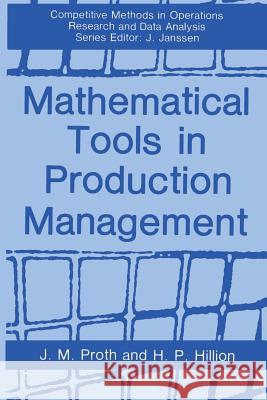
Jean-Marie Proth; Herve P. Hillion; Herve P. Hillion
Mathematical Tools in Production Management Jean-Marie Proth Herve P Herve P. Hillion 9781461595601 Springer - książkaWidoczna okładka, to zdjęcie poglądowe, a rzeczywista szata graficzna może różnić się od prezentowanej.

Mathematical Tools in Production Management

ISBN-13: 9781461595601 / Angielski / Miękka / 2012 / 391 str.

Jean-Marie Proth; Herve P. Hillion; Herve P. Hillion
cena 201,24
(netto: 191,66 VAT:  5%)

Najniższa cena z 30 dni: 192,74
Termin realizacji zamówienia:
ok. 22 dni roboczych
Bez gwarancji dostawy przed świętami

Darmowa dostawa!

The authors of this book have been in charge of over thirty industrial contracts of various length (from six months to three years); the companies involved covered a wide range of industrial activities, including steel making, hot and cold rolling, aerospace research, automobile manufactur- ing, chemical manufacturing, coal mining, bronze casting, and mechanical engineering. All contracts were related to problems connected either with the preliminary design of production systems or with the management of these systems. The problems that the authors investigated involved not only designing and scheduling, but also the modeling, analysis, and evalua- tion of production systems. The book is based to a large extent on the experience gained in working on these contracts and the mathematical procedures presented are those that have been applied during the course of work on at least one of the contracts. Moreover, the authors have always kept in mind an idea which seems pivotal in the world of industry: the difficulty in companies lies much more in determining the exact nature of a problem and defining the criteria to be taken into account, than in solving the problem itself.


Kategorie:
Nauka, Ekonomia i biznes
Kategorie BISAC:
Business & Economics > Zarządzenie i techniki zarządzania
Political Science > General
Business & Economics > Management Science
Wydawca:
Springer
Seria wydawnicza:
Competitive Methods in Operations Research and Data Analysis
Język:
Angielski
ISBN-13:
9781461595601
Rok wydania:
2012
Wydanie:
Softcover Repri
Numer serii:
000471992
Ilość stron:
391
Waga:
0.59 kg
Oprawa:
Miękka
Wolumenów:
01

1 New Trends in Manufacturing Systems and Their Consequences.- 1.1. Main Changes in the Manufacturing Environment.- 1.1.1. The Market.- 1.1.2. Physical Resources.- 1.1.3. Human Resources.- 1.2. Toward Flexibility, Modularity, and Integration.- 1.3. Flexible Manufacturing Systems (FMSs).- 1.3.1. Definition of Flexible Manufacturing Systems.- 1.3.2. Limits of Flexible Manufacturing Systems.- 1.3.3. Some Examples of Flexible Manufacturing Systems.- 1.4. Evaluation Criteria of Modern Production Systems.- 1.4.1. The Financial Evaluation.- 1.4.2. Criteria for Technical Evaluation.- 1.5. Evaluation Tools for Modern Production Systems.- 1.5.1. The Steps of Evaluation.- 1.5.2. The Various Evaluation Approaches.- 1.5.3. Simulation of Production Systems.- 1.5.4. Mathematical Approaches for the Analysis of Production Systems.- 1.5.5. A Comparison between Simulation and Mathematical Models.- 1.6. Production System Life Cycle.- 2 Preliminary Design of Production Systems.- 2.1. Static Study.- 2.1.1. Choice of the Resources.- 2.1.2. Layout Design.- 2.2. Dynamic Study.- 2.2.1. Management System versus Integration Level.- 2.2.2. MRP II, JIT, and OPT.- 2.2.3. The Hierarchical Production Management System (HPMS).- 3 Linear Programming.- 3.1. Linear Programming Formulations.- 3.1.1. Formulations.- 3.1.2. Graphical Representation.- 3.1.3. Remarks.- 3.2. LP Problems in Production Management.- 3.2.1. The Transportation Problem.- 3.2.2. The Assignment Problem.- 3.2.3. Using Resources in a Job Shop.- 3.2.4. A Planning Problem.- 3.2.5. The Blending Problem.- 3.2.6. Cutting Problem.- 3.3. Conclusion.- 4 Dynamic Programming.- 4.1. Dynamic Programming Formulation.- 4.1.1. Optimality Principle.- 4.1.2. General DP Problem Formulation.- 4.1.3. DP Solving Processes.- 4.2. Dynamic Inventory Planning Problem.- 4.2.1. Monoproduct Problem.- 4.2.2. Multiproduct Problem.- 4.3. Task Scheduling.- 4.3.1. Stating the PERT Problem.- 4.3.2. Graphic Representation.- 4.3.3. Computation of Activity Completion Times in PERT.- 4.3.4. Computation of the Optimal Solution.- 5 Branch-and-Bound Techniques.- 5.1. Branch-and-Bound Techniques.- 5.1.1. Assumptions.- 5.1.2. Basis of the Branch-and-Bound Techniques.- 5.1.3. Upper Bound of the Optimal Value of the Objective Function.- 5.1.4. Lower Bounds of the Objective Function within Overlapping Subsets.- 5.1.5. Computation of the Overlapping Subsets.- 5.1.6. Branch Rules.- 5.1.7. Branch-and-Bound for Maximizing an Objective Function.- 5.2. Algorithms and Examples.- 5.2.1. Branch-and-Bound Algorithm for Solving 0–1 LP Problem.- 5.2.2. Branch-and-Bound Algorithm for Solving Integer LP Problem.- 5.2.3. Branch-and-Bound Algorithm for Solving the Traveling Salesman Problem.- 5.3. Conclusion.- 6 Markov Chains.- 6.1. Formal Definition of a Discrete Parameter Markov Chain.- 6.2. Chapman-Kolmogorov Equations.- 6.3. Classification of States.- 6.4. Decomposition of the State-Space.- 6.5. Long-Run Properties of Irreducible Markov Chains.- 6.6. Application.- 6.7. Continuous Parameter Markov Chains.- 6.8. Long-Run Properties of Continuous Parameter Markov Chains.- 6.9. Birth and Death Processes.- 6.10. Pure Birth Processes.- 7 Queueing Theory.- 7.1. Structure of Queueing Models.- 7.1.1. Basic Elements.- 7.1.2. Service Mechanism.- 7.1.3. Parameters of Queueing Models.- 7.2. Terminology and Notation.- 7.3. Elementary Queueing Models.- 7.3.1. Queue M/M/1.- 7.3.2. Queue M/M/1/K.- 7.3.3. Queue M/M/s.- 7.3.4. Concluding Remarks.- 7.4. Queueing Networks.- 7.4.1. Open Queueing Network (OQN).- 7.4.2. Closed Queueing Network (CQN).- 7.5. Model Applicability.- 7.5.1. Extensions of the QN Model.- 7.5.2. Scope of Applicability.- 7.5.3. Conclusion.- 8 Petri Nets.- 8.1. Petri Net Theory.- 8.1.1. Basic Terminology of Petri Nets.- 8.1.2. Fundamental Properties.- 8.1.3. Timed Petri Nets.- 8.1.4. Event Graphs.- 8.2. Petri Net Model of the Job Shop.- 8.2.1. Characteristics of the Model.- 8.2.2. Operative Part.- 8.2.3. Control Part.- 8.3. Performance Evaluation.- 8.3.1. Computation of the Cycle Time.- 8.3.2. Performance Improvement.- 8.3.3. Comparison with the CQN Model.- 8.4. Optimal Control of the Job Shop.- 8.4.1. Maximum Productivity.- 8.4.2. Minimizing the Number of Pallets.- 8.4.3. Optimal Machine Sequencings.- 8.5. Model Applicability.- 8.5.1. Scope of Applicability.- 8.5.2. Stochastic Petri Nets.- 8.5.3. Colored Petri Nets.- 9 Graph Theory.- 9.1. Basic Terminology and Notation.- 9.2. The Shortest Path Problem.- 9.2.1. Problem Formulation and Solution.- 9.2.2. PERT-CPM.- 9.2.3. Inventory Management Problem.- 9.3. The Maximal Flow Problem.- 9.3.1. Problem Definition.- 9.3.2. Applications.- 9.4. Conclusion.- 10 Data Analysis.- 10.1. Definitions, Notation, and Basic Concepts.- 10.1.1. Observations.- 10.1.2. Links between Characteristics.- 10.2. Main Component Analysis (MCA).- 10.2.1. Introduction to Main Component Analysis.- 10.2.2. Mathematical Approach.- 10.2.3. Use of MCA.- 10.3. Clustering Analysis.- 10.3.1. K-Mean Analysis.- 10.3.2. Hierarchical Clustering Analysis.- 10.3.3. Cross-Decomposition Methods.- 10.4. Conclusion.- 11 Mathematical Analysis of Automated Systems: Two Examples.- 11.1. Mathematical Modeling and Analysis.- 11.2. Transfer Line with Unreliable Machines and Transportation System.- 11.2.1. Stating the Problem.- 11.2.2. The Model.- 11.2.3. Productivity versus Number of Pallets.- 11.2.4. Evaluation.- 11.3. Closed-Loop Conveyor System.- 11.3.1. Stating the Problem.- 11.3.2. The Model.- 11.3.3. Evaluation.- 11.4. Conclusion.- References.


Udostępnij

Facebook - konto krainaksiazek.pl


Opinie o Krainaksiazek.pl na Opineo.pl

Partner Mybenefit

Krainaksiazek.pl w programie rzetelna firma Krainaksiaze.pl - płatności przez paypal

Czytaj nas na:

Facebook - krainaksiazek.pl
  • książki na zamówienie
  • granty
  • książka na prezent
  • kontakt
  • pomoc
  • opinie
  • regulamin
  • polityka prywatności

Zobacz:

  • Księgarnia czeska

  • Wydawnictwo Książkowe Klimaty

1997-2025 DolnySlask.com Agencja Internetowa

© 1997-2022 krainaksiazek.pl
     
KONTAKT | REGULAMIN | POLITYKA PRYWATNOŚCI | USTAWIENIA PRYWATNOŚCI
Zobacz: Księgarnia Czeska | Wydawnictwo Książkowe Klimaty | Mapa strony | Lista autorów
KrainaKsiazek.PL - Księgarnia Internetowa

Polityka prywatnosci - link
Krainaksiazek.pl - płatnośc Przelewy24
Przechowalnia Przechowalnia





