• Wyszukiwanie zaawansowane
  • Kategorie
  • Kategorie BISAC
  • Książki na zamówienie
  • Promocje
  • Granty
  • Książka na prezent
  • Opinie
  • Pomoc
  • Załóż konto
  • Zaloguj się

Mathematical Models for Speech Technology » książka


zaloguj się | załóż konto
Logo Krainaksiazek.pl

koszyk

konto

szukaj
topmenu
Księgarnia internetowa
Szukaj
Książki na zamówienie
Promocje
Granty
Książka na prezent
Moje konto
Pomoc
 
 
Wyszukiwanie zaawansowane
Pusty koszyk
Bezpłatna dostawa dla zamówień powyżej 20 złBezpłatna dostawa dla zamówień powyżej 20 zł

Kategorie główne

• Nauka
 [2946600]
• Literatura piękna
 [1856966]

  więcej...
• Turystyka
 [72221]
• Informatyka
 [151456]
• Komiksy
 [35826]
• Encyklopedie
 [23190]
• Dziecięca
 [619653]
• Hobby
 [140543]
• AudioBooki
 [1577]
• Literatura faktu
 [228355]
• Muzyka CD
 [410]
• Słowniki
 [2874]
• Inne
 [445822]
• Kalendarze
 [1744]
• Podręczniki
 [167141]
• Poradniki
 [482898]
• Religia
 [510455]
• Czasopisma
 [526]
• Sport
 [61590]
• Sztuka
 [243598]
• CD, DVD, Video
 [3423]
• Technologie
 [219201]
• Zdrowie
 [101638]
• Książkowe Klimaty
 [124]
• Zabawki
 [2473]
• Puzzle, gry
 [3898]
• Literatura w języku ukraińskim
 [254]
• Art. papiernicze i szkolne
 [8170]
Kategorie szczegółowe BISAC

Mathematical Models for Speech Technology

ISBN-13: 9780470844076 / Angielski / Twarda / 2005 / 282 str.
Stephen C. Levinson
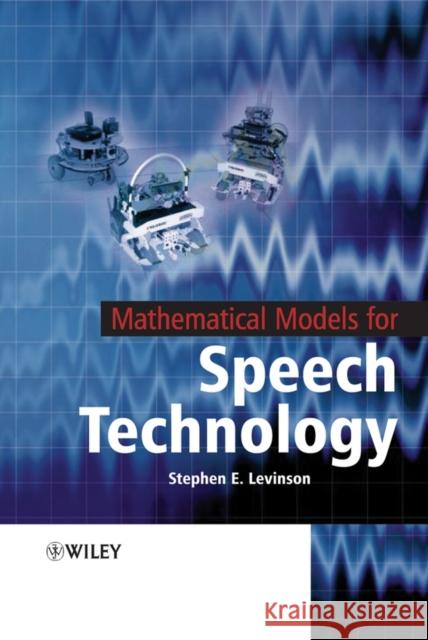
Mathematical Models for Speech Technology Stephen C. Levinson 9780470844076 John Wiley & Sons - książkaWidoczna okładka, to zdjęcie poglądowe, a rzeczywista szata graficzna może różnić się od prezentowanej.

Mathematical Models for Speech Technology

ISBN-13: 9780470844076 / Angielski / Twarda / 2005 / 282 str.

Stephen C. Levinson
cena 609,50 zł
(netto: 580,48 VAT:  5%)

Najniższa cena z 30 dni: 604,51 zł
Termin realizacji zamówienia:
ok. 30 dni roboczych
Bez gwarancji dostawy przed świętami

Darmowa dostawa!

Mathematical Models of Spoken Language presents the motivations for, intuitions behind, and basic mathematical models of natural spoken language communication. A comprehensive overview is given of all aspects of the problem from the physics of speech production through the hierarchy of linguistic structure and ending with some observations on language and mind. The author comprehensively explores the argument that these modern technologies are actually the most extensive compilations of linguistic knowledge available.Throughout the book, the emphasis is on placing all the material in a mathematically coherent and computationally tractable framework that captures linguistic structure. It presents material that appears nowhere else and gives a unification of formalisms and perspectives used by linguists and engineers. Its unique features include a coherent nomenclature that emphasizes the deep connections amongst the diverse mathematical models and explores the methods by means of which they capture linguistic structure. This contrasts with some of the superficial similarities described in the existing literature; the historical background and origins of the theories and models; the connections to related disciplines, e.g. artificial intelligence, automata theory and information theory; an elucidation of the current debates and their intellectual origins; many important little-known results and some original proofs of fundamental results, e.g. a geometric interpretation of parameter estimation techniques for stochastic models and finally the author's own unique perspectives on the future of this discipline. There is a vast literature on Speech Recognition and Synthesis however, this book is unlike any other in the field. Although it appears to be a rapidly advancing field, the fundamentals have not changed in decades. Most of the results are presented in journals from which it is difficult to integrate and evaluate all of these recent ideas. Some of the fundamentals have been collected into textbooks, which give detailed descriptions of the techniques but no motivation or perspective. The linguistic texts are mostly descriptive and pictorial, lacking the mathematical and computational aspects. This book strikes a useful balance by covering a wide range of ideas in a common framework. It provides all the basic algorithms and computational techniques and an analysis and perspective, which allows one to intelligently read the latest literature and understand state-of-the-art techniques as they evolve.


Kategorie:
Technologie
Kategorie BISAC:
Computers > Artificial Intelligence - Natural Language Processing
Wydawca:
John Wiley & Sons
Język:
Angielski
ISBN-13:
9780470844076
Rok wydania:
2005
Ilość stron:
282
Waga:
0.68 kg
Wymiary:
25.1 x 17.6 x 2.1
Oprawa:
Twarda
Wolumenów:
01
Dodatkowe informacje:
Bibliografia
Wydanie ilustrowane

"...a succinct presentation of the most important mathematical technology of speech technology and the author′s ideas for overcoming the limitations of these techniques " ( Mathematical Reviews, 2005j)

Author′s preface.

1  Introduction

2  Preliminaries

2.1  The physics of speech production

2.2  The source–filter model

2.3  Information–bearing features of the speech signal

2.4  Time–frequency representations

2.5  Classifications of acoustic patterns in speech

2.6  Temporal invariance and stationarity

2.7  Taxonomy of linguistic structure

3  Mathematical models of linguistic structure

3.1  Probabilistic functions of a discrete Markov process

3.2  Formal grammars and abstract automata

4  Syntactic analysis

4.1  Deterministic parsing algorithms

4.2  Probabilistic parsing algorithms

4.3  Parsing natural language

5  Grammatical inference

5.1  Exact inference and Gold′s theorem

5.2  Baum′s algorithm for regular grammars

5.3  Event counting in parse trees

5.4  Baker′s algorithm for context–free grammars

6  Information–theoretic analysis of speech communication

6.1  The Miller et al. experiments

6.2  Entropy of an information source

6.3  Recognition error rates and entropy

7  Automatic speech recognition and constructive theories of language

7.1  Integrated architectures

7.2  Modular architectures

7.3  Parameter estimation from fluent speech

7.4  System performance

7.5  Other speech technologies

8  Automatic speech understanding and semantics

8.1  Transcription and comprehension

8.2  Limited domain semantics

8.3  The semantics of natural language

8.4 System architectures

8.5  Human and machine performance

9  Theories of mind and language

9.1  The challenge of automatic natural language understanding

9.2  Metaphors for mind

9.3  The artificial intelligence program

10  A speculation on the prospects for a science of the mind

10.1  The parable of the thermos bottle: measurements and symbols

10.2  The four questions of science

10.3  A constructive theory of the mind

10.4  The problem of consciousness

10.5  The role of sensorimotor function, associative memory and reinforcement learning in automatic acquisition of spoken language by an autonomous robot

10.6  Final thoughts: predicting the course of discovery

Humans use language to convey meaningful messages to each other. Linguistic competence consists in the ability to express meaning reliably, not simply to obtain faithful lexical transcriptions. This invaluable reference tool is the product of many years′ experience and research on language and speech technology. It presents the motivations for, intuitions behind and basic mathematical models of natural spoken language communication. From a preliminary discussion on the physics of speech production and the taxonomy of linguistic structure, there is a natural progression taking in issues of grammatical inference, automatic speech recognition and constructive theories of language. The author counterbalances theoretical explanations and illustrations with questions of a more philosophical nature designed to highlight the seemingly limitless future potential of speech technology.

  • Emphasizes the physics of speech production in an argument underpinned by mathematical models of linguistic structure.
  • Collates the formalisms and perspectives used by linguists and engineers and examines established theories, including the Markov process, the Chomsky hierarchy, the Miller–Nicely experiments and Baum and Baker s experiments.
  • Contains strong sections on the current status and evolution of Artificial Intelligence, the problem of consciousness and future prospects for a science of the mind.
  • Illustrates all points throughout using detailed real world examples.
This comprehensive resource will appeal to researchers and practitioners in the fields of mathematical linguistics and speech technology as well as those in the related disciplines of psychology, artificial intelligence, automata theory, information theory and philosophy.

Levinson, Stephen C. Stephen C. Levinson is Director of the Max Planck ... więcej >


Udostępnij

Facebook - konto krainaksiazek.pl


Opinie o Krainaksiazek.pl na Opineo.pl

Partner Mybenefit

Krainaksiazek.pl w programie rzetelna firma Krainaksiaze.pl - płatności przez paypal

Czytaj nas na:

Facebook - krainaksiazek.pl
  • książki na zamówienie
  • granty
  • książka na prezent
  • kontakt
  • pomoc
  • opinie
  • regulamin
  • polityka prywatności

Zobacz:

  • Księgarnia czeska

  • Wydawnictwo Książkowe Klimaty

1997-2025 DolnySlask.com Agencja Internetowa

© 1997-2022 krainaksiazek.pl
     
KONTAKT | REGULAMIN | POLITYKA PRYWATNOŚCI | USTAWIENIA PRYWATNOŚCI
Zobacz: Księgarnia Czeska | Wydawnictwo Książkowe Klimaty | Mapa strony | Lista autorów
KrainaKsiazek.PL - Księgarnia Internetowa

Polityka prywatnosci - link
Krainaksiazek.pl - płatnośc Przelewy24
Przechowalnia Przechowalnia





