• Wyszukiwanie zaawansowane
  • Kategorie
  • Kategorie BISAC
  • Książki na zamówienie
  • Promocje
  • Granty
  • Książka na prezent
  • Opinie
  • Pomoc
  • Załóż konto
  • Zaloguj się

Mathematical Gauge Theory: With Applications to the Standard Model of Particle Physics » książka

zaloguj się | załóż konto
Logo Krainaksiazek.pl

koszyk

konto

szukaj
topmenu
Księgarnia internetowa
Szukaj
Książki na zamówienie
Promocje
Granty
Książka na prezent
Moje konto
Pomoc
 
 
Wyszukiwanie zaawansowane
Pusty koszyk
Bezpłatna dostawa dla zamówień powyżej 20 złBezpłatna dostawa dla zamówień powyżej 20 zł

Kategorie główne

• Nauka
 [2946350]
• Literatura piękna
 [1816154]

  więcej...
• Turystyka
 [70666]
• Informatyka
 [151172]
• Komiksy
 [35576]
• Encyklopedie
 [23172]
• Dziecięca
 [611458]
• Hobby
 [135995]
• AudioBooki
 [1726]
• Literatura faktu
 [225763]
• Muzyka CD
 [378]
• Słowniki
 [2917]
• Inne
 [444280]
• Kalendarze
 [1179]
• Podręczniki
 [166508]
• Poradniki
 [469467]
• Religia
 [507199]
• Czasopisma
 [496]
• Sport
 [61352]
• Sztuka
 [242330]
• CD, DVD, Video
 [3348]
• Technologie
 [219391]
• Zdrowie
 [98638]
• Książkowe Klimaty
 [124]
• Zabawki
 [2382]
• Puzzle, gry
 [3525]
• Literatura w języku ukraińskim
 [259]
• Art. papiernicze i szkolne
 [7107]
Kategorie szczegółowe BISAC

Mathematical Gauge Theory: With Applications to the Standard Model of Particle Physics

ISBN-13: 9783319684383 / Angielski / Miękka / 2018 / 658 str.
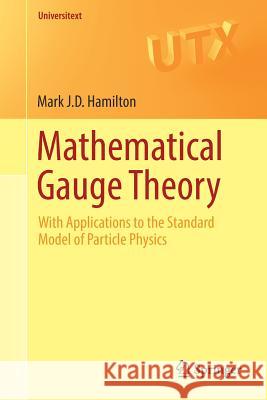
Mark J. D. Hamilton
Mathematical Gauge Theory: With Applications to the Standard Model of Particle Physics Hamilton, Mark J. D. 9783319684383 Springer - książkaWidoczna okładka, to zdjęcie poglądowe, a rzeczywista szata graficzna może różnić się od prezentowanej.

Mathematical Gauge Theory: With Applications to the Standard Model of Particle Physics

ISBN-13: 9783319684383 / Angielski / Miękka / 2018 / 658 str.

Mark J. D. Hamilton
cena 362,27
(netto: 345,02 VAT:  5%)

Najniższa cena z 30 dni: 346,96
Termin realizacji zamówienia:
ok. 22 dni roboczych.

Darmowa dostawa!

This book explains the mathematical background behind the Standard Model, translating ideas from physics into a mathematical language and vice versa. The first part of the book covers the mathematical theory of Lie groups and Lie algebras, fibre bundles, connections, curvature and spinors.


Kategorie:
Nauka, Matematyka
Kategorie BISAC:
Mathematics > Topologia
Science > Fizyka jądrowa
Science > Fizyka matematyczna
Wydawca:
Springer
Seria wydawnicza:
Universitext
Język:
Angielski
ISBN-13:
9783319684383
Rok wydania:
2018
Wydanie:
2017
Numer serii:
000024642
Ilość stron:
658
Waga:
0.92 kg
Wymiary:
23.39 x 15.6 x 3.45
Oprawa:
Miękka
Wolumenów:
01
Dodatkowe informacje:
Wydanie ilustrowane

"Assuming an introductory course on differential geometry and some basic knowledge of special relativity, both of which are summarized in the appendices, the book expounds the mathematical background behind the well-established standard model of modern particle and high energy physics... I believe that the book will be a standard textbook on the standard model for mathematics-oriented students." (Hirokazu Nishimura, zbMATH 1390.81005)

Part I Mathematical foundations
1 Lie groups and Lie algebras: Basic concepts
1.1 Topological groups and Lie groups
1.2 Linear groups and symmetry groups of vector spaces
1.3 Homomorphisms of Lie groups
1.4 Lie algebras
1.5 From Lie groups to Lie algebras
1.6 From Lie subalgebras to Lie subgroups
1.7 The exponential map
1.8 Cartan’s Theorem on closed subgroups
1.9 Exercises for Chapter 1
2 Lie groups and Lie algebras: Representations and structure theory
2.1 Representations
2.2 Invariant metrics on Lie groups
2.3 The Killing form
2.4 Semisimple and compact Lie algebras
2.5 Ad-invariant scalar products on compact Lie groups
2.6 Homotopy groups of Lie groups
2.7 Exercises for Chapter 2
3 Group actions
3.1 Transformation groups
3.2 Definition and first properties of group actions
3.3 Examples of group actions
3.4 Fundamental vector fields
3.5 The Maurer–Cartan form and the differential of a smooth group action
3.6 Left or right actions?
3.7 Quotient spaces
3.8 Homogeneous spaces
3.9 Stiefel and Grassmann manifolds
3.10 The exceptional Lie group G2
3.11 Godement’s Theorem on the manifold structure of quotient spaces
3.12 Exercises for Chapter 3
4 Fibre bundles
4.1 General fibre bundles
4.2 Principal fibre bundles
4.3 Formal bundle atlases
4.4 Frame bundles
4.5 Vector bundles
4.6 The clutching construction
4.7 Associated vector bundles
4.8 Exercises for Chapter 4
5 Connections and curvature
5.1 Distributions and connections
5.2 Connection 1-forms
5.3 Gauge transformations
5.4 Local connection 1-forms and gauge transformations
5.5 Curvature
5.6 Local curvature 2-forms
5.7 Generalized electric and magnetic fields on Minkowski spacetime of dimension 4
5.8 Parallel transport
5.9 The covariant derivative on associated vector bundles
5.10 Parallel transport and path-ordered exponentials
5.11 Holonomy and Wilson loops
5.12 The exterior covariant derivative
5.13 Forms with values in Ad(P)
5.14 A second and third version of the Bianchi identity
5.15 Exercises for Chapter 5
6 Spinors
6.1 The pseudo-orthogonal group O(s; t) of indefinite scalar products
6.2 Clifford algebras
6.3 The Clifford algebras for the standard symmetric bilinear forms
6.4 The spinor representation
6.5 The spin groups
6.6 Majorana spinors
6.7 Spin invariant scalar products
6.8 Explicit formulas for Minkowski spacetime of dimension 4
6.9 Spin structures and spinor bundles
6.10 The spin covariant derivative
6.11 Twisted spinor bundles
6.12 Twisted chiral spinors
6.13 Exercises for Chapter 6
Part II The Standard Model of elementary particle physics
7 The classical Lagrangians of gauge theories
7.1 Restrictions on the set of Lagrangians
7.2 The Hodge star and the codifferential
7.3 The Yang–Mills Lagrangian
7.4 Mathematical and physical conventions for gauge theories
7.5 The Klein–Gordon and Higgs Lagrangians
7.6 The Dirac Lagrangian
7.7 Yukawa couplings
7.8 Dirac and Majorana mass terms
7.9 Exercises for Chapter 7
8 The Higgs mechanism and the Standard Model
8.1 The Higgs field and symmetry breaking
8.2 Mass generation for gauge bosons
8.3 Massive gauge bosons in the SU(2)U(1)-theory of the electroweak interaction
8.4 The SU(3)-theory of the strong interaction (QCD)
8.5 The particle content of the Standard Model
8.6 Interactions between fermions and gauge bosons
8.7 Interactions between Higgs bosons and gauge bosons
8.8 Mass generation for fermions in the Standard Model
8.9 The complete Lagrangian of the Standard Model
8.10 Lepton and baryon numbers
8.11 Exercises for Chapter 8
9 Modern developments and topics beyond the Standard Model
9.1 Flavour and chiral symmetry
9.2 Massive neutrinos
9.3 C, P and CP violation
9.4 Vacuum polarization and running coupling constants
9.5 Grand Unified Theories
9.6 A short introduction to the Minimal Supersymmetric Standard Model (MSSM)
9.7 Exercises for Chapter 9
Part III Appendix
A Background on differentiable manifolds
A.1 Manifolds
A.2 Tensors and forms
B Background on special relativity and quantum field theory
B.1 Basics of special relativity
B.2 A short introduction to quantum field theory
References
Index

Mark Hamilton has worked as a lecturer and interim professor at the University of Stuttgart and the Ludwig-Maximilian University of Munich. His research focus lies on geometric topology and mathematical physics, in particular, the differential topology of 4-manifolds and Seiberg-Witten theory.

The Standard Model is the foundation of modern particle and high energy physics. This book explains the mathematical background behind the Standard Model, translating ideas from physics into a mathematical language and vice versa.

The first part of the book covers the mathematical theory of Lie groups and Lie algebras, fibre bundles, connections, curvature and spinors. The second part then gives a detailed exposition of how these concepts are applied in physics, concerning topics such as the Lagrangians of gauge and matter fields, spontaneous symmetry breaking, the Higgs boson and mass generation of gauge bosons and fermions. The book also contains a chapter on advanced and modern topics in particle physics, such as neutrino masses, CP violation and Grand Unification.

This carefully written textbook is aimed at graduate students of mathematics and physics. It contains numerous examples and more than 150 exercises, making it suitable for self-study and use alongside lecture courses. Only a basic knowledge of differentiable manifolds and special relativity is required, summarized in the appendix.


Udostępnij

Facebook - konto krainaksiazek.pl


Opinie o Krainaksiazek.pl na Opineo.pl

Partner Mybenefit

Krainaksiazek.pl w programie rzetelna firma Krainaksiaze.pl - płatności przez paypal

Czytaj nas na:

Facebook - krainaksiazek.pl
  • książki na zamówienie
  • granty
  • książka na prezent
  • kontakt
  • pomoc
  • opinie
  • regulamin
  • polityka prywatności

Zobacz:

  • Księgarnia czeska

  • Wydawnictwo Książkowe Klimaty

1997-2026 DolnySlask.com Agencja Internetowa

© 1997-2022 krainaksiazek.pl
     
KONTAKT | REGULAMIN | POLITYKA PRYWATNOŚCI | USTAWIENIA PRYWATNOŚCI
Zobacz: Księgarnia Czeska | Wydawnictwo Książkowe Klimaty | Mapa strony | Lista autorów
KrainaKsiazek.PL - Księgarnia Internetowa

Polityka prywatnosci - link
Krainaksiazek.pl - płatnośc Przelewy24
Przechowalnia Przechowalnia






