• Wyszukiwanie zaawansowane
  • Kategorie
  • Kategorie BISAC
  • Książki na zamówienie
  • Promocje
  • Granty
  • Książka na prezent
  • Opinie
  • Pomoc
  • Załóż konto
  • Zaloguj się

Mathematical Foundations of Computational Engineering: A Handbook » książka


zaloguj się | załóż konto
Logo Krainaksiazek.pl

koszyk

konto

szukaj
topmenu
Księgarnia internetowa
Szukaj
Książki na zamówienie
Promocje
Granty
Książka na prezent
Moje konto
Pomoc
 
 
Wyszukiwanie zaawansowane
Pusty koszyk
Bezpłatna dostawa dla zamówień powyżej 20 złBezpłatna dostawa dla zamówień powyżej 20 zł

Kategorie główne

• Nauka
 [2950560]
• Literatura piękna
 [1849509]

  więcej...
• Turystyka
 [71097]
• Informatyka
 [151150]
• Komiksy
 [35848]
• Encyklopedie
 [23178]
• Dziecięca
 [617388]
• Hobby
 [139064]
• AudioBooki
 [1657]
• Literatura faktu
 [228597]
• Muzyka CD
 [383]
• Słowniki
 [2855]
• Inne
 [445295]
• Kalendarze
 [1464]
• Podręczniki
 [167547]
• Poradniki
 [480102]
• Religia
 [510749]
• Czasopisma
 [516]
• Sport
 [61293]
• Sztuka
 [243352]
• CD, DVD, Video
 [3414]
• Technologie
 [219456]
• Zdrowie
 [101002]
• Książkowe Klimaty
 [124]
• Zabawki
 [2311]
• Puzzle, gry
 [3459]
• Literatura w języku ukraińskim
 [254]
• Art. papiernicze i szkolne
 [8079]
Kategorie szczegółowe BISAC

Mathematical Foundations of Computational Engineering: A Handbook

ISBN-13: 9783540679950 / Angielski / Miękka / 2001 / 1007 str.
Peter J. Pahl; P. J. Pahl; Rudolf Damrath
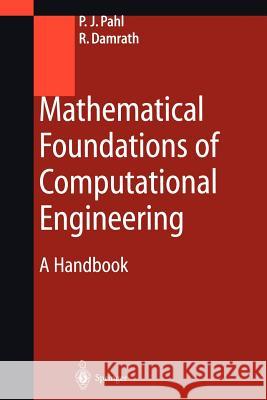
Mathematical Foundations of Computational Engineering: A Handbook Pahl, Peter J. 9783540679950 Springer - książkaWidoczna okładka, to zdjęcie poglądowe, a rzeczywista szata graficzna może różnić się od prezentowanej.

Mathematical Foundations of Computational Engineering: A Handbook

ISBN-13: 9783540679950 / Angielski / Miękka / 2001 / 1007 str.

Peter J. Pahl; P. J. Pahl; Rudolf Damrath
cena 1204,83
(netto: 1147,46 VAT:  5%)

Najniższa cena z 30 dni: 1156,64
Termin realizacji zamówienia:
ok. 22 dni roboczych
Dostawa w 2026 r.

Darmowa dostawa!

Computational engineering is the treatment of engineering tasks with computers. It is based on computational mathematics, which is presented here in a comprehensive handbook. Engineers and scientists who deal with engineering tasks have to handle large amounts of information, which must be created and structured in a systematic manner. This demands a high level of abstraction and therefore knowledge of the mathematical foundations. From the existing rich repertoire of mathematical theories and methods, the fundamentals of engineering computation are selected and presented in a coherent fashion. They are brought into a suitable order for specific engineering purposes, and their significance for typical applications is shown. The relevant definitions, notations and theories are presented in a durable form which is independent of the fast development of information and communication technology.


Kategorie:
Technologie
Kategorie BISAC:
Technology & Engineering > Engineering (General)
Mathematics > Matematyka stosowana
Mathematics > Topologia
Wydawca:
Springer
Język:
Angielski
ISBN-13:
9783540679950
Rok wydania:
2001
Wydanie:
2001
Ilość stron:
1007
Waga:
1.40 kg
Wymiary:
23.39 x 15.6 x 5.13
Oprawa:
Miękka
Wolumenów:
02

Logic.- 1.1 Representation of Thought.- 1.2 Elementary Concepts.- 1.3 Propositional Logic.- 1.3.1 Logical Variables and Connectives.- 1.3.2 Logical Expressions.- 1.3.3 Logical Normal Form.- 1.3.4 Logical Rules of Inference.- 1.4 Predicate Logic.- 1.5 Proofs and Axioms.- Set Theory.- 2.1 Sets.- 2.2 Algebra of Sets.- 2.3 Relations.- 2.4 Types of Relations.- 2.5 Mappings.- 2.6 Types of Mappings.- 2.7 Cardinality and Countability.- 2.8 Structures.- Algebraic Structures.- 3.1 Introduction.- 3.2 Inner Operations.- 3.3 Sets with One Operation.- 3.4 Sets with Two Operations.- 3.4.1 Introduction.- 3.4.2 Additive and Multiplicative Domains.- 3.4.3 Dual Domains.- 3.5 Vector Spaces.- 3.5.1 General Vector Spaces.- 3.5.2 Real Vector Spaces.- 3.6 Linear Mappings.- 3.7 Vector and Matrix Algebra.- 3.7.1 Definitions.- 3.7.2 Elementary Vector Operations.- 3.7.3 Elementary Matrix Operations.- 3.7.4 Derived Scalars.- 3.7.5 Complex Vectors and Matrices.- Ordinal Structures.- 4.1 Introduction.- 4.2 Ordered Sets.- 4.3 Extreme Elements.- 4.4 Ordered Sets with Extremality Properties.- 4.5 Mappings of Ordered Sets.- 4.6 Properties of Ordered Sets.- 4.7 Ordered Cardinal Numbers.- Topological Structures.- 5.1 Introduction.- 5.2 Topological Spaces.- 5.3 Bases and Generating Sets.- 5.4 Metric Spaces.- 5.5 Point Sets in Topological Spaces.- 5.6 Topological Mappings.- 5.7 Construction of Topologies.- 5.7.1 Final and Initial Topologies.- 5.7.2 Subspaces.- 5.7.3 Product Spaces.- 5.8 Connectedness of Sets.- 5.8.1 Disconnections and Connectedness.- 5.8.2 Connectedness of Constructed Sets.- 5.8.3 Components and Paths.- 5.9 Separation Properties.- 5.10 Convergence.- 5.10.1 Sequences.- 5.10.2 Subsequences.- 5.10.3 Series.- 5.10.4 Nets.- 5.10.5 Filters.- 5.11 Compactness.- 5.11.1 Compact Spaces.- 5.11.2 Compact Metric Spaces.- 5.11.3 Locally Compact Spaces.- 5.12 Continuity of Real Functions.- Number System.- 6.1 Introduction.- 6.2 Natural Numbers.- 6.3 Integers.- 6.4 Rational Numbers.- 6.5 Real Numbers.- 6.6 Complex Numbers.- 6.7 Quaternions.- Groups.- 7.1 Introduction.- 7.1.1 Group Theory.- 7.1.2 Outline.- 7.2 Groups and Subgroups.- 7.3 Types of Groups.- 7.3.1 Permutation Groups.- 7.3.2 Symmetry Groups.- 7.3.3 Generated Groups.- 7.3.4 Cyclic Groups.- 7.3.5 Groups of Integers.- 7.3.6 Cyclic Subgroups.- 7.4 Class Structure.- 7.4.1 Classes.- 7.4.2 Cosets and Normal Subgroups.- 7.4.3 Groups of Residue Classes.- 7.4.4 Conjugate Elements and Sets.- 7.5 Group Structure.- 7.5.1 Introduction.- 7.5.2 Homomorphism.- 7.5.3 Isomorphism.- 7.5.4 Isomorphic Types of Groups.- 7.5.5 Automorphisms.- 7.6 Abelian Groups.- 7.6.1 Introduction.- 7.6.2 Classification of Abelian Groups.- 7.6.3 Linear Combinations.- 7.6.4 Direct Sums.- 7.6.5 Constructions of Abelian Groups.- 7.6.6 Decompositions of Abelian Groups.- 7.7 Permutations.- 7.7.1 Introduction.- 7.7.2 Symmetric Groups.- 7.7.3 Cycles.- 7.7.4 Conjugate Permutations.- 7.7.5 Transpositions.- 7.7.6 Subgroups of a Symmetric Group.- 7.7.7 Group Structure of the Symmetric Group S4.- 7.7.8 Class Structure of the Symmetric Group S4.- 7.8 General Groups.- 7.8.1 Introduction.- 7.8.2 Classes in General Groups.- 7.8.3 Groups of Prime-power Order.- 7.8.4 Normal Series.- 7.9 Unique Decomposition of Abelian Groups.- Graphs.- 8.1 Introduction.- 8.2 Algebra of Relations.- 8.2.1 Introduction.- 8.2.2 Unary Relations.- 8.2.3 Homogeneous Binary Relations.- 8.2.4 Heterogeneous Binary Relations.- 8.2.5 Unary and Binary Relations.- 8.2.6 Closures.- 8.3 Classification of Graphs.- 8.3.1 Introduction.- 8.3.2 Directed Graphs.- 8.3.3 Bipartite Graphs.- 8.3.4 Multigraphs.- 8.3.5 Hypergraphs.- 8.4 Structure of Graphs.- 8.4.1 Introduction.- 8.4.2 Paths and Cycles in Directed Graphs.- 8.4.3 Connectedness of Directed Graphs.- 8.4.4 Cuts in Directed Graphs.- 8.4.5 Paths and Cycles in Simple Graphs.- 8.4.6 Connectedness of Simple Graphs.- 8.4.7 Cuts in Simple Graphs.- 8.4.8 Acyclic Graphs.- 8.4.9 Rooted Graphs and Rooted Trees.- 8.5 Paths in Networks.- 8.5.1 Introduction.- 8.5.2 Path Algebra.- 8.5.3 Boolean Path Algebra.- 8.5.4 Real Path Algebra.- 8.5.4.1 Minimal Path Length.- 8.5.4.2 Maximal Path Length.- 8.5.4.3 Maximal Path Reliability.- 8.5.4.4 Maximal Path Capacity.- 8.5.5 Literal Path Algebra.- 8.5.5.1 Path Edges.- 8.5.5.2 Common Path Edges.- 8.5.5.3 Simple Paths.- 8.5.5.4 Extreme Simple Paths.- 8.5.5.5 Literal Vertex Labels.- 8.5.5.6 Literal Edge Labels for Simple Graphs.- 8.5.5.7 Applications in Structural Analysis.- 8.5.6 Properties of Path Algebras.- 8.5.7 Systems of Equations.- 8.5.7.1 Solutions of Systems of Equations.- 8.5.7.2 Direct Methods of Solution.- 8.5.7.3 Iterative Methods of Solution.- 8.6 Network Flows.- 8.6.1 Introduction.- 8.6.2 Networks and Flows.- 8.6.3 Unrestricted Flow.- 8.6.4 Restricted Flow.- 8.6.5 Maximal Flow.- 8.6.6 Maximal Flow and Minimal Cost.- 8.6.7 Circulation.- Tensors.- 9.1 Introduction.- 9.2 Vector Algebra.- 9.2.1 Vector Spaces.- 9.2.2 Bases.- 9.2.3 Coordinates.- 9.2.4 Metrics.- 9.2.5 Construction of Bases.- 9.2.6 Transformation of Bases.- 9.2.7 Orientation and Volume.- 9.3 Tensor Algebra.- 9.3.1 Introduction.- 9.3.2 Tensors.- 9.3.3 Transformation of Tensor Coordinates.- 9.3.4 Operations on Tensors.- 9.3.5 Antisymmetric Tensors.- 9.3.6 Tensors of First and Second Rank.- 9.3.7 Properties of Dyads.- 9.3.8 Tensor Mappings.- 9.4 Tensor Analysis.- 9.4.1 Introduction.- 9.4.2 Point Spaces.- 9.4.3 Rectilinear Coordinates.- 9.4.4 Derivatives with Respect to Global Coordinates.- 9.4.5 Curvilinear Coordinates.- 9.4.6 Christoffel Symbols.- 9.4.7 Derivatives with Respect to Local Coordinates.- 9.4.8 Tensor Integrals.- 9.4.9 Field Operations.- 9.4.10 Nabla Calculus.- 9.4.11 Special Vector Fields.- 9.4.12 Integral Theorems.- Stochastics.- 10.1 Introduction.- 10.2 Random Events.- 10.2.1 Introduction.- 10.2.2 Elementary Combinatorics.- 10.2.3 Algebra of Events.- 10.2.4 Probability.- 10.2.5 Reliability.- 10.3 Random Variables.- 10.3.1 Introduction.- 10.3.2 Probability Distributions.- 10.3.3 Moments.- 10.3.4 Functions of One Random Variable.- 10.3.5 Functions of Several Random Variables.- 10.3.6 Discrete Distributions.- 10.3.6.1 Bernoulli Distribution.- 10.3.6.2 Binomial Distribution.- 10.3.6.3 Pascal Distribution.- 10.3.6.4 Poisson Distribution.- 10.3.7 Continuous Distributions.- 10.3.7.1 Gamma Distribution.- 10.3.7.2 Normal Distribution.- 10.3.7.3 Logarithmic Normal Distribution.- 10.3.7.4 Maximum Distributions.- 10.3.7.5 Minimum Distributions.- 10.4 Random Vectors.- 10.4.1 Introduction.- 10.4.2 Probability Distributions.- 10.4.3 Moments.- 10.4.4 Functions of a Random Vector.- 10.4.5 Multinomial Distribution.- 10.4.6 Multinormal Distribution.- 10.5 Random Processes.- 10.5.1 Introduction.- 10.5.2 Finite Markov Processes in Discrete Time.- 10.5.2.1 Introduction.- 10.5.2.2 States and Transitions.- 10.5.2.3 Structural Analysis.- 10.5.2.4 Spectral Analysis.- 10.5.2.5 First Passage.- 10.5.2.6 Processes of Higher Order.- 10.5.3 Finite Markov Processes in Continuous Time.- 10.5.3.1 Introduction.- 10.5.3.2 States and Transition Rates.- 10.5.3.3 First Passage.- 10.5.3.4 Queues.- 10.5.3.5 Queue Systems.- 10.5.4 Stationary Processes.- 10.5.4.1 Introduction.- 10.5.4.2 Probability Distributions and Moments.- 10.5.4.3 Stationary Processes in Discrete Time.- 10.5.4.4 Stationary Processes in Continuous Time.

o.Prof. Dr. Dr. h.c. mult. Peter Jan Pahl is an expert in the field of computational engineering, with international activities. He is proposed President of the International Society on Computing in Civil and Structural Engineering. Prof. Dr.-Ing. Rudolf Damrath worked with Professor Pahl for over 20 years and is now international renown himself. They both worked on fundamental topics in computational engineering, especially for numerical applications in civil and structural engineering. This book serves as a comprehensive handbook, bringing the fundamental mathematics of engineering computation into a suitable order for specific engineering purposes, showing their siginificance for typical applications. The relevant definitions, notations and theories are presented in a durable form which is independent of the fast development of information technology.


Udostępnij

Facebook - konto krainaksiazek.pl


Opinie o Krainaksiazek.pl na Opineo.pl

Partner Mybenefit

Krainaksiazek.pl w programie rzetelna firma Krainaksiaze.pl - płatności przez paypal

Czytaj nas na:

Facebook - krainaksiazek.pl
  • książki na zamówienie
  • granty
  • książka na prezent
  • kontakt
  • pomoc
  • opinie
  • regulamin
  • polityka prywatności

Zobacz:

  • Księgarnia czeska

  • Wydawnictwo Książkowe Klimaty

1997-2025 DolnySlask.com Agencja Internetowa

© 1997-2022 krainaksiazek.pl
     
KONTAKT | REGULAMIN | POLITYKA PRYWATNOŚCI | USTAWIENIA PRYWATNOŚCI
Zobacz: Księgarnia Czeska | Wydawnictwo Książkowe Klimaty | Mapa strony | Lista autorów
KrainaKsiazek.PL - Księgarnia Internetowa

Polityka prywatnosci - link
Krainaksiazek.pl - płatnośc Przelewy24
Przechowalnia Przechowalnia





