Mathematical Doodlings » książka





Mathematical Doodlings
ISBN-13: 9780994366696 / Angielski / Miękka / 2017 / 194 str.
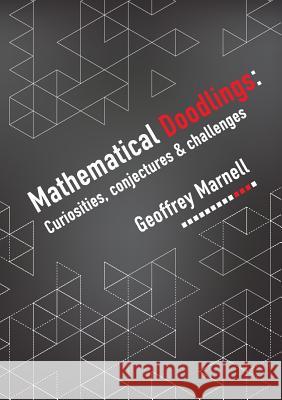
This is a journal about a trip to the edges of the mathematical universe. It is testament to the fact that even the amateur lover of numbers--one both daunted and humbled by the sledgehammer tools of the professional mathematician--can discover new terrains, new patterns and new interconnections. All that's needed is a pen and paper, an inquisitive mind and a modicum of patience--and perhaps a simple spreadsheet to see if a keyhole discovery can be scaled up into something worthy of a conjecture or even a theorem. This book is full of curiosities and conjectures, all the product of idle number-play. In it you'll find new ways to multiply, simple mathematical tricks to baffle your dinner party guests, various ways of building integers from prime numbers, and much more. And nothing in it needs more than classroom arithmetic. May it inspire the timid numerophile to seek the joy of discovery undaunted by the esoteric complexities of professional mathematics. Side by side with the playfulness in this book is a serious concern. One's dexterity in seeing patterns in numbers is often used to judge and to classify. Aptitude and intelligence tests invariably test this, and it is often fed into an assessment of one's suitability for a scholarship or a job. And yet the immense richness of the mathematical universe, the staggering interconnections between numbers, challenges even the most skilful test designer to create numeracy questions that have just one correct answer. As this book shows, one very common type of question on such tests--what number comes next in a given sequence--never has just one answer, contrary to the assumption of test designers. In fact, each such question has an infinite number of answers. The ramifications of this are explored in detail, especially from the perspective of natural justice. If someone is to be denied power, privilege, responsibility or reward on the basis of a test, the test had better be a good one. Alas, many are not. Geoffrey Marnell has a masters degree and doctorate from the University of Melbourne, gained by research in philosophy at the universities of Melbourne and Oxford. He has published widely, on such topics as language, psychology and mathematics. This is his sixth book.
This is a journal about a trip to the edges of the mathematical universe. It is testament to the fact that even the amateur lover of numbers—one both daunted and humbled by the sledgehammer tools of the professional mathematician—can discover new terrains, new patterns and new interconnections. All that’s needed is a pen and paper, an inquisitive mind and a modicum of patience—and perhaps a simple spreadsheet to see if a keyhole discovery can be scaled up into something worthy of a conjecture or even a theorem. This book is full of curiosities and conjectures, all the product of idle number-play. In it you’ll find new ways to multiply, simple mathematical tricks to baffle your dinner party guests, various ways of building integers from prime numbers, and much more. And nothing in it needs more than classroom arithmetic. May it inspire the timid numerophile to seek the joy of discovery undaunted by the esoteric complexities of professional mathematics. Side by side with the playfulness in this book is a serious concern. One’s dexterity in seeing patterns in numbers is often used to judge and to classify. Aptitude and intelligence tests invariably test this, and it is often fed into an assessment of one’s suitability for a scholarship or a job. And yet the immense richness of the mathematical universe, the staggering interconnections between numbers, challenges even the most skilful test designer to create numeracy questions that have just one correct answer. As this book shows, one very common type of question on such tests—what number comes next in a given sequence—never has just one answer, contrary to the assumption of test designers. In fact, each such question has an infinite number of answers. The ramifications of this are explored in detail, especially from the perspective of natural justice. If someone is to be denied power, privilege, responsibility or reward on the basis of a test, the test had better be a good one. Alas, many are not. Geoffrey Marnell has a masters degree and doctorate from the University of Melbourne, gained by research in philosophy at the universities of Melbourne and Oxford. He has published widely, on such topics as language, psychology and mathematics. This is his sixth book.




Czytaj nas na:
KrainaKsiazek.PL - Księgarnia Internetowa


