• Wyszukiwanie zaawansowane
  • Kategorie
  • Kategorie BISAC
  • Książki na zamówienie
  • Promocje
  • Granty
  • Książka na prezent
  • Opinie
  • Pomoc
  • Załóż konto
  • Zaloguj się

Mathematical Aspects of Paradoxes in Cosmology: Can Mathematics Explain the Contemporary Cosmological Crisis? » książka


zaloguj się | załóż konto
Logo Krainaksiazek.pl

koszyk

konto

szukaj
topmenu
Księgarnia internetowa
Szukaj
Książki na zamówienie
Promocje
Granty
Książka na prezent
Moje konto
Pomoc
 
 
Wyszukiwanie zaawansowane
Pusty koszyk
Bezpłatna dostawa dla zamówień powyżej 20 złBezpłatna dostawa dla zamówień powyżej 20 zł

Kategorie główne

• Nauka
 [2946600]
• Literatura piękna
 [1856966]

  więcej...
• Turystyka
 [72221]
• Informatyka
 [151456]
• Komiksy
 [35826]
• Encyklopedie
 [23190]
• Dziecięca
 [619653]
• Hobby
 [140543]
• AudioBooki
 [1577]
• Literatura faktu
 [228355]
• Muzyka CD
 [410]
• Słowniki
 [2874]
• Inne
 [445822]
• Kalendarze
 [1744]
• Podręczniki
 [167141]
• Poradniki
 [482898]
• Religia
 [510455]
• Czasopisma
 [526]
• Sport
 [61590]
• Sztuka
 [243598]
• CD, DVD, Video
 [3423]
• Technologie
 [219201]
• Zdrowie
 [101638]
• Książkowe Klimaty
 [124]
• Zabawki
 [2473]
• Puzzle, gry
 [3898]
• Literatura w języku ukraińskim
 [254]
• Art. papiernicze i szkolne
 [8170]
Kategorie szczegółowe BISAC

Mathematical Aspects of Paradoxes in Cosmology: Can Mathematics Explain the Contemporary Cosmological Crisis?

ISBN-13: 9783031317675 / Angielski
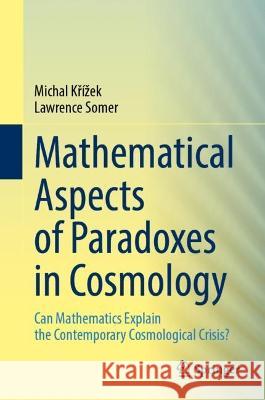
Michal Křízek; Lawrence Somer
Mathematical Aspects of Paradoxes in Cosmology: Can Mathematics Explain the Contemporary Cosmological Crisis? Michal Kř?zek Lawrence Somer 9783031317675 Springer - książkaWidoczna okładka, to zdjęcie poglądowe, a rzeczywista szata graficzna może różnić się od prezentowanej.

Mathematical Aspects of Paradoxes in Cosmology: Can Mathematics Explain the Contemporary Cosmological Crisis?

ISBN-13: 9783031317675 / Angielski

Michal Křízek; Lawrence Somer
cena 605,23 zł
(netto: 576,41 VAT:  5%)

Najniższa cena z 30 dni: 578,30 zł
Termin realizacji zamówienia:
ok. 22 dni roboczych
Bez gwarancji dostawy przed świętami

Darmowa dostawa!
inne wydania

This book provides a mathematical and numerical analysis of many problems which lead to paradoxes in contemporary cosmology, in particular, the existence of dark matter and dark energy. It is shown that these hypothetical quantities arise from excessive extrapolations of simple mathematical models to the whole physical universe. Written in a completely different style to most books on General Relativity and cosmology, the important results take the form of mathematical theorems with precise assumptions and statements. All theorems are followed by a corresponding proof, or an exact reference to the proof.Some nonstandard topics are also covered, including violation of the causality principle in Newtonian mechanics, a critical mathematical and numerical analysis of Mercury's perihelion shift, inapplicability of Einstein's equations to the classical two-body problem due to computational complexity, non-uniqueness of the notion of universe, the topology of the universe, various descriptions of a hypersphere, regular tessellations of hyperbolic spaces, local Hubble expansion of the universe, neglected gravitational redshift in the detection of gravitational waves, and the possible distribution of mass inside a black hole.The book also dispels some myths appearing in the theory of relativity and in contemporary cosmology. For example, although the hidden assumption that Einstein's equations provide a good description of the evolution of the whole universe is considered to be obvious, it is just a null hypothesis which has not been verified by any experiment, and has only been postulated by excessive extrapolations of many orders of magnitude.


This book provides a mathematical and numerical analysis of many problems which lead to paradoxes in contemporary cosmology, in particular, the existence of dark matter and dark energy. It is shown that these hypothetical quantities arise from excessive extrapolations of simple mathematical models to the whole physical universe. Written in a completely different style to most books on General Relativity and cosmology, the important results take the form of mathematical theorems with precise assumptions and statements. All theorems are followed by a corresponding proof, or an exact reference to the proof.Some nonstandard topics are also covered, including violation of the causality principle in Newtonian mechanics, a critical mathematical and numerical analysis of Mercury's perihelion shift, inapplicability of Einstein's equations to the classical two-body problem due to computational complexity, non-uniqueness of the notion of universe, the topology of the universe, various descriptions of a hypersphere, regular tessellations of hyperbolic spaces, local Hubble expansion of the universe, neglected gravitational redshift in the detection of gravitational waves, and the possible distribution of mass inside a black hole. The book also dispels some myths appearing in the theory of relativity and in contemporary cosmology. For example, although the hidden assumption that Einstein's equations provide a good description of the evolution of the whole universe is considered to be obvious, it is just a null hypothesis which has not been verified by any experiment, and has only been postulated by excessive extrapolations of many orders of magnitude.

Kategorie:
Nauka, Matematyka
Kategorie BISAC:
Science > Fizyka matematyczna
Mathematics > Systemy liczbowe
Science > Astronomia, przestrzeń i czas
Wydawca:
Springer
Język:
Angielski
ISBN-13:
9783031317675

The book has 12 chapters:


1. Mathematical Modeling.

We present a list of the main problems of the standard

cosmological model. After introducing several fundamental statements from celestial

mechanics we explain a general computational scheme. We show why long-term

numerical simulations can produce wrong results and why the Newtonian

mechanics contradicts the Principle of Causality.


2. Paradoxes in the Special Theory of Relativity.

We show that the Doppler effect and aberration of light can

produce more dominant and entirely opposite effects for relativistic speeds than those

predicted by the Special Theory of Relativity (STR), in particular, the clock

paradox, time dilation, and length contraction.

This important fact is not emphasized in most of the books on STR.


3. Einstein's Equations.

Karl Schwarzschild was probably the first scientist who ever

realized that for a fixed time instant, our universe might be non-Euclidean. We

present his exterior and interior solution of Einstein's equation of a homogeneous

mass ball. Then we introduce Einstein's equations with non-zero cosmological constant and prove some

properties of their solutions.


4. Numerical Analysis of Mercury's Perihelion Shift.

The perihelion shift of Mercury's orbit is thought to be one of the fundamental

tests of the validity of the GTR. In the current astrophysical community, it is

generally accepted that the additional relativistic perihelion shift of Mercury is the difference between

its observed perihelion shift and the one predicted by the N-body problem, and that

this difference equals 43" per century. However, as it results from the subtraction of

two quite large and inexact numbers of almost equal magnitude which are not uniquely defined,

this difference can be quite inexact.


5. Computational Problems of Einstein's Equations.

We point out the extreme complexity of Einstein's equations

which does not allow us to find their analytical solution of the N-body problem for

N>1. There are also serious problems with initial and boundary conditions, and

numerical solution of Einstein's equations. Since the classical relativistic tests are based only on the

exterior Schwarzschild solution, we cannot guarantee that Einstein's equations describe the physical

universe well, especially on very large or very small scales.


6. Friedmann Equation.

First we deal with nonuniqueness of the notion universe. We show

that there are at least 6 different meanings of this term which causes a lot of

confusion in the contemporary cosmology. Then we derive in detail the Friedmann

equation from Einstein's equations applied to the whole universe

and we point out various drawbacks of this approach. Further, we present many ways how to imagine

the three-dimensional hypersphere and also the hyperbolic pseudosphere.


7. Excessive Extrapolations From the Friedmann Equation.

The Friedmann equation was derived from Einstein's equations in a completely

rigorous mathematical manner without any approximations. However, it does not

give acceptable results. For instance, it admits a division by zero. It also leads to a wide range of paradoxes and has other

serious problems, in particular, the problem of the existence of an invisible

exotic dark matter and dark energy. The main reason is that the physical world is identified with a

very simple mathematical model ignoring the modeling error.


8. Arguments Against the Proclaimed Amount of Dark Matter.

We analyze in detail the method by Fritz Zwicky who predicted that there is a

large amount of invisible dark matter. Then we present several independent

mathematical arguments showing that there is not 6 times more dark matter than ordinary baryonic matter as the standard

cosmological model claims. We also analyze flat rotation curves of spiral galaxies proposed by Vera Rubin.


9. Dark Energy and the Local Hubble Expansion.

We present several observational arguments showing that the Solar system slightly

expands and that the corresponding expansion rate is comparable to the Hubble

constant. In particular, our Moon recedes from the Earth more rapidly than the Newtonian mechanics predicts. The same

is true for the system Titan-Saturn. We also show that Mars was much closer to the Sun when

there were rivers.


10. Anthropic Principle and the Hubble-Lemaitre Constant.

We introduce a weak formulation of the anthropic principle. We show that the local

Hubble expansion can explain the famous faint young Sun paradox, since the Sun had

much lower luminosity at its origin than now. We derive two-sided error estimates for the recession speed of the Earth

from the Sun so that the Earth receives an almost constant flux of energy from the Sun.


11. Gravitational Waves.

We show that masses of binary black hole mergers are overestimated, since a large

gravitational redshift is not taken into account. This fact allows us to explain

a high mass gap between observed binary neutron stars and calculated binary black hole mergers. We also present other reasons

why masses of black hole mergers are computed incorrectly.


12. Possible Distribution of Mass Inside a Black Hole.

It is generally believed that the center of any physical black hole contains a

point singularity with infinite mass density. This seems to be only a

mathematical idealization due to Pauli's exclusion principle. We introduce our own

hypothesis. We suggest that the hidden center of any black hole can be occupied by a neutron-like

star composed of neutrons and/or quark-gluon plasma. So there is no singularity in the center.

Michal Křížek is a senior researcher at the Institute of Mathematics of the Czech Academy of Sciences and a full professor at Charles University in Prague. For many years he was Editor-in-chief of the journal Applications of Mathematics and the Czech journal Advances of Mathematics, Physics and Astronomy. He is a member of the Czech Learned Society and the International Astronomical Union. His research focuses on mathematical and functional analysis, the numerical solution of partial differential equations, mathematical physics, and astrophysics.

Lawrence Somer is a professor emeritus of mathematics at the Catholic University of America in Washington, D.C. He obtained his B. A. degree in mathematics from Cornell University in Ithaca, New York, and his PhD. from the University of Illinois. He is a member of the Editorial board of the journal Fibonacci Quarterly. His research interests include number theory, combinatorics, algebra, geometry, and cosmology.

This book provides a mathematical and numerical analysis of many problems which lead to paradoxes in contemporary cosmology, in particular, the existence of dark matter and dark energy. It is shown that these hypothetical quantities arise from excessive extrapolations of simple mathematical models to the whole physical universe. Written in a completely different style to most books on General Relativity and cosmology, the important results take the form of mathematical theorems with precise assumptions and statements. All theorems are followed by a corresponding proof, or an exact reference to the proof.

Some nonstandard topics are also covered, including violation of the causality principle in Newtonian mechanics, a critical mathematical and numerical analysis of Mercury's perihelion shift, inapplicability of Einstein's equations to the classical two-body problem due to computational complexity, non-uniqueness of the notion of universe, the topology of the universe, various descriptions of a hypersphere, regular tessellations of hyperbolic spaces, local Hubble expansion of the universe, neglected gravitational redshift in the detection of gravitational waves, and the possible distribution of mass inside a black hole.

The book also dispels some myths appearing in the theory of relativity and in contemporary cosmology. For example, although the hidden assumption that Einstein's equations provide a good description of the evolution of the whole universe is considered to be obvious, it is just a null hypothesis which has not been verified by any experiment, and has only been postulated by excessive extrapolations of many orders of magnitude.




Udostępnij

Facebook - konto krainaksiazek.pl


Opinie o Krainaksiazek.pl na Opineo.pl

Partner Mybenefit

Krainaksiazek.pl w programie rzetelna firma Krainaksiaze.pl - płatności przez paypal

Czytaj nas na:

Facebook - krainaksiazek.pl
  • książki na zamówienie
  • granty
  • książka na prezent
  • kontakt
  • pomoc
  • opinie
  • regulamin
  • polityka prywatności

Zobacz:

  • Księgarnia czeska

  • Wydawnictwo Książkowe Klimaty

1997-2025 DolnySlask.com Agencja Internetowa

© 1997-2022 krainaksiazek.pl
     
KONTAKT | REGULAMIN | POLITYKA PRYWATNOŚCI | USTAWIENIA PRYWATNOŚCI
Zobacz: Księgarnia Czeska | Wydawnictwo Książkowe Klimaty | Mapa strony | Lista autorów
KrainaKsiazek.PL - Księgarnia Internetowa

Polityka prywatnosci - link
Krainaksiazek.pl - płatnośc Przelewy24
Przechowalnia Przechowalnia



