• Wyszukiwanie zaawansowane
  • Kategorie
  • Kategorie BISAC
  • Książki na zamówienie
  • Promocje
  • Granty
  • Książka na prezent
  • Opinie
  • Pomoc
  • Załóż konto
  • Zaloguj się

Mathematica as a Tool: An introduction with practical examples » książka


zaloguj się | załóż konto
Logo Krainaksiazek.pl

koszyk

konto

szukaj
topmenu
Księgarnia internetowa
Szukaj
Książki na zamówienie
Promocje
Granty
Książka na prezent
Moje konto
Pomoc
 
 
Wyszukiwanie zaawansowane
Pusty koszyk
Bezpłatna dostawa dla zamówień powyżej 20 złBezpłatna dostawa dla zamówień powyżej 20 zł

Kategorie główne

• Nauka
 [2950560]
• Literatura piękna
 [1849509]

  więcej...
• Turystyka
 [71097]
• Informatyka
 [151150]
• Komiksy
 [35848]
• Encyklopedie
 [23178]
• Dziecięca
 [617388]
• Hobby
 [139064]
• AudioBooki
 [1657]
• Literatura faktu
 [228597]
• Muzyka CD
 [383]
• Słowniki
 [2855]
• Inne
 [445295]
• Kalendarze
 [1464]
• Podręczniki
 [167547]
• Poradniki
 [480102]
• Religia
 [510749]
• Czasopisma
 [516]
• Sport
 [61293]
• Sztuka
 [243352]
• CD, DVD, Video
 [3414]
• Technologie
 [219456]
• Zdrowie
 [101002]
• Książkowe Klimaty
 [124]
• Zabawki
 [2311]
• Puzzle, gry
 [3459]
• Literatura w języku ukraińskim
 [254]
• Art. papiernicze i szkolne
 [8079]
Kategorie szczegółowe BISAC

Mathematica as a Tool: An introduction with practical examples

ISBN-13: 9783764350314 / Angielski / Miękka / 1994 / 430 str.
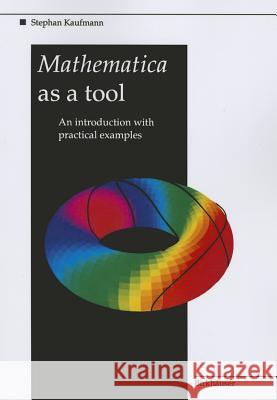
Stephan Kaufmann
Mathematica as a Tool: An introduction with practical examples Stephan Kaufmann 9783764350314 Birkhauser Verlag AG - książkaWidoczna okładka, to zdjęcie poglądowe, a rzeczywista szata graficzna może różnić się od prezentowanej.

Mathematica as a Tool: An introduction with practical examples

ISBN-13: 9783764350314 / Angielski / Miękka / 1994 / 430 str.

Stephan Kaufmann
cena 180,69
(netto: 172,09 VAT:  5%)

Najniższa cena z 30 dni: 173,46
Termin realizacji zamówienia:
ok. 22 dni roboczych
Dostawa w 2026 r.

Darmowa dostawa!

More than ten years ago, I wanted to carry out coordinate transformations for Hamiltonian systems, in order to discuss the stability of certain equilibrium posi tions. Basically, the calculations only involved rational expressions, but they turned out to be extremely complicated, because the third and fourth order terms had to be included. After several months of filling whole blocks of paper with for mulas, I was close to resignation. But, by a lucky incident, I met a colleague who showed me the computer algebra package Reduce. It still required a lot of patience and tricks, but Reduce finally did produce the desired results. After this experience, I wondered, why only a few engineers and scientists were aware of the strengths of such computer algebra programs. The mathematical treatment of scientific problems often leads to calculations which can only be solved "by hand" with a considerable investment of time, while a suitable com puter algebra program produces the solution within a couple of seconds or min utes. Even if a closed symbolic solution is not possible, such programs can often simplify a problem, before the cruder tool of numerical simulations is applied."


Kategorie:
Nauka, Matematyka
Kategorie BISAC:
Mathematics > Matematyka dyskretna
Science > Chemia - Fizyczna
Science > Fizyka matematyczna
Wydawca:
Birkhauser Verlag AG
Język:
Angielski
ISBN-13:
9783764350314
Rok wydania:
1994
Dostępne języki:
Angielski
Wydanie:
1994
Ilość stron:
430
Waga:
0.94 kg
Wymiary:
25.425.4 x 17.8
Oprawa:
Miękka
Wolumenów:
01

"Provides engineers, scientists, and applied mathematicians with a compact introduction to Mathematica, a software program combining computer algebra, graphics, animations, an elegant programming language, and numerical tools. Helps readers gain the skills necessary to use the program as a tool in their work."
-- Journal of Economic Literature

"This book is a valuable introductory textbook on Mathematica and is very useful to scientists and engineers who use Mathematica in their work."
-- Zentralblatt Math

"This book is very nicely written and recommended to everybody."
-- EMS Newsletter

1. Basics.- 1.1 Getting Started.- 1.1.1 Starting and Quitting.- 1.1.2 Interrupting and Quitting.- 1.2 Help!.- 1.3 Numerical Calculations.- 1.3.1 Simple Examples.- 1.3.2 External Packages: Units.- 1.3.3 Large Numbers: The RSA Public-Key Cryptosystem.- 1.4 Symbolic Calculations.- 1.4.1 Polynomials.- 1.4.2 Equations.- 1.4.3 Calculus.- 1.5 Plots: Different Pendulums.- 1.5.1 Two-Dimensional Plots.- 1.5.2 Example: The Triple Pendulum.- 1.5.3 Three-Dimensional Graphics and Animation: A Rotating Double Pendulum.- 1.5.4 Parametric Plots: A Rotating Double Pendulum.- 1.5.5 Plotting Data: The Random Generator.- 1.6 Lists.- 1.6.1 Creating and Formatting Lists.- 1.6.2 Calculations with Lists, Pure Functions.- 1.6.3 List Manipulation: The Cross Product.- 1.6.4 Vectors, Matrices, Tensors: The Jacobian.- 1.6.5 Eigenvectors and Eigenvalues: An Oscillator.- 1.7 Graphics Programming.- 1.7.1 The Structure of Graphics.- 1.7.2 Example: Animation of the Triple Pendulum.- 1.7.3 Example: The Oscillator.- 1.8 More Selected Tools.- 1.8.1 Graphics and Sound.- 1.8.2 Complex Numbers.- 1.8.3 Sums, Products, Series.- 1.8.4 Data Analysis,Interpolation.- 1.8.5 Transformations.- 1.8.6 Mathematical Functions.- 1.8.7 Polynomials.- 1.8.8 Linear Algebra, Linear Programming.- 1.8.9 File Manipulation.- 1.8.10 Custom Configuration.- 1.8.11 Resources.- 2. Structure.- 2.1 Expressions.- 2.1.1 The Structure of Expressions.- 2.1.2 Working with Parts of Expressions.- 2.2 Patterns.- 2.2.1 Simple Patterns.- 2.2.2 Restricted Patterns.- 2.2.3 More Complicated Patterns.- 2.2.4 Example: A Simple Integrator.- 2.3 Transformation Rules and Definitions.- 2.3.1 Transformation Rules.- 2.3.2 Definitions.- 2.3.3 Attributes.- 2.4 Evaluation and Tools for Programming.- 2.4.1 Standard Evaluation.- 2.4.2 Special Evaluation.- 2.4.3 Conditionals, Loops, and Control Structures.- 2.5 Modularity.- 2.5.1 Local Variables and Constants.- 2.5.2 Contexts and Packages.- 2.6 Strings, Text, Messages.- 2.6.1 Printing Text.- 2.6.2 Arranging Text.- 2.6.3 Built-in Formats.- 2.6.4 Formats for Numbers.- 2.6.5 Subscripts and Superscripts.- 2.6.6 Custom Formats.- 2.6.7 Strings.- 2.6.8 Messages.- 3. Programming.- 3.1 Programming Methodologies.- 3.1.1 Procedural Programming.- 3.1.2 Recursive Programming.- 3.1.3 Functional Programming.- 3.1.4 Rule-Based Programming.- 3.1.5 Programming with Constraint-Propagation.- 3.1.6 Data Types, Object-Oriented Programming.- 3.2 Developing Programs.- 3.2.1 Debugging.- 3.2.2 Example: NonNegativeQ?.- 3.2.3 Example: AbsArg?.- 3.2.4 Example: RSA?.- 3.2.5 Example: Perturbation?.- 3.3 Numerics.- 3.3.1 Compiling Expressions: Fractals.- 3.3.2 Precision and Accuracy.- 3.3.3 Controlling Numerical Built-in Functions.- 3.4 Long Calculations: RSA.- 3.4.1 Primes for RSA.- 3.4.2 Saving Results in a File.- 3.4.3 External Programs, Calculations in the Background.- References.

Dr. Stephan Kaufmann ist Adjunkt und Dozent an der ETH Zürich.


Udostępnij

Facebook - konto krainaksiazek.pl


Opinie o Krainaksiazek.pl na Opineo.pl

Partner Mybenefit

Krainaksiazek.pl w programie rzetelna firma Krainaksiaze.pl - płatności przez paypal

Czytaj nas na:

Facebook - krainaksiazek.pl
  • książki na zamówienie
  • granty
  • książka na prezent
  • kontakt
  • pomoc
  • opinie
  • regulamin
  • polityka prywatności

Zobacz:

  • Księgarnia czeska

  • Wydawnictwo Książkowe Klimaty

1997-2025 DolnySlask.com Agencja Internetowa

© 1997-2022 krainaksiazek.pl
     
KONTAKT | REGULAMIN | POLITYKA PRYWATNOŚCI | USTAWIENIA PRYWATNOŚCI
Zobacz: Księgarnia Czeska | Wydawnictwo Książkowe Klimaty | Mapa strony | Lista autorów
KrainaKsiazek.PL - Księgarnia Internetowa

Polityka prywatnosci - link
Krainaksiazek.pl - płatnośc Przelewy24
Przechowalnia Przechowalnia





