Manufacturing of Pharmaceutical Proteins : From Technology to Economy » książka





Manufacturing of Pharmaceutical Proteins : From Technology to Economy
ISBN-13: 9783527337668 / Angielski / Twarda / 2015 / 456 str.
Manufacturing of Pharmaceutical Proteins : From Technology to Economy
ISBN-13: 9783527337668 / Angielski / Twarda / 2015 / 456 str.
(netto: 469,67 VAT: 5%)
Najniższa cena z 30 dni: 491,99
ok. 10-14 dni roboczych.
Darmowa dostawa!
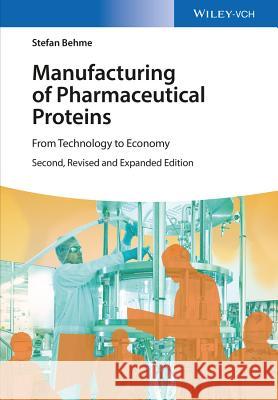
Structured like a textbook, the second edition of this reference covers all aspects of biopharmaceutical manufacturing, including legal and regulatory issues, production facility design, and quality assurance, with a focus on supply chain management and regulations in emerging markets and cost control.
The author has longstanding industrial expertise in biopharmaceutical production and years of experience teaching at universities. As such, this practical book is ideal for use in academia as well as for internal training within companies.
Now in its second edition, the text covers all aspects of biopharmaceutical manufacturing. Structured like a textbook, it is aimed at a wide audience in inductry and academia and can be used as a reference as well as for trainig purposes.
Preface XIX
Preface to First Edition XXI
List of Abbreviations XXIII
Part I: Introduction 1
1 Biopharmaceutical Production: Value Creation, Product Types, and Biological Basics Introduction 3
1.1 Role of Production in Pharmaceutical Biotechnology 3
1.1.1 Relationship Between Production and Development 6
1.1.2 Relationship Between Production and Marketing 8
1.2 Product Groups 10
1.2.1 Vaccines 11
1.2.2 Pharmaceuticals from Blood and Organs 11
1.2.3 Recombinant Therapeutic Proteins 13
1.2.4 Cell and Gene Therapeutics 13
1.2.5 Antibiotics 16
1.3 Basics of Biology 16
1.3.1 Cells and Microorganisms 17
1.3.2 The Four Molecular Building Blocks of Biochemistry 25
Part II: Technology 33
2 Manufacturing Process 35
2.1 Role of the Manufacturing Process in Biotechnology 35
2.2 Process Schematic and Evaluation 37
2.2.1 Drug Substance Manufacturing 38
2.2.2 Drug Product Manufacturing 40
2.2.3 Key Factors for Process Evaluation 41
2.3 Cell Bank 43
2.3.1 Expression Systems 43
2.3.2 Microbial Systems 44
2.3.3 Manufacturing and Storage of the Cell Bank 46
2.4 Fermentation 48
2.4.1 Basic Principles 48
2.4.2 Technologies and Equipment 56
2.4.3 Raw Materials and Processing Aids 61
2.4.4 Overview of Fermentation 63
2.5 Purification 64
2.5.1 Basic Principles 65
2.5.2 Technologies for Cell Separation and Product Isolation 73
2.5.3 Technologies for Final Purification 80
2.5.4 Raw Materials and Processing Aids 91
2.5.5 Overview of Purification 94
2.6 Formulation and Filling 96
2.6.1 Basic Principles 96
2.6.2 Freeze–Drying 98
2.7 Labeling and Packaging 99
3 Analytics 103
3.1 Role of Analytics in Biotechnology 103
3.2 Product Analytics 105
3.2.1 Identity 107
3.2.2 Content 107
3.2.3 Purity 109
3.2.4 Activity 109
3.2.5 Appearance 112
3.2.6 Stability 112
3.2.7 Quality Criteria of Analytical Methods 114
3.2.8 Analytical Methods 115
3.3 Process Analytics 132
3.3.1 Fermentation 132
3.3.2 Purification 133
3.3.3 Formulation and Packaging 134
3.4 Environmental Monitoring 135
3.5 Raw Material Testing 137
3.6 Product Comparability 137
Part III: Pharmacy 141
4 Pharmacology and Drug Safety 143
4.1 Action of Drugs in Humans 144
4.1.1 Pharmacokinetics 145
4.1.2 Pharmacodynamics 149
4.2 Routes and Forms of Administration 152
4.3 Drug Study 153
4.3.1 Pre–Clinical Study 155
4.3.2 Clinical Study 157
4.4 Path of the Drug from the Manufacturer to Patients 162
4.5 Drug Safety 164
4.5.1 Causes and Classification of Side–Effects 165
4.5.2 Methods for Supervising Drug Safety (Pharmacovigilance) 167
4.5.3 Measures upon Incidence of Adverse Reactions 168
Part IV: Quality Assurance 171
5 Fundamentals of Quality Assurance 173
5.1 Basic Principles 173
5.2 Benefit of Quality Assurance Activities 174
5.3 Quality Management According to ISO 9000 176
5.3.1 Fields of Activity 176
5.4 Structure of Quality Management Systems 178
5.5 Quality Management System Components in the Pharmaceutical Area 180
5.5.1 Documentation 180
5.5.2 Failure Prevention and Correction 181
5.5.3 Responsibility of Management and Training of Personnel 185
5.5.4 Audits 186
5.5.5 External Suppliers 187
5.5.6 Contract Review 188
5.6 Quality Assurance in Development 189
6 Quality Assurance in Manufacturing 191
6.1 GMP 191
6.1.1 Personnel 196
6.1.2 Premises and Equipment 198
6.1.3 Equipment Qualification 203
6.1.4 Process Validation 206
6.1.5 Computer Validation 208
6.1.6 Documentation 209
6.2 Operative Workflows under GMP Conditions 210
6.2.1 Product Release and Deviation Management 211
6.2.2 Changes in the Manufacturing Process 213
6.3 Production of Investigational Drugs 216
Appendix A Case Study Part 4:Warning Letters by FDA 219
Part V: Pharmaceutical Law 223
7 Pharmaceutical Law and Regulatory Authorities 225
7.1 Fields of Pharmaceutical Law 225
7.2 Bindingness of Regulations 226
7.3 Authorities, Institutions, and Their Regulations 228
7.3.1 FDA 228
7.3.2 EMA 231
7.3.3 German Authorities 233
7.3.4 Japanese Authorities 235
7.3.5 Authorities of Growth Markets 236
7.3.6 Other Important Institutions 237
7.4 Official Enforcement of Regulations 240
7.5 Drug Approval 242
Appendix B Case Study Part 5: Clinical Trials for Protein Products 245
B.1 Mabthera®/Rituxan® 245
B.2 Enbrel® 246
B.3 Remicade®Infliximab 247
B.4 Humira®40 mg 248
B.5 Lucentis® 249
B.6 Zaltrap® 249
Part VI: Production Facilities 251
8 Facility Design 253
8.1 Basic Principles 253
8.2 GMP–Compliant Plant Design 256
8.2.1 Production Flow Diagram 258
8.2.2 Conceptual Plant Layout 259
8.2.3 GMP Flow Analysis 263
8.2.4 Zoning Concept 266
8.3 Basic Concepts for Production Plants 270
8.3.1 Single– and Multiproduct Plants 271
8.3.2 Fractal and Integrated Configuration 274
8.3.3 Flexible and Fixed Piping 275
8.3.4 Steel Tanks and Disposable Equipment 277
8.4 Clean and Plant Utilities 278
8.4.1 Clean Utilities 278
8.4.2 Plant Utilities 285
8.4.3 Waste Management 288
8.5 Equipment Cleaning 289
8.6 Clean–Rooms 290
8.6.1 Separation of Zones by Clean–Room Design 291
8.6.2 Finishing of Floors,Walls, and Ceilings 293
8.6.3 HVAC Installations 294
8.6.4 Qualification 295
8.7 Automation 296
8.8 QC Laboratories 297
8.9 Location Factors 298
8.9.1 Cost 298
8.9.2 Personnel 299
8.9.3 Permitting 299
8.9.4 Synergies with Existing Facilities or Units 299
8.9.5 Logistics 299
8.9.6 Know–How and Intellectual Property Protection 300
8.9.7 Other Risks 300
8.9.8 Market Access 300
8.9.9 Language and Culture 300
9 Planning, Construction, and Commissioning of a Manufacturing Plant 301
9.1 Steps of the Engineering Project 301
9.1.1 Planning 302
9.1.2 Construction 303
9.1.3 Commissioning, Qualification, Validation 305
9.2 Project Schedules 308
9.3 Cost Estimates 309
9.4 Organization of an Engineering Project 311
9.4.1 Expert Groups Involved 311
9.4.2 Role and Selection of Contractors 311
9.4.3 Contracts and Scope Changes 312
9.5 Successful Execution of an Engineering Project 316
9.6 Legal Aspects of Facility Engineering 317
9.6.1 Health, Safety, and Environmental Law 318
9.6.2 Building Law 319
Part VII: Economy 321
10 Production Costs 323
10.1 Drug Life Cycle 323
10.2 Position of the Manufacturing Costs in the Overall Cost Framework 327
10.3 Basic Principles of Cost Calculation 329
10.3.1 Nominal Accounting Actual Accounting 330
10.3.2 Cost Accounting Profit and Loss Accounting 330
10.3.3 Direct Costs Indirect Costs 330
10.3.4 Fixed Costs Variable Costs 331
10.3.5 Relevant and Irrelevant Costs 333
10.3.6 Cost Type, Cost Center, and Cost Unit 333
10.4 Costs of Biotechnological Manufacturing Processes 334
10.4.1 Capital Costs 335
10.4.2 Operating Costs 337
10.5 Accounting Methods 338
10.5.1 Cost Accounting 347
10.5.2 Profit and Loss Accounting 350
11 Investments 353
11.1 Basic Principles 354
11.1.1 Investment Targets 354
11.1.2 Types of Investments 355
11.1.3 Decision Processes 357
11.2 Value Benefit Analysis 361
11.3 Investment Appraisal 362
11.3.1 Static Methods 366
11.3.2 Dynamic Methods 367
11.4 Dynamic Payback Time 369
12 Production Concept 371
12.1 Capacity Planning 371
12.2 Dilemma of In–House Manufacturing 374
12.3 Aspects of Manufacturing Outsourcing 377
12.3.1 Types of Cooperation 378
12.3.2 Contractual Agreements 379
12.3.3 Technology Transfer 384
12.3.4 Time Schedules 386
12.4 Make–or–Buy Analysis 387
12.5 Process Optimization after Market Launch 389
12.6 Supply–Chain Management 391
12.6.1 Security of Supply 393
12.6.2 Performance Management 396
Appendix C Examples Part 7: Manufacturing Cost Calculation 399
C.1 Introduction 399
C.2 Basic Assumptions for Both Production Processes 399
C.3 Step 1: Production of Product 1 in Dedicated Facility 399
C.3.1 Cost Structure 400
C.3.2 Product Costs 401
C.3.3 Idle Costs 401
C.3.4 Unit Price Based on Facility Usage 401
C.4 Step 2: Addition of a Second Product 402
C.4.1 Costs of Products 403
C.4.2 Evaluation of Manufacturing Options 404
References 407
Further Reading 407
Biotechnology General 407
Fermentation 408
Purification 408
Aseptic Filling and Lyophilization 408
Bioanalytics 408
Regulatory 408
Pharmacy and Clinical Development 409
Quality and Validation 409
Good Manufacturing Practice 410
Facility Design 410
Clean Rooms 410
Project Management 410
Engineering 410
Economy 411
Weblinks 411
Index 413
Dr. Stefan Behme is the department head of Strategic Sourcing Finished Products, Contract Manufacturing at Bayer Healthcare, Berlin. Before that he worked with biotech operations of Bayer, taking care for external manufacturing cooperations for biotechnological production. Stefan started his industrial career with Bayer in the engineering department, managing healthcare investment projects in Germany and the US.
From 2006 through 2010 Stefan worked as lecturer at the Universitys of Dortmund (Germany) and Berlin teaching GMP aspects of biopharmaceutical manufacturing and production processes in life sciences. In 2009 he published the book "Manufacturing of Pharmaceutical Proteins – from Technology to Economy".
Stefan received his Master′s degree in chemical engineering and worked after that as assistant teacher in the field of macromolecular thermodynamics at the Technical University of Berlin where he also earned his PhD degree.
Structured like a textbook, the second edition of this reference work covers all aspects of biopharmaceutical manufacturing, including legal and regulatory issues, quality assurance, production facility design, as well as investment and production cost calculation. It combines these aspects into an holistic view of production concepts, enabling the reader to understand the overall picture of the multidisciplinary factors influencing biopharmaceutical production. The author has longstanding industrial expertise in biopharmaceutical production and years of experience of teaching in universities. As such, this practical book is ideal for use in academia as well as for internal training within companies.




Czytaj nas na:
1997-2026 DolnySlask.com Agencja Internetowa
KrainaKsiazek.PL - Księgarnia Internetowa


