• Wyszukiwanie zaawansowane
  • Kategorie
  • Kategorie BISAC
  • Książki na zamówienie
  • Promocje
  • Granty
  • Książka na prezent
  • Opinie
  • Pomoc
  • Załóż konto
  • Zaloguj się

Manufacturing Systems: An Introduction to the Technologies » książka


zaloguj się | załóż konto
Logo Krainaksiazek.pl

koszyk

konto

szukaj
topmenu
Księgarnia internetowa
Szukaj
Książki na zamówienie
Promocje
Granty
Książka na prezent
Moje konto
Pomoc
 
 
Wyszukiwanie zaawansowane
Pusty koszyk
Bezpłatna dostawa dla zamówień powyżej 20 złBezpłatna dostawa dla zamówień powyżej 20 zł

Kategorie główne

• Nauka
 [2946350]
• Literatura piękna
 [1816154]

  więcej...
• Turystyka
 [70666]
• Informatyka
 [151172]
• Komiksy
 [35576]
• Encyklopedie
 [23172]
• Dziecięca
 [611458]
• Hobby
 [135995]
• AudioBooki
 [1726]
• Literatura faktu
 [225763]
• Muzyka CD
 [378]
• Słowniki
 [2917]
• Inne
 [444280]
• Kalendarze
 [1179]
• Podręczniki
 [166508]
• Poradniki
 [469467]
• Religia
 [507199]
• Czasopisma
 [496]
• Sport
 [61352]
• Sztuka
 [242330]
• CD, DVD, Video
 [3348]
• Technologie
 [219391]
• Zdrowie
 [98638]
• Książkowe Klimaty
 [124]
• Zabawki
 [2382]
• Puzzle, gry
 [3525]
• Literatura w języku ukraińskim
 [259]
• Art. papiernicze i szkolne
 [7107]
Kategorie szczegółowe BISAC

Manufacturing Systems: An Introduction to the Technologies

ISBN-13: 9780412384806 / Angielski / Miękka / 1988 / 208 str.
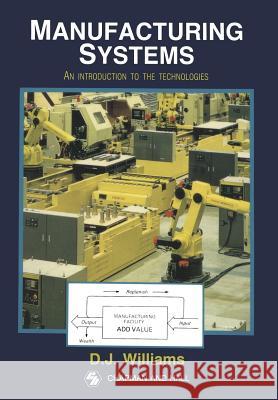
D. J. Williams
Manufacturing Systems: An Introduction to the Technologies Williams, D. J. 9780412384806 Springer - książkaWidoczna okładka, to zdjęcie poglądowe, a rzeczywista szata graficzna może różnić się od prezentowanej.

Manufacturing Systems: An Introduction to the Technologies

ISBN-13: 9780412384806 / Angielski / Miękka / 1988 / 208 str.

D. J. Williams
cena 201,24
(netto: 191,66 VAT:  5%)

Najniższa cena z 30 dni: 192,74
Termin realizacji zamówienia:
ok. 16-18 dni roboczych.

Darmowa dostawa!

It is essential for the traditionally industrialised countries to innovate in manu- facturing to survive in the increasingly competitive world marketplace. This challenge coupled with the increasing application of computers has led to significant changes in the techniques applied in manufacturing. This book seeks to introduce those technologies that are being applied in discrete parts manufacturing. In the technIcal press there have been many phrases and acronyms coined to describe these technologies including numerical control (NC), machining centres, computer aided manufacture (CAM), computer integrated manufacture (CIM), simulation, robotics, flexible manufacturing systems (FMS), automatic assembly, factory automation, Kanban, just in time (JIT), manufacturing automation protocol (MAP), advanced manufacturing technology (AMT), etc. The book is intended to introduce senior undergraduates, postgraduate students and practising engineers to the principles of these individual technologies and their integration into complete, automated, programmable manufacturing facilities and systems. It is hoped that this will allow the reader to have a critical perspective of the market- place and potential solutions to his own current or future problems. It is also intended to indicate how the complete manufacturing facility can be viewed as a system. The book does not address the related areas of Computer Aided Design (CAD), scheduling, production control and current speculative research at any significant level. It is impossible to do justice, in this short book, to such large subject areas which, without doubt, demand books in their own right. A book such as this is still necessarily wide-ranging and occasionally superficial.


Kategorie:
Nauka
Kategorie BISAC:
Science > General
Wydawca:
Springer
Język:
Angielski
ISBN-13:
9780412384806
Rok wydania:
1988
Wydanie:
Revised
Ilość stron:
208
Waga:
0.40 kg
Wymiary:
24.4 x 17.0
Oprawa:
Miękka
Wolumenów:
01

1 Introduction — manufacturing systems approaches.- 1.1 Introduction.- 1.2 The structure of the book.- 1.3 Single machines.- 1.4 Cells, assembly and systems.- 1.5 The manufacturing process.- 1.6 Business drives for manufacturing.- 1.7 Manufacturing systems approaches.- 1.8 Top down approaches.- 1.9 Bottom up approaches.- 1.10 Automation and people.- 2 More conventional approaches to factory layout.- 2.1 Introduction.- 2.2 Traditional factory layouts.- 2.3 Static build.- 2.4 Process-based layout.- 2.5 Product-based layouts.- 2.6 Techniques of factory layout.- 2.7 More recent advances on traditional approaches.- 2.8 Group technology.- 2.9 Dedicated automation.- 2.10 Kanban.- 3 The machining centre — a servo-controlled machine tool.- 3.1 Introduction.- 3.2 Feedback control.- 3.3 The horizontal machining centre.- 3.4 Constraints on the operation of machine tools.- 3.5 Elastic and thermal effects in machine tools.- 3.6 Regenerative chatter in machine tools.- 3.7 Programmable processes.- 4 The robot — a handling device, a manipulator.- 4.1 Introduction.- 4.2 A definition of the industrial robot.- 4.3 Discussion of the definition.- 4.4 Robot types.- 4.5 Robot construction.- 4.6 Manipulation with robots.- 4.7 The robot skeleton.- 4.8 Cartesian-to-Joint-Space transformation.- 4.9 The practical application of robots.- 4.10 Grippers.- 4.11 Sensory robots.- 5 Sensing.- 5.1 Sensors for manufacturing.- 5.2 Sensors to monitor position.- 5.3 Proximity sensors.- 5.4 Tough trigger probes.- 5.5 Tool breakage sensing.- 5.6 Torque and power monitoring.- 5.7 Force sensing.- 5.8 Machine vision.- 5.9 Image generation.- 5.10 Image enhancement.- 5.11 Image processing.- 5.12 Image analysis and object recognition.- 5.13 Use of image information.- 5.14 An example of vision linked with a robot.- 6 Software for single machines.- 6.1 Introduction.- 6.2 Machine tool programming.- 6.3 Manual part programming — machine tool code programming.- 6.4 Computer-assisted part programming.- 6.5 Conversational part programming.- 6.6 NC Programming from a CAD system, CADCAM.- 6.7 Representation of 3D (three-dimensional) shapes.- 6.8 CADCAM and CIM (Computer Integrated Manufacturing).- 6.9 Robot programming.- 6.10 Teach-by-showing.- 6.11 High level languages.- 6.12 Robot programming from CAD systems.- 6.13 Flow of control.- 7 The manufacturing cell — the building block of systems.- 7.1 Introduction.- 7.2 Cells of factory automation.- 7.3 Advantages and disadvantages of cellular approaches.- 7.4 Applications of the cellular philosophy.- 7.5 A prismatic machining cell.- 7.6 A turning cell.- 7.7 Differences between prismatic and rotational cells.- 7.8 A robot welding cell.- 7.9 A cell with automatic changeover.- 7.10 Cell simulation.- 7.11 The Petri net.- 7.12 Cell justification.- 8 Assembly.- 8.1 Introduction.- 8.2 Parts mating theory.- 8.3 Jamming.- 8.4 Wedging.- 8.5 Remote centre compliance.- 8.6 SCARA robots.- 8.7 Design for assembly.- 8.8 Rules for product design.- 8.9 Rules for the design of parts.- 8.10 Manual assembly.- 8.11 Dedicated assembly automation.- 8.12 Programmable assembly automation.- 9 The automated factory and systems.- 9.1 Introduction.- 9.2 Flexibility and reconfigurability.- 9.3 A hierarchical view of manufacturing.- 9.4 Generic elements of manufacturing systems.- 9.5 Direct numerical control.- 9.6 Flexible cells.- 9.7 Flexible transfer lines.- 9.8 A robot transfer line.- 9.9 A CNC machine tool transfer line.- 9.10 A SMD assembly transfer line.- 9.11 Flexible manufacturing systems.- 9.12 A monolithic FMS.- 9.13 Cell based systems.- 9.14 Virtual systems.- 9.15 Hybrid systems.- 9.16 People in systems.- 9.17 Simulation in system design.- 9.18 Application areas.- 10 Computer control of manufacturing systems.- 10.1 Introduction.- 10.2 Computer requirements for process control.- 10.3 A multivariable servomechanism.- 10.4 Hierarchical control.- 10.5 Control networks.- 10.6 Interfacing.- 10.7 Data transmission.- 10.8 Open Systems Interconnection (OSI) and LAN’s.- 10.9 Problems with Local Area Networks.- 10.10 Ethernet.- 10.11 Token rings.- 10.12 The Manufacturing Automation Protocol (MAP).- 10.13 Databases in control.- 10.14 Control hierarchy embodiment.- 10.15 Control computer embodiment.- 10.16 Host and mini computers.- 10.17 Microcomputers.- 10.18 Programmable Logic Controllers.- 10.19 Machine controllers.- 10.20 Heterarchic architectures.- 11 System software.- 11.1 Introduction.- 11.2 Software tasks in manufacturing systems.- 11.3 Scheduling.- 11.4 Generation of management information.- 11.5 Part program communication.- 11.6 Data and databases.- 11.7 Interfaces to other sub-systems.- 11.8 Control of closely co-operating machines.- 11.9 Machine monitoring.- 11.10 High level sensor interfaces.- 11.11 Design requirements of real-time languages.- 11.12 Programming languages for system control.- 11.13 Cell control computer languages.- 11.14 Programming Programmable Logic Controllers.- 11.15 Flow of control commands in robots.- 11.16 Rule driven systems.- 11.17 The future.- Further Reading.


Udostępnij

Facebook - konto krainaksiazek.pl


Opinie o Krainaksiazek.pl na Opineo.pl

Partner Mybenefit

Krainaksiazek.pl w programie rzetelna firma Krainaksiaze.pl - płatności przez paypal

Czytaj nas na:

Facebook - krainaksiazek.pl
  • książki na zamówienie
  • granty
  • książka na prezent
  • kontakt
  • pomoc
  • opinie
  • regulamin
  • polityka prywatności

Zobacz:

  • Księgarnia czeska

  • Wydawnictwo Książkowe Klimaty

1997-2026 DolnySlask.com Agencja Internetowa

© 1997-2022 krainaksiazek.pl
     
KONTAKT | REGULAMIN | POLITYKA PRYWATNOŚCI | USTAWIENIA PRYWATNOŚCI
Zobacz: Księgarnia Czeska | Wydawnictwo Książkowe Klimaty | Mapa strony | Lista autorów
KrainaKsiazek.PL - Księgarnia Internetowa

Polityka prywatnosci - link
Krainaksiazek.pl - płatnośc Przelewy24
Przechowalnia Przechowalnia






