• Wyszukiwanie zaawansowane
  • Kategorie
  • Kategorie BISAC
  • Książki na zamówienie
  • Promocje
  • Granty
  • Książka na prezent
  • Opinie
  • Pomoc
  • Załóż konto
  • Zaloguj się

Manual of Cementing Technique » książka


zaloguj się | załóż konto
Logo Krainaksiazek.pl

koszyk

konto

szukaj
topmenu
Księgarnia internetowa
Szukaj
Książki na zamówienie
Promocje
Granty
Książka na prezent
Moje konto
Pomoc
 
 
Wyszukiwanie zaawansowane
Pusty koszyk
Bezpłatna dostawa dla zamówień powyżej 20 złBezpłatna dostawa dla zamówień powyżej 20 zł

Kategorie główne

• Nauka
 [2948695]
• Literatura piękna
 [1824038]

  więcej...
• Turystyka
 [70868]
• Informatyka
 [151073]
• Komiksy
 [35227]
• Encyklopedie
 [23181]
• Dziecięca
 [621575]
• Hobby
 [138961]
• AudioBooki
 [1642]
• Literatura faktu
 [228651]
• Muzyka CD
 [371]
• Słowniki
 [2933]
• Inne
 [445341]
• Kalendarze
 [1243]
• Podręczniki
 [164416]
• Poradniki
 [479493]
• Religia
 [510449]
• Czasopisma
 [502]
• Sport
 [61384]
• Sztuka
 [243086]
• CD, DVD, Video
 [3417]
• Technologie
 [219673]
• Zdrowie
 [100865]
• Książkowe Klimaty
 [124]
• Zabawki
 [2168]
• Puzzle, gry
 [3372]
• Literatura w języku ukraińskim
 [260]
• Art. papiernicze i szkolne
 [7838]
Kategorie szczegółowe BISAC

Manual of Cementing Technique

ISBN-13: 9783642642463 / Angielski / Miękka / 2012 / 114 str.
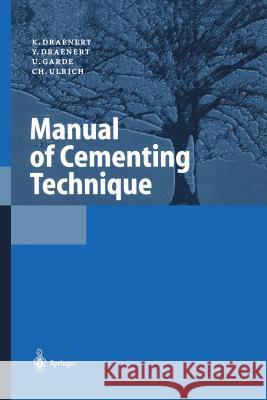
K. Draenert; Y. Draenert; U. Garde
Manual of Cementing Technique K. Draenert Y. Draenert U. Garde 9783642642463 Springer - książkaWidoczna okładka, to zdjęcie poglądowe, a rzeczywista szata graficzna może różnić się od prezentowanej.

Manual of Cementing Technique

ISBN-13: 9783642642463 / Angielski / Miękka / 2012 / 114 str.

K. Draenert; Y. Draenert; U. Garde
cena 200,77
(netto: 191,21 VAT:  5%)

Najniższa cena z 30 dni: 192,74
Termin realizacji zamówienia:
ok. 22 dni roboczych.

Darmowa dostawa!

This extensive and well-prepared manual is the work product of Klaus and Yvette Draenert, who are deeply interested in cemented total hip arthroplasty and in partic- ular, intensely involved in related research for the past 25 years. Their damage analysis is aimed at cement fixation with the purpose to rule out any risk for the patient. They introduce the theme with a wide review of the literature on the successes and failures of the various types of total hip components. Because of the lack of standardization of the various parameters used in these studies, they do not recommend anyone spe- cial type, and on the basis of this literature study they wonder why there is such a se- arch for new types and (fixation) methods of total hip arthroplasties. Instead of these long-term follow-up studies, the authors plead to carry out syste- matic histological research on retrieved human material as was firstly started and re- T. /. /. H. Slooff commended by the late Sir John Charnley. Their investigations demonstrate that po- lymethylmethacrylate behaves biologically as an inert material that can be integrated into the bone, without a fibrous membrane interface. This could also be assessed in their animal experiments when the appropriate biomechanical conditions are pro- vided. To achieve a connective tissue free bone-cement junction it is important to pre- vent deformation in the bone structures and micromotion between the bone-cement interface.


Kategorie:
Nauka, Medycyna
Kategorie BISAC:
Gardening > General
Medical > Orthopedics
Medical > Surgery - General
Wydawca:
Springer
Język:
Angielski
ISBN-13:
9783642642463
Rok wydania:
2012
Wydanie:
Softcover Repri
Ilość stron:
114
Waga:
0.21 kg
Wymiary:
23.5 x 15.5
Oprawa:
Miękka
Wolumenów:
01

1 Historical Background.- 1.1 Conditions Before Charnley.- 1.2 John Charnley.- 2 Histomorphology of the Bone-to-Cement Contact.- 2.1 The Cemented Total Hip Arthroplasty.- 2.2 Histomorphology of the Bone-to-Cement Contact (Animal Experiments).- 2.2.1 Changes Around Normal Bone Cements.- 2.2.2 TCP/HA Bone Cements.- 2.3 Histomorphology of Human Samples.- 2.3.1 Material and Methods.- 2.3.2 Summary of Results.- 3 Can Cancellous Bone Carry the Load?.- 3.1 About the Deformation Behavior of Spongiosa.- 3.1.1 Elasticity.- 3.1.2 Viscoelasticity.- 3.1.3 Isotropic Deformation.- 3.1.4 Resilience and Damping.- 3.1.5 Damping.- 3.1.6 Breaking (Tensile) Strength and Toughness.- 3.1.7 Compliance.- 3.1.8 Energy.- 3.1.9 Impact.- 3.2 Deformation of Bone Through Different Implants.- 3.3 Stiffening of Spongiosa with Bone Cement.- 3.3.1 Human Histopathological Key Findings.- 3.3.2 Histomorphological Findings in the Proximal Femur After Joint Surface Replacement.- 3.3.3 Histomorphological Findings on Cancellous Bone Stiffened with Bone Cement in the Distal Epiphysis of the Femur in Rabbits.- 4 Approach to the Hip Joint.- 4.1 Posterolateral Approach.- 4.2 Transgluteal Approach.- 5 Preparation of the Acetabulum.- 5.1 Preparatory Steps.- 5.2 Exposure of the Acetabulum.- 5.3 Fossa Acetabuli.- 5.4 Preparation of the Bony Acetabulum.- 5.5 Anatomical Composition of the Joint Surface of the Acetabulum.- 5.6 Lavage, Anticoagulation and Stiffening of the Acetabular Roof.- 5.7 Inclination and Alignment.- 6 Preparation of the Bone Cement.- 6.1 Advantages of Standard Viscosity Bone Cement.- 6.2 Cold Storage as a Simple Method To Achieve a Temporarily Lower Viscosity.- 6.3 Homogeneous and Bubble-Free Mixture.- 6.4 Prepressurizing Bone Cements, a Conditio Sine Qua Non.- 6.5 Application of the Bubble-Free Bone Cement.- 7 Preparation of the Femur.- 7.1 Opening of the Medullary Canal and Implantation Axis.- 7.2 Surgical Diamond Instrumentation.- 7.3 Drainage of the Medullary Canal.- 7.4 Preparation of the Implant’s Bed.- 7.5 Lavage.- 7.6 Plugging the Medullary Cavity.- 7.7 Heparinization, Cementation, and Implantation.- 8 Scientific Background of Vacuum Application.- 8.1 The Problem of Thromboembolism and Drainage of the Medullary Canal.- 8.2 The Distal Drill Hole.- 8.3 The Stem-Canal Volume Relationship.- 9 Consideration of the Prosthetic Design of the Femoral Stem.- 9.1 Stiffening Spongiosa of the Femur.- 9.2 Calcar Femoris.- 9.3 Stem Design.- 9.4 Preoperative Planning.- 9.4.1 Plane of the Metaphyseal “V”.- 9.4.2 Offset and Alignment.- 9.5 Centralizing Anatomical Design.- 10 Instrumentation.- 11 Conclusions: The Success of Cemented Components.- 11.1 First-Generation Cementing Techniques.- 11.2 Success of the Cemented Component Is Due to Stiffened Bone Structures.- 11.3 Cancellous Bone Stiffened by Bone Cement Can Survive.- 11.4 Preservation of Cancellous Bone.- References.- Author Index.


Udostępnij

Facebook - konto krainaksiazek.pl


Opinie o Krainaksiazek.pl na Opineo.pl

Partner Mybenefit

Krainaksiazek.pl w programie rzetelna firma Krainaksiaze.pl - płatności przez paypal

Czytaj nas na:

Facebook - krainaksiazek.pl
  • książki na zamówienie
  • granty
  • książka na prezent
  • kontakt
  • pomoc
  • opinie
  • regulamin
  • polityka prywatności

Zobacz:

  • Księgarnia czeska

  • Wydawnictwo Książkowe Klimaty

1997-2026 DolnySlask.com Agencja Internetowa

© 1997-2022 krainaksiazek.pl
     
KONTAKT | REGULAMIN | POLITYKA PRYWATNOŚCI | USTAWIENIA PRYWATNOŚCI
Zobacz: Księgarnia Czeska | Wydawnictwo Książkowe Klimaty | Mapa strony | Lista autorów
KrainaKsiazek.PL - Księgarnia Internetowa

Polityka prywatnosci - link
Krainaksiazek.pl - płatnośc Przelewy24
Przechowalnia Przechowalnia






