• Wyszukiwanie zaawansowane
  • Kategorie
  • Kategorie BISAC
  • Książki na zamówienie
  • Promocje
  • Granty
  • Książka na prezent
  • Opinie
  • Pomoc
  • Załóż konto
  • Zaloguj się

Management of Intensive Care: Guidelines for Better Use of Resources » książka


zaloguj się | załóż konto
Logo Krainaksiazek.pl

koszyk

konto

szukaj
topmenu
Księgarnia internetowa
Szukaj
Książki na zamówienie
Promocje
Granty
Książka na prezent
Moje konto
Pomoc
 
 
Wyszukiwanie zaawansowane
Pusty koszyk
Bezpłatna dostawa dla zamówień powyżej 20 złBezpłatna dostawa dla zamówień powyżej 20 zł

Kategorie główne

• Nauka
 [2949965]
• Literatura piękna
 [1857847]

  więcej...
• Turystyka
 [70818]
• Informatyka
 [151303]
• Komiksy
 [35733]
• Encyklopedie
 [23180]
• Dziecięca
 [617748]
• Hobby
 [139972]
• AudioBooki
 [1650]
• Literatura faktu
 [228361]
• Muzyka CD
 [398]
• Słowniki
 [2862]
• Inne
 [444732]
• Kalendarze
 [1620]
• Podręczniki
 [167233]
• Poradniki
 [482388]
• Religia
 [509867]
• Czasopisma
 [533]
• Sport
 [61361]
• Sztuka
 [243125]
• CD, DVD, Video
 [3451]
• Technologie
 [219309]
• Zdrowie
 [101347]
• Książkowe Klimaty
 [123]
• Zabawki
 [2362]
• Puzzle, gry
 [3791]
• Literatura w języku ukraińskim
 [253]
• Art. papiernicze i szkolne
 [7933]
Kategorie szczegółowe BISAC

Management of Intensive Care: Guidelines for Better Use of Resources

ISBN-13: 9789401074179 / Angielski / Miękka / 2011 / 246 str.
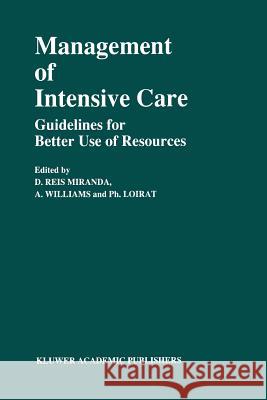
D. Reis Miranda; A. Williams; Ph. Loirat
Management of Intensive Care: Guidelines for Better Use of Resources Miranda, D. Reis 9789401074179 Springer - książkaWidoczna okładka, to zdjęcie poglądowe, a rzeczywista szata graficzna może różnić się od prezentowanej.

Management of Intensive Care: Guidelines for Better Use of Resources

ISBN-13: 9789401074179 / Angielski / Miękka / 2011 / 246 str.

D. Reis Miranda; A. Williams; Ph. Loirat
cena 806,99 zł
(netto: 768,56 VAT:  5%)

Najniższa cena z 30 dni: 771,08 zł
Termin realizacji zamówienia:
ok. 22 dni roboczych
Bez gwarancji dostawy przed świętami

Darmowa dostawa!

Intensive Care Medicine has been continuously growing and expanding, culturally, technically and geographically. Monitoring and instrumentation are continuously improving and more and more hospitals are getting Intensive Care facilities. The costs have proportionally increased over the years, so that ICUs represent today a major cost for health structures. Since the available resources are limited, a real need is emerging to set the limits and indications of Intensive Care. It is understood that the problem not only involves medical considerations, but also ethical and economical aspects of the utmost importance. For the first time in Europe, this book edited by Reis Miranda and his colleagues tackles systematically the many structural aspects of the European Intensive Care. The organisation and financing of health care in the Old Continent is deeply different from the American one, and the results and consequent proposals obtained in the USA cannot simply be transferred to this side of the Atlantic Ocean. Weare extremely pleased to welcome this first European attempt to discuss the Intensive Care problem. It lays no claims to giving definite replies in a continuously developing field, but it will surely become the basis for future discussions and proposals. I am particularly happy that this work has mainly developed within the European Society of Intensive Care, whose final target is to ensure a common standard of therapy in our old Europe, beyond national differences. We warmly congratulate the authors, and I am sure that their work will find wide diffusion and consent.


Kategorie:
Nauka, Medycyna
Kategorie BISAC:
Medical > Critical Care
Medical > Anesthesiology
Medical > Internal Medicine
Wydawca:
Springer
Seria wydawnicza:
Developments in Critical Care Medicine and Anaesthesiology
Język:
Angielski
ISBN-13:
9789401074179
Rok wydania:
2011
Wydanie:
Softcover Repri
Numer serii:
000154101
Ilość stron:
246
Waga:
0.39 kg
Wymiary:
23.39 x 15.6 x 1.47
Oprawa:
Miękka
Wolumenów:
01

I: Introduction.- 1. Intensive Care Medicine.- 1.1 Fundamentals of Intensive Care Medicine.- 1.2 The facilities.- 1.3 The different interpretations of Intensive Care Medicine.- 1.4 ICM to whom?.- 1.5 Ethics.- 2. Guidelines for Intensive Care Medicine.- 2.1 Why guidelines?.- 2.2 The target-groups.- 2.3 The guidelines.- II: The Patients.- 1. Introduction.- 2. Measuring the type of patients.- 2.1 Referral source.- 2.2 The problem of diagnosis.- 3. Measuring the previous health status and the severity of illness.- 3.1 Previous Health Status.- 3.2 Severity Indexes.- 4. Measuring the workload.- 4.1 The TISS system.- 4.2 The Omega system.- 4.3 The PRN system.- 5. Measuring the evolution of severity of illness.- 5.1 The OSF system.- 5.2 The Sickness Scoring (SS).- 6. Stratification of patient related data.- 6.1 Essential data.- 6.2 Important data.- 6.3 Desirable data.- 6.4 Optional data.- References.- Tables.- III: The Facilities.- 1. Introduction.- 2. ICUs in Europe: The great diversity.- 2.1 Size.- 2.2 Utilization pattern.- 2.3 Education and training.- 2.4 Classification of ICUs.- 3. The type and size of Intensive Care facilities.- 3.1 The type of ICUs.- 3.2 The size of ICUs.- 3.3 The location of ICUs.- 4. General standard for ICUs.- 4.1 Space and technical conditions.- 4.2 Attendance protocols and procedure manuals.- 4.3 Ancillary services.- 4.4 Quality assurance.- 5. Staffing.- 6. Comparing facilities.- Addendum I.- Addendum II.- Addendum III.- Addendum IV.- References.- IV: National and Regional Organisation.- 1. Introduction.- 2. Estimating the total number of ICU beds required.- 2.1 Rates of occupancy and availability.- 3. Factors influencing regional planning.- 3.1 Hierarchy of IC facilities.- 4. Levels of care.- 4.1 Determinants of levels of care.- 5. Calculating manpower needs.- 6. Conclusions.- References.- V: Management Control in the ICU.- 1. Planning and control.- 2. The ICU: Expense or responsibility centre?.- 3. Performance criteria.- 4. Incentives and constraints of ICU performance.- 4.1 Patient characteristics.- 4.2 Admissions and discharge decisions.- 4.3 ICU inputs.- 4.4 ICU throughputs.- 4.5 Final ICU outputs.- 5. Conclusions.- References.- VI: Education and Training.- 1. Introduction.- 2. The actual education and training of Intensive Care Medicine.- 2.1 Physicians.- 2.2 Nurses.- 2.3 Other personnel.- 3. General recommendations.- 3.1 Physicians.- 3.2 Nurses.- 3.3 Other personnel.- 4. Conclusions.- Addendum I. Present situation in European countries.- Addendum II. Basic education.- Addendum III. Special education.- Addendum IV. Catalogue of skills for special Intensive Care Medicine training.- Addendum V. General Intensive Care nursing for registered general nurses.- Addendum VI. Special Intensive Care training for nurses in West-Germany.- VII: Evaluation in Intensive Care.- 1. What should or could be evaluated.- 1.1 Technologies and interventions.- 1.2 Organisational studies.- 2. Who should evaluate?.- 2.1 Internal audit.- 2.2 External audit.- 2.3 Concensus conference.- 2.4 Recommendations.- 3 Intensivists should try to adopt common definitions and classifications.- 3.1 Classification of patients in large series.- 3.2 Classification of patients by specific diagnoses.- 3.3 DRGs and evaluation.- 4. Evaluation studies must have a proper scientific design.- 4.1 Study design.- 4.2 Proper control group.- 4.3 Stratification.- 5. The proper judgement criteria must be employed.- 6. Long term evaluation of Intensive Care: Health status and quality of life.- 6.1 Definitions.- 6.2 Proper scale.- 6.3 General characteristics of the scales.- 6.4 Functional status scales.- 6.5 Generic measures of health status.- 6.6 Measurements of perceived quality of life.- 6.7 Recommendations.- 7. Economic evaluation of intensive care utilisation.- 7.1 Cost-Benefit Analysis (CBA).- 7.2 Cost-Effectiveness Analysis (CEA).- 7.3 Conclusions and general recommendations.- References.- Table 1. Data for Evaluation of ICM.- Table 2. Components of the Activity of Daily Living.- Table 3. Elements of the Sickness Impact Profile.- Table 4. Components of the Quality of Well Being.- Table 5. Components of the Perceived Quality of Life Index.- Table 6. Costs and Benefits of Intensive Care.- Table 7. Cost Accounting in the ICU.- VIII: Epilogue.- 1. Introduction.- 2. Quantification.- 3. Regionalisation.- 4. Professionalisation.- 5. Levels of responsibility.- 6. Intensive Care Medicine societies.- 7. Concluding comments.- Directory of Intensive Care Organisations.- Subject Index and Abbreviations.- Nigel Turner.


Udostępnij

Facebook - konto krainaksiazek.pl


Opinie o Krainaksiazek.pl na Opineo.pl

Partner Mybenefit

Krainaksiazek.pl w programie rzetelna firma Krainaksiaze.pl - płatności przez paypal

Czytaj nas na:

Facebook - krainaksiazek.pl
  • książki na zamówienie
  • granty
  • książka na prezent
  • kontakt
  • pomoc
  • opinie
  • regulamin
  • polityka prywatności

Zobacz:

  • Księgarnia czeska

  • Wydawnictwo Książkowe Klimaty

1997-2025 DolnySlask.com Agencja Internetowa

© 1997-2022 krainaksiazek.pl
     
KONTAKT | REGULAMIN | POLITYKA PRYWATNOŚCI | USTAWIENIA PRYWATNOŚCI
Zobacz: Księgarnia Czeska | Wydawnictwo Książkowe Klimaty | Mapa strony | Lista autorów
KrainaKsiazek.PL - Księgarnia Internetowa

Polityka prywatnosci - link
Krainaksiazek.pl - płatnośc Przelewy24
Przechowalnia Przechowalnia






