• Wyszukiwanie zaawansowane
  • Kategorie
  • Kategorie BISAC
  • Książki na zamówienie
  • Promocje
  • Granty
  • Książka na prezent
  • Opinie
  • Pomoc
  • Załóż konto
  • Zaloguj się

Magnetic Resonance Detection of Explosives and Illicit Materials » książka


zaloguj się | załóż konto
Logo Krainaksiazek.pl

koszyk

konto

szukaj
topmenu
Księgarnia internetowa
Szukaj
Książki na zamówienie
Promocje
Granty
Książka na prezent
Moje konto
Pomoc
 
 
Wyszukiwanie zaawansowane
Pusty koszyk
Bezpłatna dostawa dla zamówień powyżej 20 złBezpłatna dostawa dla zamówień powyżej 20 zł

Kategorie główne

• Nauka
 [2949965]
• Literatura piękna
 [1857847]

  więcej...
• Turystyka
 [70818]
• Informatyka
 [151303]
• Komiksy
 [35733]
• Encyklopedie
 [23180]
• Dziecięca
 [617748]
• Hobby
 [139972]
• AudioBooki
 [1650]
• Literatura faktu
 [228361]
• Muzyka CD
 [398]
• Słowniki
 [2862]
• Inne
 [444732]
• Kalendarze
 [1620]
• Podręczniki
 [167233]
• Poradniki
 [482388]
• Religia
 [509867]
• Czasopisma
 [533]
• Sport
 [61361]
• Sztuka
 [243125]
• CD, DVD, Video
 [3451]
• Technologie
 [219309]
• Zdrowie
 [101347]
• Książkowe Klimaty
 [123]
• Zabawki
 [2362]
• Puzzle, gry
 [3791]
• Literatura w języku ukraińskim
 [253]
• Art. papiernicze i szkolne
 [7933]
Kategorie szczegółowe BISAC

Magnetic Resonance Detection of Explosives and Illicit Materials

ISBN-13: 9789400772649 / Angielski / Twarda / 2013 / 168 str.
Toma Apih; Bulat Rameev; Georgy Mozzhukhin
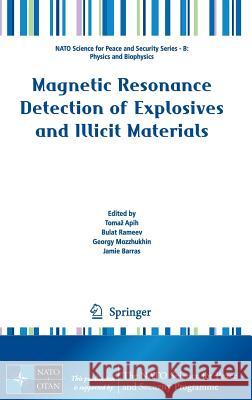
Magnetic Resonance Detection of Explosives and Illicit Materials Toma Apih Bulat Rameev Georgy Mozzhukhin 9789400772649 Springer - książkaWidoczna okładka, to zdjęcie poglądowe, a rzeczywista szata graficzna może różnić się od prezentowanej.

Magnetic Resonance Detection of Explosives and Illicit Materials

ISBN-13: 9789400772649 / Angielski / Twarda / 2013 / 168 str.

Toma Apih; Bulat Rameev; Georgy Mozzhukhin
cena 605,23 zł
(netto: 576,41 VAT:  5%)

Najniższa cena z 30 dni: 578,30 zł
Termin realizacji zamówienia:
ok. 22 dni roboczych
Bez gwarancji dostawy przed świętami

Darmowa dostawa!
inne wydania

Detection of concealed explosives is a notoriously difficult problem, and many different approaches have been proposed to solve this problem. Nuclear quadrupole resonance (NQR) is unique in many ways. It operates in a safe AM radio frequency range, and it can remotely detect unique "fingerprint" (NQR spectrum) of many explosives, such as TNT or RDX. As such, the detection of target does not depend on the shape or material of the container, or the presence of metallic object such as triggers etc. Spectra of chemically similar compounds differ enough that their presence never causes interference or false alarms. Unfortunately, widespread use is prevented due to low sensitivity, radiofrequency interference from the noisy environment, and inability to detect liquid explosives. This book presents current state of the art of the attempts to overcome NQR sensitivity problem, either by increasing the strengths of signals generated, or by increasing the specificity of the technique through a better understanding of the factors that affect the quadrupolar parameters of specific explosives. The use of these specific quadrupolar parameters is demonstrated on signal processing techniques that can detect weak signals, which are hidden in a noisy background. The problem of differentiation of liquid explosives and benign liquids in closed containers is approached by measurements of different nuclear magnetic resonance (NMR) parameters. As shown, a couple of solutions has reached a prototype stage and could find their use in a near future.


Kategorie:
Technologie
Kategorie BISAC:
Technology & Engineering > Engineering (General)
Science > Spectroscopy & Spectrum Analysis
Technology & Engineering > Electrical
Wydawca:
Springer
Seria wydawnicza:
NATO Science for Peace and Security Series B: Physics and Bi
Język:
Angielski
ISBN-13:
9789400772649
Rok wydania:
2013
Wydanie:
2014
Numer serii:
000359120
Ilość stron:
168
Waga:
4.29 kg
Wymiary:
23.5 x 15.5
Oprawa:
Twarda
Wolumenów:
01

Part 1 Nuclear Quadrupole Resonance Detection of Solids.- Further improvement of NQR technique for detection of illicit substances; T. N. Rudakov.- An Overview of NQR Signal Detection Algorithms; N. R. Butt et al.- Nuclear Quadrupole Resonance of Pantaerythritol Tetranitrate (PETN) in Different Compositions; M.D. Rowe et al.- Cross-relaxation enhanced NQR of ammonium nitrate in low magnetic field; G.V. Mozzhukhin et al.- Investigating homonuclear broadening in NQR with Carr-Purcell Meiboom-Gill performed on p-chloroaniline; M.W. Malone, K. L. Sauer.- Size Effect in 14N Nuclear Quadrupole Resonance Spectroscopy; N. Sinyavsky.- NQR Detection of Sodium Nitrite Recrystallized in Wood; J. Jover et al.- Part 2 Nuclear Magnetic Resonance Detection of Liquids.- Bottled Liquid Scanner for Security Checkpoints; Pablo J. Prado.- MagViz: A Bottled Liquids Scanner Using Ultra-low field NMR Relaxometry; R. Austin et al.-Multiparameter NMR Identification of Liquid Substances; A. B. Konov et al.- NMR-Based Liquid Explosives Detector: Advantages and Disadvantages of Different Configurations; A. Gradišek et al.-Composite Pulses in Inhomogeneous Field NMR;  G.S. Kupriyanova et al.- Part 3 Other Techniques.-Novel HTS DC Squid Solutions For NMR Applications; M.L. Chukharkin et al.- Passive Sub THz Imaging; A. Vertiy, A. Pavlyuchenko.

Detection of concealed explosives is a notoriously difficult problem, and many different approaches have been proposed to solve this problem. Nuclear quadrupole resonance (NQR) is unique in many ways. It operates in a safe AM radio frequency range, and it can remotely detect unique “fingerprint” (NQR spectrum) of many explosives, such as TNT or RDX. As such, the detection of target does not depend on the shape or material of the container, or the presence of metallic object such as triggers etc. Spectra of chemically similar compounds differ enough that their presence never causes interference or false alarms. Unfortunately, widespread use is prevented due to low sensitivity, radiofrequency interference from the noisy environment, and inability to detect liquid explosives. This book presents current state of the art of the attempts to overcome NQR sensitivity problem, either by increasing the strengths of signals generated, or by increasing the specificity of the technique through a better understanding of the factors that affect the quadrupolar parameters of specific explosives. The use of these specific quadrupolar parameters is demonstrated on signal processing techniques that can detect weak signals, which are hidden in a noisy background. The problem of differentiation of liquid explosives and benign liquids in closed containers is approached by measurements of different nuclear magnetic resonance (NMR) parameters. As shown, a couple of solutions has reached a prototype stage and could find their use in a near future.




Udostępnij

Facebook - konto krainaksiazek.pl


Opinie o Krainaksiazek.pl na Opineo.pl

Partner Mybenefit

Krainaksiazek.pl w programie rzetelna firma Krainaksiaze.pl - płatności przez paypal

Czytaj nas na:

Facebook - krainaksiazek.pl
  • książki na zamówienie
  • granty
  • książka na prezent
  • kontakt
  • pomoc
  • opinie
  • regulamin
  • polityka prywatności

Zobacz:

  • Księgarnia czeska

  • Wydawnictwo Książkowe Klimaty

1997-2025 DolnySlask.com Agencja Internetowa

© 1997-2022 krainaksiazek.pl
     
KONTAKT | REGULAMIN | POLITYKA PRYWATNOŚCI | USTAWIENIA PRYWATNOŚCI
Zobacz: Księgarnia Czeska | Wydawnictwo Książkowe Klimaty | Mapa strony | Lista autorów
KrainaKsiazek.PL - Księgarnia Internetowa

Polityka prywatnosci - link
Krainaksiazek.pl - płatnośc Przelewy24
Przechowalnia Przechowalnia




