• Wyszukiwanie zaawansowane
  • Kategorie
  • Kategorie BISAC
  • Książki na zamówienie
  • Promocje
  • Granty
  • Książka na prezent
  • Opinie
  • Pomoc
  • Załóż konto
  • Zaloguj się

Macroeconomic Policy in India Since the Global Financial Crisis » książka


zaloguj się | załóż konto
Logo Krainaksiazek.pl

koszyk

konto

szukaj
topmenu
Księgarnia internetowa
Szukaj
Książki na zamówienie
Promocje
Granty
Książka na prezent
Moje konto
Pomoc
 
 
Wyszukiwanie zaawansowane
Pusty koszyk
Bezpłatna dostawa dla zamówień powyżej 20 złBezpłatna dostawa dla zamówień powyżej 20 zł

Kategorie główne

• Nauka
 [2952079]
• Literatura piękna
 [1850969]

  więcej...
• Turystyka
 [71058]
• Informatyka
 [151066]
• Komiksy
 [35579]
• Encyklopedie
 [23181]
• Dziecięca
 [620496]
• Hobby
 [139036]
• AudioBooki
 [1646]
• Literatura faktu
 [228729]
• Muzyka CD
 [379]
• Słowniki
 [2932]
• Inne
 [445708]
• Kalendarze
 [1409]
• Podręczniki
 [164793]
• Poradniki
 [480107]
• Religia
 [510956]
• Czasopisma
 [511]
• Sport
 [61267]
• Sztuka
 [243299]
• CD, DVD, Video
 [3411]
• Technologie
 [219640]
• Zdrowie
 [100984]
• Książkowe Klimaty
 [124]
• Zabawki
 [2281]
• Puzzle, gry
 [3363]
• Literatura w języku ukraińskim
 [258]
• Art. papiernicze i szkolne
 [8020]
Kategorie szczegółowe BISAC

Macroeconomic Policy in India Since the Global Financial Crisis

ISBN-13: 9789811912788 / Angielski / Miękka / 2023
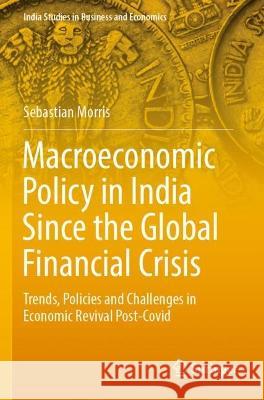
Sebastian Morris
Macroeconomic Policy in India Since the Global Financial Crisis Sebastian Morris 9789811912788 Springer Nature Singapore - książkaWidoczna okładka, to zdjęcie poglądowe, a rzeczywista szata graficzna może różnić się od prezentowanej.

Macroeconomic Policy in India Since the Global Financial Crisis

ISBN-13: 9789811912788 / Angielski / Miękka / 2023

Sebastian Morris
cena 442,79
(netto: 421,70 VAT:  5%)

Najniższa cena z 30 dni: 424,07
Termin realizacji zamówienia:
ok. 22 dni roboczych
Dostawa w 2026 r.

Darmowa dostawa!
inne wydania

This book discusses the Indian economic crisis and brings out what went wrong and the correction necessary for getting the economy back to high growth trajectory, leading to economic transformation. To do so, the book covers trends in performance of Indian economy since the Global Financial Crisis to the COVID-19 effect, bringing out factors that have determined the same.The book questions the approach to macroeconomic policy of both the RBI and the government and brings out what it takes for macroeconomic policy to be supportive of high growth. It contains revealing contrasts with East Asia and China, although India has the same potential to grow with an expansion of manufacturing. Overall, it argues that macroeconomic policies (as much as structural, industrial, and trade policies) have been deficient and even good initiatives on the industrial policy and trade flounder for the lack of a strategic approach to macroeconomics. The book highlights the special opportunities present in an emerging economy with vast under and utilised labour and the macroeconomic policy initiatives that can take advantage of this key feature.It covers the macroeconomic data on growth using multiple indicators, then the external shocks and the internal policy measures/responses; besides, GVA/GDP, credit, exports, external transactions, interest and policy rates, yields, exchange rates,  money, capital flows, indices of industrial sector, price indices and inflation, government expenditures, tax rates, fiscal deficits, market uncertainty measures to present a holistic picture of the economy and the shocks and policy actions that have followed. The book uses an innovative method of presentation and the consistency of the trends/stances of both monetary and fiscal policy using these large number of variables. It discusses the debate on overestimation of GDP/GVA growth estimates over the years from 2011-12 to about 2016-17 comprehensively. There is special coverage of GST with a comparison with China. Coverage also includes performance since the COVID-19 crisis again using a large number of indicators and an explanation for the same in terms of the limitations of the government’s initiatives to counteract.The book is a quick and ready reference of what has happened in macroeconomic terms to those interested in the relevant facts. It is of interest to international economists, policy analysts, and investors whose need to understand that the Indian economy in macroeconomic terms and in terms of the stances and penchant of the government and the RBI is of value.


Kategorie:
Nauka, Ekonomia i biznes
Kategorie BISAC:
Business & Economics > Makroekonomia
Business & Economics > Finanse publiczne
Business & Economics > Development - Economic Development
Wydawca:
Springer Nature Singapore
Seria wydawnicza:
India Studies in Business and Economics
Język:
Angielski
ISBN-13:
9789811912788
Rok wydania:
2023
Waga:
0.50 kg
Wymiary:
23.5 x 15.5
Oprawa:
Miękka
Dodatkowe informacje:
Wydanie ilustrowane

Chapter 1. Introduction.-  Chapter 2. Trends in Growth since the GFC.- Chapter 3. Credit, Employment and the Current Account.- Chapter 4. Capital Formation and Foreign Investment.- Chapter 5. Inflation and Monetary Developments.- Chapter 6. Policy and Analyses Chapter.- 7. Reflexive, not Reflective Monetary Policy.- Chapter 8. The COVID Crisis and Response.- Chapter 9. The Recovery.- Chapter 10. The Challenge of Manufacturing.- Chapter 11. Conclusions.- Chapter 12. GST and the Discrimination Against Production Oriented States.

Dr. Sebastian Morris is Senior Professor, and Chair of the Centre for Public Policy and Governance at the Goa Institute of Management. Earlier he had been teaching macroeconomics, infrastructure, Indian economic performance, and public policy at the Indian Institute of Management Ahmedabad for over 25 years. He initiated and edited the pioneering India Infrastructure Reports on various themes, which set the discussions for infrastructure reform in India. He was the lead author of the book Growth and Transformation of Small Firms and had originally designed and delivered several programmes for senior civil servants including Phase V programmes covering governance and economic strategy, economic reforms, regulation and policies for enhanced public value creation. He was also ICCR Chair Professor at the Copenhagen Business School, and Ford Foundation Fellow at the University of Pennsylvania, in addition to which he has been a consultant to various governments. He has taught extensively in the executive programmes of the IIMA engaging on the Indian economy, its growth and transformational challenges


This book discusses the Indian economic crisis and brings out what went wrong and the correction necessary for getting the economy back to high growth trajectory, leading to economic transformation. To do so, the book covers trends in performance of Indian economy since the Global Financial Crisis to the COVID-19 effect, bringing out factors that have determined the same.

The book questions the approach to macroeconomic policy of both the RBI and the government and brings out what it takes for macroeconomic policy to be supportive of high growth. It contains revealing contrasts with East Asia and China, although India has the same potential to grow with an expansion of manufacturing. Overall, it argues that macroeconomic policies (as much as structural, industrial, and trade policies) have been deficient and even good initiatives on the industrial policy and trade flounder for the lack of a strategic approach to macroeconomics. The book highlights the special opportunities present in an emerging economy with vast under and utilised labour and the macroeconomic policy initiatives that can take advantage of this key feature.

It covers the macroeconomic data on growth using multiple indicators, then the external shocks and the internal policy measures/responses; besides, GVA/GDP, credit, exports, external transactions, interest and policy rates, yields, exchange rates,  money, capital flows, indices of industrial sector, price indices and inflation, government expenditures, tax rates, fiscal deficits, market uncertainty measures to present a holistic picture of the economy and the shocks and policy actions that have followed. The book uses an innovative method of presentation and the consistency of the trends/stances of both monetary and fiscal policy using these large number of variables. It discusses the debate on overestimation of GDP/GVA growth estimates over the years from 2011-12 to about 2016-17 comprehensively. There is special coverage of GST with a comparison with China. Coverage also includes performance since the COVID-19 crisis again using a large number of indicators and an explanation for the same in terms of the limitations of the government’s initiatives to counteract.

The book is a quick and ready reference of what has happened in macroeconomic terms to those interested in the relevant facts. It is of interest to international economists, policy analysts, and investors whose need to understand that the Indian economy in macroeconomic terms and in terms of the stances and penchant of the government and the RBI is of value.




Udostępnij

Facebook - konto krainaksiazek.pl


Opinie o Krainaksiazek.pl na Opineo.pl

Partner Mybenefit

Krainaksiazek.pl w programie rzetelna firma Krainaksiaze.pl - płatności przez paypal

Czytaj nas na:

Facebook - krainaksiazek.pl
  • książki na zamówienie
  • granty
  • książka na prezent
  • kontakt
  • pomoc
  • opinie
  • regulamin
  • polityka prywatności

Zobacz:

  • Księgarnia czeska

  • Wydawnictwo Książkowe Klimaty

1997-2025 DolnySlask.com Agencja Internetowa

© 1997-2022 krainaksiazek.pl
     
KONTAKT | REGULAMIN | POLITYKA PRYWATNOŚCI | USTAWIENIA PRYWATNOŚCI
Zobacz: Księgarnia Czeska | Wydawnictwo Książkowe Klimaty | Mapa strony | Lista autorów
KrainaKsiazek.PL - Księgarnia Internetowa

Polityka prywatnosci - link
Krainaksiazek.pl - płatnośc Przelewy24
Przechowalnia Przechowalnia




