• Wyszukiwanie zaawansowane
  • Kategorie
  • Kategorie BISAC
  • Książki na zamówienie
  • Promocje
  • Granty
  • Książka na prezent
  • Opinie
  • Pomoc
  • Załóż konto
  • Zaloguj się

Machine Vision Algorithms in Java: Techniques and Implementation » książka

zaloguj się | załóż konto
Logo Krainaksiazek.pl

koszyk

konto

szukaj
topmenu
Księgarnia internetowa
Szukaj
Książki na zamówienie
Promocje
Granty
Książka na prezent
Moje konto
Pomoc
 
 
Wyszukiwanie zaawansowane
Pusty koszyk
Bezpłatna dostawa dla zamówień powyżej 20 złBezpłatna dostawa dla zamówień powyżej 20 zł

Kategorie główne

• Nauka
 [2949965]
• Literatura piękna
 [1857847]

  więcej...
• Turystyka
 [70818]
• Informatyka
 [151303]
• Komiksy
 [35733]
• Encyklopedie
 [23180]
• Dziecięca
 [617748]
• Hobby
 [139972]
• AudioBooki
 [1650]
• Literatura faktu
 [228361]
• Muzyka CD
 [398]
• Słowniki
 [2862]
• Inne
 [444732]
• Kalendarze
 [1620]
• Podręczniki
 [167233]
• Poradniki
 [482388]
• Religia
 [509867]
• Czasopisma
 [533]
• Sport
 [61361]
• Sztuka
 [243125]
• CD, DVD, Video
 [3451]
• Technologie
 [219309]
• Zdrowie
 [101347]
• Książkowe Klimaty
 [123]
• Zabawki
 [2362]
• Puzzle, gry
 [3791]
• Literatura w języku ukraińskim
 [253]
• Art. papiernicze i szkolne
 [7933]
Kategorie szczegółowe BISAC

Machine Vision Algorithms in Java: Techniques and Implementation

ISBN-13: 9781447110668 / Angielski / Miękka / 2012 / 284 str.
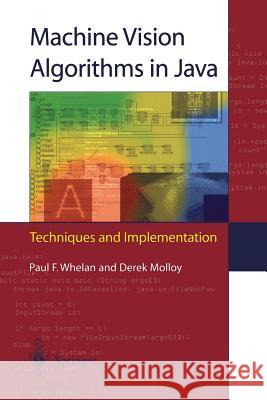
Paul F. Whelan; Derek Molloy
Machine Vision Algorithms in Java: Techniques and Implementation Whelan, Paul F. 9781447110668 Springer - książkaWidoczna okładka, to zdjęcie poglądowe, a rzeczywista szata graficzna może różnić się od prezentowanej.

Machine Vision Algorithms in Java: Techniques and Implementation

ISBN-13: 9781447110668 / Angielski / Miękka / 2012 / 284 str.

Paul F. Whelan; Derek Molloy
cena 605,23
(netto: 576,41 VAT:  5%)

Najniższa cena z 30 dni: 578,30
Termin realizacji zamówienia:
ok. 22 dni roboczych
Bez gwarancji dostawy przed świętami

Darmowa dostawa!

This book presents key machine vision techniques and algorithms, along with the associated Java source code. Special features include a complete self-contained treatment of all topics and techniques essential to the understanding and implementation of machine vision; an introduction to object-oriented programming and to the Java programming language, with particular reference to its imaging capabilities; Java source code for a wide range of real-world image processing and analysis functions; an introduction to the Java 2D imaging and Java Advanced Imaging (JAI) API; and a wide range of illustrative examples.


Kategorie:
Technologie
Kategorie BISAC:
Computers > Artificial Intelligence - Computer Vision & Pattern Recognition
Computers > Languages - Java
Computers > Programming - Object Oriented
Wydawca:
Springer
Język:
Angielski
ISBN-13:
9781447110668
Rok wydania:
2012
Wydanie:
Softcover Repri
Ilość stron:
284
Waga:
0.47 kg
Wymiary:
23.5 x 15.5
Oprawa:
Miękka
Wolumenów:
01

1. An Introduction to Machine Vision.- 1.1 Human, Computer and Machine Vision.- 1.2 Vision System Hardware.- 1.3 Vision System Software.- 1.4 Machine Vision System Design.- 1.4.1 Image Acquisition.- 1.4.2 Image Representation.- 1.4.3 Image Processing.- 1.4.4 Image Analysis.- 1.4.5 Image Classification.- 1.4.6 Systems Engineering.- 1.5 NeatVision: Where Java meets Machine Vision.- 1.5.1 NeatVisions Graphical User Interface (GUI).- 2. Java Fundamentals.- 2.1 The History of Java.- 2.1.1 What Makes Java Platform Independent?.- 2.1.2 The Just-In-Time Compiler.- 2.1.3 The Sun Java Software Development Kit (Java SDK).- 2.2 Object-oriented Programming.- 2.2.1 Encapsulation.- 2.2.2 Classes.- 2.2.3 Objects.- 2.2.4 Inheritance.- 2.2.5 Polymorphism.- 2.2.6 Abstract Classes.- 2.3 Java Language Basics.- 2.3.1 Variables.- 2.3.2 Access Control.- 2.3.3 Java Types.- 2.3.4 Java Operators.- 2.3.5 Java Comments.- 2.3.6 The super and this Keywords.- 2.3.7 Java Arrays.- 2.3.8 The “Object” and “Class” Classes.- 2.3.9 Interfaces.- 2.3.10 Packages.- 2.4 Applications and Applets.- 2.4.1 Writing Applications.- 2.4.2 Applets.- 2.4.3 An Applet and an Application?.- 2.5 Java and Image Processing.- 2.5.1 The Canvas Class.- 2.5.2 Java and Images.- 2.5.3 Image Producers and Image Consumers.- 2.5.4 Recovering Pixel Data from an Image Object.- 2.5.5 Recreating an Image Object from an Array of Pixels.- 2.6 Additional Classes.- 2.6.1 ColorModel.- 2.6.2 ImageFilter.- 2.6.3 CropImageFilter.- 2.6.4 RGBImageFilter.- 2.6.5 FilteredImageSource.- 2.7 Double Buffering.- 2.8 Recent Additions to Java for Imaging.- 2.8.1 Java2DAPI.- 2.8.2 Working with the Java 2D API.- 2.8.3 Renderable Layer and Rendered Layer.- 2.8.4 Java Advanced Imaging API (JAI).- 2.8.5 JAI Functionality.- 2.9 Additional Information on Java.- 2.10 Conclusion.- 3. Machine Vision Techniques.- 3.1 Elementary Image Processing Functions.- 3.1.1 Monadic, Point-by-point Operators.- 3.1.2 Intensity Histogram.- 3.1.3 Look-up Tables (LUT).- 3.1.4 Dyadic, Point-by-point Operators.- 3.2 Local Operators.- 3.2.1 Linear Local Operators.- 3.2.2 Non-linear Local Operators.- 3.2.3 Edge Detectors.- 3.2.4 N-tuple Operators.- 3.2.5 Edge Effects.- 3.2.6 Grey Scale Corner Detection.- 3.3 Binary Images.- 3.3.1 Boolean Operators.- 3.3.2 Connected Component (Blob) Analysis.- 3.3.3 Measurements on Binary Images.- 3.3.4 Run-length Coding.- 3.3.5 Shape Descriptors.- 3.4 Global Image Transforms.- 3.4.1 Geometric Transforms.- 3.4.2 Distance Transforms.- 3.4.3 Hough Transform.- 3.4.4 Two-dimensional Discrete Fourier Transform (DFT).- 3.5 Conclusion.- 4. Mathematical Morphology.- 4.1 Binary Mathematical Morphology.- 4.1.1 Dilation and Erosion.- 4.1.2 Hit-and-Miss Transform.- 4.1.3 Opening and Closing.- 4.1.4 Skeletonisation.- 4.1.5 Structuring Element Decomposition.- 4.1.6 Interval Coding.- 4.2 Grey Scale Mathematical Morphology.- 4.2.1 Basic Grey Scale Operators.- 4.2.2 Noise Removal using Grey Scale Morphology.- 4.2.3 Morphological Gradients.- 4.2.4 Point-Pairs.- 4.2.5 Top-Hat Transform.- 4.3 Morphological Reconstruction.- 4.3.1 Conditional Dilation.- 4.3.2 Geodesic Dilation.- 4.3.3 Geodesic Erosion.- 4.3.4 Reconstruction by Dilation.- 4.3.5 Reconstruction by Erosion.- 4.3.6 Ultimate Erosion.- 4.3.7 Double Threshold.- 4.3.8 Image Maxima.- 4.3.9 Image Minima.- 4.4 Morphological Segmentation.- 4.4.1 Skeleton Influence by Zones (SKIZ).- 4.4.2 Watershed Segmentation.- 4.5 Case Study: Geometric Packing.- 4.5.1 Geometric Packer Implementation.- 4.6 Morphological System Implementation.- 4.7 Conclusion.- 5. Texture Analysis.- 5.1 Texture and Images.- 5.2 Edge Density.- 5.3 Monte-Carlo Method.- 5.4 Auto-Correlation Function (ACF).- 5.5 Fourier Spectral Analysis.- 5.6 Histogram Features.- 5.7 Grey Level Run Length Method (GLRLM).- 5.8 Grey Level Difference Method (GLDM).- 5.9 Co-occurrence Analysis.- 5.9.1 Energy, or Angular Second Moment.- 5.9.2 Entropy.- 5.9.3 Inertia.- 5.9.4 Local Homogeneity (LH).- 5.10 Morphological Texture Analysis.- 5.10.1 Morphological Ratio.- 5.10.2 Granularity.- 5.11 Fractal Analysis.- 5.12 Textural Energy.- 5.13 Texture Spectrum Method.- 5.14 Local Binary Patterns (LBP).- 5.15 Random Field Models.- 5.16 Spatial/Frequency Methods.- 5.17 Autoregressive Model.- 5.18 Structural Approaches to Texture Analysis.- 5.19 Conclusion.- 6. Colour Image Analysis.- 6.1 Colour Cameras.- 6.2 Red-Green-Blue (RGB) Colour Representation.- 6.2.1 Maxwell’s Colour Triangle.- 6.2.2 One-dimensional Histograms: Colour Separations.- 6.2.3 Two-dimensional Scattergrams.- 6.3 Hue-Saturation-Intensity (HSI) Colour Representation.- 6.3.1 Colour Scattergrams.- 6.4 Opponent Process Representation.- 6.5 YIQ Colour Representation.- 6.6 YUV Colour Representation.- 6.7 CIE Chromaticity Diagram.- 6.8 CIEXYZ Colour Representation.- 6.9 CIELUV Colour Representation.- 6.10 CIELAB Colour Representation.- 6.11 Spatial CIELAB Colour Representation.- 6.11.1 Segmenting Colour Textures.- 6.12 Programmable Colour Filter (PCF).- 6.12.1 PCF Implementation.- 6.12.2 Recognising a Single Colour.- 6.12.3 Noise Effects.- 6.12.4 Colour Generalisation.- 6.13 Conclusion.- 7. NeatVision: Visual Programming for Machine Vision.- 7.1 Visual Programming in Neat Vision.- 7.1.1 Input and Output Components.- 7.1.2 Processing Components.- 7.1.3 Flow Control Components.- 7.1.4 System Development.- 7.1.5 Sample Programme.- 7.2 Java Programming in NeatVision.- 7.2.1 Data Flow Programming.- 7.2.2 Standard Component Architecture.- 7.2.3 Adding Functionality.- 7.2.4 Examples.- 7.3 The Neat Vision Application.- 7.3.1 Visual Programming in NeatVision.- 7.3.2 Image Processing.- 7.3.3 Other User Interfaces.- 7.3.4 The Integrated Software Development Environment.- 7.3.5 The Help Viewer.- 7.4 Sample Applications.- 7.4.1 Low-level Programming.- 7.4.2 High-level Programming.- 7.4.3 Isolating the Largest Item in an Image.- 7.4.4 Bottle-top Inspection.- 7.4.5 Plant-stem Location.- 7.5 Conclusion.- A. NeatVision Graphic File Formats.- B. NeatVision Imaging API Specification.- C. NeatVision Components.- References.


Udostępnij

Facebook - konto krainaksiazek.pl


Opinie o Krainaksiazek.pl na Opineo.pl

Partner Mybenefit

Krainaksiazek.pl w programie rzetelna firma Krainaksiaze.pl - płatności przez paypal

Czytaj nas na:

Facebook - krainaksiazek.pl
  • książki na zamówienie
  • granty
  • książka na prezent
  • kontakt
  • pomoc
  • opinie
  • regulamin
  • polityka prywatności

Zobacz:

  • Księgarnia czeska

  • Wydawnictwo Książkowe Klimaty

1997-2025 DolnySlask.com Agencja Internetowa

© 1997-2022 krainaksiazek.pl
     
KONTAKT | REGULAMIN | POLITYKA PRYWATNOŚCI | USTAWIENIA PRYWATNOŚCI
Zobacz: Księgarnia Czeska | Wydawnictwo Książkowe Klimaty | Mapa strony | Lista autorów
KrainaKsiazek.PL - Księgarnia Internetowa

Polityka prywatnosci - link
Krainaksiazek.pl - płatnośc Przelewy24
Przechowalnia Przechowalnia







