• Wyszukiwanie zaawansowane
  • Kategorie
  • Kategorie BISAC
  • Książki na zamówienie
  • Promocje
  • Granty
  • Książka na prezent
  • Opinie
  • Pomoc
  • Załóż konto
  • Zaloguj się

Machine Learning in Image Steganalysis » książka


zaloguj się | załóż konto
Logo Krainaksiazek.pl

koszyk

konto

szukaj
topmenu
Księgarnia internetowa
Szukaj
Książki na zamówienie
Promocje
Granty
Książka na prezent
Moje konto
Pomoc
 
 
Wyszukiwanie zaawansowane
Pusty koszyk
Bezpłatna dostawa dla zamówień powyżej 20 złBezpłatna dostawa dla zamówień powyżej 20 zł

Kategorie główne

• Nauka
 [2946912]
• Literatura piękna
 [1852311]

  więcej...
• Turystyka
 [71421]
• Informatyka
 [150889]
• Komiksy
 [35717]
• Encyklopedie
 [23177]
• Dziecięca
 [617324]
• Hobby
 [138808]
• AudioBooki
 [1671]
• Literatura faktu
 [228371]
• Muzyka CD
 [400]
• Słowniki
 [2841]
• Inne
 [445428]
• Kalendarze
 [1545]
• Podręczniki
 [166819]
• Poradniki
 [480180]
• Religia
 [510412]
• Czasopisma
 [525]
• Sport
 [61271]
• Sztuka
 [242929]
• CD, DVD, Video
 [3371]
• Technologie
 [219258]
• Zdrowie
 [100961]
• Książkowe Klimaty
 [124]
• Zabawki
 [2341]
• Puzzle, gry
 [3766]
• Literatura w języku ukraińskim
 [255]
• Art. papiernicze i szkolne
 [7810]
Kategorie szczegółowe BISAC

Machine Learning in Image Steganalysis

ISBN-13: 9780470663059 / Angielski / Twarda / 2012 / 296 str.
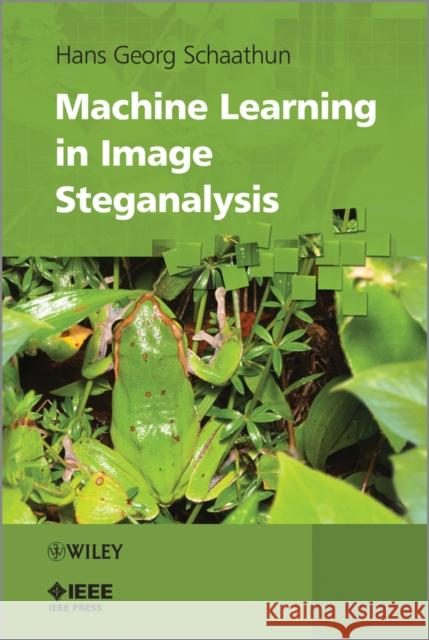
Hans Georg Schaathun
Machine Learning in Image Steganalysis Hans Georg Schaathun 9780470663059 John Wiley & Sons - książkaWidoczna okładka, to zdjęcie poglądowe, a rzeczywista szata graficzna może różnić się od prezentowanej.

Machine Learning in Image Steganalysis

ISBN-13: 9780470663059 / Angielski / Twarda / 2012 / 296 str.

Hans Georg Schaathun
cena 457,13 zł
(netto: 435,36 VAT:  5%)

Najniższa cena z 30 dni: 457,13 zł
Termin realizacji zamówienia:
ok. 30 dni roboczych
Dostawa w 2026 r.

Darmowa dostawa!

Steganography is the art of communicating a secret message, hiding the very existence of a secret message. This is typically done by hiding the message within a non-sensitive document. Steganalysis is the art and science of detecting such hidden messages. The task in steganalysis is to take an object (communication) and classify it as either a steganogram or a clean document. Most recent solutions apply classification algorithms from machine learning and pattern recognition, which tackle problems too complex for analytical solution by teaching computers to learn from empirical data. Part 1of the book is an introduction to steganalysis as part of the wider trend of multimedia forensics, as well as a practical tutorial on machine learning in this context. Part 2 is a survey of a wide range of feature vectors proposed for steganalysis with performance tests and comparisons. Part 3 is an in-depth study of machine learning techniques and classifier algorithms, and presents a critical assessment of the experimental methodology and applications in steganalysis. Key features:

  • Serves as a tutorial on the topic of steganalysis with brief introductions to much of the basic theory provided, and also presents a survey of the latest research.
  • Develops and formalises the application of machine learning in steganalysis; with much of the understanding of machine learning to be gained from this book adaptable for future study of machine learning in other applications.
  • Contains Python programs and algorithms to allow the reader to modify and reproduce outcomes discussed in the book.
  • Includes companion software available from the author's website.

Kategorie:
Technologie
Kategorie BISAC:
Science > Fala mechaniczna
Wydawca:
John Wiley & Sons
Seria wydawnicza:
Wiley - IEEE
Język:
Angielski
ISBN-13:
9780470663059
Rok wydania:
2012
Numer serii:
000416198
Ilość stron:
296
Waga:
0.57 kg
Wymiary:
25.15 x 17.27 x 1.78
Oprawa:
Twarda
Wolumenów:
01
Dodatkowe informacje:
Bibliografia
Wydanie ilustrowane

Preface xi

PART I OVERVIEW

1 Introduction 3

1.1 Real Threat or Hype? 3

1.2 Artificial Intelligence and Learning 4

1.3 How to Read this Book 5

2 Steganography and Steganalysis 7

2.1 Cryptography versus Steganography 7

2.2 Steganography 8

2.3 Steganalysis 17

2.4 Summary and Notes 23

3 Getting Started with a Classifier 25

3.1 Classification 25

3.2 Estimation and Confidence 28

3.3 Using libSVM 30

3.4 Using Python 33

3.5 Images for Testing 38

3.6 Further Reading 39

PART II FEATURES

4 Histogram Analysis 43

4.1 Early Histogram Analysis 43

4.2 Notation 44

4.3 Additive Independent Noise 44

4.4 Multi–dimensional Histograms 54

4.5 Experiment and Comparison 63

5 Bit–plane Analysis 65

5.1 Visual Steganalysis 65

5.2 Autocorrelation Features 67

5.3 Binary Similarity Measures 69

5.4 Evaluation and Comparison 72

6 More Spatial Domain Features 75

6.1 The Difference Matrix 75

6.2 Image Quality Measures 82

6.3 Colour Images 86

6.4 Experiment and Comparison 86

7 The Wavelets Domain 89

7.1 A Visual View 89

7.2 The Wavelet Domain 90

7.3 Farid s Features 96

7.4 HCF in the Wavelet Domain 98

7.5 Denoising and the WAM Features 101

7.6 Experiment and Comparison 106

8 Steganalysis in the JPEG Domain 107

8.1 JPEG Compression 107

8.2 Histogram Analysis 114

8.3 Blockiness 122

8.4 Markov Model–based Features 124

8.5 Conditional Probabilities 126

8.6 Experiment and Comparison 128

9 Calibration Techniques 131

9.1 Calibrated Features 131

9.2 JPEG Calibration 133

9.3 Calibration by Downsampling 137

9.4 Calibration in General 146

9.5 Progressive Randomisation 148

PART III CLASSIFIERS

10 Simulation and Evaluation 153

10.1 Estimation and Simulation 153

10.2 Scalar Measures 158

10.3 The Receiver Operating Curve 161

10.4 Experimental Methodology 170

10.5 Comparison and Hypothesis Testing 173

10.6 Summary 176

11 Support Vector Machines 179

11.1 Linear Classifiers 179

11.2 The Kernel Function 186

11.3 –SVM 189

11.4 Multi–class Methods 191

11.5 One–class Methods 192

11.6 Summary 196

12 Other Classification Algorithms 197

12.1 Bayesian Classifiers 198

12.2 Estimating Probability Distributions 203

12.3 Multivariate Regression Analysis 209

12.4 Unsupervised Learning 212

12.5 Summary 215

13 Feature Selection and Evaluation 217

13.1 Overfitting and Underfitting 217

13.2 Scalar Feature Selection 220

13.3 Feature Subset Selection 222

13.4 Selection Using Information Theory 225

13.5 Boosting Feature Selection 238

13.6 Applications in Steganalysis 239

14 The Steganalysis Problem 245

14.1 Different Use Cases 245

14.2 Images and Training Sets 250

14.3 Composite Classifier Systems 258

14.4 Summary 262

15 Future of the Field 263

15.1 Image Forensics 263

15.2 Conclusions and Notes 265

Bibliography 267

Index 279

Steganography is the art of communicating a secret message, hiding the very existence of a secret message. This is typically done by hiding the message within a non–sensitive document. Steganalysis is the art and science of detecting such hidden messages.  The task in steganalysis is to take an object (communication) and classify it as either a steganogram or a clean document. Most recent solutions apply classification algorithms from machine learning and pattern recognition, which tackle problems too complex for analytical solution by teaching computers to learn from empirical data. 

Part 1of the book is an introduction to steganalysis as part of the wider trend of multimedia forensics, as well as a practical tutorial on machine learning in this context. Part 2 is a survey of a wide range of feature vectors proposed for steganalysis with performance tests and comparisons. Part 3 is an in–depth study of machine learning techniques and classifier algorithms, and presents a critical assessment of the experimental methodology and applications in steganalysis.

Key features: 

  • Serves as a tutorial on the topic of steganalysis with brief introductions to much of the basic theory provided, and also presents a survey of the latest research.
  • Develops and formalises the application of machine learning in steganalysis; with much of the understanding of machine learning to be gained from this book adaptable for future study of machine learning in other applications. 
  • Contains Python programs and algorithms to allow the reader to modify and reproduce outcomes discussed in the book.
  • Includes companion software available from the author s website.


Udostępnij

Facebook - konto krainaksiazek.pl


Opinie o Krainaksiazek.pl na Opineo.pl

Partner Mybenefit

Krainaksiazek.pl w programie rzetelna firma Krainaksiaze.pl - płatności przez paypal

Czytaj nas na:

Facebook - krainaksiazek.pl
  • książki na zamówienie
  • granty
  • książka na prezent
  • kontakt
  • pomoc
  • opinie
  • regulamin
  • polityka prywatności

Zobacz:

  • Księgarnia czeska

  • Wydawnictwo Książkowe Klimaty

1997-2025 DolnySlask.com Agencja Internetowa

© 1997-2022 krainaksiazek.pl
     
KONTAKT | REGULAMIN | POLITYKA PRYWATNOŚCI | USTAWIENIA PRYWATNOŚCI
Zobacz: Księgarnia Czeska | Wydawnictwo Książkowe Klimaty | Mapa strony | Lista autorów
KrainaKsiazek.PL - Księgarnia Internetowa

Polityka prywatnosci - link
Krainaksiazek.pl - płatnośc Przelewy24
Przechowalnia Przechowalnia






